


Flying junction
 | This article needs additional citations for verification. (June 2011) |

A flying junction or flyover is a railway junction at which one or more diverging or converging tracks in a multiple-track route cross other tracks on the route by bridge to avoid conflict with other train movements. A more technical term is "grade-separated junction". A burrowing junction or dive-under occurs where the diverging line passes below the main line.
The alternative to grade separation is a level junction or flat junction, where tracks cross at grade, and conflicting routes must be protected by interlocked signals.
Complexity[edit]

Simple flying junctions may have a single track pass over or under other tracks to avoid conflict, while complex flying junctions may have an elaborate infrastructure to allow multiple routings without trains coming into conflict, in the manner of a highway stack interchange.
Flying junction without crossings[edit]
Where two lines each of two tracks merge with a flying junction, they can become a four-track railway together, the tracks paired by direction. This happens regularly in the Netherlands (see Examples below).
High-speed rail[edit]
Nearly all junctions with high-speed railways are grade-separated. On the French Lignes à Grande Vitesse (TGV) high-speed network, the principal junction on the LGV Sud-Est, at Pasilly where the line to Dijon diverges, and on the LGV Atlantique at Courtalain where the line to Le Mans diverges, are fully grade-separated with special high-speed switches (points in British terminology) that permit the normal line speed of 300 km/h (186 mph) on the main line, and a diverging speed of 220 km/h (137 mph).[note 1]
The LGV network has four grade-separated high-speed triangles: Fretin (near Lille), Coubert (southeast Paris), Claye-Souilly (northeast Paris) and Angles (Avignon). A fifth, Vémars (northeast Paris), is grade-separated except for a single-track link on the least-used side, linking Paris Gare du Nord and Paris CDG airport.
Examples[edit]
- Australia
- Bowen Hills railway station in Brisbane
- Burnley railway station in Melbourne
- Camberwell railway station in Melbourne
- Sydney Central Station
- Glenfield railway station, Sydney
- Strathfield railway station
- Sandgate Flyover, Newcastle – main line flies over coal branch line
- Goodwood railway station in Adelaide
- Bayswater railway station in Perth
- Canada

- Columbia station in New Westminster, BC – Expo Line branches for King George (top) and Production Way–University (bottom)
- Bridgeport station in Richmond, BC – Canada Line branches for YVR–Airport and Richmond–Brighouse
- Denmark
- Hvidovre, Copenhagen (55°39′51″N 12°29′01″E / 55.664158°N 12.483701°E)
- Junction of M1 and M2 lines on the Copenhagen Metro
- Lunderskov (55°28′26″N 9°18′04″E / 55.473772°N 9.301164°E)
- Roskilde, south of (55°36′27″N 12°02′47″E / 55.607374°N 12.046496°E)
- Sydhavnen, Copenhagen (55°38′29″N 12°32′54″E / 55.641273°N 12.548343°E)
- Vigerslev, Copenhagen (55°39′26″N 12°30′18″E / 55.657331°N 12.505050°E)
Finland
- Railway junction of two main lines at Kytömaa, Kerava
- France (LGV Triangles)
- Triangle de Fretin, Lille, connecting Paris, Brussels and London
- Triangle de Coubert, Paris
- Triangle des Angles, Avignon, with two parallel 1.5-kilometre (0.93 mi) viaducts
- Triangle de Claye-Souilly, Paris, partial four-way junction
- Triangle de Vémars, Paris
- Germany
- Hong Kong
- Where Airport Express and Tung Chung line diverge from each other at Tai Ho Wan
- Tseung Kwan O line to the east of Tseung Kwan O station
- Netherlands

There are between 25 and about 40 flying junctions on Dutch railways, depending on how more complex examples are counted.
- Near Harmelen. Before conversion to a flying junction, this was the site of the Harmelen train disaster.
- At Breukelen railway station
- At Lage Zwaluwe railway station
Flying junctions where the merged lines become a four track railway:
- Near Den Haag Laan van NOI railway station
- North of Leiden where lines from Haarlem and Schiphol merge
- At Boxtel railway station where lines from 's-Hertogenbosch and Tilburg merge
- West of Gouda where lines from Rotterdam and The Hague merge
More complex flying junctions, with tracks from four directions joining:
- Around Amsterdam Sloterdijk railway station
- Around Duivendrecht railway station
- Northwest exit of Utrecht Centraal railway station
- West and northwest exit of Rotterdam Centraal railway station
- At both sides of Weesp railway station (see diagram at right)
- Norway
- Lillestrøm (59°57′09″N 11°01′39″E / 59.952571°N 11.027455°E)
- Lysaker (59°54′54″N 10°37′40″E / 59.914903°N 10.627711°E)
- Sandvika, east of and west of (59°53′47″N 10°32′10″E / 59.896373°N 10.536113°E) (59°53′26″N 10°30′29″E / 59.890663°N 10.508148°E)
- Sweden
- Flemingsberg (59°12′51″N 17°56′22″E / 59.214247°N 17.939363°E)
- Järna, north of (59°07′18″N 17°36′47″E / 59.121566°N 17.613176°E)
- Järna, south of (59°04′17″N 17°32′23″E / 59.071478°N 17.539807°E)
- Lund (55°42′44″N 13°11′08″E / 55.712348°N 13.185570°E)
- Hyllie (55°33′32″N 12°57′42″E / 55.558971°N 12.961761°E)
- Myrbacken (59°40′41″N 17°49′37″E / 59.678161°N 17.826828°E)
- Lernacken (55°33′46″N 12°55′54″E / 55.562779°N 12.931545°E)
- Södertälje hamn (59°10′54″N 17°38′37″E / 59.181793°N 17.643503°E)
- Södertälje syd (59°09′34″N 17°38′14″E / 59.159427°N 17.637278°E)
- Tomteboda (59°21′10″N 18°00′56″E / 59.352646°N 18.015546°E)
- Taiwan
- Start of Shalun line, south of Zhongzhou railway station
- United Kingdom
- Pelaw Junction where both the Tyne and Wear Metro green line to South Hylton joins the Durham Coast Line and yellow line continues to South Shields – both diverging on the bridge itself
- Springhead Junction on the North Kent Line
- Southfleet Junction on the HS1
- Norton Bridge Junction near Stone, Staffordshire
- Hamilton Square underground station, Birkenhead, on Merseyrail
- Aynho Junction in Aynho, Northamptonshire
- Worting Junction near Basingstoke, Hampshire (the flyover is called Battledown Flyover)
- Cogload Junction near Taunton
- Weaver Junction near Dutton, Cheshire
- Shortlands Junction in south London
- Northwest of Harrow-on-the-Hill, in the north London suburbs
- Hitchin flyover, Hertfordshire.
- Werrington Junction dive-under, northern suburbs of Peterborough, Cambridgeshire
- Reading West Junction
- Bleach Green Viaducts & Junction, Whiteabbey, Northern Ireland
- United States

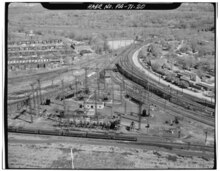

- Northeast U.S. (Amtrak)
- Along the New York–Washington section of the Northeast Corridor, and on the Philadelphia–Harrisburg section of the Keystone Corridor. Both converge at Zoo Junction near 30th Street Station in Philadelphia. All were built by the former Pennsylvania Railroad and are now maintained by Amtrak.
- Boston, Massachusetts area
- An abandoned underground junction on the Tremont Street subway approaching the Pleasant Street incline
- The B branch splits off from the C and D branches of the MBTA Green Line via an underground flying junction just west of Kenmore station.
- The Union Square spur splits off from the Green Line Extension of the MBTA Green Line via an aerial flying junction on the Red Bridge viaduct in the Inner Belt area of Somerville, Massachusetts just north of Lechmere station in Cambridge. Lead tracks to the GLX maintenance facility also split off from the junction slightly further west.
- The two southern branches of the MBTA Red Line in Boston split via a flying junction just north of JFK/UMass station. In addition, lead tracks to Cabot Yard maintenance facilities branch off from the junction.
- Chicago, Illinois
- On the Chicago "L", where Orange Line trains diverge from Green Line trains north of 18th Street, as well as underground where a non-revenue flying junction separates Red Line trains heading to 95th from those heading to the South Side main line, currently used to send some rush-period Red Line trains to Ashland/63rd.
- The Milwaukee–Dearborn subway (now part of the Blue Line) was constructed to have a flying junction where turning between Lake Street and Milwaukee Avenue at Canal Street. The outbound tunnel and its stub, designed to continue west under Lake Street, was bored at less depth than the inbound tunnel and its Lake Street stub, in order to allow future Lake Street trains (now part of the Green and (Pink Lines) to run under or over the opposing Milwaukee Avenue trains while entering or exiting the shared portion of the Lake Street tunnels. Plans in 1939 called for tunnels to replace the elevated Lake Street tracks east of approximately Racine Avenue.[1][2] By 1962, the planned Lake Street tunnels to/from Racine Avenue would have curved south to Randolph Street and bypassed the Milwaukee-Lake-Dearborn tunnel entirely.[3]
- Another flying junction is under construction immediately north of Belmont/Sheffield to increase capacity on the Red Line, Brown Line, and Purple Line Express.
- Denver, Colorado
- On the Regional Transportation District in Denver between the Southeast Corridor and the I-225 Corridor: the Southeast Corridor is on the west side of I-25 and the I-225 Corridor is in the median of I-225. The grade separations of the junction are woven into the grade separations of the interchange between the two highways.
- New York, New York
- On the New York City Subway there is an above-ground example at Hammel's Wye on the IND Rockaway Line, as well as numerous below-ground examples across the network
- Connecting Metro-North Railroad's New Haven Line and Harlem Line, near Wakefield station in the Bronx
- Philadelphia, Pennsylvania
- Amtrak's Zoo Junction, where the Northeast Corridor meets the Keystone Corridor and sorts into 30th Street Station's lower and upper level platforms. Also known as Zoo Interlocking, the name comes from the Philadelphia Zoo, which is located in the crescent shaped pocket between the junction and the river.
- On SEPTA's Cynwyd Line, diverging from the Keystone Corridor west of 52nd Street.
- On SEPTA Airport Line, diverging from the Northeast Corridor south of Penn Medicine
- On SEPTA's subway–surface trolley lines, where the Route 10 diverges from Routes 11/13/34/36 west of 33rd Street.
- On SEPTA's Broad Street subway, where Broad-Ridge Spur trains diverge at Fairmount. There are also provisions for flying junctions north of Erie for the Roosevelt Boulevard Subway, and north of Olney for an extension on North Broad Street; both are maintained as layup tracks.
- San Francisco Bay Area, California
- The Oakland Wye, where all of Bay Area Rapid Transit's mainline operations converge near downtown Oakland
- On the Market Street subway in San Francisco where the J Church and N Judah lines join the main line of the subway. The subway portal is east of the intersection of Church Street and Duboce Avenue in the Duboce Triangle neighborhood, immediately north of a Safeway supermarket and south of the San Francisco branch of the United States Mint.
- Washington, District of Columbia
- All main-line connections on the Washington Metro – adjacent to the Pepco power plant on Benning Road (near the Stadium-Armory station) is a large three-track structure with a turnback pocket where the Blue, Silver and Orange Lines meet. This would have been part of the Oklahoma Avenue station, had it been built. South of the King Street station in Alexandria is a series of tunnels where the Blue and Yellow Lines meet. There are also flying junctions near three underground rail stations: Rosslyn (Blue, Silver, and Orange Lines), L'Enfant Plaza (Green and Yellow lines), and the Pentagon (Blue and Yellow lines).
See also[edit]
Notes[edit]
- ^ See "Courtalain" on the French language Wikipedia.
References[edit]
- ^ City of Chicago, Department of Subways and Traction, Second Annual Report of the Department of Subways and Traction, City of Chicago, for the Year Ending December 31, 1940 (Chicago: City of Chicago, December 31, 1940).
- ^ Chicago Department of Subways and Traction, Comprehensive Plan, 2-29, III-VII.
- ^ Chicago Transit Board, Plan for Expanding Rapid Transit Service in the Central Area of Chicago (Chicago: Chicago Transit Board, April 20, 1962).
External links[edit]

- WikiMapia link – aerial photo of Fretin triangle (mentioned above)
- Photo link – flying junction on Pennsylvania Railroad north of 30th Street Station, Philadelphia, Pennsylvania, United States
- Photo link – simpler flying junction at terminus of Market–Frankford transit line, 69th Street Station, Philadelphia, Pennsylvania, United States