Gitanos
 | This article needs additional citations for verification. (July 2022) |
Calé, Gitanos | |
|---|---|
| Total population | |
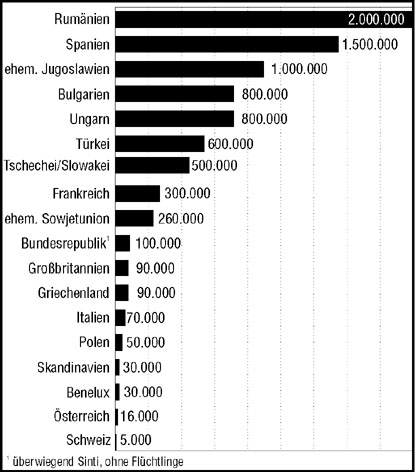
| Estimated 720,000-1,500,000[1][2][3][4] | |
| Regions with significant populations | |
| Andalusia, Valencia, Madrid and Catalonia[5] | |
| Languages | |
| Religion | |
| Roman Catholicism, Evangelicalism | |
| Related ethnic groups | |
| Other Romani people |


The Romani in Spain, generally known by the endonym Calé,[6] or the exonym gitanos (Spanish pronunciation: [xiˈtanos]), belong to the Iberian Romani subgroup known as Calé, with smaller populations in Portugal (known as ciganos) and in Southern France. Their sense of identity and cohesion stems from their shared value system, expressed among gitanos as las leyes gitanas ('Gypsy laws').[7][8]
Traditionally, they maintain their social circles strictly within their patrigroups, as interaction between patrigroups increases the risk of feuding, which may result in fatalities.[9] The emergence of Pentecostalism has impacted this practice, as the lifestyle of Pentecostal gitanos involves frequent contact with Calé people from outside their own patrigroups during church services and meetings. Data on ethnicity are not collected in Spain, although the public pollster CIS estimated in 2007 that the number of Calé present in Spain is probably around one million.[1]
Name[edit]
The term gitano evolved from the word egiptano[10] ("Egyptian"), which was the Old Spanish demonym for someone from Egipto (Egypt). "Egiptano" was the regular adjective in Old Spanish for someone from Egypt, however, in Middle and Modern Spanish the irregular adjective egipcio supplanted egiptano to mean Egyptian, probably to differentiate Egyptians from Gypsies. Meanwhile, the term egiptano evolved through elision into egitano and finally into gitano, losing the meaning of Egyptian and carrying with it a specific meaning of Romanis in Spain. The two peoples are now unambiguously differentiated in modern Spanish, "egipcios" for Egyptians and "gitanos" for Roma in Spain, with "egiptano" being obsolete for either.
Though etymologically the term gitano originally meant "Egyptian",[11] the use itself of the Old Spanish word meaning "Egyptian" (egiptano) to refer to Romanis in Spain developed in the same way that the English word "Gypsy" also evolved from the English adjective "Egyptian" to refer to Romanis in Britain. Some Romanis, a people originating in the northern regions of the Indian subcontinent, upon their first arrivals to Europe, either claimed to be Egyptians for a more favourable treatment by local Europeans, or were mistaken as Egyptians by local Europeans.
Identity[edit]
The group's identity is particularly complex in Spain for a variety of reasons that are examined below. Nevertheless, it can be safely said that both from the perspective of gitano and non-gitano (payo) Spaniards, individuals generally considered to belong to this ethnicity are those of full or near-full gitano descent and who also self-identify as such. A confusing element is the thorough hybridization of Andalusian and Roma culture (and some would say identity) at a popular level. This has occurred to the point where Spaniards from other regions of Spain commonly mistake elements of one for the other. The clearest example of this is flamenco music and Sevillanas, art forms that are Andalusian rather than gitano in origin but, having been strongly marked by gitanos in interpretative style, are now commonly associated with this ethnicity by many Spaniards. The fact that the largest population of gitanos is concentrated in Southern Spain[12] has even led to a confusion between gitano accents and those more typical of Southern Spain even though many Kale populations in the northern half of Spain (such as Galicia) do not speak Andalusian Spanish.[13]
Origin[edit]
The Romani people originate from northwestern Hindustan,[14][15][16][17][18][19] presumably from the northwestern Indian state of Rajasthan[18][19] and the Punjab region shared between India and Pakistan.[18]
The linguistic evidence has indisputably shown that the roots of the Romani language lie in the Indian subcontinent: the language has grammatical characteristics of Indic languages and shares with them a big part of the basic lexicon, for example, body parts, daily routines[20] and numerals.
More exactly, Romani shares the basic lexicon with Hindi and Punjabi. It shares many phonetic features with Marwari, while its grammar is closest to Bengali.[21] Linguistic evaluation carried out in the nineteenth century by Pott (1845) and Miklosich (1882–1888) showed that the Romani language is to be classed as a New Indo-Aryan language (NIA), not a Middle Indo-Aryan (MIA), establishing that the ancestors of the Romani could not have left the Indian subcontinent significantly earlier than AD 1000, finally reaching Europe several hundred years later.
Genetic findings in 2012 suggest the Romani originated in the northwestern region of the Indian subcontinent and migrated as a group.[15][16][22] According to a genetic study in 2012, the ancestors of present scheduled tribes and scheduled caste populations of northern India, traditionally referred to collectively as the "Ḍoma", are the likely ancestral populations of modern "Roma" in Europe.[23]
Migration to Spain[edit]
How and when the Romani arrived in the Iberian Peninsula from Northern India is a question whose consensus is far from being reached. A popular theory, although without any documentation, claims they came from North Africa, from where they would have crossed the Strait of Gibraltar to meet again in France with the northern migratory route.[24] Thus, gitanos would be a deformation of Latin Tingitani, that is, from Tingis, today Tangier. Another, more consistent theory, and well documented, is that they entered the Iberian Peninsula from France. Although there is controversy over the date of the first arrival, since there is evidence of a safe conduct granted in Perpignan in 1415 by the infante Alfonso of Aragon to one Tomás, son of Bartolomé de Sanno, who is said to be "Indie Majoris".[25] Or instead, it could be the so-called Juan de Egipto Menor, who entered through France, when in 1425 Alfonso V granted him a letter of insurance; he is mostly accepted as the first Romani person to reach the peninsula.[26]
... As our beloved and devoted Don Juan de Egipto Menor ... understands that he must pass through some parts of our kingdoms and lands, and we want him to be well treated and welcomed ... under pain of our wrath and indignation ... the mentioned Don Juan de Egipto and those who will go with him and accompany him, with all their horses, clothes, goods, gold, silver, saddlebags and whatever else they bring with them, let them go, stay and go through any city, town, place and other parts of our lordship safe and secure ... and giving those safe passage and being driven when the aforementioned don Juan requires it through this present safe conduct ... Delivered in Zaragoza with our seal on January 12 of the year of birth of our Lord 1425. King Alfonso.
In 1435 they were seen in Santiago de Compostela. Gitanos were recorded in Barcelona and Zaragoza by 1447,[27] and in 1462 they were received with honors in Jaén. Years later, to the gitanos, the grecianos, pilgrims who penetrated the Mediterranean shore in the 1480s, were added to them, probably because of the fall of Constantinople. Both of them continued to wander throughout the peninsula, being well received at least until 1493, year in which a group of gitanos arrived at Madrid, where the Council agreed to "... give alms to the gitanos because at the request of the City passed ahead, ten reales, to avoid the damages that could be done by three hundred people who came ... ".
In those years safe conducts were granted to supposedly noble Calé pilgrims. The follow-up of these safe-conducts throughout Spain has provided some data to historians according to Teresa San Román:
- The number of Romani that entered or inhabited the Peninsula in the 15th-century is estimated at 3,000 individuals.
- The Roma traveled in variable groups, of 80-150 people, led by a man.
- Each autonomous group maintained relations at a distance with one of the others, there being perhaps relations of kinship among them (something common today among Spanish Romani).
- The separation between each group was variable and sometimes some followed the others at close range and by the same routes.
- The most common survival strategy was to present as Christian pilgrims to seek the protection of a noble.
- The way of life was nomadic and dedicated to divination and performance (spectacle).
In 1492, the Roma auxiliaries helped the army of the Kingdom of Castile and León in the Reconquista in Granada ending the reign of Muslims in Spain.[28]
Gitanos have a low and little politically committed role, with some particular exceptions; Andalusian nationalism and identity is strongly based on a belief in the oriental basis of Andalusi heritage, which acted as a bridge between occidental-western and oriental-eastern Andalusian culture at a popular level. The father of such a movement, Blas Infante, in his book Orígenes de lo flamenco y secreto del cante jondo, etymologically, went as far as alleging that the word flamenco derives from Andalusian Arabic fellah mengu, supposedly meaning "escapee peasant". Infante believed that numerous Muslim Andalusians became Moriscos, who were obliged to convert, were dispersed, and were eventually ordered to leave Spain , but stayed and mixed with the Romani newcomers instead of abandoning their land. These claims have been rejected by many historians and genetic research papers.[29]


For about 300 years, Romanies were subject to a number of laws and policies designed to eliminate them from Spain as an identifiable group. Romani settlements were broken up and the residents dispersed; sometimes, Romanies were required to marry non-Roma; they were prohibited from using their language and rituals, and were excluded from public office and from guild membership.[30] In 1749, a major effort to get rid of the Calé population in Spain was carried out through a raid organized by the government.[31]
During the Spanish Civil War, gitanos were not persecuted for their ethnicity by either side.[32] Under the regime of Francisco Franco, gitanos were often harassed or simply ignored, although their children were educated, sometimes forcibly, much as all Spaniards are nowadays.[33]
In the post-Franco era, Spanish government policy has been much more sympathetic, especially in the area of social welfare and social services.[30] In 1977, the last anti-Romani laws were repealed, an action promoted by Juan de Dios Ramírez Heredia, the first Romani deputy.[30]
Beginning in 1983, the government operated a special program of Compensatory Education to promote educational rights for the disadvantaged, including those in Romani communities.[30] During the heroin epidemic that afflicted Spain in the 1980s and 1990s, gitano shanty towns became central to the drug trade, a problem that afflicts Spain to this day.[34] Nevertheless, Spain is still considered a model for integration of gitano communities when compared to other countries with Romani populations in Eastern Europe.[35]
Language[edit]
Historically, gitanos spoke Caló, also known as Romanés, fluently, often alongside the language spoken in the region they inhabited. Caló is a type of para-Romani, combining the phonology and grammar of the Catalan or Castilian, with a lexicon derived from Romani. The para-Romani resulting from the combination of Basque and Romani is called Erromintxela. Very few gitanos maintain a comprehensive and functional knowledge of Caló. A study on the actual usage patterns of Caló among a group of mainly Andalusian gitanos concluded that the language currently consists of between 350 and 400 unique terms, the knowledge of which varies considerably among gitanos. This would exclude a similar number of Calo words that have entered mainstream Spanish slang. According to the authors of the study, the majority of gitanos acknowledge that the language is in a terminal state, with many asserting that the language is totally lost.[36]
Religion[edit]
In Spain, gitanos were traditionally Roman Catholics who participated in four of the Church's sacraments (baptism, marriage, confirmation, and extreme unction). They follow traditions such as the cult of the Virgin of El Rocío. In 1997, Pope John Paul II beatified the Catholic gitano martyr Ceferino Giménez Malla, in a ceremony reportedly attended by some 3,000 Roma.[37] Sara-la-Kali is the patron saint of Romani people.
They rarely go to folk healers, and they participate fully in Spain's state-supported medical system. Gitanos have a special involvement with recently- dead kin and visit their graves frequently. They spend more money than non-gitanos of equivalent economic classes in adorning grave sites.[38]
The Spanish New-Protestant/New-Born Federation (mostly composed of members of the Assemblies of God and Pentecostal) claims that 150,000 gitanos have joined their faith in Spain.[39] The Romani Evangelical Assembly is the only religious institution entirely led and composed by Roma. The gitano Evangelical church (Iglesia de Filadelfia) asserts the gitano people originate from a group of Jews who got lost during Moses' lifetime and eventually became the gitanos.[40]
Marriage[edit]
The traditional Spanish Romani place a high value on the extended family. Virginity is essential in unmarried women. Both men and women often marry young.[41]
A traditional gitano wedding requires a pedimiento (similar to an engagement party) followed by the casamiento (wedding ceremony), where el yeli must be sung to the bride to celebrate the virginity and honour of the bride (proven by the ritual of the pañuelo). In the pañuelo ritual, a group consisting of an ajuntaora (a professional who is skilled in performing the ritual and is paid by the family), along with the married women of the family, take the bride into a separate room during the wedding and examine her to ascertain that she is a virgin. The ajuntaora is the one who performs the ritual on the bride, as the other women watch to be witnesses that the bride is virgin. The ajuntaora wraps a white, decoratively embroidered cloth (the pañuelo) around her index finger and inserts it shallowly into the vaginal canal of the bride.[42] During this process, the Bartholin's glands are depressed, causing them to secrete a liquid that stains the cloth. This action is repeated with three different sections of the cloth to produce three stains, known as "rosas". This process is conceived by the women as the retrieval of the bride's "honra", her honour, contained within a "grape" inside her genitals which is popped during the examination, and the spillage collected onto the pañuelo.[43]
When finished with the exam, the women come out of the room and sing el yeli to the couple. During this, the men at the wedding rip their shirts and lift the wife onto their shoulders and do the same with the husband, as they sing "el yeli" to them. Weddings can last very long; up to three days is usual in Gitano culture. At weddings, gitanos invite everyone and anyone that they know of (especially other gitanos). On some occasions, payos (gadjos) may attend as well, although this is not common. Through the night, many bulerías are danced and especially sung. Today, rumba gitana or rumba flamenca are usual party music fixtures.
Gitanos may also marry by elopement, an event that garners less approval than a wedding ceremony.[44]
Marginalisation[edit]
Marginalisation occurs on an institutional level. Gitano children are regularly segregated from their non-gitano peers and have poorer academic outcomes.[45] In 1978, 68% of adult gitanos were illiterate.[46] Literacy has greatly improved over time; approximately 10% of gitanos were illiterate as of 2006-2007 (with older gitanos much more likely than younger gitanos to be illiterate).[47] Ninety-eight percent of gitanos live below the poverty line.[48] Health outcomes and housing - including reduced access to clean water and electricity supplies - is worse amongst Roma compared to non-Roma in Spain and Portugal, in common with the other surveyed European countries.[45]
Roma continue to experience discrimination on an interpersonal level, such as by being refused entry to bars and clubs or losing their jobs if their ethnicity is made known to their employer. In 2016, the European Union Agency for Fundamental Rights reported that its survey showed 71 percent of Portuguese cigano, and 51 percent of Spanish gitano had suffered an episode of discrimination within the previous five years.[45] A traditional discriminatory practice in Portugal, where shops and businesses display toad figurines at entrances to dissuade ciganos from entering, was reported as being still widely seen in Portugal in 2019. (Toads are viewed as symbolic of evil and ill-omen in Roma communities in Portugal.) Ciganos and anti-discrimination activists complained of hostility to Roma being commonplace. Some shopkeepers were noted as defending their discouragement of Roma as appropriate.[49][50]
The 2016 Pew Research poll found that 49% of Spaniards held unfavorable views of Roma.[51]
In literature[edit]
The gitano in Spanish society have inspired several authors:
- Federico García Lorca, a great Spanish poet of the 20th century, wrote Romancero Gitano ("Gypsy Ballad Book")
The Roma is the most basic, most profound, the most aristocratic of my country, as representative of their way and whoever keeps the flame, blood, and the alphabet of the universal Andalusian truth.
— Federico García Lorca
- Candela, the female protagonist of the story El Amor Brujo, by Manuel de Falla is Romani.
- Prosper Mérimée's Carmen (1845) features the protagonist as a femme fatale, ready to lie, or attack and degrade men's lives. His work was adapted for Georges Bizet's opera of the same name.
- The beauty of a dark-haired Gitana has inspired artists such as Julio Romero de Torres.
- La Gitanilla ("The little Gypsy girl"), short story by Miguel de Cervantes and part of his Exemplary Novels
- Rocio Eva Granada, the escort in the novel Digital Fortress by Dan Brown
Music and dance[edit]
The art of Flamenco was developed in the Calé Romani culture of Southern Spain. Many famous Spanish flamenco musicians are of Romani ethnicity.[52]
Notable gitanos[edit]

_-_BEIC_6356204.jpg)
Leaders and politicians[edit]
- Juan de Dios Ramírez Heredia, Spanish Socialist Workers' Party MEP
- Sara Giménez Giménez, Spanish Roma politician in Citizens political party
- Mariano R. Vázquez, general secretary of the CNT (1936–1939)
- Séfora Vargas, Spanish Gypsy political activist and lawyer
Historians, philologists and writers[edit]
- Silvia Agüero, feminist writer
- Joaquín Albaicín, writer, lecturer and columnist for the artistic life
- Matéo Maximoff, French writer born in Barcelona
Poets, novelists and playwrights[edit]
- José Heredia Maya, poet and dramaturge
- Luis Heredia Amaya, sculptor
- Antonio Maya Cortés, artist painter and sculptor
- Fabian de Castro, artist painter
Catholic saints and martyrs[edit]
- Ceferino Giménez Malla, blessed
- Emilia Fernández Rodríguez, the Basket Weaver, blessed[53]
Painters and sculptors[edit]
- Helios Gómez, artist, writer and poet
- Pablo Picasso, painter and sculptor[54] [failed verification]
- Juan Vargas, sculptor
Actors, comedians and entertainers[edit]
- Rogelio Durán, theatre actor and father of Swedish actress Noomi Rapace
- Pastora Vega, actress
- Alba Flores, actress; granddaughter of Antonio González (El Pescaílla) and daughter of singer Antonio Flores
- Jesús Castro (actor), actor of film The Niño.
- El Comandante Lara, comedian and singer
- Juan Rosa Mateo, comedian of Duo Sacapuntas
Footballers and football coaches[edit]
- José Antonio Reyes, ex-footballer, for Arsenal F.C., Sevilla FC...
- José Rodríguez Martínez, footballer, currently plays for Maccabi Haifa F.C.
- Jesús Seba, footballer, ex-Real Zaragoza
- Diego, former footballer, with Sevilla Fútbol Club (Sevilla FC)
- Carlos Muñoz, former footballer, with Real Oviedo
- Carlos Aranda, former footballer, with Sevilla FC
- Ivan Amaya, former footballer, with Atletico Madrid
- Antonio Amaya, footballer, for Rayo Vallecano
- Marcos Márquez, footballer, ex-UD Las Palmas
- López Ramos, footballer, ex-UD Las Palmas
- Antonio Cortés Heredia, footballer for Málaga
- Ezequiel Calvente, ex-footballer Real Betis
- Téji Savanier, footballer frech of the origin calo Spanish, footballer Montpellier
- Jesús Navas, footballer, with Sevilla FC
Other athletes[edit]
- Rafael Soto, equestrian and Olympic medalist
- Faustino Reyes, boxer
- José Antonio Jiménez, boxer
- Patxi Ruiz Giménez, Basque pelota champion
Singers and musicians[edit]
- Carmen Amaya, Flamenco dancer
- Isabel Pantoja, singer, partially Calé
- Los Chunguitos, singers, brother duet
- Azúcar Moreno, singers, sister duet
- Manolo Caracol, Flamenco singer
- El Pescaílla, singer and composer, husband of Lola Flores
- Lolita Flores, singer and actress, daughter of Lola Flores and El Pescaílla
- Antonio Flores, singer and actor, son of Lola Flores and El Pescaílla
- Rosario Flores, singer and actress, daughter of Lola Flores and El Pescaílla
- Vicente Escudero, dancer and choreographer of Spanish Flamenco; occasionally painter, writer, cinematographic actor and flamenco singer
- Gipsy Kings, French group of Rumba flamenca
- Camarón de la Isla, Flamenco singer
- Farruquito, Flamenco dancer
- Los Niños de Sara, French fusion musicians
- Ketama, fusion musicians
- Kendji Girac, French singer
- Diego "El Cigala", Flamenco singer
- Joaquín Cortés, star flamenco dancer
- Beatriz Luengo, singer and actress
- Natalia Jiménez, singer and vocalist of La quinta estacion
- Jorge González, singer
- Manitas de Plata, guitar player
- Peret, Catalan singer, guitar player and composer of Catalan rumba
- Camela, singers of Spanish musical group of techno rumba and flamenco pop.
- Los Chichos, singers
- Las Grecas, singers
- Estrella Morente, singer
- Niña Pastori, singer and composer
- Belén Maya, bailaora (Flamenco dancer)
- Juan Villar, cantaor (Flamenco singer)
- José Mercé, cantaor (Flamenco singer)
- El Príncipe Gitano, cantaor (Flamenco singer) and bailaor (Flamenco dancer)
- Dolores Vargas, "La Terremoto" cantaora (Flamenco singer) and bailaora (Flamenco dancer)
- Gerardo Núñez, guitarist and composer
- Mario Maya, cantaor and bailaor
- Tomatito, Flamenco guitarist and composer
- Remedios Amaya, cantaora
- Falete, cantaor (Flamenco singer)
- La Chunga, bailaora (Flamenco dancer)
- Manuel Agujetas, cantaor
- Antonio Mairena, cantaor
- Manuel Torre, cantaor
- La Niña de los Peines, cantaora (Flamenco singer)
- Pastora Imperio, bailaora
- Chiquetete, cantaor
- El Lebrijano, Flamenco guitarist
- Paco Cepero, Flamenco guitarist
- Vicente Soto Sordera, cantaor
- Cancanilla de Marbella, cantaor and bailaor
- Perla de Cádiz, cantaora
- Manzanita, singer and guitarist
- Moraito Chico, guitarist of Flamenco
- Diego Carrasco, cantaor and guitarist
- Mala Rodríguez, singer
- La Serneta, cantaora
- Antonia La Negra, cantaora
- Lole y Manuel, Flamenco singers
- Alba Molina, singer
- Rancapino, cantaor
- Sabicas, Flamenco Guitarist
- Pilar Montoya, bailaora
- Juana la Macarrona, cantaora
- Antonio Carmona, singer of Flamenco
- La Macanita, cantaora
- Pansequito, cantaor
Gitano surnames[edit]
Due to endogamy, several Spanish surnames are more frequent among the Gitanos,[55][56] though they are not exclusive to them:
- Altamira or Altamirano
- Amaya
- Antunes or Antúnez (alternatively, Antuñez)
- Calaf (Catalan Gypsy)
- Cortés
- Fernández
- Flores
- Gabarri (Catalan Gypsy)
- Gutiérrez or Guiterez
- Heredia
- Jiménez or Giménez
- Malla or Maya
- Molina
- Montoya
- Monge or Monje
- Moreno
- Morgade
- Motos
- Pereiro or Pereira
- Pubill (Catalan Gypsy)
- Ravelino or Rabellino
- Reyes
- Sandoval
- Salazar
- Santi
- Santiago
- Vargas LP
- Villar or Vilar
- Viso
- Carretero
- Pérez
- González
- Escudero
- Ximénez[57]
See also[edit]

- Triana, Seville, a neighbourhood traditionally linked to Gitano history.
- Sacromonte, the traditional Gitano quarter of Granada.
- George Borrow, an English missionary and traveller who studied the Calé of Spain and other parts of Europe.
- Quinqui, a nomad community of Spain with a similar lifestyle, but of unrelated origin.
- Cagot, similarly historically persecuted people in France and Spain.
- Cascarots, an ethnic group in the Spanish Basque country and the French Basque coast sometimes linked to the Cagots.
- Cleanliness of blood, ethnic discrimination in the Spanish Old Regime.
- Maragato, an ethnic group in Spain who were also discriminated against and have unknown origins.
- Vaqueiros de alzada, a discriminated group of cowherders in Northern Spain.
- Xueta a persecuted ethnic minority in Mallorca, often referenced in works discussing the persecution of Cagots in Spain.
References[edit]
Sources[edit]
- The Situation of Roma in Spain. The Open Society Institute, 2002 (PDF).
- Worth, Susannah and Sibley, Lucy R. "Maja Dress and the Andalusian Image of Spain." Clothing and Textiles Research Journal, Summer 1994, Vol. 12, pp. 51–60.
Notes[edit]
- ^ a b "Diagnóstico social de la comunidad gitana en España" (PDF). Msc.es. Archived from the original (PDF) on 2017-10-10. Retrieved 2016-05-21.
- ^ "Estimations" (JPG). Gfbv.it. Retrieved 2016-05-21.
- ^ "The Situation of Roma in Spain" (PDF). Open Society Institute. 2002. Archived from the original (PDF) on 1 December 2007. Retrieved 15 September 2010.
The Spanish government estimates the number of Gitanos at a maximum of 650,000.
- ^ Recent Migration of Roma in Europe, A study by Mr. Claude Cahn and Professor Elspeth Guild, page 87-8 (09.2010 figures)
- ^ "Roma/Gypsies". Minority Rights Group. 19 June 2015.
- ^ West, Christina (2011). "Memory—Recollection—Culture—Identity—Space: Social Context, Identity Formation, and Self-construction of the Calé (Gitanos) in Spain". In Meusburger P.; Heffernan M.; Wunder E. (eds.). Cultural Memories. Knowledge and Space (Klaus Tschira Symposia) (PDF). Vol. 4. Springer Science+Business Media. pp. 101–118. doi:10.1007/978-90-481-8945-8_7. ISBN 978-90-481-8945-8.
- ^ Gay y Blasco, Paloma (20 December 2002). "'We don't know our descent': how the Gitanos of Jarana manage the past". Journal of the Royal Anthropological Institute. 7 (4): 631–647. doi:10.1111/1467-9655.00081.
- ^ Gay y Blasco, Paloma (September 2011). "Agata's story: singular lives and the reach of the 'Gitano law'". Journal of the Royal Anthropological Institute. 17 (3): 445–461. doi:10.1111/j.1467-9655.2011.01701.x.
- ^ Gay y Blasco, Paloma (2000). "The Politics of Evangelism: Hierarchy, Masculinity and Religious Conversion Among Gitanos". Romani Studies. 10 (1): 4.
- ^ "egiptano - Diccionario Dirae". Dirae.es. Retrieved 23 December 2017.
- ^ "Diccionario de la lengua española - Vigésima segunda edición". Buscon.rae.es. Retrieved 2013-08-15.
- ^ THE STATE AND THE ROMA IN SPAIN
- ^ Labanyi, Jo (2002). Constructing Identity in Contemporary Spain. Oxford University Press. ISBN 978-0-19-815993-3.
- ^ Hancock, Ian F. (2005) [2002]. We are the Romani People. Univ of Hertfordshire Press. p. 70. ISBN 978-1-902806-19-8: 'While a nine century removal from India has diluted Indian biological connection to the extent that for some Romani groups, it may be hardly representative today, Sarren (1976:72) concluded that we still remain together, genetically, Asian rather than European'
{{cite book}}: CS1 maint: postscript (link) - ^ a b Mendizabal, Isabel (6 December 2012). "Reconstructing the Population History of European Romani from Genome-wide Data". Current Biology. 22 (24): 2342–2349. doi:10.1016/j.cub.2012.10.039. hdl:10230/25348. PMID 23219723.
- ^ a b Bhanoo, Sindya N. (11 December 2012). "Genomic Study Traces Roma to Northern India". The New York Times.
- ^ Current Biology.
- ^ a b c K. Meira Goldberg; Ninotchka Devorah Bennahum; Michelle Heffner Hayes (2015-09-28). Flamenco on the Global Stage: Historical, Critical and Theoretical Perspectives. McFarland. p. 50. ISBN 9780786494705. Retrieved 2016-05-21.
- ^ a b Broughton, Simon; Ellingham, Mark; Trillo, Richard (1999). World Music: Africa, Europe and the Middle East. Rough Guides. p. 147. ISBN 9781858286358. Retrieved 2016-05-21.
- ^ Šebková, Hana; Žlnayová, Edita (1998), Nástin mluvnice slovenské romštiny (pro pedagogické účely) (PDF), Ústí nad Labem: Pedagogická fakulta Univerzity J. E. Purkyně v Ústí nad Labem, p. 4, ISBN 978-80-7044-205-0, archived from the original (PDF) on 2016-03-04
- ^ Hübschmannová, Milena (1995). "Romaňi čhib – romština: Několik základních informací o romském jazyku". Bulletin Muzea Romské Kultury (4/1995). Brno: Muzeum romské kultury.
Zatímco romská lexika je bližší hindštině, marvárštině, pandžábštině atd., v gramatické sféře nacházíme mnoho shod s východoindickým jazykem, s bengálštinou.
- ^ "5 Intriguing Facts About the Roma". Live Science. 23 October 2013.
- ^ Rai, N; Chaubey, G; Tamang, R; Pathak, AK; Singh, VK (2012), "The Phylogeography of Y-Chromosome Haplogroup H1a1a-M82 Reveals the Likely Indian Origin of the European Romani Populations", PLOS ONE, 7 (11): e48477, Bibcode:2012PLoSO...748477R, doi:10.1371/journal.pone.0048477, PMC 3509117, PMID 23209554
- ^ DIÁLOGOS. REVISTA ELECTRÓNICA DE HISTORIA
- ^ Viellieard, Jeanne, Pèlerins d'Espagne a la fin de Moten âge (PDF), archived from the original (PDF) on 2016-08-20, retrieved 2018-05-20
- ^ Unión Romaní Archived 2008-05-09 at the Wayback Machine.
- ^ World Directory of Minorities and Indigenous Peoples - Spain : Roma/Gypsies
- ^ Alejandro Martínez Dhier, La condición social y jurídica de los gitanos en la legislación histórica española (PDF), Universidad de Granada, p. 53
- ^ Gusmão, A.; Gusmão, L.; Gomes, V.; Alves, C.; Calafell, F.; Amorim, A.; Prata, M. J. (2008), "A perspective on the history of the Iberian gypsies provided by phylogeographic analysis of Y-chromosome lineages", Annals of Human Genetics, 72 (Pt 2), Annals of Human Genetics: Wiley Publishing: 215–27, doi:10.1111/j.1469-1809.2007.00421.x, PMID 18205888, S2CID 36365458
- ^ a b c d Library of Congress Federal Research Division (December 1988). "The Gypsies". Spain: A Country Study. p. 99.
 This article incorporates text from this source, which is in the public domain.
- ^ The Great “Gypsy” Round-up in Spain
- ^ Resisting Respectability: Gypsies In Saragossa
- ^ Flamenco and Its Gitanos An Investigation of the Paradox of Andalusia: History, Politics and Dance Art
- ^ Roma in an Expanding Europe: Breaking the Poverty Cycle
- ^ The Situation of Roma in Spain
- ^ Gamella, Juan F; Fernández, Cayetano; Nieto, Magdalena; Adiego, Ignasi-Xavier (December 2011). "La agonía de una lengua. Lo que queda del caló en el habla de los gitanos. Parte I. Métodos, fuentes y resultados generales". Gazeta de Antropologia (in Spanish). Universidad de Granada. Retrieved 13 February 2020.
- ^ Bohlen, Celestine (5 May 1997). "Spanish Martyr Is First Gypsy Beatified by Catholic Church". The New York Times.
- ^ Gitanos
- ^ "Evangelics fish faithful in catholic crisis" Archived 2009-02-28 at the Wayback Machine; FEREDE, October 2008 (in Spanish)
- ^ Gay y Blasco 2002 p. 634
- ^ A `Different' Body? Desire and Virginity Among Gitanos
- ^ "Mujeres Gitanas Documental". YouTube. Archived from the original on 2021-12-19.
- ^ Gay y Blasco, Paloma (September 1997). "A 'Different' Body? Desire and Virginity Among gitanos". The Journal of the Royal Anthropological Institute. 3 (3): 517–535. doi:10.2307/3034765. JSTOR 3034765.
- ^ Gay y Blasco 1997, p. 528
- ^ a b c European Union Agency for Fundamental Rights (2016). Second European Union minorities and discrimination survey: Roma - selected findings (2nd ed.). Luxembourg: Publications Office of the European Union. pp. 36–37. ISBN 978-92-9491-871-0. Archived (PDF) from the original on 2023-08-04. Retrieved 4 May 2021.
- ^ Experiencias y trayectorias de éxito escolar de gitanas y gitanos en España, p. 100.
- ^ Historias de éxito: Modelos para reducir el abandono escolar de la adolescencia gitana, p. 120.
- ^ Gay y Blasco, Paloma; Hernández, Liria (24 November 2019). Writing Friendship: a reciprocal ethnography. Palgrave Macmillan. ISBN 978-3-030-26542-7.
- ^ Vidal, Marta (4 February 2019). "Portuguese shopkeepers using ceramic frogs to 'scare away' Roma". www.aljazeera.com. Retrieved 4 May 2021.
- ^ Silva, Claudia Carvalho (28 June 2019). "Minipreço retira sapo de loiça usado para afastar ciganos e pede desculpa". PÚBLICO (in Portuguese). Retrieved 13 February 2020.
- ^ "Negative opinions about Roma, Muslims in several European nations". Pew Research Center. 11 July 2016.
- ^ Leblon, Bernard (2003). Gypsies and Flamenco: The Emergence of the Art of Flamenco in Andalusia. Translated by Ni Shuinear, Sinead. Hatfield: University of Hertfordshire Press. ISBN 9781902806051.
- ^ El Mundo (23 June 2016) Emilia 'la Canastera', la primera gitana mártir
- ^ [1]
- ^ Diccionario de apellidos españoles, Roberto Faure, María Asunción Ribes, Antonio García, Editorial Espasa, Madrid 2001. ISBN 84-239-2289-8. Section III.3.8 page XXXIX.
- ^ Gamella, Juan F.; Gómez Alfaro, Antonio; Pérez Pérez, Juan. "Los apellidos de los gitanos españoles en los censos de 1783-85 - Artículos - Revista de Humanidades". www.revistadehumanidades.com (in Spanish). Retrieved 3 February 2020.
- ^ Nominal Assimilation: The Ethnic and National Identities of the Gitanos or Calé of Spain as Shown by their Surnames in the 1783–1785 Census

External links[edit]

- Romani union (in English)(English exonym present)
- Romani presence in European Music (in Spanish)
| Indigenous ethnic groups | |
|---|---|
| Historic and related minorities | |
| Related topics | |

| Authority control databases: National |
|---|