


Gjøvik
Gjøvik Municipality
Gjøvik kommune | |
|---|---|
 View of the town of Gjøvik | |
 Flag | |
 Innlandet within Norway | |
 Gjøvik within Innlandet | |
| Coordinates: 60°47′33″N 10°41′42″E / 60.79250°N 10.69500°E | |
| Country | Norway |
| County | Innlandet |
| District | Vestoppland |
| Established | 1 Jan 1861 |
| • Preceded by | Vardal Municipality |
| Administrative centre | Gjøvik |
| Government | |
| • Mayor (2023) | Anne Bjertnæs (H) |
| Area | |
| • Total | 671.12 km2 (259.12 sq mi) |
| • Land | 628.91 km2 (242.82 sq mi) |
| • Water | 42.21 km2 (16.30 sq mi) 6.3% |
| • Rank | #169 in Norway |
| Population (2023) | |
| • Total | 30,563 |
| • Rank | #35 in Norway |
| • Density | 48.6/km2 (126/sq mi) |
| • Change (10 years) |  +3.9% +3.9% |
| Demonyms | Gjøvikenser Gjøvikensar[1] |
| Official language | |
| • Norwegian form | Bokmål |
| Time zone | UTC+01:00 (CET) |
| • Summer (DST) | UTC+02:00 (CEST) |
| ISO 3166 code | NO-3407[3] |
| Website | Official website |

Gjøvik (ⓘ) is a municipality in Innlandet county, Norway. It is located in the traditional district of Toten. The administrative centre of the municipality is the town of Gjøvik. Some of the villages in Gjøvik include Biri, Bybrua, and Hunndalen.
The 671-square-kilometre (259 sq mi) municipality is the 169th largest by area out of the 356 municipalities in Norway. Gjøvik is the 35th most populous municipality in Norway with a population of 30,563. The municipality's population density is 48.6 inhabitants per square kilometre (126/sq mi) and its population has increased by 3.9% over the previous 10-year period.[4][5]
General information[edit]


Historically, the village of Gjøvik was part of the parish and municipality of Vardal. On 1 January 1861, the village was granted kjøpstad (town) status. At that time, the village was separated from Vardal to form a separate municipality given its new status as a town. Initially, the new town and municipality of Gjøvik had 626 residents. On 1 July 1921, a part of Vardal municipality located just outside the town of Gjøvik (population: 723) was annexed into the town.[6]
Again, on 1 January 1955, another part of Vardal (population: 1,372) was transferred to the town. During the 1960s, there were many municipal mergers across Norway due to the work of the Schei Committee. On 1 January 1964, the neighboring rural municipalities of Biri (population: 3,274), Snertingdal (population: 2,471), and most of Vardal (population: 9,612) were all merged with the town of Gjøvik (population: 8,251) to form the new, larger Gjøvik Municipality.[6]
Etymology[edit]
The municipality (originally the town) is named after the old Gjøvik farm (Old Norse: Djúpvík). The first element is djúpr which means "deep". The last element is vík which means "small bay" or "inlet".[7]
Coat of arms[edit]
The original coat of arms was granted in 1922 and it was in use until 2 September 1960 when a new coat of arms was put into use. The diagonal division of the shield shows green and white to symbolise the dark forests around the (light) city. The vertical wavy pale symbolises the Hunnselva river that runs into the lake Mjøsa (the largest lake in Norway). At the same time the pale also symbolizes a linden tree (which has no known symbolism). The linden tree has yellow leaves over the green background and red leaves over the white background. The arms included the statement Vis et voluntas (meaning "force and will") on the lower part of the shield. The base of the design was meant to look like both water (the lake) and also a so-called "potpourri" vase, the most significant design of the glassworks factory that was the founding industry of the town.[8] Photo of the old arms.
The current coat of arms was granted on 2 September 1960 to replace an older coat of arms. The official blazon is "Azure, a swan naiant argent" (Norwegian: På blå bunn en svømmende sølv svane). This means the arms have a blue field (background) and the charge is a swimming swan (Cygnus cygnus). The swan has a tincture of argent which means it is commonly colored white, but if it is made out of metal, then silver is used. The swan is a symbol for the side-wheel steamer Skiblander, often called the "white swan of Mjøsa", which is usually docked in the town harbor. The arms were designed by Finn Krafft. The municipal flag has the same design as the coat of arms.[8][9][10]
Churches[edit]

The Church of Norway has seven parishes (sokn) within the municipality of Gjøvik. It is part of the Toten prosti (deanery) in the Diocese of Hamar.
| Parish (sokn) | Church name | Location of the church | Year built |
|---|---|---|---|
| Biri | Biri Church | Biri | 1777 |
| Bråstad | Bråstad Church | Bråstad | 1963 |
| Engehaugen | Engehaugen Church | Gjøvik | 1994 |
| Gjøvik | Gjøvik Church | Gjøvik | 1994 |
| Hunn | Hunn Church | Hunndalen | 1968 |
| Snertingdal | Nykirke | Ålset in Snertingdal | 1872 |
| Seegård Church | Seegård | 1997 | |
| Vardal | Vardal Church | Øverbygda | 1803 |
Gjøvik Church is the main church for the municipality. It was designed by architect Jacob Wilhelm Nordan. The wooden structure was built between 1881 and 1882. Both the church buildings and fixtures are designed in Gothic Revival architecture. The exterior of the church has contrasting colors on wall surfaces and bearing structures. The altarpiece was painted by artist, Asta Nørregaard. The churchyard has a monument dedicated to the memory of Lutheran missionary, Paul Olaf Bodding. The church was restored during 1927, 1960, 2004-2005 and in 2009.[11][12]
Geography[edit]
| Ancestry | Number |
|---|---|
 Poland Poland |
453 |
 Eritrea Eritrea |
334 |
 Somalia Somalia |
309 |
 Syria Syria |
265 |
 Iran Iran |
225 |
 Iraq Iraq |
219 |
 Lithuania Lithuania |
192 |
 Bosnia-Herzegovina Bosnia-Herzegovina |
168 |
 China China |
159 |
 Afghanistan Afghanistan |
145 |
 Sweden Sweden |
143 |
 Thailand Thailand |
125 |
 Vietnam Vietnam |
120 |
 Germany Germany |
118 |
 Kosovo Kosovo |
105 |
 Myanmar Myanmar |
105 |
 Russia Russia |
101 |
Along with Hamar, Lillehammer, Brumunddal, and Moelv, Gjøvik is one of the many towns bordering Norway's biggest lake, Mjøsa. The town administration of Gjøvik also includes the suburb area Hunndalen and the rural districts of Biri, Snertingdal, and Vardal.
Gjøvik is bordered on the north by Lillehammer Municipality, in the south by Østre Toten Municipality and Vestre Toten Municipality, and in the west by Søndre Land Municipality and Nordre Land Municipality. Across Lake Mjøsa to the east lies Ringsaker Municipality.
The highest point is Ringsrudåsen with a height of 842 metres (2,762 ft).
Economy[edit]
Gjøvik owes much of its early growth to the local glassworks, which were established there by Caspar Kauffeldt in 1807. In the early 19th century, there was considerable immigration there from Valdres and Western Norway, aiding Gjøvik's growth. The village of Gjøvik was granted kjøpstad status in 1861, making it a town and self-governing municipality. Later, O. Mustad & Son became one of the world's largest manufacturers of fish hooks.[14]
Today dolphitech, Hoff Potetindustrier, Hunton Fiber, and Natre Vinduer are some of the industrial companies operating from Gjøvik. The town is also a port for the former traffic ship, Skibladner, which is now a tourist ship.
The local paper is the Oppland Arbeiderblad. It was formerly a Labour Party newspaper. Defunct newspapers include Oplændingen and Velgeren (Labour Democrat/Liberal), Samhold (Liberal, later Agrarian) and Ny Dag (Communist).
Gjøvik has two notable hotels, the Grand hotel and the Strand hotel.
There have been three notable concerts held in Gjøvik's history, which starred Toto, Robbie Williams and Bryan Adams (June 2011).
Government[edit]
Gjøvik Municipality is responsible for primary education (through 10th grade), outpatient health services, senior citizen services, welfare and other social services, zoning, economic development, and municipal roads and utilities. The municipality is governed by a municipal council of directly elected representatives. The mayor is indirectly elected by a vote of the municipal council.[15] The municipality is under the jurisdiction of the Vestre Innlandet District Court and the Eidsivating Court of Appeal.
Municipal council[edit]
The municipal council (Kommunestyre) of Gjøvik is made up of 41 representatives that are elected to four year terms. The tables below show the current and historical composition of the council by political party.
| Party name (in Norwegian) | Number of representatives | |
|---|---|---|
| Labour Party (Arbeiderpartiet) | 11 | |
| Progress Party (Fremskrittspartiet) | 4 | |
| Green Party (Miljøpartiet De Grønne) | 1 | |
| Conservative Party (Høyre) | 9 | |
| Industry and Business Party (Industri‑ og Næringspartiet) | 1 | |
| Christian Democratic Party (Kristelig Folkeparti) | 1 | |
| Red Party (Rødt) | 3 | |
| Centre Party (Senterpartiet) | 8 | |
| Socialist Left Party (Sosialistisk Venstreparti) | 2 | |
| Liberal Party (Venstre) | 1 | |
| Total number of members: | 41 | |
| Party name (in Norwegian) | Number of representatives | |
|---|---|---|
| Labour Party (Arbeiderpartiet) | 14 | |
| Progress Party (Fremskrittspartiet) | 2 | |
| Green Party (Miljøpartiet De Grønne) | 2 | |
| Conservative Party (Høyre) | 8 | |
| Christian Democratic Party (Kristelig Folkeparti) | 1 | |
| Red Party (Rødt) | 2 | |
| Centre Party (Senterpartiet) | 9 | |
| Socialist Left Party (Sosialistisk Venstreparti) | 2 | |
| Liberal Party (Venstre) | 1 | |
| Total number of members: | 41 | |
| Party name (in Norwegian) | Number of representatives | |
|---|---|---|
| Labour Party (Arbeiderpartiet) | 19 | |
| Progress Party (Fremskrittspartiet) | 2 | |
| Green Party (Miljøpartiet De Grønne) | 1 | |
| Conservative Party (Høyre) | 9 | |
| Christian Democratic Party (Kristelig Folkeparti) | 2 | |
| Pensioners' Party (Pensjonistpartiet) | 2 | |
| Red Party (Rødt) | 2 | |
| Centre Party (Senterpartiet) | 5 | |
| Socialist Left Party (Sosialistisk Venstreparti) | 1 | |
| Liberal Party (Venstre) | 2 | |
| Total number of members: | 45 | |
| Party name (in Norwegian) | Number of representatives | |
|---|---|---|
| Labour Party (Arbeiderpartiet) | 20 | |
| Progress Party (Fremskrittspartiet) | 2 | |
| Conservative Party (Høyre) | 11 | |
| Christian Democratic Party (Kristelig Folkeparti) | 2 | |
| Pensioners' Party (Pensjonistpartiet) | 2 | |
| Red Party (Rødt) | 1 | |
| Centre Party (Senterpartiet) | 3 | |
| Socialist Left Party (Sosialistisk Venstreparti) | 1 | |
| Liberal Party (Venstre) | 3 | |
| Total number of members: | 45 | |
| Party name (in Norwegian) | Number of representatives | |
|---|---|---|
| Labour Party (Arbeiderpartiet) | 19 | |
| Progress Party (Fremskrittspartiet) | 6 | |
| Conservative Party (Høyre) | 6 | |
| Christian Democratic Party (Kristelig Folkeparti) | 3 | |
| Pensioners' Party (Pensjonistpartiet) | 2 | |
| Red Electoral Alliance (Rød Valgallianse) | 1 | |
| Centre Party (Senterpartiet) | 3 | |
| Socialist Left Party (Sosialistisk Venstreparti) | 3 | |
| Liberal Party (Venstre) | 2 | |
| Total number of members: | 45 | |
| Party name (in Norwegian) | Number of representatives | |
|---|---|---|
| Labour Party (Arbeiderpartiet) | 21 | |
| Progress Party (Fremskrittspartiet) | 6 | |
| Conservative Party (Høyre) | 5 | |
| Christian Democratic Party (Kristelig Folkeparti) | 3 | |
| Red Electoral Alliance (Rød Valgallianse) | 1 | |
| Centre Party (Senterpartiet) | 3 | |
| Socialist Left Party (Sosialistisk Venstreparti) | 5 | |
| Liberal Party (Venstre) | 1 | |
| Total number of members: | 45 | |
| Party name (in Norwegian) | Number of representatives | |
|---|---|---|
| Labour Party (Arbeiderpartiet) | 22 | |
| Progress Party (Fremskrittspartiet) | 5 | |
| Conservative Party (Høyre) | 6 | |
| Christian Democratic Party (Kristelig Folkeparti) | 4 | |
| Red Electoral Alliance (Rød Valgallianse) | 1 | |
| Centre Party (Senterpartiet) | 3 | |
| Socialist Left Party (Sosialistisk Venstreparti) | 3 | |
| Liberal Party (Venstre) | 1 | |
| Total number of members: | 45 | |
| Party name (in Norwegian) | Number of representatives | |
|---|---|---|
| Labour Party (Arbeiderpartiet) | 24 | |
| Progress Party (Fremskrittspartiet) | 5 | |
| Conservative Party (Høyre) | 5 | |
| Christian Democratic Party (Kristelig Folkeparti) | 3 | |
| Centre Party (Senterpartiet) | 5 | |
| Socialist Left Party (Sosialistisk Venstreparti) | 2 | |
| Liberal Party (Venstre) | 1 | |
| Total number of members: | 45 | |
| Party name (in Norwegian) | Number of representatives | |
|---|---|---|
| Labour Party (Arbeiderpartiet) | 24 | |
| Progress Party (Fremskrittspartiet) | 2 | |
| Conservative Party (Høyre) | 10 | |
| Christian Democratic Party (Kristelig Folkeparti) | 4 | |
| Centre Party (Senterpartiet) | 7 | |
| Socialist Left Party (Sosialistisk Venstreparti) | 9 | |
| Liberal Party (Venstre) | 2 | |
| [[Bygdeliste|Grassroots list]] (Grasrotlista) | 3 | |
| Total number of members: | 61 | |
| Party name (in Norwegian) | Number of representatives | |
|---|---|---|
| Labour Party (Arbeiderpartiet) | 33 | |
| Progress Party (Fremskrittspartiet) | 6 | |
| Conservative Party (Høyre) | 9 | |
| Christian Democratic Party (Kristelig Folkeparti) | 4 | |
| Centre Party (Senterpartiet) | 4 | |
| Socialist Left Party (Sosialistisk Venstreparti) | 3 | |
| Liberal Party (Venstre) | 2 | |
| Total number of members: | 61 | |
| Party name (in Norwegian) | Number of representatives | |
|---|---|---|
| Labour Party (Arbeiderpartiet) | 36 | |
| Progress Party (Fremskrittspartiet) | 2 | |
| Conservative Party (Høyre) | 10 | |
| Christian Democratic Party (Kristelig Folkeparti) | 4 | |
| Centre Party (Senterpartiet) | 4 | |
| Socialist Left Party (Sosialistisk Venstreparti) | 3 | |
| Liberal Party (Venstre) | 2 | |
| Total number of members: | 61 | |
| Party name (in Norwegian) | Number of representatives | |
|---|---|---|
| Labour Party (Arbeiderpartiet) | 34 | |
| Progress Party (Fremskrittspartiet) | 1 | |
| Conservative Party (Høyre) | 12 | |
| Christian Democratic Party (Kristelig Folkeparti) | 5 | |
| Centre Party (Senterpartiet) | 4 | |
| Socialist Left Party (Sosialistisk Venstreparti) | 2 | |
| Liberal Party (Venstre) | 3 | |
| Total number of members: | 61 | |
| Party name (in Norwegian) | Number of representatives | |
|---|---|---|
| Labour Party (Arbeiderpartiet) | 37 | |
| Conservative Party (Høyre) | 7 | |
| Christian Democratic Party (Kristelig Folkeparti) | 6 | |
| Centre Party (Senterpartiet) | 7 | |
| Socialist Left Party (Sosialistisk Venstreparti) | 2 | |
| Liberal Party (Venstre) | 2 | |
| Total number of members: | 61 | |
| Party name (in Norwegian) | Number of representatives | |
|---|---|---|
| Labour Party (Arbeiderpartiet) | 37 | |
| Conservative Party (Høyre) | 6 | |
| Christian Democratic Party (Kristelig Folkeparti) | 6 | |
| Centre Party (Senterpartiet) | 7 | |
| Liberal Party (Venstre) | 3 | |
| Socialist common list (Venstresosialistiske felleslister) | 2 | |
| Total number of members: | 61 | |
| Party name (in Norwegian) | Number of representatives | |
|---|---|---|
| Labour Party (Arbeiderpartiet) | 38 | |
| Conservative Party (Høyre) | 7 | |
| Christian Democratic Party (Kristelig Folkeparti) | 4 | |
| Centre Party (Senterpartiet) | 6 | |
| Socialist People's Party (Sosialistisk Folkeparti) | 3 | |
| Liberal Party (Venstre) | 3 | |
| Total number of members: | 61 | |
| Party name (in Norwegian) | Number of representatives | |
|---|---|---|
| Labour Party (Arbeiderpartiet) | 40 | |
| Conservative Party (Høyre) | 7 | |
| Communist Party (Kommunistiske Parti) | 1 | |
| Christian Democratic Party (Kristelig Folkeparti) | 4 | |
| Centre Party (Senterpartiet) | 6 | |
| Liberal Party (Venstre) | 3 | |
| Total number of members: | 61 | |
| Party name (in Norwegian) | Number of representatives | |
|---|---|---|
| Labour Party (Arbeiderpartiet) | 23 | |
| Conservative Party (Høyre) | 7 | |
| Communist Party (Kommunistiske Parti) | 2 | |
| Christian Democratic Party (Kristelig Folkeparti) | 3 | |
| Liberal Party (Venstre) | 2 | |
| Total number of members: | 37 | |
| Party name (in Norwegian) | Number of representatives | |
|---|---|---|
| Labour Party (Arbeiderpartiet) | 22 | |
| Conservative Party (Høyre) | 7 | |
| Communist Party (Kommunistiske Parti) | 3 | |
| Christian Democratic Party (Kristelig Folkeparti) | 3 | |
| Liberal Party (Venstre) | 2 | |
| Total number of members: | 37 | |
| Party name (in Norwegian) | Number of representatives | |
|---|---|---|
| Labour Party (Arbeiderpartiet) | 20 | |
| Conservative Party (Høyre) | 7 | |
| Communist Party (Kommunistiske Parti) | 3 | |
| Christian Democratic Party (Kristelig Folkeparti) | 3 | |
| Liberal Party (Venstre) | 3 | |
| Total number of members: | 36 | |
| Party name (in Norwegian) | Number of representatives | |
|---|---|---|
| Labour Party (Arbeiderpartiet) | 18 | |
| Conservative Party (Høyre) | 5 | |
| Communist Party (Kommunistiske Parti) | 5 | |
| Christian Democratic Party (Kristelig Folkeparti) | 4 | |
| Joint list of the Liberal Party (Venstre) and the Radical People's Party (Radikale Folkepartiet) | 4 | |
| Total number of members: | 36 | |
| Party name (in Norwegian) | Number of representatives | |
|---|---|---|
| Labour Party (Arbeiderpartiet) | 17 | |
| Communist Party (Kommunistiske Parti) | 8 | |
| Christian Democratic Party (Kristelig Folkeparti) | 4 | |
| Joint list of the Liberal Party (Venstre) and the Radical People's Party (Radikale Folkepartiet) | 3 | |
| Joint List(s) of Non-Socialist Parties (Borgerlige Felleslister) | 4 | |
| Total number of members: | 36 | |
| Party name (in Norwegian) | Number of representatives | |
|---|---|---|
| Labour Party (Arbeiderpartiet) | 22 | |
| Nasjonal Samling Party (Nasjonal Samling) | 1 | |
| Liberal Party (Venstre) | 5 | |
| Joint List(s) of Non-Socialist Parties (Borgerlige Felleslister) | 8 | |
| Total number of members: | 36 | |
| Note: Due to the German occupation of Norway during World War II, no elections were held for new municipal councils until after the war ended in 1945. | ||
| Party name (in Norwegian) | Number of representatives | |
|---|---|---|
| Labour Party (Arbeiderpartiet) | 20 | |
| Communist Party (Kommunistiske Parti) | 1 | |
| Nasjonal Samling Party (Nasjonal Samling) | 4 | |
| Liberal Party (Venstre) | 4 | |
| Joint List(s) of Non-Socialist Parties (Borgerlige Felleslister) | 7 | |
| Total number of members: | 36 | |
| Party name (in Norwegian) | Number of representatives | |
|---|---|---|
| Labour Party (Arbeiderpartiet) | 18 | |
| Communist Party (Kommunistiske Parti) | 1 | |
| Liberal Party (Venstre) | 5 | |
| Joint List(s) of Non-Socialist Parties (Borgerlige Felleslister) | 12 | |
| Total number of members: | 36 | |
| Party name (in Norwegian) | Number of representatives | |
|---|---|---|
| Labour Party (Arbeiderpartiet) | 17 | |
| Communist Party (Kommunistiske Parti) | 2 | |
| Joint list: Temperance Party, Democrats, and Liberal Party (Avholdsfolk, demokrater, og Venstre) | 5 | |
| Joint List(s) of Non-Socialist Parties (Borgerlige Felleslister) | 12 | |
| Total number of members: | 36 | |
| Party name (in Norwegian) | Number of representatives | |
|---|---|---|
| Labour Party (Arbeiderpartiet) | 14 | |
| Social Democratic Labour Party (Socialdemokratiske Arbeiderparti) |
1 | |
| Joint list: Liberal Party and Temperance Party (Venstre og avholdspartiet) | 5 | |
| Joint List(s) of Non-Socialist Parties (Borgerlige Felleslister) | 13 | |
| Workers' Common List (Arbeidernes fellesliste) | 3 | |
| Total number of members: | 36 | |
| Party name (in Norwegian) | Number of representatives | |
|---|---|---|
| Labour Party (Arbeiderpartiet) | 13 | |
| Labour Democrats (Arbeiderdemokratene) | 3 | |
| Social Democratic Labour Party (Socialdemokratiske Arbeiderparti) |
2 | |
| Joint List(s) of Non-Socialist Parties (Borgerlige Felleslister) | 10 | |
| Total number of members: | 28 | |
| Party name (in Norwegian) | Number of representatives | |
|---|---|---|
| Labour Party (Arbeiderpartiet) | 11 | |
| Temperance Party (Avholdspartiet) | 3 | |
| Gjøvik workers' list (Gjøvik arbeidere) | 3 | |
| Joint List(s) of Non-Socialist Parties (Borgerlige Felleslister) | 11 | |
| Total number of members: | 28 | |
Mayors[edit]
The mayors (Norwegian: ordfører) of Gjøvik:[43]
- 1861–1872: Adolph Martin Lund
- 1873-1873: Peter Soelberg
- 1874-1874: Martin Opsahl
- 1875–1879: Adolph Martin Lund
- 1879–1884: Haagen Skattum (H)
- 1885–1888: Mathias Wildaasen (V)
- 1889-1889: Hans O. Eger (V)
- 1890-1890: Andreas Slettum
- 1891–1893: Fredrik Fischer (H)
- 1894-1894: Christian Nygaard (V)
- 1895–1896: Anders Østbye (V)
- 1897-1898: Fredrik Fischer (H)
- 1898–1899: Anders Østbye (V)
- 1900-1900: Fredrik Fischer (H)
- 1901-1901: Anders Østbye (V)
- 1902–1904: Alf Mjøen (V)
- 1905-1905: Fredrik Fischer (H)
- 1906-1906: Adolf Houg (V)
- 1907-1907: Fredrik Fischer (H)
- 1908-1908: Leif Castberg (AD)
- 1909-1909: Adolf Skattum (H)
- 1910–1916: Leif Castberg (AD)
- 1917–1922: Johan Granvin (H)
- 1923–1941: Niels Ødegaard (Ap)
- 1941–1945: John Lærum (NS)
- 1945–1967: Niels Ødegaard (Ap)
- 1968–1978: Nils Røstadstuen (Ap)
- 1978–1981: Alf Iversen (Ap)
- 1982–1991: Martin Stikbakke (Ap)
- 1992–2000: Tore Hagebakken (Ap)
- 2000–2001: Kåre Haugen (Ap)
- 2001–2005: Tore Hagebakken (Ap)
- 2005–2007: Kåre Haugen (Ap)
- 2007–2019: Bjørn Iddberg (Ap)
- 2019–2023: Torvild Sveen (Sp)
- 2023-present: Anne Bjertnæs (H)[44]
Attractions[edit]
- The world's largest arena excavated in rock, called Gjøvik Olympic Hall (Norwegian: Fjellhallen), is located in Gjøvik. It was one of the sites of the Lillehammer Winter Olympics ice hockey games in 1994.
- Gjøvik farm
- Gjøvik glassworks
- Eiktunet cultural-history museum
- The world's oldest paddle steamer still on a regular schedule, the PS Skibladner
- Biri Travbane
Notable people[edit]

.jpg)
Public Service & public thinking[edit]
- Anders Lysgaard (1756–1827), a farmer and representative at the Norwegian Constituent Assembly
- Hans Schikkelstad (1789–1843), a farmer and politician who founded O. Mustad & Søn
- Balthazar Mathias Keilhau (1797–1858), a Norwegian geologist and mountain pioneer
- Hans Mustad (1837–1918), a Norwegian businessperson who shaped the company O. Mustad & Son
- Johan Castberg (1862–1926), a jurist and politician in Gjøvik from 1890-1900
- Paul Olaf Bodding (1865–1938), a missionary to India memorialized by monument at Gjøvik church
- Ole Evinrude (1877–1934), a Norwegian-American who invented the first practical outboard motor
- Niels Ødegaard (1892–1976), an educator, newspaper editor, and politician
- Harold Harby (1894–1978), a city council member in Los Angeles, California
- Arne Austeen DFC (1911–1945), a Norwegian flying ace who was killed in WWII
- Ragnhild A. Lothe (born 1958), a microbiologist and cancer researcher
- Hans Olav Lahlum (born 1973), an historian, crime author, chess player, and politician
The Arts[edit]
_(cropped).jpg)
- Finn Lange (1895–1976), a Norwegian actor[45]
- Georg Adelly (1919–1997), a Swedish film actor[46]
- Torbjørn Sunde (born 1954), a jazz trombonist and former speed-skater
- Kjell Ola Dahl (born 1958), an author of Nordic noir crime novels
- Per A. Borglund (born 1961), a Norwegian newspaper and magazine editor
- Per Elvestuen (born 1962), a Norwegian illustrator
- Mai Britt Normann (born 1966), a Norwegian singer-songwriter
- Eirik Hegdal (bornr 1973), a jazz saxophonist, composer, and leader of Trondheim Jazz Orchestra
- Ali Pirzad-Amoli (born 1988), a pop singer-songwriter and rapper who goes by the stage name A-Lee
- Anna Lotterud (born 1989), a singer-songwriter who goes by the stage name Anna of the North
- Nora Foss al-Jabri (born 1996), a singer and participant in the Norwegian 2012 Eurovision Song Contest
Sport[edit]
.jpg)
- Guttorm Berge (1929–2004), an Alpine skier, bronze medalist at the 1952 Winter Olympics
- Roger Aandalen (born 1965), a Norwegian boccia player and paralympic medallist
- Bente Nordby (born 1974), a former football goalkeeper with 172 caps with Norway women
- Tord Linnerud (born 1974), a rallycross driver
- Else-Marthe Sørlie Lybekk (born 1978), a retired team handball player and Olympic medallist
- Gro Hammerseng (born 1980), a handball player and captain of the Norwegian national team
- Ingvild Flugstad Østberg (born 1990), a cross-country skier and medallist at the 2014 Winter Olympics
- Maren Lundby (born 1994), a successful ski jumper and gold medallist at the 2018 Winter Olympics
Twin towns – sister cities[edit]


Media gallery[edit]

-
 Gjøvik City Hall
 -
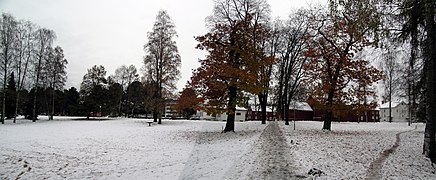 Park at the Gjøvik farm
 -
 Skibladner boathouse, Gjøvik


References[edit]
- ^ "Navn på steder og personer: Innbyggjarnamn" (in Norwegian). Språkrådet.
- ^ "Forskrift om målvedtak i kommunar og fylkeskommunar" (in Norwegian). Lovdata.no.
- ^ Bolstad, Erik; Thorsnæs, Geir, eds. (26 January 2023). "Kommunenummer". Store norske leksikon (in Norwegian). Kunnskapsforlaget.
- ^ Statistisk sentralbyrå. "Table: 06913: Population 1 January and population changes during the calendar year (M)" (in Norwegian).
- ^ Statistisk sentralbyrå. "09280: Area of land and fresh water (km²) (M)" (in Norwegian).
- ^ a b Jukvam, Dag (1999). Historisk oversikt over endringer i kommune- og fylkesinndelingen (PDF) (in Norwegian). Statistisk sentralbyrå. ISBN 9788253746845.
- ^ Rygh, Oluf (1902). Norske gaardnavne: Kristians amt (anden halvdel) (in Norwegian) (4-2 ed.). Kristiania, Norge: W. C. Fabritius & sønners bogtrikkeri. p. 40.
- ^ a b "Civic heraldry of Norway - Norske Kommunevåpen". Heraldry of the World. Retrieved 22 April 2023.
- ^ "Gjøvik, Oppland (Norway)". Flags of the World. Retrieved 22 April 2023.
- ^ "Godkjenning av våpen og flagg". Lovdata.no (in Norwegian). Norges kommunal- og arbeidsdepartementet. 2 September 1960. Retrieved 22 April 2023.
- ^ Anne Wichstrøm. "Asta Nørregaard". Norsk biografisk leksikon. Retrieved 1 February 2018.
- ^ Torstein Jørgensen. "Paul Olaf Bodding". Norsk biografisk leksikon. Retrieved 1 February 2018.
- ^ "Immigrants and Norwegian-born to immigrant parents, by immigration category, country background and percentages of the population". ssb.no. Archived from the original on 28 April 2022. Retrieved 28 April 2022.
- ^ Stagg, Frank Noel (1956). East Norway and its Frontier. George Allen & Unwin, Ltd.
- ^ Hansen, Tore; Vabo, Signy Irene, eds. (20 September 2022). "kommunestyre". Store norske leksikon (in Norwegian). Kunnskapsforlaget. Retrieved 14 October 2022.
- ^ "Kommunestyrevalg 2023 - Innlandet". Valgdirektoratet. Retrieved 14 January 2024.
- ^ "Kommunestyrevalg 2019 - Innlandet". Valgdirektoratet. Retrieved 9 October 2022.
- ^ "Kommunestyrevalg 2015 - Oppland". Valgdirektoratet.
- ^ a b c d "Table: 04813: Members of the local councils, by party/electoral list at the Municipal Council election (M)" (in Norwegian). Statistics Norway.
- ^ "Kommunestyrevalg 2011 - Oppland". Valgdirektoratet.
- ^ Kommunestyrevalget 1999 (PDF) (in Norwegian). Oslo-Kongsvinger, Norge: Statistisk sentralbyrå. 2000. ISBN 8253748531. ISSN 0332-8023.
- ^ Kommunestyrevalget 1995 (PDF) (in Norwegian). Oslo-Kongsvinger, Norge: Statistisk sentralbyrå. 1996. ISBN 8253743351. ISSN 0332-8023.
- ^ Kommunestyrevalget 1991 (PDF) (in Norwegian). Oslo-Kongsvinger, Norge: Statistisk sentralbyrå. 1993. ISBN 8253737939. ISSN 0332-8023.
- ^ Kommunestyrevalget 1987 (PDF) (in Norwegian). Oslo-Kongsvinger, Norge: Statistisk sentralbyrå. 1988. ISBN 8253726325. ISSN 0332-8023.
- ^ Kommunestyrevalget 1983 (PDF) (in Norwegian). Oslo-Kongsvinger, Norge: Statistisk sentralbyrå. 1984. ISBN 8253720378. ISSN 0332-8023.
- ^ Kommunestyrevalget 1979 (PDF) (in Norwegian). Oslo, Norge: Statistisk sentralbyrå. 1979. ISBN 8253710836. ISSN 0332-8023.
- ^ Kommunevalgene 1975 (PDF) (in Norwegian). Oslo, Norge: Statistisk sentralbyrå. 1977. ISBN 8253705646.
- ^ Kommunevalgene 1972 (PDF) (in Norwegian). Vol. I. Oslo, Norge: Statistisk sentralbyrå. 1973. ISBN 8253701144.
- ^ "Kommunevalgene 1967" (PDF) (in Norwegian). Oslo, Norge: Statistisk sentralbyrå. 1967.
- ^ "Kommunevalgene 1963" (PDF) (in Norwegian). Oslo, Norge: Statistisk sentralbyrå. 1964.
- ^ "Kommunevalgene og Ordførervalgene 1959" (PDF) (in Norwegian). Oslo, Norge: Statistisk sentralbyrå. 1960.
- ^ "Kommunevalgene og Ordførervalgene 1955" (PDF) (in Norwegian). Oslo, Norge: Statistisk sentralbyrå. 1957.
- ^ "Kommunevalgene og Ordførervalgene 1951" (PDF) (in Norwegian). Oslo: Statistisk sentralbyrå. 1952.
- ^ "Kommunevalgene og Ordførervalgene 1947" (PDF) (in Norwegian). Oslo: Statistisk sentralbyrå. 1948.
- ^ "Kommunevalgene og Ordførervalgene 1945" (PDF) (in Norwegian). Oslo: Statistisk sentralbyrå. 1947.
- ^ "Kommunevalgene og Ordførervalgene 1937" (PDF) (in Norwegian). Oslo: Statistisk sentralbyrå. 1938.
- ^ "Kommunevalgene og Ordførervalgene 1934" (PDF) (in Norwegian). Oslo, Norge: Statistisk sentralbyrå. 1935.
- ^ "Kommunevalgene og Ordførervalgene 1931" (PDF) (in Norwegian). Oslo, Norge: Statistisk sentralbyrå. 1932.
- ^ "Kommunevalgene og Ordførervalgene 1928" (PDF) (in Norwegian). Oslo, Norge: Statistisk sentralbyrå. 1929.
- ^ "Kommunevalgene og Ordførervalgene 1925" (PDF) (in Norwegian). Oslo, Norge: Statistisk sentralbyrå. 1926.
- ^ "Kommunevalgene og Ordførervalgene 1922" (PDF) (in Norwegian). Oslo, Norge: Statistisk sentralbyrå. 1923.
- ^ "Kommunevalgene og Ordførervalgene 1919" (PDF) (in Norwegian). Oslo, Norge: Statistisk sentralbyrå. 1920.
- ^ "Ordførere i Gjøvik kommune". LokalHistorieWiki.no (in Norwegian). Retrieved 23 April 2023.
- ^ "Anne Bjertnæs (H) blir ny ordfører". NRK (in Norwegian). 27 September 2023. Retrieved 13 January 2024.
- ^ Finn Lange at IMDb. Retrieved 15 January 2021.
- ^ Georg Adelly at IMDb. Retrieved 15 January 2021.
- ^ "Vennskapsbyer". gjovik.kommune.no (in Norwegian). Gjøvik Kommune. Retrieved 31 January 2021.
External links[edit]


 Gjøvik travel guide from Wikivoyage
- Municipal fact sheet from Statistics Norway (in Norwegian)
- Tourist information Archived 29 December 2018 at the Wayback Machine
- NTNU Gjøvik - University

| |||||||||||||
 | Towns and cities |
| |||||||||||
| Municipalities |
| ||||||||||||
| |||||||||||||


| International | |
|---|---|
| National | |
| Geographic | |
