


Kangaroo emblems and popular culture

Kangaroos, Wallabies and other Macropodidae have become emblems and symbols of Australia, as well as appearing in popular culture both internationally and within Australia itself.
Kangaroos are part of cultural and spiritual significance for many Indigenous Australians. Since its European discovery, Kangaroos have since become an emblem of Australia, appearing in their coat of arms and in many state and city coat of arms, Australian logos such as the Qantas logo, names of Australian sport teams, mascots such as the Boxing Kangaroo and in public art. Kangaroos are also well represented in film, television, songs, toys and souvenirs around the world.
European first encounters[edit]
The kangaroo was considered a unique oddity when Captain Cook's HMB Endeavour arrived back in England in 1771 with a specimen on board. Over time it has come to symbolise Australia and Australian values.[1]
Joseph Banks, the naturalist on the Endeavour voyage, commissioned George Stubbs to paint a portrait of the kangaroo specimen. When the official account of the voyage was published in 1773, it was illustrated with an engraving of Stubbs' kangaroo. From that time on, the kangaroo quickly came to symbolise the Australian continent, appearing in exhibitions, collections, art and printed works across Europe.[2]
Kangaroo status[edit]
It took a long time for the kangaroo to achieve official recognition in Australia. Despite being a "declared noxious animal" because of its reputation for damaging crops and fences and competing with domestic animals for resources, the kangaroo finally achieved official recognition with its inclusion on Australia's coat of arms in 1908.[3] The kangaroo is now popularly regarded as Australia's unofficial animal emblem.[4]
Kangaroo emblems and logos[edit]

The kangaroo and emu are bearers on the Australian Coat of Arms. It has been claimed these animals were chosen to signify a country moving 'forward' because of a common belief that neither can move backward.[5]
Two red kangaroos serve as bearers to the Coat of Arms of Western Australia.
Australia's national airline, Qantas, uses a bounding kangaroo for its logo. The kangaroo has always been part of the Qantas logo,[6] and the airline has previously been known informally as "The Flying Kangaroo".
Tourism Australia makes use of the kangaroo in its logo to "help ensure instant recognition for Australia around the world".[7]
The Australian Grown logo uses a golden kangaroo in a green triangle to show that a product is made or grown in Australia.[8]
The Royal Australian Air Force roundel features a bounding red kangaroo.
Warships of the Royal Australian Navy have red kangaroo symbols (based on the kangaroo on the reverse of the Australian penny) fixed to either side of their superstructure or funnel. This originated during the Korean War: as the destroyer HMAS Anzac was repeatedly mistaken for a British warship, her executive officer had a brass 'weathervane' in the shape of a kangaroo made and mounted to the ship's mainmast.[9]
The kangaroo is part of the official emblem of the Royal Australian Regiment with a kangaroo in between two Lee–Enfield bolt-action rifles.
The Victorian Coat of Arms includes the upper portion of a kangaroo holding an Imperial Crown in its paws.
The red kangaroo is the animal emblem of the Northern Territory.
The kangaroo is the official emblem of Northern Territory Police.
British clothing and headwear company Kangol, known for its berets, features a kangaroo in its logo.

Kangaroos and coins[edit]
The kangaroo has been featured on coins on the pre-decimal Australian pound and decimal coins of the Australian dollar. The kangaroo appears on the pre-decimal penny and half-penny coins. Five kangaroos are featured on the one dollar coin.
Kangaroo mascots in Australia[edit]
.jpg)
The boxing kangaroo – mascot for the Australia II team in the 1983 America's Cup. This rendition of the kangaroo has become a sporting icon, known informally as the green and gold "Sporting Kangaroo", and is highly popular with cricket crowds and international sporting events which feature Australian participation.
Matilda, the mascot at the 1982 Commonwealth Games held in Brisbane, Queensland, Australia, was represented by both a cartoon kangaroo and a 13-metre high (42 feet 8 inches) mechanical kangaroo (which winked at the spectators during the opening and closing ceremonies). The 'medal', which was worn by both the cartoon and mechanical versions of Matilda, features the 1982 Commonwealth Games logo — a stylised representation of a kangaroo bounding (in "flight") – similar to the pose of the kangaroo featured on the pre-decimal half-penny coin.[10]
During the First World War, pet kangaroos and toy kangaroos were a popular choice of mascot for Australian servicemen.[11][12]

Architectural references[edit]
The first uses of Kangaroo ornaments as architectural expression appeared during the Victorian era. This was at first limited to the use of the coat of arms on buildings; however, kangaroos soon became used as decorative motifs on their own in some commercial buildings, particularly in Melbourne.
It was the Federation architecture, however, which brought native ornamentation into the mainstream, so that kangaroos began to be mass-produced as ornamentation on domestic houses in the large cities, as part of an Australiana movement and effort to create a uniquely Australian style. Examples of this decoration include the ornamental terracotta tile capping on residential roofs. Reproduction products using Kangaroos are still used today.
Public art and sculpture[edit]

Kangaroo motifs have been used as a form of public art.
Notable examples include:
- Victorian lamp post (1880) in front of the Royal Exhibition Building at the Carlton Gardens in Carlton, Victoria
- Petrie Tableaux sculpture (1989). In front of Brisbane City Hall at King George Square by Stephen Walker
- Perth kangaroo sculptures (1996, 1997 & 2000). St Georges Terrace, in several locations, Perth, Western Australia, by Anne Neil, Joan Walsh-Smith, Charles Smith
- City Roo sculptures (1999). George Street, Brisbane, Queensland – made from scrap metal by Christopher Trotter
- Eastern grey kangaroo sculpture in the City Botanic Gardens
- Kangaroo and joey sculpture at Queens Park in Ipswich, Queensland
-
 Kangaroo ornaments on a Victorian lamp post at the Royal Exhibition Building
 -
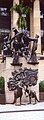 Petrie Tableaux sculpture in front of Brisbane City Hall
 -
 One of the City Roo sculptures in George Street, Brisbane
 -
 Eastern Grey kangaroo sculpture in the City Botanic Gardens
 -
 Kangaroo and joey sculpture at Queens Park in Ipswich, Queensland


Decorative arts and design[edit]
An early depiction of a kangaroo on an item of decorative art is the Macintosh & Degraves Token Shilling 1823.[13] Another early example is the Garret salver. This item of Tasmanian colonial silver incorporates a kangaroo, an emu and wattle branches in its design.[14]
The kangaroo has continued to be incorporated into decorative designs by craftspeople and designers in Australia and elsewhere in the world. The Terence Lane kangaroo collection at the National Museum of Australia consists of more than 150 objects and ephemera in a wide range of styles produced over a period of 150 years. The collection ranges from a one-metre-high Doulton ceramic kangaroo umbrella stand to small items of jewellery.[15]
Cultural references[edit]
Kangaroos are extremely well represented in films, television, songs, toys and souvenirs around the world.
Television and films[edit]
Skippy the Bush Kangaroo, star of the 1960s Australian children's television series.
Wake in Fright is a 1971 movie which includes a controversial kangaroo hunting scene containing graphic footage of kangaroos actually being shot.[16] In a more comical vein, the 1986 film Crocodile Dundee features a scene in which the title character frightens away kangaroo hunters by making them think that a kangaroo is shooting back at them.[17]
Matilda is a 1978 movie starring Elliott Gould about a promoter working with a kangaroo.
Kangaroo Jack is the title character of an American film of the same name.
A giant kangaroo is featured in the movie Welcome to Woop Woop.
The Hallmark Properties television series Zoobilee Zoo has a character named Whazzat Kangaroo (the Canadian actress and singer Stephanie Louise "Stevie" Vallance plays this role).
Songs[edit]
Kangaroos are mentioned, or featured, in the Rolf Harris songs "Tie Me Kangaroo Down, Sport" and "Six White Boomers".
Kangaroos are also mentioned in the Peter Allen song "Tenterfield Saddler".
Kangaroos are also mentioned in Holden jingle "Football, meat pies, kangaroos and Holden cars".
Kangaroos are also mentioned in the songs "Christmas Where The Gum Trees Grow", "Christmas in the Scrub" and "The Five Days of Christmas".
Books[edit]
There is a "Sour Kangaroo" in the Dr. Seuss tale Horton Hears a Who!.
Kanga and Roo are fictional mother and son kangaroos in the popular series of children's books about Winnie-the-Pooh.
Kidding Kangaroo in the Sweet Pickles book series by Ruth Lerner Perle, Jacquelyn Reinach and Richard Hefter.
One of the several intelligent races described in the fantasy novel Shadowkeep, written by Alan Dean Foster, are high-bounding, fun-loving marsupials, known as "roos" and obviously meant to be intelligent kangaroos.
A kangaroo is shot and killed by Ernest in The Swiss Family Robinson, a book written by Johann Wyss.
Cartoons[edit]
Kiko the Kangaroo is a recurring character in the Terrytoons cartoons.
Kanga and Roo are fictional mother and son kangaroos in the popular series of cartoons about Winnie-the-Pooh.
A team of kangaroo basketball players feature in the French cartoon series Kangoo and its spin-off/prequel Kangoo Juniors.
In several Looney Tunes/Merrie Melodies cartoons, Sylvester the Cat is beaten up by Hippety Hopper the baby kangaroo, who always accomplishes this feat after escaping from the captivity of humans who have attempted to take him to a zoo in assorted American cities and whom Sylvester believes to be a giant mouse.
In Tom and Jerry: The Fast and the Furry, the commentators are holding a kangaroo by the leash when the racers reach Australia.
In the British punk style comic strips Tank Girl, the protagonist's boyfriend is Booga, the mutant anthro-kangaroo. There are some other minor kangaroo characters. In the U.S. movie Tank Girl, slightly based on the comic strips, the protagonist is assisted by Rippers – mutant kangaroo genetically engineered supersoldiers (and Booga is among them, of course).
Rocko the wallaby in Rocko's Modern Life
Dot and the Kangaroo was a cartoon juxtaposed on a film of the Australian bush.
In The Simpsons episode "Bart vs. Australia", Homer and Bart try to escape from a crowd in the pouches of two kangaroos, which they ultimately cannot because of the kangaroos' pouches being filled with mucus.
In Adventures of Sonic the Hedgehog, there is a kangaroo named MacHopper, who is also a parody of Crocodile Dundee, another Australian icon.
In the Kick Buttowski: Suburban Daredevil episode "Bwar and Peace", Brad talks about his Australian self, who afterward was punched, and the kangaroo appears before and during his wedding with the girl he is with. Kick also interacted with the kangaroo.
In the fifth season of The Flintstones, the Rubbles adopt Hoppy, a pet hoparoo (a Stone Age version of a kangaroo) from Down Under, for Bamm-Bamm.
Advertisements[edit]
Aussie hair products from Procter & Gamble sports a kangaroo hopping on its label, while the magazine and television ads display an animatronic purple kangaroo in them.
Dunkaroos are a snack in the U.S. which used to feature a talking kangaroo in commercials and on product containers.
Video games and other games[edit]
Roo is a fighting kangaroo in the Sega Genesis video game Streets of Rage 3.
Ripper Roo, a crazy kangaroo in a straitjacket, is a boss character and antagonist of the video game series Crash Bandicoot.
Kao the Kangaroo and its sequels are a Polish video game series involving a yellow/orange kangaroo in a boxing uniform as its protagonist.
Sheila, a female kangaroo of the video game series Spyro the Dragon.
Roger the boxing kangaroo from the Tekken series of video games.
In the Game Boy Color games The Legend of Zelda: Oracle of Seasons and The Legend of Zelda: Oracle of Ages, there is a kangaroo by the name of Ricky which will help you in your quest.
In Mortal Kombat Trilogy, Johnny Cage turns into a kangaroo.
In Bomberman 3 and 5 on SNES, the animals which hatch from eggs are called rooeys and they are based on kangaroos.
The Animal Crossing series features kangaroos as possible neighbours.
There are at least three homonymous fairy chess pieces called kangaroo.
Others[edit]
Austin of The Backyardigans is a young kangaroo.
In Warriors of Virtue, the five main heroes are kangaroos.
In the Pokémon franchise, Kangaskhan is a Normal type based on a kangaroo with reptilian features. Breloom, a Grass and Fighting type, is also partly based on a kangaroo with mushroom and boxing features.
In the anime and manga series Reborn! the character Ryohei Sasagawa has a kangaroo in one of his ring boxes that enables healing and advances abilities of others.
Chimera Punch, a kangaroolike monster in Tokyo Mew Mew.
Kangaroos and sporting teams[edit]
The kangaroo features prominently in sport. Australian sports teams with nicknames derived from the kangaroo (and wallaby) include the following:
Australia[edit]
Australian national teams[edit]
The Australian national rugby league team is nicknamed the Kangaroos.
The Australia national rugby union team is nicknamed the Wallabies.
The Australia national association football team (men's) is nicknamed the Socceroos.
The Australia national under-23 football team plays Football at the Summer Olympics and is nicknamed Olyroos.
The Australia national under-20 football team is nicknamed the Young Socceroos
The Australia national under-17 football team is the Joeys
The Australian Women's field hockey team is nicknamed the Hockeyroos.
The Australian national ice hockey team is nicknamed the Mighty Roos.
The Australian men's national basketball team is nicknamed the Boomers.
Australian domestic teams[edit]
The North Melbourne Football Club in the Australian Football League is nicknamed the Kangaroos.
United States[edit]
Kasey Kangaroo is the mascot for the University of Missouri–Kansas City, whose sports teams were historically known as the UMKC Kangaroos but rebranded as the Kansas City Roos in 2019.
Zippy the kangaroo is the mascot for The University of Akron, athletically the Akron Zips.
The kangaroo is the mascot for Austin College in Sherman, Texas
The kangaroo is the mascot for Terryville High School in Terryville, Connecticut
Lizzie (a purple and white kangaroo) is the mascot of Lake Washington High School in Kirkland, Washington
Stomper is the mascot for the professional wrestling promotion Impact Wrestling.
The kangaroo is the mascot for State University of New York at Canton in Canton (town), New York
The kangaroo is the mascot for Wilmington Friends School in Wilmington, Delaware
Moe the Kangaroo is the mascot for Virginia Military Institute in Lexington, Virginia. However, VMI's sports teams are known as the VMI Keydets.
The kangaroo is the mascot for Killeen High School in Killeen, Texas.
Weatherford, Texas High School's mascot is the Kangaroos
Abington Friends School, in Abington, Pennsylvania, has a kangaroo named Roo as its mascot.
Other countries[edit]
The Samoa national Australian rules football team is nicknamed the Kangaroos.
The FC Bohemians Praha, a Czech football team is nicknamed the Klokani (Czech for kangaroos) since their tour in Australia in 1927.
Place names[edit]
The kangaroo has inspired a number of place names in Australia. They include:
- Kangaroo Point
- Kangaroo Point – (Brooklyn)
- Kangaroo River – (Clarence Valley)
- Kangaroo River – (Shoalhaven)
- Kangaroo Valley
References[edit]
- ^ Harper, Melissa and White, Richard (eds) (2010). Symbols of Australia, p. 28-29, UNSW Press, Sydney: National Museum of Australia Press, Canberra. ISBN 978-1-921410-50-5
- ^ Symbols of Australia: Kangaroo, National Museum of Australia
- ^ Harper, Melissa and White, Richard (eds) (2010). Symbols of Australia, p. 24. UNSW Press, Sydney: National Museum of Australia Press, Canberra. ISBN 978-1-921410-50-5
- ^ Australian Government Department of Foreign Affairs and Trade: About Australia – National Icons Archived 19 October 2011 at the Wayback Machine
- ^ Harper, Melissa and White, Richard (eds) (2010). Symbols of Australia, p. 25. UNSW Press, Sydney: National Museum of Australia Press, Canberra. ISBN 978-1-921410-50-5
- ^ Qantas: The Kangaroo Symbol
- ^ Tourism Australia: Using the Brandmark
- ^ Australian Made | Australian Grown
- ^ Cassells, Vic (2000). The Destroyers: their battles and their badges. East Roseville, NSW: Simon & Schuster. pp. 11–12. ISBN 0-7318-0893-2. OCLC 46829686.
- ^ "1982 Commonwealth Games Mascot," Australian Commonwealth Games Association
- ^ Kangaroo soft toy mascot: Red Cross Hut, Rouelles, Australian War Memorial
- ^ Photograph: Australian nurse with a kangaroo mascot, Harefield, England, Australian War Memorial
- ^ Macintosh & Degraves Token Shilling 1823, Museum Victoria
- ^ Garrett salver, Tasmanian Museum and Art Gallery
- ^ Terence Lane kangaroo collection, National Museum of Australia
- ^ "Wake in Fright – BBFC Insight". British Board of Film Classification. 28 January 2014. Retrieved 4 January 2015.
- ^ Croft, David B. (1991). Australian People and Animals in Today's Dreamtime: The Role of Comparative Psychology in the Management of Natural Resources. New York: Praeger. p. 32. ISBN 0-275-93908-1.
In Australia's latest version of the bush hero, Mick "Crocodile" Dundee, we find an explicitly totemic being who is a poacher turned conservationist as he chases away a group of kangaroo shooters at the behest of his American girlfriend.
| Types | |||||||||||||||
|---|---|---|---|---|---|---|---|---|---|---|---|---|---|---|---|
| Topics | |||||||||||||||
| Achievement | |||||||||||||||
| Charges | |||||||||||||||
| Tinctures |
| ||||||||||||||
| Applications | |||||||||||||||
| Related | |||||||||||||||
| |||||||||||||||


