


Ouroboros

The ouroboros or uroboros (/ˌjʊərəˈbɒrəs/;[2] /ˌʊərəˈbɒrəs/[3]) is an ancient symbol depicting a serpent or dragon[4] eating its own tail. The ouroboros entered Western tradition via ancient Egyptian iconography and the Greek magical tradition. It was adopted as a symbol in Gnosticism and Hermeticism and most notably in alchemy. Some snakes, such as rat snakes, have been known to consume themselves.[5]
Name and interpretation[edit]
The term derives from Ancient Greek οὐροβόρος,[6] from οὐρά oura 'tail' plus -βορός -boros '-eating'.[7][8]
The ouroboros is often interpreted as a symbol for eternal cyclic renewal or a cycle of life, death and rebirth; the snake's skin-sloughing symbolises the transmigration of souls. The snake biting its own tail is a fertility symbol in some religions: the tail is a phallic symbol and the mouth is a yonic or womb-like symbol.[9]
Historical representations[edit]

Ancient Egypt[edit]
One of the earliest known ouroboros motifs is found in the Enigmatic Book of the Netherworld, an ancient Egyptian funerary text in KV62, the tomb of Tutankhamun, in the 14th century BCE. The text concerns the actions of Ra and his union with Osiris in the underworld. The ouroboros is depicted twice on the figure: holding their tails in their mouths, one encircling the head and upper chest, the other surrounding the feet of a large figure, which may represent the unified Ra-Osiris (Osiris born again as Ra). Both serpents are manifestations of the deity Mehen, who in other funerary texts protects Ra in his underworld journey. The whole divine figure represents the beginning and the end of time.[10]
.svg)
The ouroboros appears elsewhere in Egyptian sources, where, like many Egyptian serpent deities, it represents the formless disorder that surrounds the orderly world and is involved in that world's periodic renewal.[11] The symbol persisted from Egyptian into Roman times, when it frequently appeared on magical talismans, sometimes in combination with other magical emblems.[12] The 4th-century CE Latin commentator Servius was aware of the Egyptian use of the symbol, noting that the image of a snake biting its tail represents the cyclical nature of the year.[13]
Gnosticism and alchemy[edit]

In Gnosticism, a serpent biting its tail symbolised eternity and the soul of the world.[14] The Gnostic Pistis Sophia (c. 400 CE) describes the ouroboros as a twelve-part dragon surrounding the world with its tail in its mouth.[15]
The famous ouroboros drawing from the early alchemical text, The Chrysopoeia of Cleopatra (Κλεοπάτρας χρυσοποιία), probably originally dating to the 3rd century Alexandria, but first known in a 10th-century copy, encloses the words hen to pan (ἓν τὸ πᾶν), "the all is one". Its black and white halves may perhaps represent a Gnostic duality of existence, analogous to the Taoist yin and yang symbol.[16] The chrysopoeia ouroboros of Cleopatra the Alchemist is one of the oldest images of the ouroboros to be linked with the legendary opus of the alchemists, the philosopher's stone.[citation needed]
A 15th-century alchemical manuscript, The Aurora Consurgens, features the ouroboros, where it is used among symbols of the sun, moon, and mercury.[17]
-
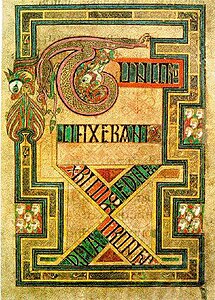 A highly stylised ouroboros from The Book of Kells, an illuminated Gospel Book (c. 800 CE)
 -
![Engraving of a wyvern-type ouroboros by Lucas Jennis, in the 1625 alchemical tract De Lapide Philosophico. The figure serves as a symbol for mercury.[18]](//upload.wikimedia.org/wikipedia/commons/thumb/8/87/Ouroboros_1.jpg/294px-Ouroboros_1.jpg) Engraving of a wyvern-type ouroboros by Lucas Jennis, in the 1625 alchemical tract De Lapide Philosophico. The figure serves as a symbol for mercury.[18]
Engraving of a wyvern-type ouroboros by Lucas Jennis, in the 1625 alchemical tract De Lapide Philosophico. The figure serves as a symbol for mercury.[18] -
 An engraving of a woman holding an ouroboros in Michael Ranft's 1734 treatise on vampires
 -
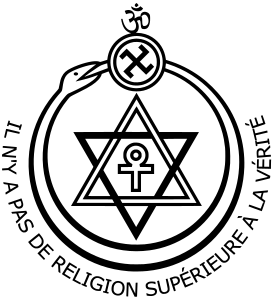 Seal of the Theosophical Society, founded 1875

![Engraving of a wyvern-type ouroboros by Lucas Jennis, in the 1625 alchemical tract De Lapide Philosophico. The figure serves as a symbol for mercury.[18]](/wiki/File:Ouroboros_1.jpg)


World serpent in mythology[edit]
In Norse mythology, the ouroboros appears as the serpent Jörmungandr, one of the three children of Loki and Angrboda, which grew so large that it could encircle the world and grasp its tail in its teeth. In the legends of Ragnar Lodbrok, such as Ragnarssona þáttr, the Geatish king Herraud gives a small lindworm as a gift to his daughter Þóra Town-Hart after which it grows into a large serpent which encircles the girl's bower and bites itself in the tail. The serpent is slain by Ragnar Lodbrok who marries Þóra. Ragnar later has a son with another woman named Kráka and this son is born with the image of a white snake in one eye. This snake encircled the iris and bit itself in the tail, and the son was named Sigurd Snake-in-the-Eye.[19]
It is a common belief among indigenous people of the tropical lowlands of South America that waters at the edge of the world-disc are encircled by a snake, often an anaconda, biting its own tail.[20]
The ouroboros has certain features in common with the Biblical Leviathan. According to the Zohar, the Leviathan is a singular creature with no mate, "its tail is placed in its mouth", while Rashi on Baba Batra 74b describes it as "twisting around and encompassing the entire world". The identification appears to go back as far as the poems of Kalir in the 6th–7th centuries.[citation needed]
Connection to Indian thought[edit]
In the Aitareya Brahmana, a Vedic text of the early 1st millennium BCE, the nature of the Vedic rituals is compared to "a snake biting its own tail."[21]
Ouroboros symbolism has been used to describe the Kundalini.[22] According to the medieval Yoga-kundalini Upanishad: "The divine power, Kundalini, shines like the stem of a young lotus; like a snake, coiled round upon herself she holds her tail in her mouth and lies resting half asleep as the base of the body" (1.82).[23]
Storl (2004) also refers to the ouroboros image in reference to the "cycle of samsara".[24]
Modern references[edit]
Jungian psychology[edit]
Swiss psychiatrist Carl Jung saw the ouroboros as an archetype and the basic mandala of alchemy. Jung also defined the relationship of the ouroboros to alchemy: Carl Jung, Collected Works, Vol. 14 para. 513.
The alchemists, who in their own way knew more about the nature of the individuation process than we moderns do, expressed this paradox through the symbol of the Ouroboros, the snake that eats its own tail. The Ouroboros has been said to have a meaning of infinity or wholeness. In the age-old image of the Ouroboros lies the thought of devouring oneself and turning oneself into a circulatory process, for it was clear to the more astute alchemists that the prima materia of the art was man himself. The Ouroboros is a dramatic symbol for the integration and assimilation of the opposite, i.e. of the shadow. This 'feedback' process is at the same time a symbol of immortality since it is said of the Ouroboros that he slays himself and brings himself to life, fertilizes himself, and gives birth to himself. He symbolizes the One, who proceeds from the clash of opposites, and he, therefore, constitutes the secret of the prima materia which ... unquestionably stems from man's unconscious.
The Jungian psychologist Erich Neumann writes of it as a representation of the pre-ego "dawn state", depicting the undifferentiated infancy experience of both mankind and the individual child.[25]
Kekulé's dream[edit]

.png)
The German organic chemist August Kekulé described the eureka moment when he realised the structure of benzene, after he saw a vision of Ouroboros:[26]
I was sitting, writing at my text-book; but the work did not progress; my thoughts were elsewhere. I turned my chair to the fire and dozed. Again the atoms were gamboling before my eyes. This time the smaller groups kept modestly in the background. My mental eye, rendered more acute by the repeated visions of the kind, could now distinguish larger structures of manifold conformation: long rows, sometimes more closely fitted together; all twining and twisting in snake-like motion. But look! What was that? One of the snakes had seized hold of its own tail, and the form whirled mockingly before my eyes. As if by a flash of lightning I awoke; and this time also I spent the rest of the night in working out the consequences of the hypothesis.
Cosmos[edit]
Martin Rees used the ouroboros to illustrate the various scales of the universe, ranging from 10−20 cm (subatomic) at the tail, up to 1025 cm (supragalactic) at the head.[27] Rees stressed "the intimate links between the microworld and the cosmos, symbolised by the ouraborus", as tail and head meet to complete the circle.[28]
Cybernetics[edit]
W. Ross Ashby applied ideas from biology to his own work as a psychiatrist in "Design for a Brain" (1952): that living things maintain essential variables of the body within critical limits with the brain as a regulator of the necessary feedback loops. Parmar contextualises his practices as an artist in applying the cybernetic Ouroboros principle to musical improvisation.[29]
Hence the snake eating its tail is an accepted image or metaphor in the autopoietic calculus for self-reference,[30] or self-indication, the logical processual notation for analysing and explaining self-producing autonomous systems and "the riddle of the living", developed by Francisco Varela. Reichel describes this as:
an abstract concept of a system whose structure is maintained through the self-production of and through that structure. In the words of Kauffman, is "the ancient mythological symbol of the worm ouroboros embedded in a mathematical, non-numerical calculus".[31][32]
The calculus derives from the confluence of the cybernetic logic of feedback, the sub-disciplines of autopoiesis developed by Varela and Humberto Maturana, and calculus of indications of George Spencer Brown. In another related biological application:
It is remarkable, that Rosen's insight, that metabolism is just a mapping ..., which may be too cursory for a biologist, turns out to show us the way to construct recursively, by a limiting process, solutions of the self-referential Ouroborus equation f(f) = f, for an unknown function f, a way that mathematicians had not imagined before Rosen.[33][34]
Second-order cybernetics, or the cybernetics of cybernetics, applies the principle of self-referentiality, or the participation of the observer in the observed, to explore observer involvement.[35] including D. J. Stewart's domain of "observer valued imparities".[36]
Armadillo girdled lizard[edit]
The genus of the armadillo girdled lizard, Ouroborus cataphractus, takes its name from the animal's defensive posture: curling into a ball and holding its own tail in its mouth.[37]

In Iberian culture[edit]
A medium-sized European hake, known in Spanish as pescadilla and in Portuguese as pescada, is often presented with its mouth biting its tail. In Spanish it receives the name of pescadilla de rosca ("torus hake").[38] Both expressions Uma pescadinha de rabo na boca "tail-in mouth little hake" and La pescadilla que se muerde la cola, "the hake that bites its tail", are proverbial Portuguese and Spanish expressions for circular reasoning and vicious circles.[39]
Dragon Gate Pro-Wrestling[edit]
The Kobe, Japan-based Dragon Gate Pro-Wrestling promotion used a stylised ouroboros as their logo for the first 20 years of the company's existence. The logo is a silhouetted dragon twisted into the shape of an infinity symbol, devouring its own tail. In 2019, the promotion dropped the infinity dragon logo in favour of a shield logo.
In fiction[edit]
Literature[edit]
The Worm Ouroboros is a high-fantasy novel written by E. R. Eddison. Much like the cyclical symbol of the ouroboros eating its own tail, the novel ends as it begins. The main villain has a ring in the form of Ouroboros.
In The Wheel of Time and its 2021 television adaption, the Aes Sedai wear a "Great Serpent" ring, described as a snake consuming its own tail.[40]
In the science fiction short story "All You Zombies" (1958) by American writer Robert A. Heinlein, the character Jane wears an Ouroboros ring, "the worm Ouroboros, the world snake".[41] The short story later inspired the movie Predestination (2014).
In the SCP Foundation universe, the proposal tale "The Ouroboros Cycle"[42] spans the story of the SCP Foundation from its creation to its ending.
In the A Discovery of Witches novels and television adaptation, the crest of the de Clermont family is an ouroboros. The symbol plays a significant role in the alchemical plot of the story.
In the book series A Court of Thorns and Roses, there is a mirror named the Ouroboros, also known as the Mirror of Beginnings and Endings, which shows the user who or what they truly are.
In the novel Lock Every Door by Riley Sager, a painting of an ouroboros is featured in one of the apartments and acts as a symbol for longtime residents of the building.
"Ouroboros" is the title of Chapters/Fight 47 and 49 of Gunnm/Battle Angel Alita by Yukito Kishiro (Ouroboros I and Ouroboros II, respectively). In the manga plot, ouroboros refers to a self-absorbing dream/trap.
Ouroboros is mentioned throughout the science fiction novel Aurora, by Kim Stanley Robinson. One such use comes midway through the story, as told by the ship's computer contemplating an ongoing, seemingly unresolvable conflict: "We felt here the perilous Ouroboros of an unresolvable halting problem, about to spin forever in contemplation of an unaswerable question."
Film and television[edit]
The Ouroboros is the adopted symbol of the End Times-obsessed Millennium Group in the TV series Millennium.[43] It also briefly appears when Dana Scully gets a tattoo of it in The X-Files Season 4 episode "Never Again" (1997).[44]
"Ouroboros" is an episode of the British science-fiction sitcom Red Dwarf, in which Dave Lister learns that he is his own father through time travel.[45] In Season 1 (2018) of the cyberpunk Netflix series Altered Carbon, the protagonist Takeshi Kovacs gets an ouroboros tattoo in shape of an infinity symbol.[46] Season 4 (2021) of The Sinner features it throughout.[47]
In the Season 2 premiere of Loki (TV series), a character named Ouroboros (played by Ke Huy Quan) is introduced. He is an employee of the Time Variance Authority. In the fourth episode, he also references a snake biting its own tail.[48]
Season 2 Episode 6 (2016) of Fear the Walking Dead is entitled 'Ouroboros'.[49] The character of Alpha in The Walking Dead wears an ouroboros belt buckle.[50]
Anime Fullmetal Alchemist: Brotherhood uses the symbol (carved/tattooed/branded/marked) to identify the characters known as homunculi.[51]
Gaming[edit]
Splatoon 3 has a similar creature, called the Horrorboros.[52] The main six playable characters of the video game Xenoblade Chronicles 3 are able to transform into fiercely powerful forms called Ouroboros, which are ultimately tied to the fate of their world.[53] Inscryption features a card called Ouroboros, depicting the drawing of a snake with small legs biting its own tail. This card bears the Unkillable sigil and grows more powerful each time it is killed or sacrificed.[54] Honkai: Star Rail features an Aeon called Ouroboros, who represents the Path of Voracity and is described to be an insatiable devourer of worlds. It is also mentioned to have simultaneously been an ancient lifeform known as the Leviathan. [55]
See also[edit]
- Amphisbaena
- Cyclic model
- Dragon (M. C. Escher)
- Endless knot
- Ensō
- Eternal return (Eliade)
- Eternalism (philosophy of time)
- Historic recurrence
- Hoop snake
- Infinite loop
- Kulshedra
- Möbius strip
- Quine (computing)
- Self-licking ice cream cone
- Self-reference
- Social cycle theory
- Strange loop
- Three hares
- Valknut
- The Worm Ouroboros
References[edit]
Notes[edit]
- ^ Theodoros Pelecanos's manuscript of an alchemical tract attributed to Synesius, in Codex Parisinus graecus 2327 in the Bibliothèque Nationale, France, mentioned s.v. 'alchemy', The Oxford Classical Dictionary, Oxford University Press, 2012, ISBN 0199545561
- ^ "uroboros". Lexico UK English Dictionary. Oxford University Press. Archived from the original on 19 December 2019.
- ^ "ouroboros". Dictionary.com. Random House.
- ^ "Salvador Dalí: Alchimie des Philosophes | The Ouroboros". Academic Commons. Willamette University.
- ^ Mattison, Chris (2007). The New Encyclopedia of Snakes. Princeton, N.J.: Princeton University Press. p. 105. ISBN 978-0-691-13295-2.
- ^ Liddell & Scott (1940), οὐροβόρος
- ^ Liddell & Scott (1940), οὐρά
- ^ Liddell & Scott (1940), βορά
- ^ Arien Mack (1999). Humans and Other Animals. Ohio State University Press. p. 359.
- ^ Hornung, Erik. The Ancient Egyptian Books of the Afterlife. Cornell University Press, 1999. pp. 38, 77–78
- ^ Hornung, Erik (1982). Conceptions of God in Egypt: The One and the Many. Cornell University Press. pp. 163–64.
- ^ Hornung 2002, p. 58.
- ^ Servius, note to Aeneid 5.85: "according to the Egyptians, before the invention of the alphabet the year was symbolized by a picture, a serpent biting its own tail because it recurs on itself" (annus secundum Aegyptios indicabatur ante inventas litteras picto dracone caudam suam mordente, quia in se recurrit), as cited by Danuta Shanzer, A Philosophical and Literary Commentary on Martianus Capella's De Nuptiis Philologiae et Mercurii Book 1 (University of California Press, 1986), p. 159.
- ^ Origen, Contra Celsum 6.25.
- ^ Hornung 2002, p. 76.
- ^ Eliade, Mircea (1976). Occultism, Witchcraft, and Cultural Fashions. Chicago and London: U of Chicago Press. pp. 55, 93–113.
- ^ Bekhrad, Joobin. "The ancient symbol that spanned millennia". BBC. Retrieved 24 July 2021.
- ^ Lambsprinck: De Lapide Philosophico. E Germanico versu Latine redditus, per Nicolaum Barnaudum Delphinatem .... Sumptibus LUCAE JENNISSI, Frankfurt 1625, p. 17.
- ^ Jurich, Marilyn (1998). Scheherazade's Sisters: Trickster Heroines and Their Stories in World Literature. Greenwood Publishing Group. ISBN 978-0-313-29724-3.
- ^ Roe, Peter (1986), The Cosmic Zygote, Rutgers University Press
- ^ Witzel, M., "The Development of the Vedic Canon and its Schools: The Social and Political Milieu" in Witzel, Michael (ed.) (1997), Inside the Texts, Beyond the Texts. New Approaches to the Study of the Vedas, Harvard Oriental Series, Opera Minora vol. 2, Cambridge: Harvard University Press. p. 325 footnote 346
- ^ Henneberg, Maciej; Saniotis, Arthur (24 March 2016). The Dynamic Human. Bentham Science Publishers. p. 137. ISBN 978-1-68108-235-6.
- ^ Mahony, William K. (1 January 1998). The Artful Universe: An Introduction to the Vedic Religious Imagination. SUNY Press. p. 191. ISBN 978-0-7914-3579-3.
- ^ "When Shakti is united with Shiva, she is a radiant, gentle goddess; but when she is separated from him, she turns into a terrible, destructive fury. She is the endless Ouroboros, the dragon biting its own tail, symbolizing the cycle of samsara." Storl, Wolf-Dieter (2004). Shiva: The Wild God of Power and Ecstasy. Inner Traditions / Bear & Co. p. 219. ISBN 978-1-59477-780-6.
- ^ Neumann, Erich. (1995). The Origins and History of Consciousness. Bollington series XLII: Princeton University Press. Originally published in German in 1949.
- ^ Read, John (1957). From Alchemy to Chemistry. Courier Corporation. pp. 179–180. ISBN 978-0-486-28690-7.
- ^ M Rees Just Six Numbers (London 1999) pp. 7–8
- ^ M Rees Just Six Numbers (London 1999) p. 161
- ^ Parmar, Robin. "No Input Software: Cybernetics, Improvisation, and the Machinic Phylum." ISSTA 2011 (2014). He further discusses the cybernetics in elementary actions (like picking up a drum stick), the evolution of cybernetic science from Norbert Wiener to Gordon Pask, Heinz von Foerster, and Autopoiesis, and in related fields such as Autocatalysis, the philosophical system of Gilles Deleuze and Félix Guattari, and Manuel DeLanda.
- ^ Varela, Francisco J. "A Calculus for Self-reference." International Journal of General Systems 2 (1975): 5–24.
- ^ Kauffman sub-reference: Kauffman L. H. 2002. Laws of form and form dynamics. Cybernetics & Human Knowing 9(2): 49–63, pp. 57–58.
- ^ Reichel, André (2011). "Snakes all the Way Down: Varela's Calculus for Self-Reference and the Praxis of Paradis" (PDF). Systems Research and Behavioral Science. 28 (6): 646–662. doi:10.1002/sres.1105. S2CID 16051196.
- ^ Gutiérrez, Claudio, Sebastián Jaramillo, and Jorge Soto-Andrade. "Some Thoughts on A. H. Louie's More Than Life Itself: A Reflection on Formal Systems and Biology." Axiomathes 21, no. 3 (2011): 439–454, p. 448.
- ^ Soto-Andrade, Jorge, Sebastia Jaramillo, Claudio Gutierrez, and Juan-Carlos Letelier. "Ouroboros Avatars: A Mathematical Exploration of Self-reference and Metabolic Closure". "One of the most important characteristics observed in metabolic networks is that they produce themselves. This intuition, already advanced by the theories of Autopoiesis and (M,R)-systems, can be mathematically framed in a weird-looking equation, full of implications and potentialities: f(f) = f. This equation (here referred to as Ouroboros equation), arises in apparently dissimilar contexts, like Robert Rosen’s synthetic view of metabolism, hyper set theory and, importantly, untyped lambda calculus. ... We envision that the ideas behind this equation, a unique kind of mathematical concept, initially found in biology, would play an important role in the development of a true systemic theoretical biology." MIT Press online.
- ^ Müller, K. H. Second-order Science: The Revolution of Scientific Structures. Complexity, design, society. Edition Echoraum, 2016.
- ^ Scott, Bernard. "The Cybernetics of Systems of Belief". Kybernetes: The International Journal of Systems & Cybernetics 29, nos. 7–8 (2000): 995–998.
- ^ Stanley, Edward L.; Bauer, Aaron M.; Jackman, Todd R.; Branch, William R.; Mouton, P. Le Fras N. (2011). "Between a rock and a hard polytomy: Rapid radiation in the rupicolous girdled lizards (Squamata: Cordylidae)". Molecular Phylogenetics and Evolution 58 (1): 53–70. (Ouroborus cataphractus, new combination).
- ^ Spínola Bruzón, Carlos. "Pescadilla; entre pijota y pescada.- Grupo Gastronómico Gaditano". grupogastronomicogaditano.com (in European Spanish). Grupo Gastronómico Gaditano. Retrieved 28 October 2021.
La pescadilla se fríe en forma de rosca, de modo que la cola esté cogida por los dientes del pez.
- ^ "pescadilla". Diccionario de la lengua española (in Spanish) (24th ed.). RAE-ASALE. 2014. Retrieved 28 October 2021.
- ^ Jacobs, Mira. "The Wheel of Time Star Hints at What to Look For in Aes Sedai Rings". Comic Book Resources.
- ^ Gomel, Elena (2010). Postmodern Science Fiction and Temporal Imagination. Bloomsbury Publishing. p. 55.
- ^ "The Ouroboros Cycle Proposal". Retrieved 19 December 2023.
- ^ Black, A. J. (2020). Myth-Building in Modern Media The Role of the Mytharc in Imagined Worlds. McFarland. p. 43.
- ^ Delasara, Jan (2015). PopLit, PopCult and The X-Files A Critical Exploration. McFarland. p. 9.
- ^ "Ouroboros". Red Dwarf: The Official Site. Grant Naylor Productions. Retrieved 10 October 2022.
- ^ "Why Takeshi's Tattoo In Altered Carbon Means More Than You Think". Looper.
- ^ "The Sinner recap: A central mystery is solved but new secrets and questions emerge". Entertainment Weekly.
- ^ Owens, Lucy. "Loki Season 2: There's A Secret Meaning Behind A Fan Favorite Character's Name". Game Rant.
- ^ Moylan, Brian. "Fear the Walking Dead recap: season two, episode three – Ouroboros". The Guardian.
- ^ Gleason, Jack. "New Walking Dead Detail Connects Alpha To FTWD's Alicia & Teddy". Screen Rant.
- ^ Kemner, Louis; Aravind, Ajay; Turner, Lauren (5 October 2019). "The Symbols & Logos In Fullmetal Alchemist: Brotherhood, Explained". CBR. Retrieved 27 March 2024.
- ^ "Splatoon 3: Big Run's King Salmonid Continue a Clever Boss Pattern". Game Rant.
- ^ "Xenoblade Chronicles 3 Direct – Nintendo Switch". Nintendo of America. 22 June 2022 – via YouTube.
- ^ "How to Get Infinite Ouroboros Upgrades". IGN.
- ^ "Honkai Star Rail's 18 Aeons Explained". Game Rant.
Bibliography[edit]
- Bayley, Harold S (1909). New Light on the Renaissance. Kessinger. Reference pages hosted by the University of Pennsylvania
{{cite book}}: CS1 maint: postscript (link) - Hornung, Erik (2002). The Secret Lore of Egypt: Its Impact on the West. Cornell University Press.
- Liddell, Henry George; Scott, Robert (1940). A Greek-English Lexicon. Oxford: Clarendon Press – via perseus.tufts.edu.
External links[edit]


| Beliefs |  | ||||||||
|---|---|---|---|---|---|---|---|---|---|
| Practices | |||||||||
| Deities |
| ||||||||
| Creatures | |||||||||
| Characters | |||||||||
| Locations | |||||||||
| Symbols and objects |
| ||||||||
| Writings |
| ||||||||
| Festivals | |||||||||
| Related religions | |||||||||

| Types | |||||||||||||||
|---|---|---|---|---|---|---|---|---|---|---|---|---|---|---|---|
| Topics | |||||||||||||||
| Achievement | |||||||||||||||
| Charges |
| ||||||||||||||
| Tinctures |
| ||||||||||||||
| Applications | |||||||||||||||
| Related | |||||||||||||||
| |||||||||||||||


| Authority control databases: National |
|---|
