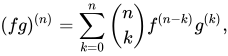
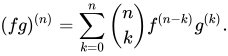
In calculus, the general Leibniz rule,[1] named after Gottfried Wilhelm Leibniz, generalizes the product rule (which is also known as "Leibniz's rule"). It states that if and are n-times differentiable functions, then the product is also n-times differentiable and its n-th derivative is given by
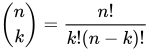
where is the binomial coefficient and denotes the jth derivative of f (and in particular ).
The formula can be generalized to the product of m differentiable functions f1,...,fm.
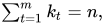
where the sum extends over all m-tuples (k1,...,km) of non-negative integers with and
are the multinomial coefficients. This is akin to the multinomial formula from algebra.
The proof of the general Leibniz rule proceeds by induction. Let and be -times differentiable functions. The base case when claims that:
which is the usual product rule and is known to be true. Next, assume that the statement holds for a fixed that is, that
Then,
And so the statement holds for , and the proof is complete.
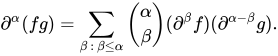
With the multi-index notation for partial derivatives of functions of several variables, the Leibniz rule states more generally:
This formula can be used to derive a formula that computes the symbol of the composition of differential operators. In fact, let P and Q be differential operators (with coefficients that are differentiable sufficiently many times) and Since R is also a differential operator, the symbol of R is given by:
A direct computation now gives:
This formula is usually known as the Leibniz formula. It is used to define the composition in the space of symbols, thereby inducing the ring structure.














![{\displaystyle {\begin{aligned}(fg)^{(n+1)}&=\left[\sum _{k=0}^{n}{\binom {n}{k}}f^{(n-k)}g^{(k)}\right]'\\&=\sum _{k=0}^{n}{\binom {n}{k}}f^{(n+1-k)}g^{(k)}+\sum _{k=0}^{n}{\binom {n}{k}}f^{(n-k)}g^{(k+1)}\\&=\sum _{k=0}^{n}{\binom {n}{k}}f^{(n+1-k)}g^{(k)}+\sum _{k=1}^{n+1}{\binom {n}{k-1}}f^{(n+1-k)}g^{(k)}\\&={\binom {n}{0}}f^{(n+1)}g^{(0)}+\sum _{k=1}^{n}{\binom {n}{k}}f^{(n+1-k)}g^{(k)}+\sum _{k=1}^{n}{\binom {n}{k-1}}f^{(n+1-k)}g^{(k)}+{\binom {n}{n}}f^{(0)}g^{(n+1)}\\&={\binom {n+1}{0}}f^{(n+1)}g^{(0)}+\left(\sum _{k=1}^{n}\left[{\binom {n}{k-1}}+{\binom {n}{k}}\right]f^{(n+1-k)}g^{(k)}\right)+{\binom {n+1}{n+1}}f^{(0)}g^{(n+1)}\\&={\binom {n+1}{0}}f^{(n+1)}g^{(0)}+\sum _{k=1}^{n}{\binom {n+1}{k}}f^{(n+1-k)}g^{(k)}+{\binom {n+1}{n+1}}f^{(0)}g^{(n+1)}\\&=\sum _{k=0}^{n+1}{\binom {n+1}{k}}f^{(n+1-k)}g^{(k)}.\end{aligned}}}](https://wikimedia.org/api/rest_v1/media/math/render/svg/195166910864530fea5b647df661b47df305b4b3)