


Salabhasana
.jpg)
Salabhasana or Purna Salabhasana[1] (Sanskrit: शलभासन; IAST: Śalabhāsana), Locust pose,[2] or Grasshopper pose[3] is a prone back-bending asana in modern yoga as exercise.[4]
Etymology and origins[edit]
The asana's name comes from the Sanskrit शलभा "shalabh" which means "grasshopper" or "locust".[5]
The pose is not found in the medieval hatha yoga texts. It is included in Yoga Ghamande's 1905 Yogasopana Purvacatuska, the first yoga manual with printed illustrations, uniquely as halftone plates.[6][7] It is described independently in Swami Vishnudevananda's 1960 Complete Illustrated Book of Yoga in the Sivananda Yoga tradition, and by B. K. S. Iyengar in his 1966 Light on Yoga, implying that it may have older origins.[8] A similar pose was found in Western gymnastics in The Bagot Stack Stretch-and-Swing System, 1931, though Mary Bagot Stack had visited India.[9]
-
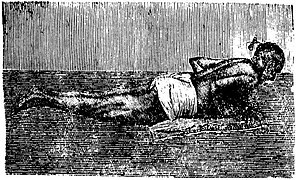 Salabhasana in Yogasopana Purvacatuska, 1905
 -
 A locust, Schistocerca gregaria, both head and 'tail' up
 -
 Mary Bagot Stack in "Seal" posture, 1931

.JPG)

Description[edit]
Salabhasana is entered from a prone position. The legs are stretched out straight and lifted; the arms are stretched straight back, palms down, and lifted; the head is lifted and the gaze is directed straight ahead.[5] It is a back bend, or spine stretch, utilizing the strength of the upper and middle back to lift the weight of the legs as high as possible from a starting position while face down on the floor. It improves flexibility and coordination, exercises the back muscles, and increases strength and stamina.[10]
Variations[edit]
Ardha Salabhasana (Half Locust Pose) raises one leg and the opposite arm at a time; the other arm may rest on the floor or be folded over the back.[11][12]
In Bikram Yoga, Salabhasana, following another reclining backbend, Bhujangasana or Cobra Pose, is performed in stages. First, the arms are placed under the body pointing straight towards the feet, palms downwards, and the chin is rested on the floor. Then the left and right legs are lifted alternately. Finally, both legs are lifted together.[13]
-
 Half Locust Pose, variant moving leg only
 -
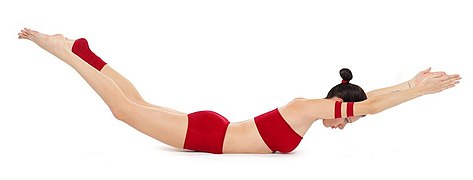 Variant arm position


References[edit]
- ^ Locust Pose. Yoga Journal. August 1996. p. 14.
- ^ "Locust Pose". Yoga Journal. Retrieved 11 April 2011.
- ^ Yesudian, Selvarajan; Haich, Elisabeth (January 1953). Yoga and health. Harper. p. 139.
- ^ Salabhasana http://yoganga.com/articles/salabhasana/
- ^ a b Mehta 1990, p. 92.
- ^ Ghamande, Narayana (1905). Yogasopana Purvacatuska (in Marathi). Janardan Mahadev Gurjar, Niranayasagar Press. p. 65.
- ^ Diamond, Debra; Aitken, Molly Emma (2013). Yoga: The Art of Transformation. Smithsonian Institution. p. 286. ISBN 978-1-58834-459-5.
- ^ Sjoman, Norman E. (1999) [1996]. The Yoga Tradition of the Mysore Palace (2nd ed.). Abhinav Publications. p. 88. ISBN 81-7017-389-2.
- ^ Stack, Mary Bagot (1931). Building the Body Beautiful, the Bagot Stack Stretch-and-Swing System. Chapman and Hall.
- ^ Stiles, Mukunda (2000). Structural Yoga Therapy: Adapting to the Individual. Red Wheel. ISBN 1-57863-177-7.
- ^ Pratap, Vijayendra (1997). Beginning Yoga. Tuttle Publishing. p. 26. ISBN 978-0-8048-2104-9.
- ^ Mohanty. Managing Common Musculoskeletal Conditions by Physiotherapy & Yoga. Jaypee Brothers Publishers. p. 15. ISBN 978-81-8448-357-4.
- ^ "Salabhasana | Locust". BYC. Retrieved 2 January 2019. (Three web pages)
Further reading[edit]
- Iyengar, B. K. S. (1 October 2005). Illustrated Light on Yoga. HarperCollins. ISBN 978-81-7223-606-9.
- Mehta, Silva; Mehta, Mira; Mehta, Shyam (1990). Yoga: The Iyengar Way. Dorling Kindersley.
{{cite book}}: CS1 maint: multiple names: authors list (link) - Saraswati, Swami Satyananda (1 August 2003). Asana Pranayama Mudra Bandha. Nesma Books India. ISBN 978-81-86336-14-4.
_from_Jogapradipika_1830_(cropped).jpg)
| Topics |
|  | ||||||||||||
|---|---|---|---|---|---|---|---|---|---|---|---|---|---|---|
| History |
| |||||||||||||
| Schools (Gurus) |
| |||||||||||||
| Related | ||||||||||||||