


Lotus position


Lotus position or Padmasana (Sanskrit: पद्मासन, romanized: padmāsana)[1] is a cross-legged sitting meditation pose from ancient India, in which each foot is placed on the opposite thigh. It is an ancient asana in yoga, predating hatha yoga, and is widely used for meditation in Hindu, Tantra, Jain, and Buddhist traditions.
Variations include easy pose (Sukhasana), half lotus, bound lotus, and psychic union pose. Advanced variations of several other asanas including yoga headstand have the legs in lotus or half lotus. The pose can be uncomfortable for people not used to sitting on the floor, and attempts to force the legs into position can injure the knees.[2]
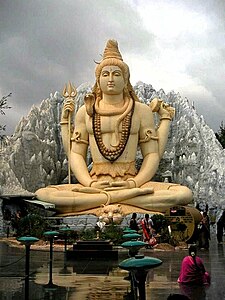
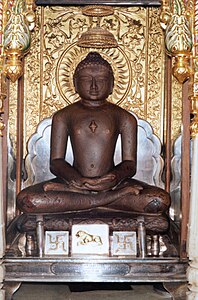
Shiva, the meditating ascetic God of Hinduism, Gautama Buddha, the founder of Buddhism, and the Tirthankaras in Jainism have been depicted in the lotus position, especially in statues. The pose is emblematic both of Buddhist meditation and of yoga, and as such has found a place in Western culture as a symbol of healthy living and well-being.
Etymology and history[edit]

The name Padmasana is from the Sanskrit पद्म Padma, "lotus" and आसन, Āsana, "posture" or "seat".[4][5] In Asian cultures,[6] the sacred lotus is used as a symbol of growth towards perfection and enlightenment as it is rooted in the mud at the bottom of the pond, but rises and blooms above the water.[7] In Chinese and Tibetan Buddhism, the pose is also called the "vajra position" (Skt. vajrāsana, Ch. 金剛座 jīngāngzuò).[8][9]
The pose is ancient and is described, along with other asanas (sitting postures), in the 8th century book Patanjalayogashastravivarana.[10] A figure seated in lotus position on a lotus flower is shown on dinar coins of Chandragupta II, who reigned c. 380–c. 415 AD.[11] The first tantric text to discuss posture (asana), the 6th-10th century Nisvasattvasamhita Nayasutra (4.11-17, 4.104-106), directs the meditator and "user of mantras" to sit in lotus or a similar posture.[12] The 15th century Hatha Yoga Pradipika states that the pose destroys all diseases, and that a yogin in the pose who retains the air breathed in through the nadi channels attains liberation.[13]
Sukhasana is from Sanskrit सुख sukha, meaning "pleasure" or "ease".[14] The 19th century Sritattvanidhi describes and illustrates the pose.[15] The name, and the more general name Yogasana ("Yoga pose") which may denote a variety of sitting poses, is found in much older documents as a meditation seat, such as in the 4th century Darshana Upanishad.[16]
Position[edit]
From sitting cross-legged on the floor (Sukhasana), one foot is placed on top of the opposite thigh with its sole facing upward and heel close to the abdomen. The other foot is then placed on the opposite thigh as symmetrically as possible.[4] The pose requires "very open hips".[17] It can be modified using a support such as a cushion or blanket; by sitting on its forward edge, the pelvis is tilted forward.[18][19]
Variations[edit]
Sukhasana (Sanskrit: सुखासन, romanized: Sukhāsana), Easy Pose, has the legs simply crossed in front of the body.[20][21]
In half lotus, अर्ध पद्मासन (Ardha Padmasana), one leg is bent and resting on the ground, the other leg is bent with the foot in lotus position. It is an easier meditation position than full lotus.[22]
In bound lotus, बद्ध पद्मासन (Baddha Padmasana), the practitioner sits in full lotus, and each hand reaches around the back to grasp the opposite foot.[23]
For psychic union pose, यओगमुद्रासन (Yogamudrasana), the practitioner bends forward in full lotus, bringing the forehead as close to the floor as possible.[24] The pose is both an asana and a mudra; easier variants begin from Ardha Padmasana.[25]
Variations of several other asanas such as Sirsasana (yoga headstand), Sarvangasana (shoulderstand), Simhasana (lion pose), Matsyasana (fish pose), and Gorakshasana (cowherd pose) have the legs in lotus.[26] Asanas such as Vatayanasana (horse pose) and advanced forms of Ardha Matsyendrasana (half lord of the fishes pose) have one leg as in half lotus.[27]
-
 Sukhasana, easy pose
 -
 The sage Bharadvaja meditating in half lotus. 19th century
 -
 Baddha Padmasana
 -
 Yogamudrasana
 -
 Padma Sirsasana, lotus headstand

.jpg)


.jpg)
Effects[edit]
Lotus is one of the yoga poses that most commonly causes injury.[2][28] Attempts to force the legs into lotus pose can injure the knees by squeezing and damaging the medial meniscus cartilage; this is painful and takes a long time to heal. The hip joints must rotate outwards approximately 115 degrees to permit full lotus. Students who cannot achieve this much hip rotation may try to compensate by bending the knee joint sideways, risking injury. Rather than bending the knee, the thighs can be encouraged to rotate outwards (using hand pressure or a strap).[29]
The yoga guru B. K. S. Iyengar notes that people unused to sitting on the floor will initially feel "excruciating" pain in the knees, but that this subsides with practice, until the pose becomes relaxing, both restful and alert and hence ideal for pranayama.[30]
Twentieth century advocates of some schools of yoga, such as Iyengar, made claims for the effects of yoga on specific organs, without adducing any evidence.[31][32] Iyengar claimed that Padmasana encourages blood circulation in the abdomen and lumbar region, toning the spine and abdominal organs.[33]
In art and culture[edit]
Asian art[edit]
In Buddhism, statues of the founder, Gautama Buddha, sometimes depict him seated in lotus position and enthroned on a lotus flower.[34][35][36] In Hinduism, statues often depict gods, especially Shiva, meditating in Padmasana.[37] In Bali, a Padmasana is also a type of Hindu shrine, named for the posture.[38][39] In Jainism, seated Tirthankaras are represented in Lotus posture.[40]
-

-
-
-
 A Padmasana shrine, here of Pura Jagatnatha in Denpasar, Bali


.jpg)
Western culture[edit]
The scholar of religion Thomas Tweed wrote in 2008 that "the prevailing image of Buddhist practice has been the solitary meditator, eyes half closed, sitting in the lotus position."[41] Ian Fleming's 1964 novel You Only Live Twice has the action hero James Bond visiting Japan, where he "assiduously practised sitting in the lotus position."[42] The critic Lisa M. Dresner notes that Bond is mirroring Fleming's own struggles with the pose.[43] The BBC journalist Megan Lane commented in 2003 that since yoga as exercise had become mainstream, lotus position (like tree pose) had been used by advertisers to sell "all manner of goods and services."[44] She noted that both "healthy living"[44] goods such as vitamins, fitness clubs, water filter and probiotic yogurt, and unrelated items such as cars, airlines, financial services "and even beer"[44] have made use of images of yoga to convey a message of well-being.[44] Poland's Obory Dairy gave its advertising agency the goal of creating awareness of their "Jogi" yogurt as exclusive and with a positive image. The agency responded with a photograph of two young women meditating in lotus pose at dawn under the heading "Start your day with Jogi", the brand name also meaning "yoga" in Polish.[45]
See also[edit]
- Kukkutasana, cockerel pose, a balancing asana with the hands threaded through the folded legs of Padmasana
- List of asanas
- Maravijaya
- Padmasana (shrine)
- Zazen
References[edit]
- ^ Budilovsky, Joan; Adamson, Eve (2000). The complete idiot's guide to yoga (2 ed.). Penguin. p. 204. ISBN 978-0-02-863970-3.
- ^ a b Acott, Ted S.; Cramer, Holger; Krucoff, Carol; Dobos, Gustav (2013). "Adverse Events Associated with Yoga: A Systematic Review of Published Case Reports and Case Series". PLOS ONE. 8 (10): e75515. Bibcode:2013PLoSO...875515C. doi:10.1371/journal.pone.0075515. ISSN 1932-6203. PMC 3797727. PMID 24146758.
- ^ Baillie, Allan; Ostro, Suzanne (1999). "The Lotus". Tricycle, the Buddhist Review. 8 (3, Spring 1999). Retrieved 11 April 2020.
- ^ a b Iyengar 1991, pp. 129–133.
- ^ Zimmer, Heinrich Robert (2015). Myths and Symbols in Indian Art and Civilization. Princeton University Press. pp. 100, 220. ISBN 978-1-4008-6684-7. Archived from the original on 6 September 2017.
- ^ Devendra, D. T. (1969). "Lotus without Symbolism". The Journal of the Ceylon Branch of the Royal Asiatic Society of Great Britain & Ireland. 13: 83–92. JSTOR 43483467.
- ^ Temple 2007, p. Chapter 1, The Symbolism of the Lotus Flower.
- ^ Hua, Hsuan (2004). The Chan handbook: talks about meditation (PDF). Buddhist Text Translation Society. p. 36. ISBN 0-88139-951-5. Archived from the original (PDF) on 28 March 2012. Retrieved 17 December 2018.
- ^ Rinpoche, Patrul; Padmakara Translation Group (trans.) (1998). Words of My Perfect Teacher: A Complete Translation of a Classic Introduction to Tibetan Buddhism (Revised ed.). AltaMira Press. p. 440.
- ^ Mallinson & Singleton 2017, p. 97.
- ^ Los Angeles County Museum of Art; Pal, Pratapaditya (1986). Indian Sculpture: Circa 500 B.C.-A.D. 700. University of California Press. p. 110. ISBN 978-0-520-05991-7.
Reverse: Goddess, nimbate, sitting en face on lotus with legs folded in lotus position. Diadem or noose in right hand, lotus flower turned towards her in left. .. Legend: Śrī-vikramaḥ (the courageous one).
- ^ Mallinson & Singleton 2017, pp. 99–100.
- ^ Mallinson & Singleton 2017, p. 111.
- ^ Joshi, K. S. (1991). Yogic Pranayama: Breathing for Long and Good Health. Orient Paperbacks. p. 45. ISBN 978-81-222-0089-8.
- ^ Sjoman, Norman E. (1999) [1996]. The Yoga Tradition of the Mysore Palace (2nd ed.). Abhinav Publications. pp. 80, 89, 96. ISBN 81-7017-389-2.
- ^ Larson, Gerald James; Bhattacharya, Ram Shankar (2008). Yoga : India's Philosophy of Meditation. Motilal Banarsidass. pp. 479, 599. ISBN 978-81-208-3349-4.
- ^ Powers, Sarah (2008). Insight Yoga. Shambhala. p. 181. ISBN 978-1-59030-598-0. OCLC 216937520.
- ^ Mehta, Silva; Mehta, Mira; Mehta, Shyam (1990). Yoga: The Iyengar Way. Dorling Kindersley. p. 54. ISBN 978-0863184208.
{{cite book}}: CS1 maint: multiple names: authors list (link) - ^ Pynt, Jenny; Higgs, Joy (2010). A History of Seating, 3000 BC to 2000 AD: Function Versus Aesthetics. Cambria Press. p. 101, note 18. ISBN 978-1-60497-718-9.
- ^ Costello, Nikki (25 March 2013). "Sukhasana Isn't All Easy". Yoga Journal. Retrieved 17 November 2022.
- ^ Maharsi, Ramana (1962). The teachings of Bhagavan Sri Ramana Maharshi in his own words. Rider. p. 134.
- ^ Swami Satyananda Saraswati (1996). Asana Pranayama Mudra Bandha (PDF). Munger, Bihar, India: Yoga Publications Trust. p. 97. ISBN 978-81-86336-14-4. Archived from the original (PDF) on 7 August 2015. Retrieved 11 November 2018.
- ^ Sjoman, Norman E. (1999) [1996]. The Yoga Tradition of the Mysore Palace (2nd ed.). Abhinav Publications. p. Plate 6. ISBN 81-7017-389-2.
- ^ Saraswati 2004, pp. 182–183.
- ^ Vishnudevananda (1988). The Complete Illustrated Book of Yoga. New York: Crown Trade Paperbacks. pp. plates 128–129. ISBN 978-0-517-88431-7. OCLC 32442598.
- ^ Iyengar 1991, pp. 137–139, 142–143, 204–206, 230–237.
- ^ Iyengar 1991, pp. 98–99, 270–276.
- ^ Penman, Stephen; Stevens, Philip; Cohen, Marc; Jackson, Sue (2012). "Yoga in Australia: Results of a national survey". International Journal of Yoga. 5 (2): 92–101. doi:10.4103/0973-6131.98217. ISSN 0973-6131. PMC 3410203. PMID 22869991.
- ^ Cole, Roger (5 February 2019) [2007]. "How to Protect the Knees in Lotus and Related Postures". Yoga Journal.
- ^ Iyengar 1991, p. 131.
- ^ Newcombe 2019, pp. 203–227, Chapter "Yoga as Therapy".
- ^ Jain 2015, pp. 82–83.
- ^ Iyengar 1991, pp. 131–132.
- ^ "Buddhas Crossed Legged Position - Lotus Position". Asian Art. Retrieved 11 April 2020.
One of the most popular seated positions of Lord Buddha is crossed legged position. In various Buddhism traditions like Mahayana and Theravada Buddhism, Lord Buddha is often shown with his ankles tucked and different hand and fingers position. The seated Crossed legged position is known as Lotus position.
- ^ "Lotus-Enthroned Buddha Akshobhya, the Transcendent Buddha,8th–early 9th century". Metropolitan Museum of Art. Retrieved 2 August 2019.
- ^ "Representation of: Buddha (Śākyamuni/Gotama/Shaka)". British Museum. Retrieved 2 August 2019.
- ^ Dehejia, Vidya (February 2007). "Recognizing the Gods". Metropolitan Museum of Art.
- ^ Auger, Timothy (2001). Bali & Lombok. Eyewitness Travel Guides. London: Dorling Kindersley. pp. 26, 46–47. ISBN 0751368709.
- ^ Eiseman, Fred B. Jr. (2011). Bali – Sekala and Niskala: Essays on religion, ritual, and art. Tuttle Publishing. p. 266. ISBN 978-1462900923.
- ^ Wiley, Kristi L. (2004). Historical Dictionary of Jainism. Scarecrow Press. p. 98. ISBN 978-0-8108-6558-7.
Tirthankaras are depicted in only two postures: seated in the classic lotus position (padmasana), which represents the Tirthankara preaching in the assembly hall (samavasarana), and standing in the kayotsarga posture, which represents abandoning the body.
- ^ Tweed, Thomas A. (2008). "Why are Buddhists so nice? Media representations of Buddhism and Islam in the United States since 1945". Material Religion. 4 (1): 91–93. doi:10.2752/175183408X288168. S2CID 192174202.
- ^ Fleming, Ian (2012) [1964]. You Only Live Twice. Random House. p. 10. ISBN 9781448139361.
- ^ Dresner, Lisa M. (2016). ""Barbary Apes Wrecking a Boudoir": Reaffirmations of and Challenges to Western Masculinity in Ian Fleming's Japan Narratives". The Journal of Popular Culture. 49 (3): 627–645. doi:10.1111/jpcu.12422. ISSN 0022-3840.
- ^ a b c d Lane, Mega (9 October 2003). "The tyranny of yoga". BBC.
- ^ Lee, Monle; Johnson, Carla (2005). Principles of Advertising: A Global Perspective. Psychology Press. pp. 213–215. ISBN 978-0-7890-2300-1.
Sources[edit]
- Iyengar, B. K. S. (1991) [1966]. Light on Yoga. Unwin Paperbacks. ISBN 978-1855381667.
- Jain, Andrea (2015). Selling Yoga : from Counterculture to Pop culture. Oxford University Press. ISBN 978-0-19-939024-3. OCLC 878953765.
- Mallinson, James; Singleton, Mark (2017). Roots of Yoga. Penguin Books. ISBN 978-0-241-25304-5. OCLC 928480104.
- Newcombe, Suzanne (2019). Yoga in Britain: Stretching Spirituality and Educating Yogis. Bristol, England: Equinox Publishing. ISBN 978-1-78179-661-0.
- Saraswati, Satyananda (January 2004). A Systematic Course in the Ancient Tantric Techniques of Yoga and Kriya. Nesma Books India. ISBN 978-81-85787-08-4.
- Temple, Anton (2007). Becoming the lotus: a systematic course of stretching and posture leading to the safe and comfortable adoption of the lotus posture, including a guide to the symbolism and spiritual meaning behind the lotus flower. Merkur. ISBN 978-1-885928-18-4.
External links[edit]

_from_Jogapradipika_1830_(cropped).jpg)
| Subtle body |  | |
|---|---|---|
| Texts (Asanas) |
| |
| Mudras | ||
| Shatkarmas | ||
| Pranayama | ||
| Related | ||
| Topics |
|  | ||||||||||||
|---|---|---|---|---|---|---|---|---|---|---|---|---|---|---|
| History |
| |||||||||||||
| Schools (Gurus) |
| |||||||||||||
| Related | ||||||||||||||