


William Crookes
William Crookes | |
|---|---|
 Crookes in 1906 | |
| Born | 17 June 1832 London, England, UK |
| Died | 4 April 1919 (aged 86) London, England, UK |
| Nationality | English |
| Citizenship | British |
| Alma mater | Royal College of Chemistry Imperial College London |
| Known for | Plasma Scintillator Spinthariscope Thallium Gemstone irradiation Crookes tube Crookes radiometer |
| Awards | Royal Medal (1875) Davy Medal (1888) Albert Medal (1899) Copley Medal (1904) Elliott Cresson Medal (1912) |
| Scientific career | |
| Fields | Physical chemistry |
Sir William Crookes OM FRS (/krʊks/; 17 June 1832 – 4 April 1919) was a British chemist and physicist who attended the Royal College of Chemistry,[1] now part of Imperial College London, and worked on spectroscopy. He was a pioneer of vacuum tubes, inventing the Crookes tube which was made in 1875. This was a foundational discovery that eventually changed the whole of chemistry and physics.
He is credited with discovering the element thallium, announced in 1861, with the help of spectroscopy. He was also the first to describe the spectrum of terrestrial helium, in 1865. Crookes was the inventor of the Crookes radiometer but did not discern the true explanation of the phenomenon he detected. Crookes also invented a 100% ultraviolet blocking sunglass lens. For a time, he was interested in spiritualism and became president of the Society for Psychical Research.
Biography
[edit]Crookes's life was one of unbroken scientific activity that extended over sixty-seven years. He was considered remarkable for his industriousness and for his intellectual qualities.[2] His experiments in chemistry and physics were known for the originality of their design,[3] and he is considered a "superb experimentalist".[4] His interests, ranging over pure and applied science, economic and practical problems, and psychic research, made him a well-known personality and earned him a substantial income. He received many public and academic honours.[2][3]
Early years
[edit]William Crookes was born in London in 1832, the eldest of eight surviving children (eight others died young) of Joseph Crookes (1792–1889), a wealthy tailor and real estate investor of north-country origin, and his second wife, Mary (née Scott; 1806–1884).[5][6] Joseph Crookes's father, William (1734–1814), was also a tailor, whose grandfather, John Crookes (b. 1660), had been Mayor of Hartlepool, County Durham on three occasions.[7]
Joseph Crookes had had five children with his first wife; two sons from that marriage, Joseph and Alfred, took over the tailoring business, leaving William free to choose his own path.[7] In 1848, at age 16, Crookes entered the Royal College of Chemistry (now the Imperial College chemistry department) to study organic chemistry. Crookes lived with his parents about three miles from the College in Oxford Street. His father's shop was about half a mile away. Crookes paid £25 for his first year's tuition and had to provide his own apparatus and some of the more expensive chemicals. At the end of his first year, Crookes won the Ashburton scholarship which covered his second year's tuition. At the end of his second year, Crookes became a junior assistant to August Wilhelm von Hofmann, doing laboratory demonstrations and helping with research and commercial analysis. In October 1851, Crookes was promoted to senior assistant, a position he held until 1854.[3]: 8–10
Although Crookes revered Hofmann, he did not share his primary interest in organic chemistry.[3] One of Crookes's students was the Reverend John Barlow, Secretary of the Royal Institution, who chose to take a course in analytical chemistry. Through Barlow, Crookes met scientists such as George Gabriel Stokes and Michael Faraday.[3]: 11 Such friends reinforced Crookes's interest in optical physics[3]: 13 which was respected by Hofmann.[3]: 12–13 By 1851, Crookes's interest in photography and optics caused his father to build him a laboratory in the garden at home for his research.[3]: 8
When Crookes embarked upon original work, it wasn't in organic chemistry, but rather into new compounds of selenium. These were the subject of his first published papers, in 1851. He worked with Manuel Johnson at the Radcliffe Observatory in Oxford in 1854, where he adapted the recent innovation of wax paper photography to machines built by Francis Ronalds to continuously record meteorological parameters.[8] In 1855 he was appointed lecturer in chemistry at the Chester Diocesan Training College.[9]
In April 1856 Crookes married Ellen, daughter of William Humphrey of Darlington.[1] Since staff at Chester were required to be bachelors, he had to resign his position. William's father, Joseph Crookes, gave the couple a house at 15 Stanley Street, Brompton. Ellen's mother, Mrs. Humphrey, lived with them for the rest of her life, nearly forty years. A devoted couple, William and Ellen Crookes had six sons and three daughters. Their first child, Alice Mary (born 1857, later Mrs. Cowland) remained unmarried for forty years, living with her parents and working as an assistant to her father. Two of Crookes's sons became engineers, and two lawyers.[3]
Married and living in London, Crookes sought to support his new family through independent work as a photographic chemist.[3] In 1859, he founded the Chemical News, a science magazine which he edited for many years and conducted on much less formal lines than was usual for the journals of scientific societies. Between 1864 and 1869, he was also involved with the Quarterly Journal of Science. At various times he edited the Journal of the Photographic Society and the Photographic News.[3]
Middle years
[edit]
Crookes was effective in experimentation. The method of spectral analysis, introduced by Bunsen and Kirchhoff, was received by Crookes with great enthusiasm and to great effect.[2][3][10][11][12]


7(Tl, Ag)Se
4), named for Crookes
His first important discovery was that of the element thallium, made with the help of flame spectroscopy. Crookes discovered a previously unknown element with a bright green emission line in its spectrum. He named the element thallium, from Greek θαλλός, thallós, meaning "a green shoot or twig". Crookes's findings were published on 30 March 1861.[3][10][11][12][13][14][15]
Thallium was also independently discovered by Frenchman Claude Auguste Lamy, who had the advantage of access to large amounts of materials via his brother-in-law, Charles Frédéric Kuhlmann. Both Crookes and Lamy isolated the element in 1862.[10][16][17][18][12]
Crookes was elected a fellow of the Royal Society in 1863.[2][3][11] Crookes wrote a standard treatise on Select Methods in Chemical Analysis in 1871.[3]
In 1866, Adolf Erik Nordenskiöld identified a rare mineral from Skrikerum as a selenide of copper, thallium, and silver (Cu
7(Tl, Ag)Se
4), and named the mineral crookesite in honor of Sir William Crookes.[11][10]
Crookes developed the Crookes tube,[19] investigating cathode rays. He published numerous papers on spectroscopy and conducted research on a variety of minor subjects. In his investigations of the conduction of electricity in low pressure gases, he discovered that as the pressure was lowered, the negative electrode (cathode) appeared to emit rays (the so-called "cathode rays", now known to be a stream of free electrons, and used in cathode-ray display devices). As these examples indicate, he was a pioneer in the construction and use of vacuum tubes for the study of physical phenomena.[20] He was, as a consequence, one of the first scientists to investigate what is now called a plasma and identified it as the fourth state of matter in 1879.[21] He also devised one of the first instruments for studying nuclear radioactivity, the spinthariscope.[3][22][23][24]
-
 Portrait of William Crookes, age 18
 -
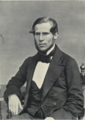 Portrait of William Crookes, age 24
 -
 Portrait of William Crookes, age 57
 -
 Portrait of Sir William Crookes, O.M., age 79
 -
 Sir William Crookes by Sir Leslie Ward, 1902




Crookes investigated the properties of cathode rays, showing that they travel in straight lines, cause fluorescence when they fall on some substances, and that their impact can produce great heat. He believed that he had discovered a fourth state of matter, which he called "radiant matter",[25] but his theoretical views on the nature of "radiant matter" were to be superseded.[26] He believed the rays to consist of streams of particles of ordinary molecular magnitude. It remained for Sir J. J. Thomson to expound on the subatomic nature of cathode rays (consisting of streams of negative electrons[27]). Nevertheless, Crookes's experimental work in this field was the foundation of discoveries which eventually changed the whole of chemistry and physics.[28]
Crookes's attention had been attracted to the vacuum balance in the course of his research into thallium. He soon discovered the phenomenon which drives the movement in a Crookes radiometer, in which a set of vanes, each blackened on one side and polished on the other, rotate when exposed to radiant energy. Crookes did not, however, provide the true explanation of this apparent "attraction and repulsion resulting from radiation".[29][30][31]

After 1880, Crookes lived at 7 Kensington Park Gardens in the fashionable area of Notting Hill. His household included a large multigenerational family and a number of servants. There all his later work was done, in what was then "the finest private laboratory in Britain". It comprised an entire floor of the house and included three interconnected laboratory rooms, for chemistry, physics, and mechanical construction, and a library. Crookes was able to purchase the house and build the laboratory because of his income from the National Guano Company and from various patents.[3]: 35
By 1880 Crookes employed a paid full-time scientific assistant (first Charles Gimingham and after 1883 James Gardiner). He was also helped by his daughter Alice, who was "adept at fractionating rare earth elements" and "no mean interpreter of spectra".[3]
His daily routine was to manage his commercial affairs in the morning, do further business or go to scientific meetings in the afternoon, eat dinner at 7, work in his library from 8 to 9, and then in the laboratory until after midnight. From his home, Crookes could easily reach the Chemical News offices, the Royal Society, the Chemica Society, and the Athenaeum Club.[3]
On 16 January 1884, Crookes's father died. Crookes's daughter Florence died of scarlet fever in the same week. Joseph Crookes's estate was left in trust, divided between his three surviving sons, Alfred, William and Frank. Combined with his previous income, this ensured that Crookes was very well off.[3]
In 1886, Crookes was elected as a member to the American Philosophical Society.[32]
Later years
[edit]
On 13 August 1894, John William Strutt, 3rd Baron Rayleigh and William Ramsay announced the detection of a new gas in the atmosphere. On 31 January 1895 they made a full report to the Royal Society on the new gas, argon. In addition, William Crookes, who had been asked to examine a sample, presented on the spectra of argon, reported that argon displayed two distinct spectra. In this way, Crookes identified the first known sample of terrestrial helium[33] and established its correspondence to observations of solar helium.[2] The discovery of argon and of helium led to identification of the noble gases and the reorganization of the periodic system.[33] Crookes himself suggested a design for a Periodic table in the style of a space lemniscate in 1898.[34][35][36] Crookes was knighted in 1897.[4]
Crookes was named president of the British Association for the Advancement of Science in 1898. In his inaugural address, he outlined in detail a coming catastrophe: The wheat-eating peoples of the world were going to start running out of food in the 1930s. The reason, he said, was a dearth of nitrogen fertilizer available from natural sources. Crookes called on chemists to develop new ways of making fertilizer from the enormous stock of nitrogen in the atmosphere (which is roughly 80 percent nitrogen). His remarks on the coming famine achieved wide distribution in the press and were turned into a popular book. Scientists addressing the problem in the first years of the twentieth century included Kristian Birkeland, whose technology helped found Norsk Hydro, and Fritz Haber and Carl Bosch, whose Haber–Bosch process forms the foundation of today's nitrogen fertilizer industry.[37]
In 1903[contradictory], Crookes turned his attention to the newly discovered phenomenon of radioactivity, achieving the separation from uranium of its active transformation product, uranium-X (later established to be protactinium).[38] Crookes observed the gradual decay of the separated transformation product, and the simultaneous reproduction of a fresh supply in the original uranium. At about the same time as this important discovery, he observed that when "p-particles", ejected from radio-active substances, impinge upon zinc sulfide, each impact is accompanied by a minute scintillation, an observation which forms the basis of one of the most useful methods in the detection of radioactivity.[39]
In 1913, Crookes[40] created an ultraviolet blocking lens[41][42] made from glass containing cerium,[43] but only lightly tinted.[44] They were an unintended by-product of Crookes's research to find a lens glass formulation that would protect glass workers from cataracts.[45] Crookes tested more than 300 formulations,[46] each numbered and labelled. Crookes Glass 246 was the tint recommended for glassworkers. The best-known Crookes tints are A (withdrawn due to its uranium), A1, B, and B2, which absorb all ultraviolet below 350 nm while darkening visual light. Crookes's samples were made by Whitefriars, London, stained glass makers, and Chance Brothers, Birmingham.[47][48][49][45]
Spiritualism
[edit]Crookes became interested in spiritualism in the late 1860s, and was most strongly involved around 1874–1875. Eric Deeson notes that Crookes's studies of the occult are related to his scientific work on radiometry in that both involved the detection of previously undiscovered forces.[50]
Crookes was possibly influenced by the death of his younger brother Philip in 1867 at 21 from yellow fever contracted while he was on an expedition to lay a telegraph cable from Cuba to Florida.[51][52] In 1867, influenced by Cromwell Fleetwood Varley, Crookes attended a séance to try to get in touch with his brother.[53][54]
Between 1871 and 1874, Crookes studied the mediums Kate Fox, Florence Cook, and Daniel Dunglas Home. After his investigation, he believed that the mediums could produce genuine paranormal phenomena and communicate with spirits.[55][56] Psychologists Leonard Zusne and Warren H. Jones have described Crookes as gullible as he endorsed fraudulent mediums as genuine.[57]

The anthropologist Edward Clodd noted that Crookes had poor eyesight, which may have explained his belief in spiritualist phenomena and quoted William Ramsay as saying that Crookes is "so shortsighted that, despite his unquestioned honesty, he cannot be trusted in what he tells you he has seen."[58] Biographer William Hodson Brock wrote that Crookes was "evidently short-sighted, but did not wear spectacles until the 1890s. Until then he may have used a monocle or pocket magnifying glass when necessary. What limitations this imposed upon his psychic investigations we can only imagine."[3]: 140
After studying the reports of Florence Cook, the science historian Sherrie Lynne Lyons wrote that the alleged spirit "Katie King" was at times Cook herself and at other times an accomplice. Regarding Crookes, Lyons wrote, "Here was a man with a flawless scientific reputation, who discovered a new element, but could not detect a real live maiden who was masquerading as a ghost".[59] Cook was repeatedly exposed as a fraudulent medium but she had been "trained in the arts of the séance" which managed to trick Crookes.[60] Some researchers such as Trevor H. Hall suspected that Crookes had an affair with Cook.[61][62][63][64][65]
In a series of experiments in London, England at the house of Crookes in February 1875, the medium Anna Eva Fay managed to fool Crookes into believing she had genuine psychic powers. Fay later confessed to her fraud and revealed the tricks that she had used.[66] Regarding Crookes and his experiments with mediums, the magician Harry Houdini suggested that Crookes had been deceived.[67] The physicist Victor Stenger wrote that the experiments were poorly controlled and "his desire to believe blinded him to the chicanery of his psychic subjects."[68]
In 1897, John Grier Hibben wrote that Crookes's idea of ether waves explaining telepathy was not a scientific hypothesis "he presents no facts to indicate its probability or to save it from being relegated to the sphere of bare conjecture."[69]
In 1916, William Hope tricked Crookes with a fake spirit photograph of his wife. Oliver Lodge revealed there had been obvious signs of double exposure, the picture of Lady Crookes had been copied from a wedding anniversary photograph, but Crookes was a convinced spiritualist and claimed it was genuine evidence for spirit photography.[3]: 474
The physiologist Gordon Stein suspected that Crookes was too ashamed to admit he had been duped by the medium Florence Cook or that he conspired with her for sexual favors. He also suggested that Crookes had conspired with Anna Eva Fay. He noted that contrary to popular belief, Hope had been exposed as a fraud on several occasions. Stein concluded that all feats of Hope were conjuring tricks.[70] In a review, biographer William Brock wrote that Stein made his "case against Crookes and Home clearly and logically."[71]
Crookes joined the Society for Psychical Research, becoming its president in the 1890s: he also joined the Theosophical Society and The Ghost Club,[51] of which he was president from 1907 to 1912.[3]: 440 In 1890 he was initiated into the Hermetic Order of the Golden Dawn.[72]
See also
[edit]References
[edit]- ^ a b Chisholm, Hugh, ed. (1911). . Encyclopædia Britannica. Vol. 7 (11th ed.). Cambridge University Press. pp. 501–502.
- ^ a b c d e Dyer, B.; Thorpe, T. E.; Harker, J. A.; Simmonds, C.; Perkin, F. Mollwo (1920). "Obituary notices: Sir William Crookes, O.M., 1832–1919; Thomas Fairley, 1843–1919; Walter William Fisher, 1842–1920; Antoine Paul Nicolas Franchimont, 1844–1919; Harold Cecil Greenwood, 1887–1919; Charles Edward Groves, 1841–1920; John Holmes, 1871–1919; Sir Boverton Redwood, Bart., 1846–1919; John Charles Umney, 1868–1919". J. Chem. Soc., Trans. 117: 444–472. doi:10.1039/CT9201700444.
- ^ a b c d e f g h i j k l m n o p q r s t u v w Brock, William H. (10 November 2016). William Crookes (1832–1919) and the Commercialization of Science. Routledge. pp. xxiii-. ISBN 978-1138259881. Retrieved 7 December 2019.
- ^ a b James, Frank A. J. L. (11 April 2009). "Champion of Victorian Science". Distillations. Science History Institute. Archived from the original on 6 March 2022. Retrieved 23 August 2018.
- ^ "William Crookes: Covert Resources and a Mentor, 1871–81. By the late Derek R. Guttery" (PDF).
- ^ "Crookes, Sir William (1832–1919), chemist and science journalist". Oxford Dictionary of National Biography (online ed.). Oxford University Press. 2004. doi:10.1093/ref:odnb/32639. (Subscription or UK public library membership required.)
- ^ a b William Crookes (1832–1919) and the Commercialization of Science, William H. Brock, Routledge, 2008; Routledge, pp. 3–4
- ^ Ronalds, B.F. (2016). Sir Francis Ronalds: Father of the Electric Telegraph. London: Imperial College Press. ISBN 978-1-78326-917-4.
- ^ Ruoff, Henry W. (1910). Masters of achievement; the world's greatest leaders in literature, art, religion, philosophy, science, politics and industry. Buffalo, N.Y.: The Frontier press company. p. 639. Retrieved 7 December 2019.
- ^ a b c d Marshall, James L. Marshall; Marshall, Virginia R. Marshall (2011). "Rediscovery of the elements: Thallium, Crookes, and Lamy" (PDF). The Hexagon: 62–67. Retrieved 30 December 2019.
- ^ a b c d Weeks, Mary Elvira (1956). The discovery of the elements (6th ed.). Easton, PA: Journal of Chemical Education.
- ^ a b c DeKosky, Robert K. (1973). "Spectroscopy and the Elements in the Late Nineteenth Century: The Work of Sir William Crookes". The British Journal for the History of Science. 6 (4): 400–423. doi:10.1017/S0007087400012553. JSTOR 4025503. S2CID 146534210.
- ^ Crookes, William (30 March 1861) "On the existence of a new element, probably of the sulphur group," Chemical News, vol. 3, pp. 193–194; reprinted in: Crookes, William (April 1861). "XLVI. On the existence of a new element, probably of the sulphur group". Philosophical Magazine. 21 (140): 301–305. doi:10.1080/14786446108643058.
- ^ Crookes, William (18 May 1861) "Further remarks on the supposed new metalloid," Chemical News, vol. 3, p. 303.
- ^ Crookes, William (19 June 1862) "Preliminary researches on thallium," Proceedings of the Royal Society of London, vol. 12, pages 150–159.
- ^ Lamy, A. (16 May 1862) "De l'existencè d'un nouveau métal, le thallium," Comptes Rendus, vol. 54, pages 1255–1262.
- ^ Weeks, Mary Elvira (1932). "The discovery of the elements: XVI. The rare earth elements". Journal of Chemical Education. 9 (10): 1751–1773. Bibcode:1932JChEd...9.1751W. doi:10.1021/ed009p1751.
- ^ Weeks, Mary Elvira (1932). "The discovery of the elements. XIII. Supplementary note on the discovery of thallium". Journal of Chemical Education. 9 (12): 2078. Bibcode:1932JChEd...9.2078W. doi:10.1021/ed009p2078.
- ^ The difference between "Crookes tubes" and "Geissler tubes" is this: In a Geissler tube the exhaustion is very much less than in a Crookes tube, the light which we see in the Geissler tube being due to the luminescence of the residual gas. (Transactions, Volume 9. Hertfordshire Natural History Society and Field Club. The Club, 1898. Page 136.)
- ^ Alexander E. Outerbridge, Jr., A Fourth State of Matter. Lecture delivered before the Franklin Institute, 17 February 1881. Journal of the Franklin Institute of the State of Pennsylvania, Volume 81. By Franklin Institute (Philadelphia, Pa.). Page 287+.
- ^ William Crookes, On Radiant Matter. Lecture delivered before the British Association for the Advancement of Science, at Sheffield, Friday, 22 August 1879. The Popular Science Monthly, Volume 16. D. Appleton, 1880. Pg157+
- ^ Crookes, W. Certain Properties of the Emanations of Radium. Chemical News; Vol. 87:241; 1903.
- ^ Frame, Paul W. "The Crookes Spinthariscope". Oak Ridge Associated Universities. Retrieved 11 October 2021.
- ^ Alfred Romer (1960). The Restless Atom: The Awakening of Nuclear Physics. Anchor Books. Retrieved 2 May 2013.
- ^ Radio-activity induced by the oscillatory discharge, or, The subsequent radio-active emanation from substances exposed to the Tesla oscillatory discharge. Harry Marshall Diemer, Ralph Stuart Cooper. Cornell University, 1903. Page 43+.
- ^ Chemist & Druggist, Volume 60. Benn Brothers., 1902. Pg 268.
- ^ Negatively electrified particles whose mass is only 1/1840 that of a hydrogen atom
- ^ Martz, Harry E.; Logan, Clint M.; Schneberk, Daniel J.; Shull, Peter J. (2016). X-ray imaging : fundamentals, industrial techniques, and applications. CRC Press. p. 27. ISBN 9780849397721. Retrieved 7 December 2019.
- ^ Crookes, William (1 January 1874). "On Attraction and Repulsion Resulting from Radiation". Philosophical Transactions of the Royal Society of London. 164: 501–527. doi:10.1098/rstl.1874.0015. S2CID 110306977..
- ^ Lebedew, Peter (1901). "Untersuchungen über die Druckkräfte des Lichtes". Annalen der Physik. 311 (11): 433–458. Bibcode:1901AnP...311..433L. doi:10.1002/andp.19013111102.
- ^ U.S. patent 182,172, Improvement in Apparatus For Indicating The Intensity of Radiation
- ^ "APS Member History". search.amphilsoc.org. Retrieved 24 May 2021.
- ^ a b Giunta, Carmen J. (2001). "Argon and the Periodic System: the Piece that Would not Fit". Foundations of Chemistry. 3 (2): 105–128. CiteSeerX 10.1.1.25.615. doi:10.1023/A:1011464516139. S2CID 92514263.
- ^ "Crookes' spiral periodic system". Science Museum Group. Retrieved 12 December 2019.
- ^ Leach, Mark R. "3-Dimensional Periodic Table formulations". Internet Database of Periodic Tables. Retrieved 12 December 2019.
- ^ "Periodic table in the style of a space lemniscate". Science History Institute. Retrieved 12 December 2019.
- ^ Hager, Thomas (2008). The Alchemy of Air. New York City: Three Rivers Press. pp. 3–11. ISBN 978-0-307-35179-1.
- ^ Burns, Peter C.; Finch, Robert J. (7 May 2018). Uranium : mineralogy, geochemistry and the environment. Mineralogical Society of America. p. 6. ISBN 9780939950508. Retrieved 7 December 2019.
- ^ Lincoln, Donald (2012). Understanding the universe : from quarks to the cosmos (Revisedition ed.). World Scientific. p. 26. ISBN 9789814374453.
- ^ "Crookes lens definition and meaning – Collins English Dictionary". www.collinsdictionary.com. Retrieved 3 June 2018.
- ^ Gardiner, J. H. (3 June 2018). "Sir William Crookes' anti-glare glasses". Transactions of the Optical Society. 24 (2): 102–103. Bibcode:1923TrOS...24..102G. doi:10.1088/1475-4878/24/2/310.
- ^ Brock, William Hodson (3 June 2018). William Crookes (1832-1919) and the Commercialization of Science. Ashgate Publishing, Ltd. ISBN 9780754663225. Retrieved 3 June 2018 – via Google Books.
- ^ "The College of Optometrists". museyeum.org. Retrieved 3 June 2018.
- ^ "Optical connnections: The work of Sir William Crookes – Optician". 3 June 2018. Archived from the original on 3 June 2018. Retrieved 3 June 2018.
- ^ a b "Out of the shade". 9 November 2015. Retrieved 3 June 2018 – via www.thetimes.co.uk.
- ^ "Coblentz, W. W.; Emerson, W. B. Glasses for protecting eyes from injurious radiations. (1st ed.) 1916-11-14" (PDF). NIST
- ^ "Sir William Crookes' U "Ultimate" Anti-Glare Formula OPHTHALMIC LENSES tinted lens samples set, Sir William Crookes Anti-Glare Glass Co Ltd; Melson Wingate Ltd – British Optical Association Museum – The College of Optometrists". museyeum.org. Retrieved 3 June 2018.
- ^ "The Ultra-Violet Limit of Chance's 'Crookes' Glasses Compared with White Spectacle Glass and Some Common Tinted Glasses – Chance Brothers & Co. Ltd Smethwick, Birmingham, England 1920s (Promotional chart reproducing in black and white a spectral chart comparing various types of glass used for ophthalmic lenses. Landscape format, printed on one side only of a single sheet of white paper.) – British Optical Association Museum – The College of Optometrists". museyeum.org. Retrieved 3 June 2018.
- ^ "Colorless crookes glass". google.com. Retrieved 3 June 2018.
- ^ Deeson, Eric (26 December 1974). "Commonsense and Sir William Crookes". New Scientist: 922–925.[permanent dead link]
- ^ a b Janet Oppenheim. (1988). The Other World: Spiritualism and Psychical Research in England, 1850–1914. Cambridge University Press. pp. 343–347. ISBN 978-0521265058
- ^ John Hannavy. (2007). Encyclopedia of Nineteenth-Century Photography. Routledge. p. 350. ISBN 978-0415972352 "Crookes' beloved younger brother had died in 1867 and the scientist hoped that spiritualism could provide a reunion. Although warned of the risk of ridicule, Crookes announced his intent to investigate mediums."
- ^ Sherrie Lynne Lyons. (2010). Species, Serpents, Spirits, and Skulls: Science at the Margins in the Victorian Age. State University of New York Press. p. 92. ISBN 978-1438427980 "Crookes appears to have been initially attracted to spiritualism when his youngest brother, whom he was quite close to, died of yellow fever. Brought up with the traditional Christian belief in the afterlife, Crookes was persuaded to attend a séance in 1867 to try to make contact with his brother."
- ^ Martyn Jolly. (2006). Faces of the Living dead: The Belief in Spirit Photography. Miegunyah Press. p. 30. ISBN 978-0712348997 "In 1867, he was devastated by the death of his much-loved youngest brother who, at the age of twenty-one. had caught yellow fever while laying a submarine telegraph cable in Cuba. At the time, Crookes was collaborating with a fellow electro-physicist Cromwell Fleetwood Varley, who was a pioneer of intercontinental telegraphy, as well as a clairvoyant. He persuaded Crookes to try to get in touch with his dead brother by spiritualist means."
- ^ Daniel Cohen. (1971). Masters of the Occult. Dodd, Mead & Company. p. 111. ISBN 978-0396064077
- ^ Andrew Neher. (2011). Paranormal and Transcendental Experience: A Psychological Examination. Dover Publications. p. 214. ISBN 978-0486261676 "William Crookes, the noted English physicist, had endorsed Catherine Fox as genuine... Crookes also endorsed several other mediums who were later exposed, including Anna Eva Fay (who was exposed more than once and who eventually explained how she duped Crookes), Florence Cook (who was the subject of more than one expose), and D. D. Home."
- ^ Leonard Zusne; Warren H. Jones. (2014). Anomalistic Psychology: A Study of Magical Thinking. Psychology Press. p. 216. ISBN 978-0-805-80508-6 "The fact is that William Crookes, although very good at physics experiments, was rather weak on drawing inferences and on theorizing. Besides, he was gullible. He endorsed several mediums in spite of their demonstrated trickery. Having witnessed a single seance with Kate Fox, he became convinced that the Fox sisters' rappings were genuine."
- ^ Edward Clodd. (1917). The Question: A Brief History and Examination of Modern Spiritualism. Grant Richards, London. p. 100
- ^ Sherrie Lynne Lyons. (2010). Species, Serpents, Spirits, and Skulls: Science at the Margins in the Victorian Age. State University of New York Press. p. 101. ISBN 978-1438427980
- ^ M. Lamar Keene. (1997). The Psychic Mafia. Prometheus Books. p. 64. ISBN 978-1573921619 "The most famous of materialization mediums, Florence Cook-- though she managed to convince a scientist, Sir William Crookes, that she was genuine-- was repeatedly exposed in fraud. Florence had been trained in the arts of the séance by Frank Herne, a well-known physical medium whose materializations were grabbed on more than one occasion and found to be the medium himself."
- ^ Trevor H. Hall. (1963). The Spiritualists: The Story of Florence Cook and William Crookes. Helix Press.
- ^ Brandon, Ruth (18 July 1985). "Unsavoury Spirits". New Scientist: 52.[permanent dead link]
- ^ Brandon, Ruth (16 June 1983). "Scientists and the Supernormal". New Scientist: 783–786.[permanent dead link]
- ^ John Sladek. (1974). The New Apocrypha: A Guide to Strange Sciences and Occult Beliefs. Panther. p. 194. ISBN 978-0586039748 "Crookes was forty-one, and his wife was pregnant with their tenth child. Florence was eighteen and pretty, and willing to spend considerable time at Crookes home, locked into a dark room alone with him, while beautiful apparitions were shown to him. The man Florence had secretly married, Captain Corner, put an unspiritual construction on the proceedings, and gave Crookes a beating. By 1875 the situation was becoming obvious to outsiders, who published hints that the next manifestation might be an infant phenomenon. As for the apparitions, no one but Crookes is reported to have ever seen them ... By 1880 Florence had been exposed as a fraud by Sir George Sitwell."
- ^ Amy Lehman. (2009). Victorian Women and the Theatre of Trance: Mediums, Spiritualists. McFarland. p. 158. ISBN 978-0786434794 Crookes took 44 photographs of "Katie King", in some of which he, or Florence Cook appear alongside her. He described in detail the physical differences between the spirit and her medium. The fact that some of these photographs, which still exist, show a Katie King who looks almost identical to Florence Cook calls Crookes's judgment, not to mention his veracity, into question. Skeptics at the time who were convinced that Florence was a fake thought that either Crookes was being completely hood-winked or that he had agreed to perpetrate the fraud with Florence. And the only explanation in either case had to be that Crookes was smitten with Florence—at the very least besotted with her and probably having an affair."
- ^ Massimo Polidoro. (2000). Anna Eva Fay: The Mentalist Who Baffled Sir William Crookes. Skeptical Inquirer 24: 36–38.
- ^ Harry Houdini. (2011, originally published 1924). A Magician Among the Spirits. Cambridge University Press. p. 205. ISBN 978-1108027489 "There is not the slightest doubt in my mind that this brainy man was hoodwinked, and that his confidence was betrayed by the so-called mediums that he tested. His powers of observation were blinded and his reasoning faculties so blunted by his prejudice in favor of anything psychic or occult that he could not, or would not, resist the influence."
- ^ Victor J. Stenger. (1990). Physics and Psychics: The Search for a World Beyond the Senses. Prometheus Books. pp. 156–157. ISBN 978-0-87975-575-1
- ^ Hibben, J. G. (1897). Review of Presidential Address to the Society for Psychical Research, by W. Crookes. Psychological Review 5: 362–387.
- ^ Stein, Gordon (1993). The sorcerer of kings : the case of Daniel Dunglas Home and William Crookes. Prometheus Books. ISBN 0-87975-863-5.
- ^ Brock, William. (1994). Was Crookes A Crook?. Nature 367: 422–422.
- ^ Alex Owen (2007). The Place of Enchantment: British Occultism and the Culture of the Modern. Chicago: University of Chicago Press. p. 70.
Further reading
[edit]- William Hodson Brock (2004). "Crookes, Sir William (1832–1919)". Oxford Dictionary of National Biography (online ed.). Oxford University Press. doi:10.1093/ref:odnb/32639. (Subscription or UK public library membership required.)
- Edmund Edward Fournier d'Albe (2011, originally published in 1923). The Life of Sir William Crookes. Cambridge University Press. ISBN 978-1-108-06159-9
External links
[edit]


- Works by William Crookes at Project Gutenberg
- Works by or about William Crookes at the Internet Archive
- Crookes's (1874) A practical handbook of dyeing and calico-printing Archived 29 July 2017 at the Wayback Machine – digital facsimile from the Linda Hall Library
| International | |
|---|---|
| National | |
| Academics | |
| Artists | |
| People | |
| Other | |

- 1832 births
- 1919 deaths
- 19th-century British chemists
- 19th-century British physicists
- 19th-century English people
- 20th-century British chemists
- 20th-century British physicists
- 20th-century English scientists
- Academics of the University of Chester
- Alumni of Imperial College London
- Burials at Brompton Cemetery
- Discoverers of chemical elements
- English physical chemists
- English physicists
- English spiritualists
- Fellows of the Royal Society
- Foreign associates of the National Academy of Sciences
- Knights Bachelor
- Members of the Order of Merit
- British parapsychologists
- People from Notting Hill
- People involved with the periodic table
- English plasma physicists
- Presidents of the Royal Society
- Recipients of the Copley Medal
- Royal Medal winners
- British scientific instrument makers
- Scientists from London
- Thallium
- Rare earth scientists
- Members of the American Philosophical Society