


Wisła Kraków
 | ||||
| Full name | Towarzystwo Sportowe Wisła Kraków Spółka Akcyjna[1] | |||
|---|---|---|---|---|
| Nickname(s) | Biała Gwiazda (The White Star) | |||
| Founded | 1906 | |||
| Ground | Henryk Reyman Stadium | |||
| Capacity | 33,326[2] | |||
| Owner |
| |||
| President | Jarosław Królewski | |||
| Manager | Mariusz Jop | |||
| League | I liga | |||
| 2023–24 | I liga, 10th of 18 | |||
| Website | www | |||
|
| ||||






Towarzystwo Sportowe Wisła Kraków Spółka Akcyjna, commonly referred to as Wisła Kraków (Polish pronunciation: [ˈviswa ˈkrakuf]), is a Polish professional football club based in Kraków. They currently compete in the I liga, the second level of Polish football league system, following relegation from the 2021–22 Ekstraklasa season. It ranks fourth in the number of national titles won (13), behind Górnik Zabrze, Ruch Chorzów (both on 14), and Legia Warsaw (15), and second in all-time victories. Wisła was founded in 1906 under the name TS Wisła (Polish: Towarzystwo Sportowe Wisła). The team plays its home matches at Henryk Reyman Stadium.
The club's coat of arms is a white star on a red background crossed by a blue ribbon.
Wisła Kraków was one of the most successful Polish football clubs of 2000s, winning eight league championships since 1999. Along with league titles, Wisła also won the Polish Cup on five occasions, including the first-ever edition in 1926, and are the current cup holders. Wisła also enjoyed some success in European competitions in the 1970s, reaching the quarter-finals in the 1978–79 European Cup.
History
[edit]
Wisła Kraków was founded in 1906 when students of the Second Practical School in Kraków, inspired by their professor Tadeusz Łopuszański, formed a football club.[3]
In this first, historic season of the League, the fight for the championship was decided between two teams: Wisła Kraków and 1. FC Kattowitz. This rivalry was treated very seriously, not only by the two sides involved, but also by the whole nation. 1. FC was regarded as the team supported by the German minority, while Wisła, at the end of this historic season, represented ambitions of all Poles.

Some time in the fall of 1927 in Katowice, an ill-fated game between 1.FC and Wisła took place. Stakes were very high – the winner would become the Champion. Kraków's side won 2–0 and became the Champion. 1.FC finished second, third was Warta Poznań.
During the German occupation of Poland (World War II), the club operated secretly. Co-founder Franciszek Brożek and pre-war player Adam Obrubański were among Poles murdered by the Russians in the large Katyn massacre in April–May 1940.[4]
In 1949, the club was renamed to Gwardia-Wisła Kraków. In 1955 the club returned to its original name, TS Wisła. In 1967, the club was once again renamed, to GTS Wisła, a name which held until 1990 when the club reverted to its original name, TS Wisła. In the late 1990s, the football section of the club was incorporated and was renamed Wisła Kraków SSA.
The club has had its ups and downs, winning national championships and earning European qualification. It was also relegated to the second division on three occasions. Since the football section has been bought by Tele-Fonika Kable S.A. in 1998, the team has been far and away the most successful club in Poland, winning seven national championships and finishing in second place three times, totalling ten top two finishes in 12 years.
At international level, Wisła has competed in all three of the European competitions. The club's greatest success came in the 1978–79 season, when Wisła was able to reach the quarter-finals of the European Cup, eventually to be knocked out by Malmö FF 3–5 on aggregate. Most recently, Wisła narrowly missed out on a chance to compete in the 2005–06 UEFA Champions League group stage, being defeated 4–5 by Panathinaikos after extra time.[5]
Wisła also twice reached the second round of the European Cup Winners' Cup in 1967–68 and 1984–85, falling 0–5 and 2–3 by Hamburger SV and Fortuna Sittard, respectively. The White Star has competed in the UEFA Cup ten times.
On 15 May 2022, Wisła was relegated to the I liga for the first time since 1996, after losing 4–2 against Radomiak Radom.[6]
On 2 May 2024, they won their fifth Polish Cup title after defeating Pogoń Szczecin 1–2 in extra time, becoming the fifth second division team to win this competition, and the first since Ruch Chorzów in 1996.[7] The White Star itself finished the 2023–24 season ranked 10th in the second tier.[8]
Stadium
[edit]Henryk Reyman Stadium is located at 22 Reymonta Street in Kraków. The stadium was originally built in 1953 and currently has a capacity of 33,326. The stadium was renovated in 2010, being upgraded to UEFA elite standards. The Wisła Stadium was also chosen as a reserve venue for the UEFA Euro 2012 tournament, jointly held in Poland and Ukraine. The record attendance of 45,000 at Wisła Stadium came on 29 September 1976 when Wisła defeated Celtic 2–0. The venue has been a fortress for Wisła, where the team is especially difficult to defeat. Wisła holds the all-time Polish football record for consecutive league home games without a loss. The streak began following a loss on 16 September 2001 to KSZO Ostrowiec Świętokrzyski, and ended more than five years later on 11 November 2006, when GKS Bełchatów defeated Wisła 4–2. The number of matches without a loss was then settled at 73, overcoming the former Polish record of 48 which belonged to Legia Warsaw. During the 2008–09 season, Wisła lost points at home only twice, drawing with ŁKS Łódź and being defeated by Lech Poznań.
-
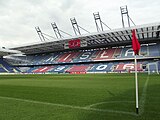 Stadium
 -
 Full view of the stadium
 -
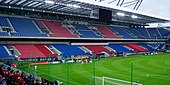 West Vip stand


Supporters and rivalries
[edit]
Fan friendlies
[edit]Wisła fans formerly had long friendships relations with Lechia Gdańsk and Śląsk Wrocław, known as the "Three Kings of Great Cities" alliance until 2016, when their alliance fell apart.[citation needed] They formed a new group with Ruch Chorzów and Widzew Łódź (and by extension Elana Toruń, Slovan Bratislava and KKS Kalisz), which divided Wisła fans.
The fans have an amicable relationship with Polonia Przemyśl. Although Garbarnia Kraków, Puszcza Niepołomice and Kmita Zabierzów have no organised fan movements they are known to have local Wisła fans attend their games. Kmita was founded initially as Wisła Zabierzów as a local branch of the Wisła sports club.
The club also has close relations with Italian side Lazio since their Rome derby match in 2016, as well private contacts with CSKA Moscow and VfL Bochum.
The fans formerly held relations with Unia Tarnów, Jagiellonia Białystok, Siarka Tarnobrzeg, Resovia Rzeszów and Zagłębie Wałbrzych.
Rivalries
[edit]With Cracovia
[edit].jpg)
The term "Holy War" refers to the intense rivalry between the two Kraków-based teams; Wisła and KS Cracovia. In 1906, the establishment of the two first Polish football clubs, Cracovia and Wisła, created a rivalry that now dates back more than 100 years. The term "Holy War" was first used to describe the rivalry of Kraków's Jewish teams, Makkabi and Jutrzenka. A Jutrzenka defender, Ludwik Gintel, who later joined the Cracovia side referred to the derby match against Wisła as the "Holy War". The phrase was incorporated into a song and has since been popular amongst both Wisła and Cracovia fans.
The first recorded Kraków Derby was contested on 20 September 1908, a 1–1 draw. A historic derby match between Cracovia and Wisła occurred on 8 May 1913. It was the first time Polish teams played a championship game officially sanctioned by FIFA; Cracovia won 2–1. The most famous derby took place in 1948 when after the first post-war season, both Cracovia and Wisła accumulated an even number of points and the championship had to be decided by an additional game played at a neutral venue. On 5 December 1948, Cracovia defeated Wisła 3–1 and was crowned national champions. As of May 2011, the Kraków derby game between Wisła and Cracovia has been contested 183 times, with Wisła winning 82 times, tying 42 times and Cracovia winning 59 times.
With Legia Warsaw
[edit].jpg)
The match contested between Wisła Kraków and Legia Warsaw, dubbed "The Derby of Poland", is commonly recognized as one of the greatest rivalries in Polish club football. Historically the two sides have been the most successful clubs in Poland, both in the top two in the all-time table. The rivalry between two of Poland's premier cities of Kraków and Warsaw sparks the rivalry even more. The regional differences of Kraków (south) and Warsaw (north), and the fact that Kraków used to be the capital of Poland before Warsaw (in the years 1038–1079 and 1138–1596) and the full official name of Kraków is Stołeczne Królewskie Miasto Kraków, or "Royal Capital City of Kraków" in English, also add a greater meaning to the match.
With Hutnik Kraków
[edit]The other Kraków derby is contested against Hutnik, historically the third team in Kraków representing Nowa Huta. Owing to Hutnik's lack of recent sporting success, the rivalry is mostly off-pitch and with Wisla's reserve team or in other sports sections of both clubs.
Other rivalries
[edit]Other rivalries are with Lech Poznań, Arka Gdynia and Tarnovia Tarnów, an extension of the fierce rivalry with Cracovia as all three maintain good friendships with them.
Fans of Zagłębie Sosnowiec, Korona Kielce, GKS Katowice, and Polonia Warsaw are also inter-regional fierce rivals.
Additional teams
[edit]In addition to the professional team, Wisła Kraków plays also in the Polish Junior league.[9]
Current squad
[edit]- As of 8 November 2024[10]
Note: Flags indicate national team as defined under FIFA eligibility rules; some limited exceptions apply. Players may hold more than one non-FIFA nationality.
|
|


Out on loan
[edit]Note: Flags indicate national team as defined under FIFA eligibility rules; some limited exceptions apply. Players may hold more than one non-FIFA nationality.
|
|
Coaching staff
[edit]| Manager |  Mariusz Jop Mariusz Jop
|
| Assistant coaches | Bartosz Bąk Kazimierz Kmiecik Michał Siwierski
|
| Fitness coach | Kazimierz Piechnik
|
| Goalkeeping coach | Łukasz Załuska
|
| Analyst | Krzysztof Siłka
|
| Physiotherapists | Bartłomiej Grzegorczyk Marcin Sapalski
|
| Team doctor | Mariusz Urban
|
| Team manager | Kamil Binda
|
| Kit manager | Jan Batko
|
Honours
[edit]Domestic
[edit]- ^ (In 1951 Wisła was league champion, however, the Polish Championship title was awarded to the Cup winner, Ruch Chorzów)
- Polish non-League Football Championship:
- I liga
- Champions : 1964–65
- Runners-up: 1985–86, 1988–89, 1995–96
- Galician Championship
- 2nd place: 1913
- Polish Cup
- Polish Super Cup
- Winners: 2001
- Runners-up: 1999, 2004, 2008, 2009
- Polish League Cup
- Winners : 2000–01
- Runners-up: 2001–02
Europe
[edit]- European Cup/UEFA Champions League
- Quarterfinal: 1978–79
- UEFA Cup/UEFA Europa League
- Round of 16: 2002–03
- European Cup Winners' Cup
- Intertoto Cup
Youth teams
[edit]- Młoda Ekstraklasa
- Champions: 2007–08
- Runners-up: 2008–09
- Polish U-19 Championship
- Champions: 1936, 1937, 1958, 1975, 1976, 1982, 1996, 1997, 2000, 2014
- Runners-up: 1938
- Polish U-17 Championship
- Champions: 2013
- Runners-up: 2003
Records
[edit]Team records
- Biggest win: 21–0 (8–0) – in Polish Championship elimination match with Pogoń Siedlce in Kraków, 24 August 1947.
- Highest home attendance: 45,000 – Wisła Kraków 2–0
 Celtic (UEFA Cup), 29 September 1976.
 - Highest home league attendance: 40,000 – Wisła Kraków 2–1 Legia Warszawa (Polish league), 7 August 1977.
- Debut in the league: 3 April 1927 in the first in league history.
- In the table of all time: 2nd place
- Consecutive matches without defeat in the league: 38 (25 October 2003 – 22 May 2005) – a record in the league
- Consecutive home matches without defeat: 73 (16 September 2001 – 11 November 2006) – a record in the league
- Biggest win in European competition:
 WIT Georgia Tbilisi 2:8 Wisła Kraków, in Georgia, 27 July 2004. Wisła Kraków 7–0
  Newtown, in Kraków, 29 July 1998.


Records individual
- Top scorer in the league:
 Kazimierz Kmiecik – 153 goals in 304 matches
 - Top scorer in the second league: Grzegorz Kaliciak – 32 goals
- Top scorer (total): Kazimierz Kmiecik – 181 goals in 350 matches
- Top scorer in European competition: Maciej Żurawski – 23 goals
- Most matches in European Cups: Marcin Baszczyński – 52 games
- Most meetings (total): Arkadiusz Głowacki – 461 games
- The youngest debut: Stefan Śliwa – 14 years, 268 days
- The oldest player: Marcin Wasilewski – 40 years 39 days
- Most matches in the Poland national team: Antoni Szymanowski – 65 games (a total of 82 games in the national team)
- Most goals in the Poland national team: Maciej Żurawski – 14 goals
- Top scorer in one season: Mieczysław Gracz and Maciej Żurawski – 38 goals (all meetings), Henryk Reyman – 37 goals (league only)
- All records
Wisła in European football
[edit]- Q = Qualifying
- PO = Play-Off
- Group = Group stage
- R32 = Round of 32
- QF = Quarter final


Best results in European competitions
[edit]| Season | Achievement | Notes | |
|---|---|---|---|
| European Cup/UEFA Champions League | |||
| 1978–79 | Quarter-final | lost to  Malmö 2–1 in Kraków, 1–4 in Malmö Malmö 2–1 in Kraków, 1–4 in Malmö
| |
| UEFA Cup Winners' Cup | |||
| 1967–68 | Round of 16 | lost to  Hamburger SV 0–1 in Kraków, 0–4 in Hamburg Hamburger SV 0–1 in Kraków, 0–4 in Hamburg
| |
| 1984–85 | Round of 16 | lost to  Fortuna Sittard 0–2 in Sittard, 2–1 in Kraków Fortuna Sittard 0–2 in Sittard, 2–1 in Kraków
| |
| UEFA Cup/UEFA Europa League | |||
| 2002–03 | Round of 16 | lost to  Lazio 3–3 in Rome, 1–2 in Kraków Lazio 3–3 in Rome, 1–2 in Kraków
| |
| UEFA Conference League | |||
| 2024–25 | Play-off | lost to  Cercle Brugge 1–6 in Kraków, 4–1 in Bruges Cercle Brugge 1–6 in Kraków, 4–1 in Bruges
| |
Notable players
[edit]Had international caps for their respective countries. Players whose name is listed in bold represented their countries while playing for Wisła.


Managerial history
[edit]Caretaker managers listed in italics.
 Imre Schlosser (1924–29)
 František Koželuh (1929–34)
- Vilmos Nyúl (1934–39)
- Otto Mazal-Skvajn (1939–46)
- Jan Kotlarczyk (1946–47)
- Artur Walter (1947–48)
- Josef Kuchynka (1948–50)
- Michał Matyas (1950–54)
- Mieczysław Gracz (1954–55)
- Artur Woźniak (1956–57)
- Josef Kuchynka (1958–59)
 Károly Kósa (1959–60)
- Karel Finek (1960–61)
- Mieczysław Gracz (1961–62)
- Karel Kolsky (1963–64)
- Czesław Skoraczyński (1964–67)
- Mieczysław Gracz (1967–69)
- Gyula Teleky (1969–70)
- Michał Matyas (1970–71)
- Marian Kurdziel (1971–72)
- Jerzy Steckiw (1972–74)
- Henryk Stroniarz (1974–75)
- Aleksander Brożyniak (1975–77)
- Orest Lenczyk (1977–79)
- Lucjan Franczak (1979–81)
- Wiesław Lendzion (1981–82)
- Roman Durniok (1982–83)
- Edmund Zientara (1983–84)
- Orest Lenczyk (1984–85)
- Stanisław Chemicz (1985)
- Lucjan Franczak (1985–86)
- Stanisław Cygan (1986–87)
- Aleksander Brożyniak (1987–89)
- Stanisław Chemicz (1989)
- Adam Musiał (1989)
- Bogusław Hajdas (1989)
- Adam Musiał (1990–92)
- Kazimierz Kmiecik (1992)
 Karol Pecze (1992–93)
- Marek Kusto (1993–94)
- Orest Lenczyk (1994)
- Marek Kusto (1994)
- Lucjan Franczak (1994–96)
- Kazimierz Kmiecik (1996)
- Henryk Apostel (1996–97)
- Kazimierz Kmiecik (1997)
- Wojciech Łazarek (1997–98)
- Jerzy Kowalik (1998)
- Franciszek Smuda (1998–99)
- Jerzy Kowalik (1999)
- Marek Kusto (1999–2000)
- Wojciech Łazarek (2000)
- Adam Nawałka (2000)
- Orest Lenczyk (2000–01)
- Adam Nawałka (2001)
- Franciszek Smuda (2001–02)
- Henryk Kasperczak (2002–04)
- Verner Lička (2004–05)
- Jerzy Engel (2005)
- Tomasz Kulawik (2005)
 Dan Petrescu (2005–06)
 Dragomir Okuka (2006)
- Adam Nawałka (2007)
- Kazimierz Moskal (2007)
- Maciej Skorża (2007–10)
- Henryk Kasperczak (2010)
- Tomasz Kulawik (2010)
 Robert Maaskant (2010–11)
- Kazimierz Moskal (2011–12)
- Michał Probierz (2012)
- Tomasz Kulawik (2012–13)
- Franciszek Smuda (2013–15)
- Kazimierz Moskal (2015)
- Marcin Broniszewski (2015–16)
- Tadeusz Pawłowski (2015–16)
- Marcin Broniszewski (2016)
- Dariusz Wdowczyk (2016)
- Kazimierz Kmiecik (2016)
 Kiko Ramírez (2017)
- Radosław Sobolewski (2017)
- Joan Carrillo (2018)
- Maciej Stolarczyk (2018–19)
- Artur Skowronek (2019–20)
 Peter Hyballa (2020–21)
- Kazimierz Kmiecik (2021)
- Adrián Guľa (2021–22)
- Jerzy Brzęczek (2022)[13]
- Radosław Sobolewski (2022–23)
- Mariusz Jop (2023)
- Albert Rudé (2023–24)
- Kazimierz Moskal (2024)
- Mariusz Jop (2024–present)

Other sections
[edit]Esports
[edit]Wisła Kraków also has an esports division, with teams in Counter-Strike: Global Offensive and FIFA 20.[14]
Women's basketball
[edit]The women's basketball section are one of the most successful clubs in the country, winning 25 national championships, 12 vice-championships, 13 Polish Cups and continental runners-up in 1970.
References
[edit]- ^ "Towarzystwo Sportowe Wisła Kraków Spółka Akcyjna" (in Polish). Ministry of Justice's Krajowy Rejestr Sądowy. Archived from the original on 26 March 2022. Retrieved 20 March 2022.
- ^ "Informacje - Wisła Kraków". Wisła Kraków (in Polish). Archived from the original on 26 March 2019. Retrieved 26 March 2019.
- ^ "Historia TS Wisła w pigułce". Towarzystwo Sportowe Wisła (in Polish). Archived from the original on 20 September 2020. Retrieved 26 March 2019.
- ^ Ciesielski, Kacper (2021). "Sportowcy wśród ofiar zbrodni katyńskiej oraz powiązane z nimi artefakty grobowe i archiwalia w zbiorach Muzeum Katyńskiego". Łambinowicki rocznik muzealny (in Polish). 44. Opole: 145, 147. ISSN 0137-5199.
- ^ "Kotsios completes comeback". UEFA. 24 August 2005. Archived from the original on 23 January 2017. Retrieved 26 March 2019.
- ^ "Spadamy z Ekstraklasy! Radomiak - Wisła 4-2". Wisła Portal (in Polish). 15 May 2022. Archived from the original on 6 July 2022. Retrieved 17 July 2022.
- ^ "Olbrzymia niespodzianka w finale Pucharu Polski. Wisła Kraków wygrała z Pogonią Szczecin [WIDEO]". sport.tvp.pl (in Polish). 2 May 2024. Archived from the original on 2 May 2024. Retrieved 2 May 2024.
- ^ "Szybka reakcja! Wisła Kraków wydała oświadczenie". www.polsatsport.pl (in Polish). 26 May 2024. Retrieved 27 May 2024.
- ^ "Drużyny - Wisła Kraków S.A." Wisła Kraków (in Polish). Archived from the original on 26 March 2019. Retrieved 16 June 2020.
- ^ "Drużyna - Wisła Kraków". Wisła Kraków (in Polish). Archived from the original on 26 March 2019. Retrieved 17 June 2019.
- ^ Miga, Mateusz (4 June 2024). "Kazimierz Moskal trenerem Wisły Kraków". sport.tvp.pl (in Polish). Retrieved 4 June 2024.
- ^ "Sztab trenerski Kazimierza Moskala" (in Polish). Wisła Kraków. 20 June 2024. Retrieved 2 July 2024.
- ^ "Jerzy Brzęczek nowym trenerem Białej Gwiazdy". Wisła Kraków. 14 February 202. Archived from the original on 14 February 2022. Retrieved 14 February 2022.
- ^ "Wisla All in Games". Archived from the original on 13 November 2021. Retrieved 3 November 2020.
External links
[edit]- Official website (in Polish and English)
- Official Wisla Supporters' website
- Wisła Kraków on Facebook
- Club history – Wisła encyclopedia


| International | |
|---|---|
| National | |
