


Arachne
| Arachnè | |
|---|---|
.jpg) Minerva and Arachne, by René-Antoine Houasse, 1706. | |
| In-universe information | |
| Species | Human, then spider |
| Gender | Female |
| Children | Closter |
| Relatives | Idmon (father) Phalanx (brother) |
| Birthplace | Lydia or Attica |
| Source | Metamorphoses, 8 AD |
Arachne (/əˈrækniː/; from Ancient Greek: Ἀράχνη, romanized: arákhnē, lit. 'spider', cognate with Latin araneus)[1] is the protagonist of a tale in Greek mythology known primarily from the version told by the Roman poet Ovid (43 BCE–17 CE), which is the earliest extant source for the story.[2] In Book Six of his epic poem Metamorphoses, Ovid recounts how the talented mortal Arachne challenged the goddess Athena to a weaving contest. When Athena could find no flaws in the tapestry Arachne had woven for the contest, the goddess became enraged and beat the girl with her shuttle. After Arachne hanged herself out of shame, she was transformed into a spider. The myth both provides an aetiology of spiders' web-spinning abilities and was a cautionary tale about hubris.
Biography[edit]
According to the myth as recounted by Ovid, Arachne was a Lydian maiden who was the daughter of Idmon of Colophon, who was a famous dyer in purple.[3] She was credited to have invented linen cloth and nets while her son Closter introduced the use of spindle in the manufacture of wool. She was said to have been a native of Hypaepa, near Colophon in Asia Minor.[4]
Mythology[edit]
Ovid[edit]

In Metamorphoses the Roman poet Ovid writes that Arachne was a shepherd's daughter who began weaving at an early age. She became a great weaver, boasted that her skill was greater than Athena's, and refused to acknowledge that her skill came, at least in part, from the goddess. Athena took offense and set up a contest between them. Presenting herself as an old lady, she approached the boasting girl and warned her that it was unwise to compare herself to any of the gods, and that she should plead for forgiveness from Athena.
Arachne was not disheartened, and boasted that if Athena wished to make her stop, she should appear in person and do it herself. Immediately, Athena removed her disguise and appeared in shimmering glory, clad in a sparkling white chiton. The two began weaving straight away. Athena's weaving represented four separate contests between mortals and the gods in which the gods punished mortals for setting themselves as equals of the gods. Arachne's weaving depicted ways that the gods, particularly Zeus, had misled and abused mortals, tricking, and seducing many women. When Athena saw that Arachne had not only insulted the gods but done so with a work far more beautiful than Athena's own, she was enraged. She ripped Arachne's work to shreds and hit her on the head three times with her shuttle. Shaken and embarrassed, Arachne took her life by hanging.
Seeing that, Athena felt pity for the girl, and transformed her into a spider, which would go on to create webs for all time, as would her descendants. Athena did so by sprinkling her with the juice of Hecate's herb,
[A]nd immediately at the touch of this dark poison, Arachne’s hair fell out. With it went her nose and ears, her head shrank to the smallest size, and her whole body became tiny. Her slender fingers stuck to her sides as legs, the rest is belly, from which she still spins a thread, and, as a spider, weaves her ancient web.[5]
The myth of Arachne can also be seen as an attempt to show relation between art and tyrannical power in Ovid's time. He wrote under the emperor Augustus and was exiled by him. At the time weaving was a common metaphor for poetry, therefore Arachne's artistry and Athena's censorship to it may offer a provocative allegory of the writer's role under an autocratic regime.[6]
The tapestries[edit]
Athena wove a tapestry with themes of hubris being punished by the gods, as a warning to Arachne against what she was doing, in each of its four corners. Those were Hera and Zeus transforming Rhodope and Haemus into the eponymous mountain ranges, Hera transforming Queen Gerana into a crane for daring to boast of being more beautiful than the queen of the gods, Hera again turning Antigone of Troy into a stork for competing with her, and finally Cinyras' daughter being petrified. Those four tales surrounded the central one, which was Athena and Poseidon's dispute on the areopagus over which would receive the city of Athens; Athena offered an olive tree, and Poseidon a saltwater spring (the Athenians eventually chose Athena). Finally, the goddess surrounded the outer edges with olive wreaths.[7]
Arachne meanwhile chose to include several tales of male gods tricking and deceiving women by assuming other forms instead of their own. She depicted Zeus transformed into: a bull for Europa, an eagle for Asteria, a swan for Leda, a satyr for Antiope, Amphitryon for Alcmene, golden shower for Danaë, flame for Aegina, a shepherd for Mnemosyne, and a snake for Persephone. Poseidon transformed into a bull for Canace, Enipeus for Iphimedeia,[a] a ram for Theophane, a horse for Demeter, a bird for Medusa, and a dolphin for Melantho. Apollo transformed into a shepherd for Issa, and further as a countryman, a hawk and a lion in three more obscure occasions, Dionysus as 'delusive grapes' for Erigone, and finally Cronus as a horse for Philyra. The outer edge of the tapestry had flowers interwoven with entangled ivy.[8]
Other attestations[edit]
An ancient Corinthian aryballos dating to the sixth-century BC has been suggested to depict the weaving contest of Athena and Arachne, which would make it the earliest attestation of the myth;[9][10] however it has been noted that this interpretation is not an indisputable one, and the aryballos could be just depicting Athena teaching the art of weaving to the people, with no relation to Arachne whatsoever.[11]
Meanwhile, the earliest written attestation of an Arachne who clashed with Athena comes courtesy of Virgil, a Roman poet of the first century BCE who wrote that the spider is hated by Athena, but did not explain the reason why.[12] Pliny the Elder wrote that Arachne had a son, Closter (meaning "spindle" in Greek), by an unnamed father, who invented the use of the spindle in the manufacture of woollen.[13]
In a rarer version, Arachne was a girl from Attica who was taught by Athena the art of weaving, while her brother Phalanx was taught instead martial arts by the goddess. But then the two siblings engaged in incestuous intercourse, so Athena, disgusted, changed them both into spiders, animals doomed to be devoured by their own young.[14]
The satirical writer Lucian, around the second century AD, wrote in this work The Gout that the "Maeonian maid Arachne thought herself Athene's match, but she lost her shape and still today must spin and spin her web".[15]
Influence[edit]

The metamorphosis of Arachne in Ovid's telling furnished material for an episode in Edmund Spenser's mock-heroic Muiopotmos, 257–352.[16] Spenser's adaptation, which "rereads an Ovidian story in terms of the Elizabethan world" is designed to provide a rationale for the hatred of Arachne's descendant Aragnoll for the butterfly-hero Clarion.[17]
Dante Alighieri uses Arachne in Canto XVII of Inferno, the first part of The Divine Comedy, to describe the horrible monster Geryon. "His back and all his belly and both flanks were painted arabesques and curlicues: the Turks and Tartars never made a fabric with richer colors intricately woven, nor were such complex webs spun by Arachne."[18]
The tale of Arachne inspired one of Velázquez' most factual paintings: Las Hilanderas ("The Spinners, or The fable of Arachne", in the Prado), in which the painter represents the two important moments of the myth. In the front, the contest of Arachne and the goddess (the young and the old weaver), in the back, an Abduction of Europa that is a copy of Titian's version (or maybe of Rubens' copy of Titian). In front of it appears Minerva (Athena) at the moment she punishes Arachne. It transforms the myth into a reflection about creation and imitation, god and man, master and pupil (and therefore about the nature of art).[19]
It has also been suggested that Jeremias Gotthelf's nineteenth century novella, The Black Spider, was heavily influenced by the Arachne story from Ovid's Metamorphoses.[20] In the novella, a woman is turned into a venomous spider having reneged on a deal with the devil.[citation needed]
Gallery[edit]
-
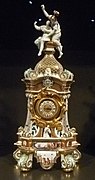 Pendule with Arachne and Athena in Meissen porcelain, attributed to Johann Gottlieb Kirchner and George Fritzsche (1727)
 -
 Paolo Veronese - Dialettica - Palazzo Ducale


See also[edit]


- Cultural depictions of spiders
- Marsyas, a satyr who engaged in a musical contest with Apollo and also suffered for his presumption
- Medusa, who was also transformed as a result of Athena's wrath
- 407 Arachne, an asteroid named after Arachne
Footnotes[edit]
References[edit]
- ^ R. S. P. Beekes, Etymological Dictionary of Greek, Brill, 2009, p. 124.
- ^ "Theoi.com".
- ^ Ovid, Metamorphoses, 6. 8
- ^ Pliny the Elder. Naturalis Historia, Book 7.56.3; According to Justin, B. ii. c. 6, the Athenians introduced the use of wool among their countrymen; but it has been supposed that they learned it from the Egyptians. As we have sufficient evidence that linen was manufactured by the Egyptians at a very early period, we may presume that this account of Arachne either is fabulous, or that in some way or other she was instrumental in the introduction of linen into Greece.
- ^ Kline, A.S. "Ovid—the Metamophoses" (PDF). Tikaboo. A.S. kline. Archived from the original (PDF) on 18 April 2016. Retrieved 12 December 2016.
- ^ Roman, L., & Roman, M. (2010). Encyclopedia of Greek and Roman mythology., p. 78, at Google Books
- ^ Ovid, Metamorphoses 6.70-102
- ^ Ovid, Metamorphoses 6.103-128
- ^ Oakley, John (August 31, 2014). Athenian Potters and Painters. Vol. III. United States: Oxbow Books. p. 99. ISBN 978-1-78297-663-9.
- ^ Unknown. Aryballos with a representation of the myth about the battle between Arachne and Athena (Clay). Corinth, Greece: Archaeological Museum of Ancient Corinth. Archived from the original on 2023-10-04. Retrieved June 4, 2023.
- ^ "Αρχαιολογικά Ανάλεκτα εξ Αθηνών". Athens Annals of Archaeology (in Greek). 3–4. General Directorate of Antiquities and Restoration: 95. 1971.
- ^ Virgil, Georgics 4.246 ff
- ^ Pliny the Elder, Natural History 7.196
- ^ Salzman-Mitchell, Patricia B. (2005). A Web of Fantasies: Gaze, Image, and Gender in Ovid's Metamorphoses. Ohio State University Press. p. 228. ISBN 0-8142-0999-8.
- ^ Lucian (1967). Soloecista. Lucius or The Ass. Amores. Halcyon. Demosthenes. Podagra. Ocypus. Cyniscus. Philopatris. Charidemus. Nero. Loeb Classical Library 432. Translated by M. D. MacLeod. Cambridge, MA: Harvard University Press. p. 318-319.
- ^ Written c. 1590 and published in Complaints, 1591. Spenser's allusion to Arachne in The Faerie Queene, ii, xii.77, is also noted in Smith, Reed (1913). "The Metamorphoses in Muiopotmos". Modern Language Notes. 28 (3): 82–85. doi:10.2307/2916008. JSTOR 2916008.
- ^ Brinkley, Robert A. (1981). "Spenser's Muiopotmos and the Politics of Metamorphosis". ELH. 48 (4): 668–676. doi:10.2307/2872956. JSTOR 2872956.
- ^ Dante Alighieri, The Divine Comedy, Volume 1: Inferno. Canto XVII, lines 15-18 (pp. 223-224). Translated by Mark Musa.
- ^ "La légende d'Arachné" (in French). Retrieved 20 February 2013.
- ^ Gallagher, David (October 2008). "The Transmission of Ovid's Arachne Metamorphosis in Jeremias Gotthelf's Die Schwarze Spinne". Neophilologus. 92 (4): 699–711. doi:10.1007/s11061-007-9071-y. S2CID 162479504.
Bibliography[edit]
Primary sources[edit]
- Ovid, Metamorphoses vi.1–145
- Pliny the Elder, Naturalis Historia vii.56.196
- Virgil, Georgics iv.246-247
Secondary sources[edit]
- Harry Thurston Peck, Harpers Dictionary of Classical Antiquities (1898) (13.23)
- Chisholm, Hugh, ed. (1911). . Encyclopædia Britannica (11th ed.). Cambridge University Press.
Further reading[edit]
- Harries, Byron (1990). "The spinner and the poet: Arachne in Ovid's Metamorphoses". Proceedings of the Cambridge Philological Society. 36 (216): 64–82. doi:10.1017/S006867350000523X. JSTOR 44696682.
- Hejduk, Julia D. (2012). "Arachne's Attitude: Metamorphoses 6.25". Mnemosyne. 65 (4/5): 764–768. doi:10.1163/156852512X585241. JSTOR 41725255.
- Höfler, Stefan; Nielsen, Johan Ulrik (2022). "A Proto-Indo-European word for 'spider'? : un-weaving the prehistory of the Greek ἀράχνη and the Latin arāneus". Graeco-Latina Brunensia (1): 69–89. doi:10.5817/GLB2022-1-6. hdl:11222.digilib/145031. S2CID 251755480.
External links[edit]
 The dictionary definition of Arachne at Wiktionary
 Media related to Arachne at Wikimedia Commons
- Works by Arachne at Project Gutenberg
- Works by or about Arachne at Internet Archive
- The Warburg Institute Iconographic Database (images of Arachne)


.jpg)
.jpg)

| International | |
|---|---|
| National | |
| Other | |
