


Buck Institute for Research on Aging
 | |
| Established | 30 Sep 1999 |
|---|---|
| President | Eric M. Verdin |
| Budget | $37 million |
| Formerly called | Buck Institute for Age Research |
| Address | 8001 Redwood Blvd. Novato, CA 94945-1400 |
| Location | Novato , California , United States |
| Coordinates | 38.133939°N 122.570432°W |
| Website | buckinstitute |
The Buck Institute for Research on Aging[1] is an independent biomedical research institute that researches aging and age-related disease.[2] The mission of the Buck Institute is to extend the healthy years of life. The Buck Institute is one of nine centers for aging research of the Glenn Foundation for Medical Research.[3]
The institute, a nonprofit organization located in Novato, California, began its research program in 1999, making it the world's first institute founded primarily to study intervention into the aging process.[4] It is named for Marin County philanthropists Leonard and Beryl Hamilton Buck, whose estate funded the endowment that helped establish the institute, and the Buck Trust currently contributes approximately $6 million annually to support the institute's work. The campus of the Buck Institute was designed by architect I. M. Pei.[5][6]
In May 2007, the institute established a cooperative agreement with the University of California's Davis and Merced campuses to coordinate stem-cell research.[7]
History
[edit]The Buck Foundation Trust was created by Beryl Hamilton Buck after the death in 1953 of her husband, pathologist Leonard W. Buck. Leonard's father, Frank Buck, was one of the founders of Belridge Oil.[8] When Beryl Buck died in 1975, the bulk of the estate became part of the San Francisco Foundation, about $7.6 million dedicated to "charitable purposes in Marin County" including, "extending help to the problems of aging." The Belridge Oil stock in the trust was bought in 1979 by Shell Oil for $253 million, increasing the trust's value substantially.[8][9]
Attempts by the San Francisco Foundation to use the cy pres doctrine to spend outside of Marin County resulted in litigation which the SF Foundation lost.[8][10] As part of a 1986 court settlement, the Marin Community Foundation was established to administer the trust, valued in 2013 at approximately $1 billion.[11] The settlement required that 80% of the trust's annual earnings be distributed to causes specific to Marin County. The remaining 20% is to be distributed among three Marin County organizations:[2]
- The Buck Institute for Research on Aging
- The Buck Institute for Education[12]
- Alcohol Justice, formerly named The Marin Institute, which deals with alcohol-related problems.
In 2016, the institute began talks with the Gladstone Institutes, a San Francisco-based foundation, regarding a possible research alliance or merger. That discussion ended in October 2016.[13]
In December 2022, the institute hosted The Longevity Summit, a two-day conference on ageing, the emerging new biotech companies in the field, and their innovations.[14]
Facilities
[edit]
The institute is on a 488-acre (1.97 km2; 0.76 sq mi) site located in the foothills of Mount Burdell, north of Novato, California. Of this, a 238-acre (0.96 km2; 0.37 sq mi) portion is dedicated to permanent agricultural use; another 70-acre (0.28 km2; 0.11 sq mi) portion is open public space.
I. M. Pei, who responded in 1989 to a request to submit a proposal to design the research facility, was selected as the architect for the institute's facility.[15] Pei's master plan called for 355,000 square feet (33,000 m2) of laboratory and facility space.[5] The multi-stage plan calls for five interlocking buildings (four laboratory buildings and a support building)[16] around a one-acre hexagonal courtyard, designed to provide a green oasis for quiet contemplation and outdoor activities. Pei used varied geometric elements and floating staircases, which appear throughout both the administrative and research buildings.[17] The second of four research buildings approved in the master plan was completed in 2012.[18]
As of 2016, the institute had more than $80 million in bond debt from building its Novato headquarters in 1999 and completing its third building in 2012.[13] It was leasing 27,000 sq ft of its campus to for-profit businesses, including BioMarin, Ultragenyx, Cellular Dynamics, An2H Discovery Limited, and Excel Venture Management.[19]
Research
[edit]The Buck Institute's research program has ten focus areas related to geriatrics and longevity.[20] The institute had about 250 staff members as of 2017.[21]
Buck Institute conducts its research programs through twenty laboratories that focus on specific subjects. After a 12-year dispute with local animal activists, the institute agreed to limit research to animals no higher than rats and mice; many laboratories use no animals at all.[16]
As of 2013, about half of the institute's support came from peer-reviewed grants from the National Institutes of Health and other federal agencies. Foundations and private donors contributed another 35% of the funding. An endowment from the Buck Trust Fund provided approximately 15% of the annual budget.[22]
Grant revenue in 2015 was $17.4 million, compared to more than $28 million in 2011.[13]
In 2015, California researchers opened the world's largest publicly available stem cell bank, with samples stored at the Buck Institute. The initial bank had 300 stem cell lines, with an ultimate goal of 9,000 lines.[23]
In 2016, the institute launched a startup, called Unity Biotechnology First Company, aimed at developing medicines to treat age-related diseases and boost healthy lifespans.[24]
One drug developed at the institute, rapamycin, is being researched by Mount Tam Biotechnologies, a private company named for Mount Tamalpais, the highest peak in Marin County, with the institute owning significant legal rights to the drug.[4]
Leadership
[edit]The founding president and CEO, Dale Bredesen, now heads the lab focused on Alzheimer's disease research.[25] In July 2010 he was succeeded by Brian K. Kennedy, who resigned in October 2016.[26] The institute's current president and CEO, Eric M. Verdin, was appointed in November 2016.[19]
Notable faculty
[edit]Gallery
[edit]-
 Entry sign for the Buck Institute, on Redwood Blvd.
 -
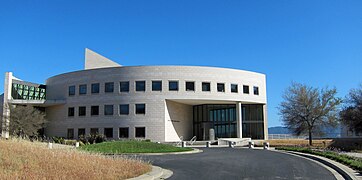 The main entrance of the Buck Institute
 -
 The second building of the Buck Institute
 -
 The Administration Building of the Buck Institute, as seen from the courtyard
 -
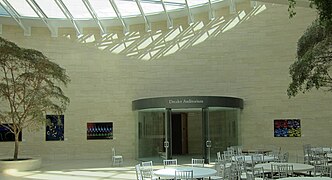 Lobby entrance to Drexler Auditorium, in the Administrative Building
 -
 Inside Drexler Auditorium, in the Administrative Building


References
[edit]- ^ On January 1, 2011, the name of the institute was changed from "Buck Institute for Age Research"
- ^ a b Russo, Eugene (February 5, 2001). "Forging a Palace for Research on Aging". The Scientist Magazine. Retrieved May 17, 2019.
- ^ page of Buck Institute on website of Glenn Foundation for Medical Research
- ^ a b Cox, Patrick. "This Company With Anti-Aging Drug Is Secretly Preparing For Trump's New FDA". Forbes. Retrieved 2017-02-26.
- ^ a b "Buck Institute for Age Research". Pei Cobb Freed and Partners. Archived from the original on 13 May 2012. Retrieved 25 April 2013.
- ^ "The Buck is Growing". Marin Magazine. Archived from the original on 4 September 2012. Retrieved 25 April 2013.
- ^ "UC Davis, UC Merced and Buck Institute: Cooperate to Meet Stem Cell Oversight Requirements". California Institute for Regenerative Medicine (CIRM). 17 May 2007. Retrieved 25 April 2013.
- ^ a b c Dale, Harvey P. (March 18, 1987). "The Buck Trust" (PDF). New York University. Archived from the original (PDF) on 2011-12-18. Retrieved August 20, 2020.
- ^ Robert R. Augsburger; Victoria Chang; William F. Meehan III (1998-01-01). "The San Francisco Foundation: The Dilemma of the Buck Trust (A)". Harvard Business Review. Archived from the original on 2015-06-29. Retrieved 2013-05-06.
- ^ Friedman, Lawrence Mier (2009). Dead Hands: a social history of wills, trusts, and inheritance law. Stanford University Press. pp. 159–161. ISBN 9780804760362.
- ^ "About MCF". Marin Community Foundation. Retrieved 2013-04-30.
- ^ "The BIE Story". Buck Institute for Education. Archived from the original on 2013-05-07. Retrieved 2013-05-06.
- ^ a b c Halstead, Richard (October 28, 2016). "Buck Institute changes CEOs as talks with Gladstone Institutes fizzle". Marin Independent Journal. Retrieved May 17, 2019.
- ^ Mazin, Arkadi (December 20, 2022). "The Science-Packed Longevity Summit at the Buck Institute".
- ^ "Famed architect I.M. Pei dies at 102; designed Buck Institute in Novato". Marin Independent Journal. May 16, 2019. Retrieved May 17, 2019.
- ^ a b Doyle, Jim (July 25, 2003). "Asking age-old questions / At Buck Institute in Novato, top scientists investigate how we grow old". SF Chronicle. Retrieved May 17, 2019.
- ^ Keeling, Brock (May 16, 2019). "I.M. Pei left lasting impression in Novato with the Buck Institute". Curbed SF. Retrieved May 17, 2019.
- ^ Wood, Jim (August 17, 2011). "The Buck is Growing". Marin Magazine. Retrieved May 17, 2019.
- ^ a b Halstead, Richard (November 27, 2016). "Novato: Buck institute shakeup leaves lingering funding, leadership questions". Marin Independent Journal. Retrieved May 17, 2019.
- ^ "Focus Areas - BUCK". BUCK. Retrieved 2018-11-19.
- ^ "Buck Institute could lose $3.2M under proposed NIH cuts". The North Bay Business Journal. 16 March 2017. Retrieved 31 October 2018.
- ^ "News & Events, Quick Facts". Buck Institute for Research on Aging. Retrieved 25 April 2013.
- ^ Khury, Stela (September 1, 2015). "World's largest public stem cell bank inaugurated in California". The Sacramento Bee. ISSN 0890-5738. Archived from the original on 2019-09-22. Retrieved 2019-05-17.
- ^ Dunn, James (February 3, 2016). "Buck Institute launches Unity Biotechnology". The North Bay Business Journal. Archived from the original on May 17, 2019. Retrieved May 17, 2019.
- ^ Davidson, Keay (2004-09-13). "Researchers discover 'Jekyll and Hyde' cancer gene/Amount of a specific protein determines whether a tumor is created or suppressed". San Francisco Chronicle. Retrieved 2013-06-08.
- ^ Halstead, Richard (November 1, 2016). "At Buck Institute, second top executive resigns". Marin Independent Journal. Retrieved May 17, 2019.
External links
[edit]

- Official website
- Marin Community Foundation website
- The Senescence Associated Secretory Phenotype atlas, an index of SASP research

38°08′02″N 122°34′14″W / 38.133939°N 122.570432°W
| International | |
|---|---|
| National | |

- Gerontology organizations
- Buildings and structures in Marin County, California
- Medical research institutes in California
- Novato, California
- Non-profit organizations based in the San Francisco Bay Area
- Organizations based in Marin County, California
- Research institutes in the San Francisco Bay Area
- I. M. Pei buildings