Smith numbers were named by Albert Wilansky of Lehigh University, as he noticed the property in the phone number (493-7775) of his brother-in-law Harold Smith:
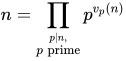
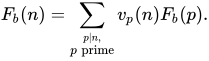
Let be a natural number. For base , let the function be the digit sum of in base . A natural number with prime factorisation
is a Smith number if
Here the exponent is the multiplicity of as a prime factor of (also known as the p-adic valuation of ).
For example, in base 10, 378 = 21 · 33 · 71 is a Smith number since 3 + 7 + 8 = 2 · 1 + 3 · 3 + 7 · 1, and 22 = 21 · 111 is a Smith number, because 2 + 2 = 2 · 1 + (1 + 1) · 1.
W.L. McDaniel in 1987 proved that there are infinitely many Smith numbers.[1][2]
The number of Smith numbers in base 10 below 10n for n = 1, 2, ... is given by
1, 6, 49, 376, 3294, 29928, 278411, 2632758, 25154060, 241882509, ... (sequence A104170 in the OEIS).
Two consecutive Smith numbers (for example, 728 and 729, or 2964 and 2965) are called Smith brothers.[3] It is not known how many Smith brothers there are. The starting elements of the smallest Smith n-tuple (meaning n consecutive Smith numbers) in base 10 for n = 1, 2, ... are[4]
4, 728, 73615, 4463535, 15966114, 2050918644, 164736913905, ... (sequence A059754 in the OEIS).