


Digital root
 | This article includes a list of references, related reading, or external links, but its sources remain unclear because it lacks inline citations. (January 2016) |
The digital root (also repeated digital sum) of a natural number in a given radix is the (single digit) value obtained by an iterative process of summing digits, on each iteration using the result from the previous iteration to compute a digit sum. The process continues until a single-digit number is reached. For example, in base 10, the digital root of the number 12345 is 6 because the sum of the digits in the number is 1 + 2 + 3 + 4 + 5 = 15, then the addition process is repeated again for the resulting number 15, so that the sum of 1 + 5 equals 6, which is the digital root of that number. In base 10, this is equivalent to taking the remainder upon division by 9 (except when the digital root is 9, where the remainder upon division by 9 will be 0), which allows it to be used as a divisibility rule.
Formal definition[edit]
Let be a natural number. For base , we define the digit sum to be the following:


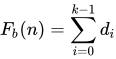
where is the number of digits in the number in base , and


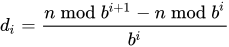
is the value of each digit of the number. A natural number is a digital root if it is a fixed point for , which occurs if .


All natural numbers are preperiodic points for , regardless of the base. This is because if , then


and therefore
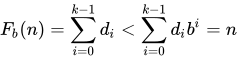
because . If , then trivially

Therefore, the only possible digital roots are the natural numbers , and there are no cycles other than the fixed points of .

Example[edit]
In base 12, 8 is the additive digital root of the base 10 number 3110, as for






This process shows that 3110 is 1972 in base 12. Now for



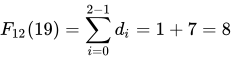
shows that 19 is 17 in base 12. And as 8 is a 1-digit number in base 12,
- .

Direct formulas[edit]
We can define the digit root directly for base in the following ways:

Congruence formula[edit]
The formula in base is:

or,

In base 10, the corresponding sequence is (sequence A010888 in the OEIS).
The digital root is the value modulo because and thus So regardless of the position of digit , , which explains why digits can be meaningfully added. Concretely, for a three-digit number ,








To obtain the modular value with respect to other numbers , one can take weighted sums, where the weight on the -th digit corresponds to the value of . In base 10, this is simplest for , where higher digits except for the unit digit vanish (since 2 and 5 divide powers of 10), which corresponds to the familiar fact that the divisibility of a decimal number with respect to 2, 5, and 10 can be checked by the last digit.



Also of note is the modulus . Since and thus taking the alternating sum of digits yields the value modulo .




Using the floor function[edit]
It helps to see the digital root of a positive integer as the position it holds with respect to the largest multiple of less than the number itself. For example, in base 6 the digital root of 11 is 2, which means that 11 is the second number after . Likewise, in base 10 the digital root of 2035 is 1, which means that . If a number produces a digital root of exactly , then the number is a multiple of .



With this in mind the digital root of a positive integer may be defined by using floor function , as


Properties[edit]
- The digital root of in base is the digital root of the sum of the digital root of and the digital root of : This property can be used as a sort of checksum, to check that a sum has been performed correctly.



- The digital root of in base is congruent to the difference of the digital root of and the digital root of modulo :


- The digital root of in base is


- The digital root of the product of nonzero single digit numbers in base is given by the Vedic Square in base .

- The digital root of in base is the digital root of the product of the digital root of and the digital root of :

Additive persistence[edit]
The additive persistence counts how many times we must sum its digits to arrive at its digital root.
For example, the additive persistence of 2718 in base 10 is 2: first we find that 2 + 7 + 1 + 8 = 18, then that 1 + 8 = 9.
There is no limit to the additive persistence of a number in a number base . Proof: For a given number , the persistence of the number consisting of repetitions of the digit 1 is 1 higher than that of . The smallest numbers of additive persistence 0, 1, ... in base 10 are:
The next number in the sequence (the smallest number of additive persistence 5) is 2 × 102×(1022 − 1)/9 − 1 (that is, 1 followed by 2 222 222 222 222 222 222 222 nines). For any fixed base, the sum of the digits of a number is proportional to its logarithm; therefore, the additive persistence is proportional to the iterated logarithm.[1]
Programming example[edit]
The example below implements the digit sum described in the definition above to search for digital roots and additive persistences in Python.
def digit_sum(x: int, b: int) -> int:
    total = 0
    while x > 0:
        total = total + (x % b)
        x = x // b
    return total

def digital_root(x: int, b: int) -> int:
    seen = set()
    while x not in seen:
        seen.add(x)
        x = digit_sum(x, b)
    return x

def additive_persistence(x: int, b: int) -> int:
    seen = set()
    while x not in seen:
        seen.add(x)
        x = digit_sum(x, b)
    return len(seen) - 1
In popular culture[edit]
Digital roots are used in Western numerology, but certain numbers deemed to have occult significance (such as 11 and 22) are not always completely reduced to a single digit.
Digital roots form an important mechanic in the visual novel adventure game Nine Hours, Nine Persons, Nine Doors.
See also[edit]
References[edit]
- ^ Meimaris, Antonios (2015), On the additive persistence of a number in base p, Preprint
- Averbach, Bonnie; Chein, Orin (27 May 1999), Problem Solving Through Recreational Mathematics, Dover Books on Mathematics (reprinted ed.), Mineola, NY: Courier Dover Publications, pp. 125–127, ISBN 0-486-40917-1 (online copy, p. 125, at Google Books)
- Ghannam, Talal (4 January 2011), The Mystery of Numbers: Revealed Through Their Digital Root, CreateSpace Publications, pp. 68–73, ISBN 978-1-4776-7841-1, archived from the original on 29 March 2016, retrieved 11 February 2016 (online copy, p. 68, at Google Books)
- Hall, F. M. (1980), An Introduction into Abstract Algebra, vol. 1 (2nd ed.), Cambridge, U.K.: CUP Archive, p. 101, ISBN 978-0-521-29861-2 (online copy, p. 101, at Google Books)
- O'Beirne, T. H. (13 March 1961), "Puzzles and Paradoxes", New Scientist, 10 (230), Reed Business Information: 53–54, ISSN 0262-4079 (online copy, p. 53, at Google Books)
- Rouse Ball, W. W.; Coxeter, H. S. M. (6 May 2010), Mathematical Recreations and Essays, Dover Recreational Mathematics (13th ed.), NY: Dover Publications, ISBN 978-0-486-25357-2 (online copy at Google Books)
External links[edit]
Classes of natural numbers | |||||||||||||||||||||||||
|---|---|---|---|---|---|---|---|---|---|---|---|---|---|---|---|---|---|---|---|---|---|---|---|---|---|
| |||||||||||||||||||||||||
| |||||||||||||||||||||||||
| |||||||||||||||||||||||||
| |||||||||||||||||||||||||
| |||||||||||||||||||||||||
| |||||||||||||||||||||||||
| |||||||||||||||||||||||||
| |||||||||||||||||||||||||
| |||||||||||||||||||||||||
| |||||||||||||||||||||||||
