


Pentatope number

In number theory, a pentatope number is a number in the fifth cell of any row of Pascal's triangle starting with the 5-term row 1 4 6 4 1, either from left to right or from right to left. It is named because it represents the number of 3-dimensional unit spheres which can be packed into a pentatope (a 4-dimensional tetrahedron) of increasing side lengths.
The first few numbers of this kind are:

Pentatope numbers belong to the class of figurate numbers, which can be represented as regular, discrete geometric patterns.[1]
Formula[edit]
The formula for the nth pentatope number is represented by the 4th rising factorial of n divided by the factorial of 4:

The pentatope numbers can also be represented as binomial coefficients:
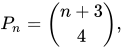
which is the number of distinct quadruples that can be selected from n + 3 objects, and it is read aloud as "n plus three choose four".
Properties[edit]
Two of every three pentatope numbers are also pentagonal numbers. To be precise, the (3k − 2)th pentatope number is always the th pentagonal number and the (3k − 1)th pentatope number is always the th pentagonal number. The (3k)th pentatope number is the generalized pentagonal number obtained by taking the negative index in the formula for pentagonal numbers. (These expressions always give integers).[2]


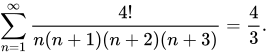
The infinite sum of the reciprocals of all pentatope numbers is 4/3.[3] This can be derived using telescoping series.
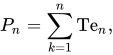
Pentatope numbers can be represented as the sum of the first n tetrahedral numbers:[2]
and are also related to tetrahedral numbers themselves:

No prime number is the predecessor of a pentatope number (it needs to check only -1 and 4 = 22), and the largest semiprime which is the predecessor of a pentatope number is 1819.
Similarly, the only primes preceding a 6-simplex number are 83 and 461.
Test for pentatope numbers[edit]
We can derive this test from the formula for the nth pentatope number.
Given a positive integer x, to test whether it is a pentatope number we can compute the positive root using Ferrari's method:

The number x is pentatope if and only if n is a natural number. In that case x is the nth pentatope number.
Generating function[edit]
The generating function for pentatope numbers is[4]

Applications[edit]
In biochemistry, the pentatope numbers represent the number of possible arrangements of n different polypeptide subunits in a tetrameric (tetrahedral) protein.
References[edit]
- ^ Deza, Elena; Deza, M. (2012), "3.1 Pentatope numbers and their multidimensional analogues", Figurate Numbers, World Scientific, p. 162, ISBN 9789814355483
- ^ a b Sloane, N. J. A. (ed.). "Sequence A000332". The On-Line Encyclopedia of Integer Sequences. OEIS Foundation.
- ^ Rockett, Andrew M. (1981), "Sums of the inverses of binomial coefficients" (PDF), Fibonacci Quarterly, 19 (5): 433–437. Theorem 2, p. 435.
- ^ "Wolfram MathWorld site".
Classes of natural numbers | |||||||||||||||||||||||||
|---|---|---|---|---|---|---|---|---|---|---|---|---|---|---|---|---|---|---|---|---|---|---|---|---|---|
| |||||||||||||||||||||||||
| |||||||||||||||||||||||||
| |||||||||||||||||||||||||
| |||||||||||||||||||||||||
| |||||||||||||||||||||||||
| |||||||||||||||||||||||||
| |||||||||||||||||||||||||
| |||||||||||||||||||||||||
| |||||||||||||||||||||||||
| |||||||||||||||||||||||||

 | This article about a number is a stub. You can help Wikipedia by expanding it. |