From Wikipedia, the free encyclopedia
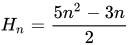
A heptagonal number is a figurate number that is constructed by combining heptagons with ascending size. The n -th heptagonal number is given by the formula
H
n
=
5
n
2
−
3
n
2
{\displaystyle H_{n}={\frac {5n^{2}-3n}{2}}}
The first five heptagonal numbers. The first few heptagonal numbers are:
0 , 1 , 7 , 18 , 34 , 55 , 81 , 112 , 148 , 189 , 235 , 286, 342, 403, 469, 540, 616 , 697, 783, 874, 970, 1071, 1177, 1288, 1404, 1525, 1651, 1782, … (sequence A000566 OEIS )The parity of heptagonal numbers follows the pattern odd-odd-even-even. Like square numbers , the digital root in base 10 of a heptagonal number can only be 1, 4, 7 or 9. Five times a heptagonal number, plus 1 equals a triangular number .
Additional properties [ edit ] The heptagonal numbers have several notable formulas:
H
m
+
n
=
H
m
+
H
n
+
5
m
n
{\displaystyle H_{m+n}=H_{m}+H_{n}+5mn}
H
m
−
n
=
H
m
+
H
n
−
5
m
n
+
3
n
{\displaystyle H_{m-n}=H_{m}+H_{n}-5mn+3n}
H
m
−
H
n
=
(
5
(
m
+
n
)
−
3
)
(
m
−
n
)
2
{\displaystyle H_{m}-H_{n}={\frac {(5(m+n)-3)(m-n)}{2}}}
40
H
n
+
9
=
(
10
n
−
3
)
2
{\displaystyle 40H_{n}+9=(10n-3)^{2}}
A formula for the sum of the reciprocals of the heptagonal numbers is given by:[ 1]
∑
n
=
1
∞
2
n
(
5
n
−
3
)
=
1
15
π
25
−
10
5
+
2
3
ln
(
5
)
+
1
+
5
3
ln
(
1
2
10
−
2
5
)
+
1
−
5
3
ln
(
1
2
10
+
2
5
)
=
1
3
(
π
5
ϕ
6
4
+
5
2
ln
(
5
)
−
5
ln
(
ϕ
)
)
=
1.3227792531223888567
…
{\displaystyle {\begin{aligned}\sum _{n=1}^{\infty }{\frac {2}{n(5n-3)}}&={\frac {1}{15}}{\pi }{\sqrt {25-10{\sqrt {5}}}}+{\frac {2}{3}}\ln(5)+{\frac {{1}+{\sqrt {5}}}{3}}\ln \left({\frac {1}{2}}{\sqrt {10-2{\sqrt {5}}}}\right)+{\frac {{1}-{\sqrt {5}}}{3}}\ln \left({\frac {1}{2}}{\sqrt {10+2{\sqrt {5}}}}\right)\\&={\frac {1}{3}}\left({\frac {\pi }{\sqrt[{4}]{5\,\phi ^{6}}}}+{\frac {5}{2}}\ln(5)-{\sqrt {5}}\ln(\phi )\right)\\&=1.3227792531223888567\dots \end{aligned}}}
with golden ratio
ϕ
=
1
+
5
2
{\displaystyle \phi ={\tfrac {1+{\sqrt {5}}}{2}}}
In analogy to the square root of x, one can calculate the heptagonal root of x , meaning the number of terms in the sequence up to and including x .
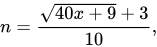
The heptagonal root of x is given by the formula
n
=
40
x
+
9
+
3
10
,
{\displaystyle n={\frac {{\sqrt {40x+9}}+3}{10}},}
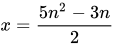
which is obtained by using the quadratic formula to solve
x
=
5
n
2
−
3
n
2
{\displaystyle x={\frac {5n^{2}-3n}{2}}}
n .
Possessing a specific set of other numbers
Expressible via specific sums







![{\displaystyle {\begin{aligned}\sum _{n=1}^{\infty }{\frac {2}{n(5n-3)}}&={\frac {1}{15}}{\pi }{\sqrt {25-10{\sqrt {5}}}}+{\frac {2}{3}}\ln(5)+{\frac {{1}+{\sqrt {5}}}{3}}\ln \left({\frac {1}{2}}{\sqrt {10-2{\sqrt {5}}}}\right)+{\frac {{1}-{\sqrt {5}}}{3}}\ln \left({\frac {1}{2}}{\sqrt {10+2{\sqrt {5}}}}\right)\\&={\frac {1}{3}}\left({\frac {\pi }{\sqrt[{4}]{5\,\phi ^{6}}}}+{\frac {5}{2}}\ln(5)-{\sqrt {5}}\ln(\phi )\right)\\&=1.3227792531223888567\dots \end{aligned}}}](https://wikimedia.org/api/rest_v1/media/math/render/svg/41ea2e77d9e6f84bb7e13f5f79f55915e844b3d3)