


Flag of Lebanon
 | |
| Use | National flag and ensign     |
|---|---|
| Proportion | 2:3 |
| Adopted | 7 December 1943 |
| Design | A horizontal triband of red, white (double height) and red; charged with a green Lebanese cedar tree. |
| Designed by | Henri Philippe Pharaoun |
The national flag of Lebanon (Arabic: علم لبنان) is formed of two horizontal red stripes enveloping a horizontal white stripe. The white stripe is twice the height (width) of the red ones (ratio 1:2:1)—a Spanish fess. The green cedar (Lebanon cedar) in the middle touches each of the red stripes and its width is one third of the width of the flag.[1] The red stripes represent the blood shed by those who fought for Lebanon. The white stripe represents purity, peace and the snow-capped mountains of Lebanon. The cedar on the flag represents the Lebanese cedar, which is the national symbol of Lebanon. These trees grow prevalently across the country.
Symbolism[edit]

The presence and position of the Cedar in the middle of the flag is directly inspired by the Lebanese cedar (Cedrus libani). The Cedar is the symbol of Lebanon. The Cedar of Lebanon has its origin in many biblical references.
The cedar of Lebanon is mentioned seventy-seven times in the Bible, notably in the book Psalms, chapter 92, verse 12, where it says that "The righteous shall flourish like the palm tree, He shall grow like a cedar in Lebanon"[2] and Chapter 104, verse 16, where it is stated: "[t]he trees of the Lord are well watered, the cedars of Lebanon that he planted".[3]
Alphonse de Lamartine (1790–1869), marveling at the cedars of Lebanon during his trip to the Middle East with his daughter Julia, had these words: "[t]he cedars of Lebanon are the relics of centuries and nature, the most famous natural landmarks in the universe. They know the history of the earth, better than the story itself".[4]
Antoine de Saint-Exupéry (1900–1944), who loved the cedars and also had visited Lebanon in 1935, wrote in his work Citadel "[t]he peace is a long growing tree. We need, as the cedar, to rock its unity".[5]
In 1920, in a text of the proclamation of the State of Greater Lebanon, it was said: "[a]n evergreen cedar is like a young nation despite a cruel past. Although oppressed, never conquered, the cedar is its rallying. By the union, it will break all attacks".[5]
The white color on the flag represents the snow as a symbol of purity and peace. The two red stripes refer to the Lebanese blood shed to preserve the country against the successive invaders.
Construction sheet[edit]
According to the Article 5 of the constitution of Lebanon: "The Lebanese flag shall be composed of three horizontal stripes, a white stripe between two red ones. The width of the white stripe shall be equal to that of both red stripes. In the center of and occupying one-third of the white stripe is a green cedar tree with its top touching the upper red strip and its base touching the lower red stripe".[6]

Colors scheme[edit]
 |
Colors scheme |
Red | White | Green |
|---|---|---|---|
| RAL | 3028 | 9016 | 6024 |
| CMYK | 0-91-87-7 | 0-0-0-0 | 100-0-52-35 |
| HEX | #EE161F | #FFFFFF | #00A850 |
| RGB | 238-22-31 | 255-255-255 | 0-167-80 |
History[edit]
Ottoman rule and French mandate[edit]
.png)
The 1913 version of the flag was created by two Lebanese Brazilian journalists, Shukri El Khoury and Naoum Labaki, who were both part of the Mahjar movement in the Americas. The flag, which simply had a white background which featured the Lebanese cedar in the middle, is believed to have been created in the 17th or 18th century, its first recorded use was in October 1848 which was used by the Maronite people.[7] The flag was also raised as the first national flag of Lebanon on October 2, 1918, following the fall of the Ottoman Empire.[8] An alternate version was also made in 1918 by El Khoury inspired by the French tricolor flag. It featured red and blue triangular on the left of the white cedar flag which was done to honor the French mandate.[9]

In May 1919, the Lebanese flag was designed by the president of the Lebanese Renaissance Movement, the late Naoum Mokarzel. It was similar to the tricolour flag of France but with a green cedar (Lebanon Cedar) in the middle. However many Lebanese Christians opposed to this as they felt threatened. The Administrative Council and Lebanese municipalities flew the plain white cedar flag in protest. This was reportedly mostly flown in the districts of Batroun and Keserwan. However demonstrators in Baabda unanimously demand, among other things: “The affirmation of the union of Lebanon with France, consecrated by the choice, as a national emblem, of the tricolor flag with the Cedar in a white band”.[9]
On March 22, 1920, a demonstration took place in Baabda which raised the tri-color flag. This flag, hailed by General Gouraud as a "symbol of freedom", was officially adopted in 1926. "The Lebanese flag, according to Article 5 of the Constitution, is blue, white, red, in equal vertical bands with a cedar on the white band.[9]
-
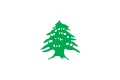
 Flag used by the Lebanon League of Progress and by the Administrative Council of Mount Lebanon (1913-1920)
 -
 Flag of the State of Greater Lebanon during the French mandate (1920–1943)
 -
 Flag of the State of Greater Lebanon during the French mandate 1920–1943 (variant)
 -


.svg)
_2.svg)
_3.svg)

Lebanese Republic[edit]

The present Lebanese flag was adopted just prior to independence from France in 1943. Seeking independence, the actual flag was first drawn by member of parliament Henri Pharaon[10][11] in the Chamber of Deputies Saeb Salam's house in Mousaitbeh by the deputies of the Lebanese parliament. It was adopted on 7 December 1943, during a meeting in the parliament, where article 5 in the Lebanese constitution was modified.
One theory is that Henri Pharaon based the composition of the flag on the Lebanese geography and therefore, the first red represents the Mount Lebanon and the second red represents the Anti-Lebanon Mountains and the white represents the Beqaa Valley, which is situated in the middle of the two mountain ranges on the map of Lebanon. And the green cedar (Lebanon Cedar) in the middle of the white part touches each of the red stripes is added because Lebanon is sometimes metonymically referred to as the Land of the Cedars.[12][13] The composition of the white stripe (a Spanish fess) could have been inspired by the red-yellow-red Flag of Spain, where the flag structure is based on the Lebanese connection to the Mediterranean Sea and its Phoenician past that reached to the Mediterranean shores of present-day Spain.
However, the most likely inspiration for the modern flag is the flag of the precursor to the modern republic, The Mount Lebanon Emirate. The Emirate bore the flag of the Ma'an dynasty, a Druze dynasty which included one of the most influential figures in the shaping of an independent Lebanese identity, Emir Fakhr al-Din II,[14] who struggled through his reign to establish independence from the Ottoman Empire. The flag has the exact same color scheme and even a similar composition. Red, white, and green being the primary colors with the green wreath in the center being replaced by the cedar in the modern flag; it is entirely probable that the modern flag is simply a redesign of this older, dynastic flag. Further evidence is supported by the fact that many government institutions in Lebanon continue to use the Ma'anid flag, such as the flag of the Lebanese Armed Forces, but without the green wreath, and it is still in place to this day.
Variant flags of Lebanon[edit]
.png)
 Vertical flag of Lebanon
The following is a list of variant flags used in Lebanon. Their is no official document that states the exact dimensions and shape of the Cedar, hence it varies.
-
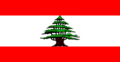 Design stored at WIPO
 -
 Design commonly seen from 1943-1995
 -
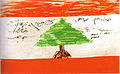 Flag as drawn and approved by the members of the parliament during the Declaration of independence in 1943
 -
 Variant flag made popular during the 17 October Revolution

.svg)


See also[edit]

Notes[edit]
- ^ The description of the flag is cited in the Lebanese Constitution, Chapter 1, Article 5.
- ^ "The Bible". Retrieved 27 October 2014.
- ^ "The Bible". Retrieved 27 October 2014.
- ^ "Firdaous – Arab world". 28 November 2007. Archived from the original on 6 June 2013. Retrieved 2 September 2013.
- ^ a b "L'Orient-Le Jour". 16 July 2014. Retrieved 27 October 2014.
- ^ "Ministry of information". Archived from the original on 2 November 2014. Retrieved 27 October 2014.
- ^ "Cedar Flag 1918 (Historical Flags, Lebanon)". crwflags.com. 31 July 2020.
- ^ "Flags and banners". lebarmy.gov.lb. Lebanese Armed Forces. December 2016.
- ^ a b c Dr. Jean Charaf: “Histoire du drapeau libanais” (In French) Beirut, August 2004
- ^ "Henry Pharoun Is Slain at Home; Founder of Free Lebanon Was 92". The New York Times. 7 August 1993. Retrieved 8 October 2008.
- ^ "Lubnān, Republic of Lebanon, Al-Jumhūriyyah al-Lubnāniyyah". Flags of The World. CRW. Retrieved 8 August 2009.
- ^ Budge, E.A.W. (2010). The Literature of the Ancient Egyptians. HardPress. p. 261.
- ^ Cromer, G. (2004). A war of words: political violence and public debate in Israel. Cass series on political violence. Frank Cass. ISBN 978-0-7146-5631-1.
- ^ "History Atlas". www.historyatlas.com. Retrieved 19 August 2020.
External links[edit]

- Lebanon at Flags of the World
- Lebanese Flag Accurate, high quality, & high resolution flags of Lebanon.
 | ||


| National flags | |
|---|---|
| National coats of arms | |
