


Flag of Saudi Arabia
 لَا إِلٰهَ إِلَّا اللَّٰه مُحَمَّدٌ رَسُولُ اللَّٰه("There is no god but God; Muhammad is the Messenger of God") | |
| Use | State and war flag, state and naval ensign     |
|---|---|
| Proportion | 2:3 |
| Adopted |
|
| Design | A green field with the Shahada or Muslim creed written in the Thuluth script in white above a horizontal sword, having its tip pointed to the left. |
| Designed by | Hafiz Wahba |
The national flag of Saudi Arabia, also known as the al-Alam,[a] is a green background with Arabic inscription and a sword in white. The inscription is the Islamic creed, or shahada: "There is no deity but God; Muhammad is the Messenger of God". The current design has been used by the government of Saudi Arabia since 15 March 1973.
Design[edit]
The Arabic inscription on the flag, written in the calligraphic Thuluth script with the current one by Saleh al-Mansouf, is the shahada or Islamic declaration of faith:
- لَا إِلٰهَ إِلَّا الله مُحَمَّدٌ رَسُولُ الله
- lā ʾilāha ʾillā-llāh, muḥammadun rasūlu-llāh
- "There is no god but God; Muhammad is the Messenger of God."[1]
The green of the flag represents Islam and the sword stands for the strictness in applying justice.[2]
The flag is manufactured with identical obverse and reverse sides, to ensure the shahada reads correctly, from right to left, from either side. The sword also points to the left on both sides, in the direction of the script.[3]
The usual color of the flag's green was approximated by Album des pavillons as Pantone 330 C, while the color used on flags at United Nations is approximately Pantone 349. At the 2012 London Olympics, Pantone 355 was used.[4][5]
Construction sheet[edit]
-
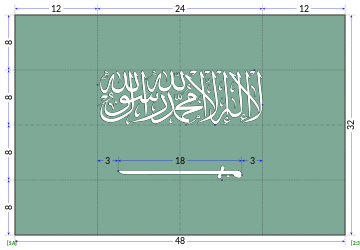 A construction sheet for the governmental version of the flag of Saudi Arabia
.svg)
|
|
Green | White |
|---|---|---|
| Pantone | 2427 C |
White
|
| RGB | 0/84/48 |
255/255/255
|
| Hexadecimal | #005430 |
#FFFFFF
|
| CMYK | 100/0/42/67 |
0/0/0/0
|
Use[edit]

Because the shahada is considered holy, the flag is not normally used on T-shirts or other items. Saudi Arabia protested against its inclusion on a planned football to be issued by FIFA, bearing all the flags of the participants of the 2002 FIFA World Cup. Saudi officials said that kicking the creed with the foot was completely unacceptable. Similarly, an attempt by the U.S. military to win favour with children of the Khost Province of Afghanistan by distributing footballs adorned with flags, including that of Saudi Arabia, ended in demonstrations.[6]
The flag is never lowered to half-mast as a sign of mourning, because lowering it would be considered blasphemous and desecrating.[7] Similarly, the flags of Afghanistan and Iraq are also never at half-mast.[8]
The normal flag cannot be hoisted vertically according to Saudi legislation. Special vertical flags are manufactured where both the inscription (the creed) and the emblem (the sword) are rotated, although this is rare, as most Arab countries traditionally do not hoist flags vertically.[5]
History[edit]
The precursor states to Saudi Arabia were Nejd and Hejaz. The state flag of Nejd followed today's Saudi flag pattern very closely. The state of Hejaz followed the patterns seen in countries like Palestine and Sudan. Caliphs such as Rashiduns, Umayyads and Abbasids used different colors, inscriptions and symbols. After the Siege of Baghdad in 1258, the primary caliphate became the Mamluk Sultanate. In 1517, the Ottomans invaded Egypt and inherited Hejaz and ruled it until the Arab Revolt (1916–18). From 1902 until 1921 a different Arabic inscription was used. One of the primary opponents to the Saudis was the Emirate of Jabal Shammar of the Al Rashid family in the north of the peninsula, until their defeat in 1921.
-

-

-

 The yellow flag was the royal banner of the Fatimid caliph and the state flag of the Ayyubid dynasty, which conquered what is now Hejaz
 -

 This flag was used by the Mamluk Sultanate, which inherited Hejaz from the Ayyubids
 -

 Flag of the First Saudi State from 1744 to 1818 and flag of the Second Saudi State from 1822 to 1891 and the flag of the Third Saudi State from 1902 to 1913
 -
 Flag of the Emirate of Jabal Shammar from 1835 to 1921
 -
 This flag was used by the Ottoman Empire and correspondingly by Ottoman Hejaz and Arabia from 1844-1916. The Ottomans captured Hejaz from the Mamluks in 1517.
 -
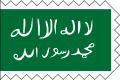 Flag of the Idrisid Emirate of Asir from 1909 to 1927
 -

-
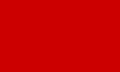 Provisional flag of the Kingdom of Hejaz from 1916 to 1917
 -
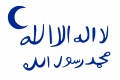 Flag of the Sheikdom of Upper Asir from 1916 to 1920
 -

-
 Flag of the Kingdom of Hejaz from 1920 to 1926. This flag was also used by the Sharifian Caliphate from 1924 to 1925, before Hejaz merged with Nejd to form a union.
 -
-
-
 Flag of the Idrisid Emirate of Asir from 1927 to 1930


.svg)

.svg)
.svg)


.svg)


.svg)
.svg)

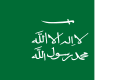
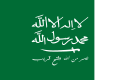
The Al Saud, the ruling family of Saudi Arabia, has long been closely related with Muhammad ibn Abd al-Wahhab. He and the people who followed him, since the 18th century, had used the shahada on their flags.[9] In 1921, Abdulaziz Abdulrahman Al-Saud, leader of the Al Saud and the future founder of the Kingdom of Saudi Arabia, added a sword to this flag.[9] The design of the flag was not standardized prior to 15 March 1973 when its use became official.[10] Variants with two swords and/or a white vertical stripe at the hoist were frequently used. By 1938, the flag had basically assumed its present form, except the sword had a different design (with a more curved blade) and it, along with the shahada above, took up more of the flag's space.
-
 Flag of Saudi Arabia from 1932 to 1934, with white stripe on the hoist
 -
 Flag of Saudi Arabia from 1934 to 1937, with a thinner white stripe
 -
 Flag of Saudi Arabia from 1938 to 1973, with no stripe
 -
 Flag of Saudi Arabia since 1973
.svg)
.svg)
.svg)
Royal Standard[edit]
The Royal Standard consists of a green flag, with an Arabic inscription and a sword featured in white, and with the national emblem embroidered in gold in the lower right canton of the year 1973.
The script on the flag is written in the Thuluth script. It is the shahada or Islamic declaration of faith:
- لَا إِلٰهَ إِلَّا الله مُحَمَّدٌ رَسُولُ الله
- lā ʾilāha ʾillā-llāh, muhammadun rasūlu-llāh
- There is no god but God; Muhammad is the Messenger of God[11]
-
 Royal Flag of the King of Saudi Arabia. (Ratio: 2:3)
 -
 Royal Standard of the King of Saudi Arabia. (Ratio: 1:1)
 -
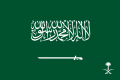 Royal Flag of the Crown Prince of Saudi Arabia. (Ratio: 2:3)
 -
 Royal Standard of the Crown Prince of Saudi Arabia. (Ratio: 1:1)


-
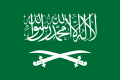 Royal Flag of the King (1938–1953)
(Ratio: 2:3) -
 Royal Banner of the King (1938–1953)
(Ratio: 12:25) -
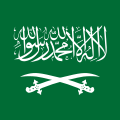 Royal Standard of the King (1938–1953)
(Ratio: 1:1)
.svg)
.svg)
.svg)
-
 Royal Flag of the King (1953–1964)
(Ratio: 2:3) -
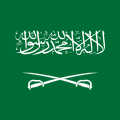 Royal Standard of the King (1953–1964)
(Ratio: 1:1) -
 Royal Flag of the King (1964–1973)
(Ratio: 2:3) -
 Royal Standard of the King (1964–1973)
(Ratio: 1:1)
.svg)
.svg)
.svg)
.svg)
Other flags[edit]
The civil ensign, for use by merchant vessels at sea, is a green flag with the state flag in the canton with a white border. The royal standard is the state flag with the palm tree and swords in the canton.
-

-
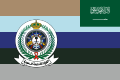 Flag of the Armed Forces (Ratio: 2:3)
 -
 Flag of the Royal Saudi Land Forces (Ratio: 2:3)
 -
 Flag of the Royal Saudi Air Force (Seal) (Ratio: 2:3)
 -
 Ensign of the Royal Saudi Air Force (Roundel) (Ratio: 2:3)
 -
 Flag of the Royal Saudi Naval Forces. (Ratio: 2:3)
 -
 Naval Ensign of Saudi Arabia (Ratio: 12:25)
 -
 Flag of the Royal Saudi Air Defense Force (Ratio: 2:3)
 -
 Flag of the Royal Saudi Strategic Missile Force (Ratio: 2:3)
 -
 Flag of the Ministry of National Guard (Ratio: 2:3)
 -
 Flag of the Ministry of Interior (Ratio: 2:3)
.svg)


.svg)


See also[edit]

Notes[edit]
References[edit]
- ^ "About Saudi Arabia: Facts and figures". The Royal Embassy of Saudi Arabia, Washington D.C. Archived from the original on 2012-04-17. Retrieved 2016-08-05.
{{cite web}}: CS1 maint: unfit URL (link) - ^ Eriksen, Thomas; Jenkins, Richard (2007). Flag, Nation and Symbolism in Europe and America. p. 171. ISBN 9780415444040. Retrieved 3 October 2012.
- ^ Saudi Arabia: The Reverse of the Flag, FOTW Flags Of The World, 3 June 2019. Accessed 2 May 2020.
- ^ UN Map Library
- ^ a b Saudi Arabia, FOTW Flags Of The World, 19 January 2008. Accessed 13 May 2009.
- ^ Leithead, Alastair (2007-08-26). "'Blasphemous' balls anger Afghans". BBC News Online. Retrieved 2007-08-26.
- ^ "Saudi King Fahd is laid to rest". BBC News. 2 August 2005.
- ^ "The National Emblem of Afghanistan". Ministry of Foreign Affairs of the Islamic Republic of Afghanistan. Archived from the original on 2021-11-23. Retrieved 2020-12-17.
- ^ a b Firefly Guide to Flags of the World. Firefly Books. 2003. p. 165. ISBN 978-1552978139. Retrieved 12 September 2012.
- ^ Elie Podeh (2011). The Politics of National Celebrations in the Arab Middle East. Cambridge: Cambridge University Press. p. 256. doi:10.1017/CBO9780511734748.009. ISBN 9780511734748.
- ^ "About Saudi Arabia: Facts and figures". The Royal Embassy of Saudi Arabia, Washington D.C. Archived from the original on 17 April 2012. Retrieved 24 April 2012.
External links[edit]

- Saudi Arabia at Flags of the World
- World Flags Information, Saudi Arabian page Archived 2011-10-07 at the Wayback Machine
- Saudi Arabian flag and associated information
- Saudi Arabia Flag Guide (in English)

 | ||


| National flags | |
|---|---|
| National coats of arms | |
