


Lyford, Oxfordshire
| Lyford | |
|---|---|
 St Mary the Virgin parish church, seen from the north | |
  Lyford Location within Oxfordshire | |
| Population | 44 (2001 Census) |
| OS grid reference | SU3994 |
| Civil parish |
|
| District | |
| Shire county | |
| Region | |
| Country | England |
| Sovereign state | United Kingdom |
| Post town | Wantage |
| Postcode district | OX12 |
| Police | Thames Valley |
| Fire | Oxfordshire |
| Ambulance | South Central |
| UK Parliament | |
Lyford is a small village and civil parish on the River Ock about 4 miles (6 km) north of Wantage. Historically it was part of the ecclesiastical parish of Hanney.[1] Lyford was part of Berkshire until the 1974 boundary changes transferred the Vale of White Horse to Oxfordshire. The 2001 Census recorded the parish's population as 44.[2] Lyford's name refers to a former ford across the river Ock, now replaced with a bridge on the road to Charney Bassett. "Ly" is derived from the Old English lin, meaning "flax". In 1034 it was recorded as Linford.[3]
Manors[edit]
There were two manors in Lyford: Lyford Manor and Lyford Grange.
Lyford Manor[edit]
The manor of Lyford dates from at least 944, when Edmund I granted six hides of land there to one Ælfheah. The manor was enlarged by a grant of a further two hides of land by King Canute in 1034. The Domesday Book of 1086 records Lyford as Linford.[1] The present manor house was built in the latter part of the 16th century and extended in 1617.[4] It is a Grade II* listed building.[5]
Lyford Grange[edit]
Lyford Grange, just east of the village, was originally a moated manor house of Abingdon Abbey built in a quadrangle. The present house was built between 1430 and 1480. It is timber-framed, with a post-and-truss roof[6][clarification needed] including one queen post. It is a Grade II* listed building.[7] In the reign of Elizabeth I the Grange belonged to a recusant family, the Yates, who harboured a community of Bridgettine nuns.[1] In 1581 the house was searched; three priests were eventually found and arrested by the government agent, George Eliot: Thomas Ford, John Colleton and the renowned Jesuit, Edmund Campion.[8] They were subsequently tried and martyred.[1][9] The Mass is held annually in the village in commemoration of this event.[9] The raid and martyrdoms did not stop recusancy at Lyford. In 1690 an informer reported that a small estate in the parish had been reserved to build a nunnery "when Popish times should come".[1][10]
Parish church[edit]
The Church of England parish church of St Mary the Virgin was built as a chapelry of Hanney in the first half of the 13th century.[1] There is a Mass dial scratched on the south wall. The wooden bell-turret was added in the 15th century;[1] it has a scissor-braced timber frame and three bells. The Perpendicular Gothic[11] clerestory was added either at the same time or early in the 16th century.[1] The church was restored in 1875 under the direction of the Gothic revival architect Ewan Christian. It is a Grade II* listed building.[12] St Mary's parish is now part of the United Benefice of Cherbury with Gainfield.[13] Rev. Michael Camilleri (c. 1814–1903), sometime vicar of Lyford, translated the New Testament into Maltese.[citation needed]
Social and economic history[edit]
In the early 1960s the digging of a soakaway in a cottage garden opposite the vicarage unearthed a small pottery bottle from the late 13th or early 14th century, and a bronze scale-pan.[14] An open field system of farming continued in the parish until Parliament passed an Inclosure Act for Lyford in 1801.[1]
Almshouses[edit]
Oliver Ashcombe founded Lyford almshouses in 1611. The present quadrangle of brick-built almshouses and a chapel appear to be 18th century.[1][4] The quadrangle was completed as 20 houses, which were still tenanted as such in the early 1920s.[1] More recently they have been combined into eight larger units.[13]
Air crash[edit]
On 8 April 1945 an Avro Lancaster B.I Special bomber aircraft, HK788 of No. 9 Squadron RAF based at Bardney in Lincolnshire, had taken part in a raid on a benzole factory in mainland Europe. On its return flight the plane caught fire and crashed in a field barely 400 yards (370 m) south of the parish church and Manor Farm.[15] All seven aircrew were killed. Six were members of the Royal Air Force Volunteer Reserve. The seventh was a warrant officer from the Royal Canadian Air Force. All are buried in the Commonwealth War Graves section of Botley Cemetery on the outskirts of Oxford.[15] Flight Sergeant Gordon Symonds, who was born and raised in Wantage, was killed just a couple of miles from his home. In October 2008 the widow of one of the crew provided a plaque commemorating the seven dead. It was installed in the parish church; the actor Richard Briers attended the ceremony[16] and read Noël Coward's poem Lie in the Dark and Listen.[15][17]
See also[edit]
- Cowleaze Wood in southeast Oxfordshire, where an RAF Handley Page Halifax Mk III bomber aircraft crashed in 1944.
Gallery[edit]
-
 Lyford manor house
 -
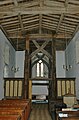 The west end of the nave in St Mary the Virgin parish church, showing the scissor-braced 15th-century frame supporting the bell-turret
 -
 Monument in St Mary's parish church to the crew of RAF Lancaster HK788
 -
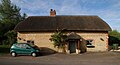 18th-century thatched cottage in Lyford
 -
 St Mary the Virgin parish church: the south side of the chancel (right) and part of the south side of the nave (left)


References[edit]
- ^ a b c d e f g h i j k Page & Ditchfield 1924, pp. 285–294
- ^ "Area selected: Vale of White Horse (Non-Metropolitan District)". Neighbourhood Statistics: Full Dataset View. Office for National Statistics. Archived from the original on 22 June 2011. Retrieved 30 March 2010.
- ^ Arkell 1942, p. 6.
- ^ a b Pevsner 1966, p. 173.
- ^ Historic England. "Manor Farmhouse and attached wall (Grade II*) (1048351)". National Heritage List for England. Retrieved 2 July 2015.
- ^ Fletcher 1968, p. 76.
- ^ Historic England. "Lyford Grange (Grade II*) (1283468)". National Heritage List for England. Retrieved 13 November 2015.
- ^ Ford, David Nash (2011). "The Arrest of St. Edmund Campion". Royal Berkshire History. Nash Ford Publishing. Archived from the original on 11 October 2013. Retrieved 22 January 2011.
- ^ a b Foley 1877, pp. 279, 280, 284
- ^ "Original record of court proceedings (National Archive E126/14)". Anglo-American Legal Tradition website.
- ^ Pevsner 1966, p. 172.
- ^ Historic England. "Church of St Mary, The Green (Grade II*) (1199327)". National Heritage List for England. Retrieved 13 November 2015.
- ^ a b Archbishops' Council. "Benefice of Cherbury with Gainfield". A Church Near You. Church of England. Archived from the original on 16 September 2009. Retrieved 2 July 2015.
- ^ Sturdy & Case 1963, p. 90.
- ^ a b c "07/08.04.1945 No, 9 Squadron Lancaster I HK788 WS-E F/O. Jeffs". Archive Report: Allied Forces. Aircrew Remembered. Retrieved 13 November 2015.
- ^ "Richard Briers". Latest News. Lincolnshire Aviation Heritage Centre. Retrieved 13 November 2015.
- ^ Coward, Noël. "Lie in the Dark and Listen". Poetry of Direct Personal Experience. Aircrew Remembered. Retrieved 13 November 2015.
Sources[edit]
- Arkell, WJ (1942). "Place-Names and Topography in the Upper Thames Country: A Regional Essay" (PDF). Oxoniensia. VII. Oxford Architectural and Historical Society: 6, 22. ISSN 0308-5562.
- Fletcher, John (1968). "Crucks In the West Berkshire and Oxford Region" (PDF). Oxoniensia. XXXIII. Oxford Architectural and Historical Society: 74, 76. ISSN 0308-5562.
- Foley, Henry (1877). Records of the English province of the Society of Jesus: historic facts illustrative of the labours and sufferings of its members in the sixteenth and seventeenth centuries. Burns & Oates. pp. 279, 280, 284. Retrieved 10 April 2009.
- Hadland, Tony (1992). Thames Valley Papists: from Reformation to Emancipation 1534–1829. Hadland Books. ISBN 0-9507431-4-3. Archived from the original on 14 March 2012.[page needed]
- Page, W.H.; Ditchfield, P.H., eds. (1924). A History of the County of Berkshire. Victoria County History. Vol. 4. assisted by John Hautenville Cope. London: The St Katherine Press. pp. 285–294.
- Pevsner, Nikolaus (1966). Berkshire. The Buildings of England. Harmondsworth: Penguin Books. pp. 172–173.
- Sturdy, David; Case, Humphrey (1963). "Notes and News" (PDF). Oxoniensia. XXVIII. Oxford Architectural and Historical Society: 90. ISSN 0308-5562.
External links[edit]

- The geographic coordinates are from the Ordnance Survey.
The District of the Vale of White Horse | ||
|---|---|---|
| Towns |  | |
| Large villages | ||
| Other civil parishes (component villages and hamlets) |
| |
| Former districts and boroughs | ||
| Former constituencies | ||
| Authority control databases: National |
|---|
