


Serbian cross
 Serbian tetragrammic cross | |
| Heraldic tradition | Byzantine |
|---|---|
| Jurisdiction | Serbia; Republika Srpska |
| Governing body | Serbian Heraldry Society |
The Serbian cross (Serbian Cyrillic: Cрпски крст, romanized: Srpski krst), also known as the Firesteels (Serbian Cyrillic: Оцила, romanized: Ocila), is one of national symbols of Serbia. It is present on the coat of arms and flag of Serbia. The cross is based on a tetragrammic cross emblem of the Palaiologos dynasty of the Byzantine Empire, with the difference in Serbian use being that the cross is usually white on a red background, rather than gold on a red background (though it can be depicted in gold as well).
It is composed of a cross symbol with four "fire striker" shapes, originally four Greek letters beta (Β). Serbian tradition attributes the letters to Saint Sava, the 13th-century Archbishop of the Serbs, and interprets the four "fire striker" shapes as four Cyrillic letters "С", for the motto Only Unity Saves the Serbs (Serbian Cyrillic: Cамо слога Србина спасава, romanized: Samo sloga Srbina spasava). The Serbian cross has been frequently used in Serbian heraldry, and along with Serbian eagle, is the main heraldic symbol which represent the national identity of the Serbian people.[1][2]
History[edit]
Crosses with firesteels have been used since Roman times, as symbols, but not as coats of arms or emblems.[3] Some historians connect it with the labarum, the Imperial flag of Constantine the Great (r. 306–337).[3] In the 6th century the cross with four fields (with either letters or heraldry) appear on Byzantine coins.[4] The symbol was adopted by the First Crusaders since the first event, People's Crusade (1096).[4]
Michael VIII Palaiologos (1261–1282) adopted the symbol when he resurrected the Byzantine Empire, with the initials (letters β) of the imperial motto of the Palaiologos dynasty: "King of Kings, help the King" (Ancient Greek: Βασιλεύ Βασιλέων Βασιλεί Βοήθει; Basileu Basileōn, Basilei Boithi).[4] It was used in flags and coins.[4] The symbol appears on the Imperial flag divellion (διβελλιον) used in front of all other banners, recorded by Pseudo-Kodinos (fl. 1347–68) wrongly[5] as "a cross with firesteels" (σταυρον μετα πυρεκβολων),[6] and depicted in the Castilian Conosçimiento de todos los reynos atlas (c. 1350).[4][7] As Alexander Soloviev writes, the use of letters in western heraldry is nonexistent.[5]

The oldest preserved historical source of the cross used in Serbia is from the Dečani oil-lamp (Dečanski polijelej), which was a gift to King Stefan Milutin (r. 1282–1321), the ktetor (founder) of Visoki Dečani, now preserved at the Monastery of Prohor Pčinjski.[8] Stojan Novaković argued that the recorded use of the Serbian cross, as a national symbol, began in 1397, during the rule of Stefan Lazarević.[9] Serbian historian Stanoje Stanojević argued that it entered its use in 1345, with Stefan Dušan's elevation to Emperor.[10] In the Middle Ages, both the "Greek style", with closed fire-steels (β–B), and the "Serbian syle", with open fire-steels (C-S), were used in Serbia.[5]
A 1439 map by Gabriel de Vallseca used both the Serbian cross and eagle when depicting Serbia.
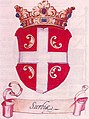
In South Slavic heraldic sources (also known as Illyrian Armorials), the Serbian cross is found in the Korenić-Neorić Armorial (1595), which shows the coat of arms of Serbia (Svrbiae) as a white cross over a red background, with four firesteels, also depicting the Mrnjavčević noble house with the same design, with inverted colours and the Serbian eagle in the center of the cross. According to Mavro Orbini (1607), it was used by Vukašin Mrnjavčević (King, 1365–1371) and Prince Lazar Hrebeljanović (r. 1371–1389).[10] Next, it is found in the Belgrade Armorial II (ca. 1600–1620), the Fojnica Armorial (between 1675 and 1688), the Armorial of Stanislaus Rubcich (c. 1700), and Stemmatographia (1741), while still continuing to be used in foreign heraldic sources.
The Metropolitanate of Karlovci, established in 1691, adopted it in its seal.
After the Serbian Revolution, the Serbian cross then appeared on all official Serbian coats of arms, except the Serbian coat of arms adopted in 1947, which had the cross removed, leaving four stylized S; this was done symbolically by the Yugoslav government to "socially curtail and politically marginalize religious communities and religion in general".[11] Miloš Obrenović adopted the Serbian cross as the military flag when forming the first units of the regular army in 1825.[12]
Gallery[edit]
Historical[edit]
Flags[edit]
-
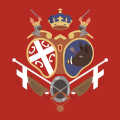 Revolutionary Serbia (1804-1812)
 -
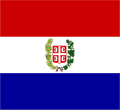 Principality of Serbia (1835)
 -
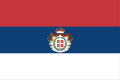 Principality of Serbia (1835–1882)
 -
 Serbian Vojvodina (1848–1849)
 -
 Kingdom of Serbia (1882–1918)
 -
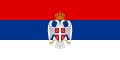 Republic of Serbian Krajina (1992–1995)
 -
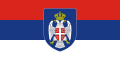 Eastern Slavonia, Baranja and Western Syrmia (1995–1998)
 -
 Republic of Serbia (2004–2010)

.svg)
.svg)


.svg)

.svg)
Coat of arms and seals[edit]
-
 Mrnjavčević family,
(c. 1370) -

-
-
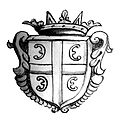 Serbs,
ed. of Mavro Orbini's Regno degli Slavi (1601) -
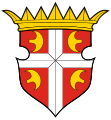
-
 Metropolitanate of Karlovci (1713)
 -
 Revolutionary Serbia (1805–1813)
 -
 Prince Miloš I
(1817–1835) -
 Principality of Serbia
(1835–1882) -
 Serbian Vojvodina
(1848–1849) -
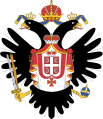 Voivodeship of Serbia and Ban. of Temeschwar
(1849–1860) -
 King Milan I
(1878–1889) -
 King Peter I
(1903–1918) -
 Obrenović dynasty (1882–1903)
 -
 Karađorđević dynasty
(1903–1918) -
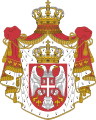 Kingdom of Serbia (1882–1918)
 -
 Kingdom of Yugoslavia (1918–1944)
 -
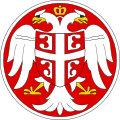 Government of National Salvation (1941–1944)
 -
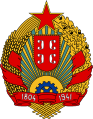 Socialist Republic of Serbia (1947–1992) and Republic of Serbia (1992–2004)
 -
 Republic of Serbian Krajina (1992–1995)
 -
 Republika Srpska (1992–2006)
 -
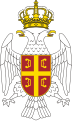 Eastern Slavonia, Baranja and Western Syrmia (1995–1998)
 -
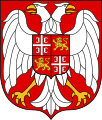
-
 Republic of Serbia (2004–2010)
 -
 Republic of Serbia (2004–2010)

,_prema_portolanu_Gabriel_de_Vallseca.jpg)


_(14th_century).svg)


.png)


.svg)


.svg)


.svg)
.svg)
Current[edit]
National[edit]
-
 State flag of the Republic of Serbia
 -
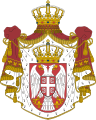 Greater coat of arms of the Republic of Serbia
 -
 Lesser coat of arms of the Republic of Serbia


Regional[edit]
-
 Traditional flag of Vojvodina
 -
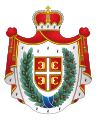 Traditional coat of arms of Vojvodina


Local[edit]
-
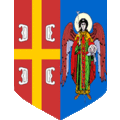 Aranđelovac (Serbia)
 -
 Barajevo (Serbia)
 -
 Kragujevac (Serbia)
 -
 Ljubovija (Serbia)
 -
 Mladenovac (Serbia)
 -
 Rača (Serbia)
 -
 Srpska Crnja (Serbia)
 -
 Surdulica (Serbia)
 -
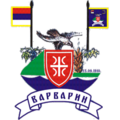 Varvarin (Serbia)
 -
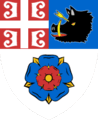 Voždovac (Serbia)
 -
 Vračar (Serbia)
 -
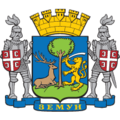 Zemun (Serbia)
 -
 Zvezdara (Serbia)
 -
 Gradiška
(Republika Srpska, BiH) -
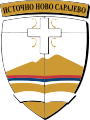 Istočno Novo Sarajevo
(Republika Srpska, BiH) -
 Kotor Varoš
(Republika Srpska, BiH) -
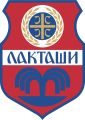 Laktaši
(Republika Srpska, BiH) -
 Srbac
Srbac
(Republika Srpska, BiH) -
 Šipovo
(Republika Srpska, BiH) -
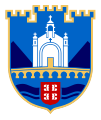 Višegrad
(Republika Srpska, BiH) -
 Staro Nagoričane
(North Macedonia)


.png)


.svg)
.svg)
.svg)

.svg)
.svg)

Other usage[edit]
Military[edit]
-
 Shoulder patch on service uniforms of the Serbian Armed Forces
 -
 Shoulder patch on combat uniforms of the Serbian Armed Forces


-
 Emblem of Serbian Volunteer Corps (Ljotićevci) paramilitary organization
(1941–1945) -
 Emblem of Serb Volunteer Guard (Arkanovci) paramilitary unit (1990–1996)
 -
 Emblem of Serbian Guard paramilitary unit
(1991–1992)


Police[edit]
-
 Emblem of the Police Helicopter Unit
 -
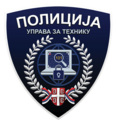 Emblem of the Police Technical Directorate


Intelligence[edit]
-
 Emblem of the Security Intelligence Agency
 -
 Emblem of the State Security Directorate (1991-2002)


Orders and decorations[edit]


Science and arts[edit]
-
 Member badge of the Serbian Academy of Sciences and Arts

Religious[edit]
-
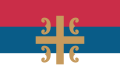 Flag of the Serbian Orthodox Church
 -
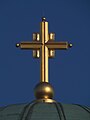 Serbian cross on the dome of the Church of Saint Sava in Belgrade


Sports[edit]
-
 Logo of the Olympic Committee of Serbia

Miscellaneous[edit]
-
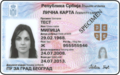
-

-
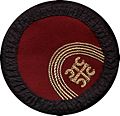
-
 Česnica, Serbian Christmas bread


See also[edit]
References[edit]
- ^ Atlagić 2009, p. 180.
- ^ Anarheologija Slika 5: Srpski štit, grb Despotovine od početka XV veka.
- ^ a b Atlagić 1997, p. 1.
- ^ a b c d e Atlagić 1997, p. 2.
- ^ a b c Atlagić 1997, p. 3.
- ^ Palavestra 1998, p. 1.
- ^ "Other Byzantine flags shown in the "Book of All Kingdoms" (14th century)". Flags of the World. Retrieved 2010-10-10.
- ^ Atlagić 2009, p. 182.
- ^ Atlagić 1997, p. 4.
- ^ a b Atlagić 1997, p. 5.
- ^ Mitja Velikonja (2003). Religious Separation and Political Intolerance in Bosnia-Herzegovina. Texas A&M University Press. pp. 187–. ISBN 978-1-60344-724-9.
nations (in a symbolical sense as well, for example, by removing the cross from the Serbian coat of arms but keeping the four stylized esses), and to socially curtail and politically marginalize religious communities and religion in general.
- ^ Posebna izdanja 295. SANU. 1957. p. 133.
Sources[edit]
- Atlagić, Marko (1997). "The cross with symbols S as heraldic symbols" (PDF). Baština. 8: 149–158. Archived from the original (PDF) on May 21, 2013.
- Atlagić, Marko (2009). "Određivanje nacionalnih heraldičkih simbola na primjeru Srba i Hrvata" [Étude des symboles nationaux héraldiques à l' exemple des Serbes et des Croates] (PDF). Zbornik radova Filozofskog fakulteta u Prištini. 39: 179–188.
- Atlagić, Marko (2007). "Dečanski polijelej" (PDF). Baština. 22: 245–250.
- Milićević, Milić (1995). Grb Srbije: razvoj kroz istoriju. Službeni glasnik. ISBN 9788675490470.
- Palavestra, Aleksandar (June 1998). "O ocilima" (PDF). Glasnik SHD (in Serbian). Archived from the original (PDF) on 2013-10-29.
- Solovjev, Aleksandar Vasiljevič (1958). Istorija srpskog grba. Srpska misao.
- Stanojević, Stanoje (1934). "O srpskom grbu". Iz naše prošlosti. Belgrade: Geca Kon A. D. pp. 85–90.
External links[edit]

- Борис Субашић (16 March 2014). "Србија сачувала симболе Византије" (in Serbian). Novosti.

| In modern use |
|  |
|---|---|---|
| Historical |
| |
| By function | ||
| Christograms, Chrismons | ||
| See also | ||
.svg)
.svg)

.svg)
.svg)

.svg)


.svg)


.svg)

.svg)
.svg)


.svg)
.svg)
.svg)

.svg)


.svg)
.svg)

.svg)

.svg)
.svg)
.svg)
.svg)
.svg)
.svg)
.svg)
.svg)
.svg)


.svg)
.svg)
.svg)


.svg)
.svg)
.svg)


.svg)

.svg)
.svg)
.svg)
.svg)
.svg)


.svg)
.svg)
.svg)
.svg)
.svg)


.svg)


.svg)


.svg)

.svg)


.svg)
.svg)


.svg)
.svg)


.svg)


.svg)


.svg)
.svg)
.svg)


.svg)
.svg)

.svg)

_Swastika_(%D0%A1%D0%B2%D0%B0%D1%81%D1%82%D0%B8%D0%BA%D0%B0)_-_Rodnovery.svg)


.svg)


.svg)


