Evol (Sonic Youth album)
| EVOL | ||||
|---|---|---|---|---|
 | ||||
| Studio album by | ||||
| Released | May 1986 | |||
| Recorded | March 1986 | |||
| Studio | BC Studio, Brooklyn, New York, United States | |||
| Genre | ||||
| Length | 36:08 | |||
| Label | SST (059) | |||
| Producer |
| |||
| Sonic Youth chronology | ||||
| ||||
| Singles from EVOL | ||||
| ||||
EVOL is the third full-length studio album by the American alternative rock band Sonic Youth. Released in May 1986, EVOL was Sonic Youth’s first album on SST Records, and also the first album to feature then-new drummer Steve Shelley who had just replaced Bob Bert.
In retrospective reviews, critics cite EVOL as marking Sonic Youth’s transition from their no wave roots toward a greater pop sensibility, while bassist Kim Gordon has referred to it as the band’s “goth record.” Pitchfork has praised the album, saying that EVOL "[was] where the seeds of greatness were sown", and placed the album 31st on their Top 100 Albums of the 1980s list, alongside Sonic Youth's next two albums, Sister and Daydream Nation, which ranked 14th and first, respectively.[1]
Background and recording[edit]
In June 1985, during the Bad Moon Rising tour, Bert left the band and was replaced by Shelley. The new lineup quickly began working on new material for their third album. The band signed to SST as, by 1986, label founder Greg Ginn was anxious for the label to move away from its American hardcore roots. Sonic Youth took a break from the tour and finished the writing for EVOL. In March 1986, the band recorded the album at BC Studio with Martin Bisi.[2] EVOL was the second time that the band had worked with New York singer and performance artist Lydia Lunch. Lunch had shared vocals on Bad Moon Rising's "Death Valley '69", and on this record, she co-wrote the song "Marilyn Moore".
Mike Watt played bass guitar on the tracks "In the Kingdom #19" and the band's cover of "Bubblegum". The band encouraged him to play on the former track shortly after Watt's fellow Minutemen band member D. Boon died in a car crash. Coincidentally, the song is also about a car crash. Watt had entered a severe depression following Boon's death and was considering leaving his career in music behind. He credited the time he spent with the members of Sonic Youth during the recording of EVOL as a major factor in his decision to re-enter the music world.[2][3] Watt's next band, Firehose, would support Sonic Youth on their Flaming Telepaths tour.[4] During this time, the band began the Ciccone Youth project, which featured all members of Sonic Youth and Watt. They released a single consisting of three tracks: "Into the Groove(y)" (a cover of Madonna's hit "Into the Groove", incorporating snippets of her recording) and the short "Tuff Titty Rap" on the A-side (both performed by the Sonic Youth members), and "Burnin' Up" (performed by Watt with additional guitars by Ginn) on the B-side. The project resulted in 1988's The Whitey Album.
On the vinyl version of the album, the time length for "Expressway to Yr. Skull" was indicated by the infinity symbol (∞); the final moment of the song featured a locked groove that repeatedly plays the last few seconds of a song, making it theoretically endless. The CD version added a bonus track: the band's cover of the Kim Fowley tune "Bubblegum". According to Watt, he and Shelley played the basic rhythm track over the actual Fowley record, which was afterwards removed when the other members added their parts.[5]
Packaging[edit]
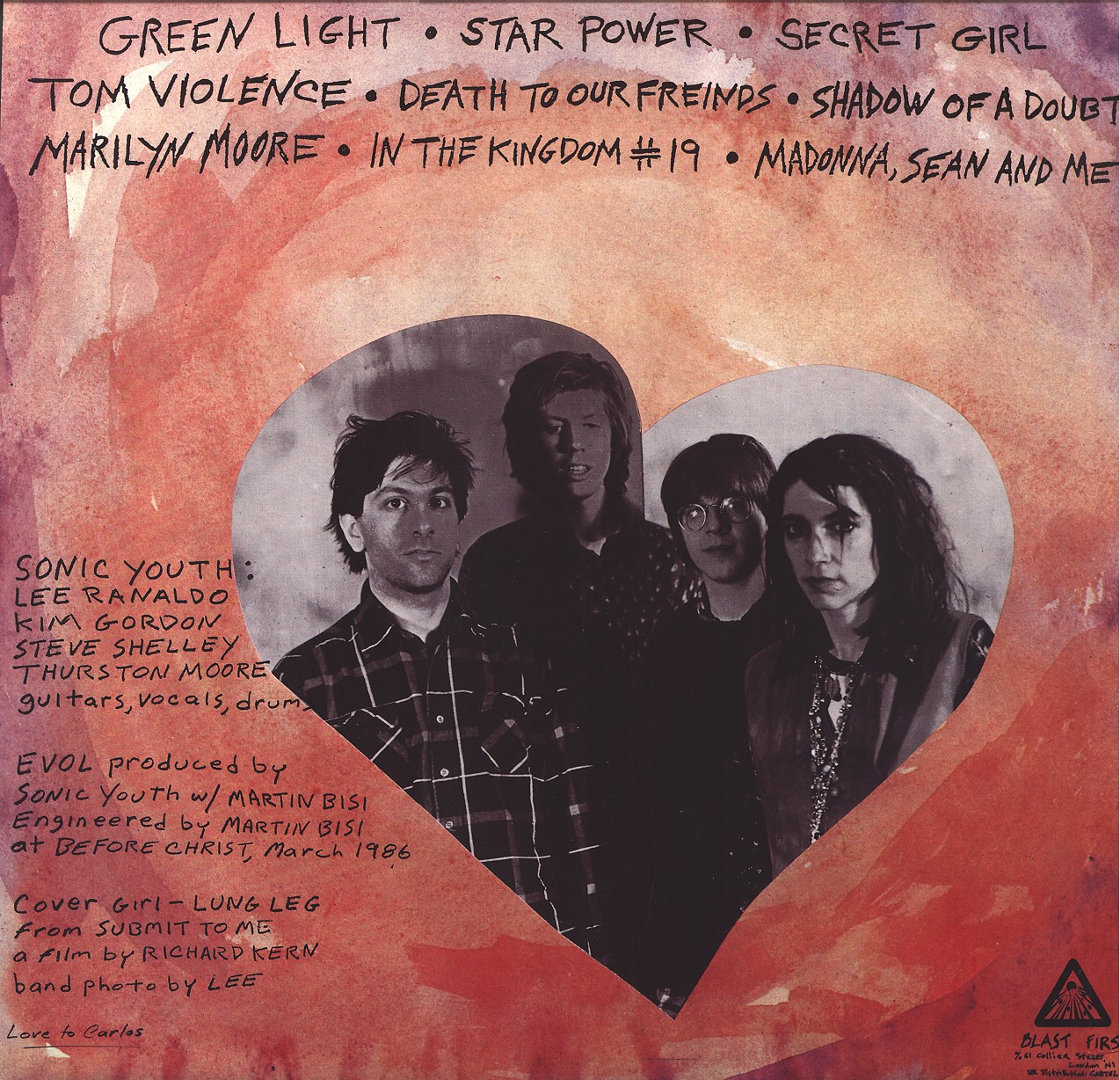
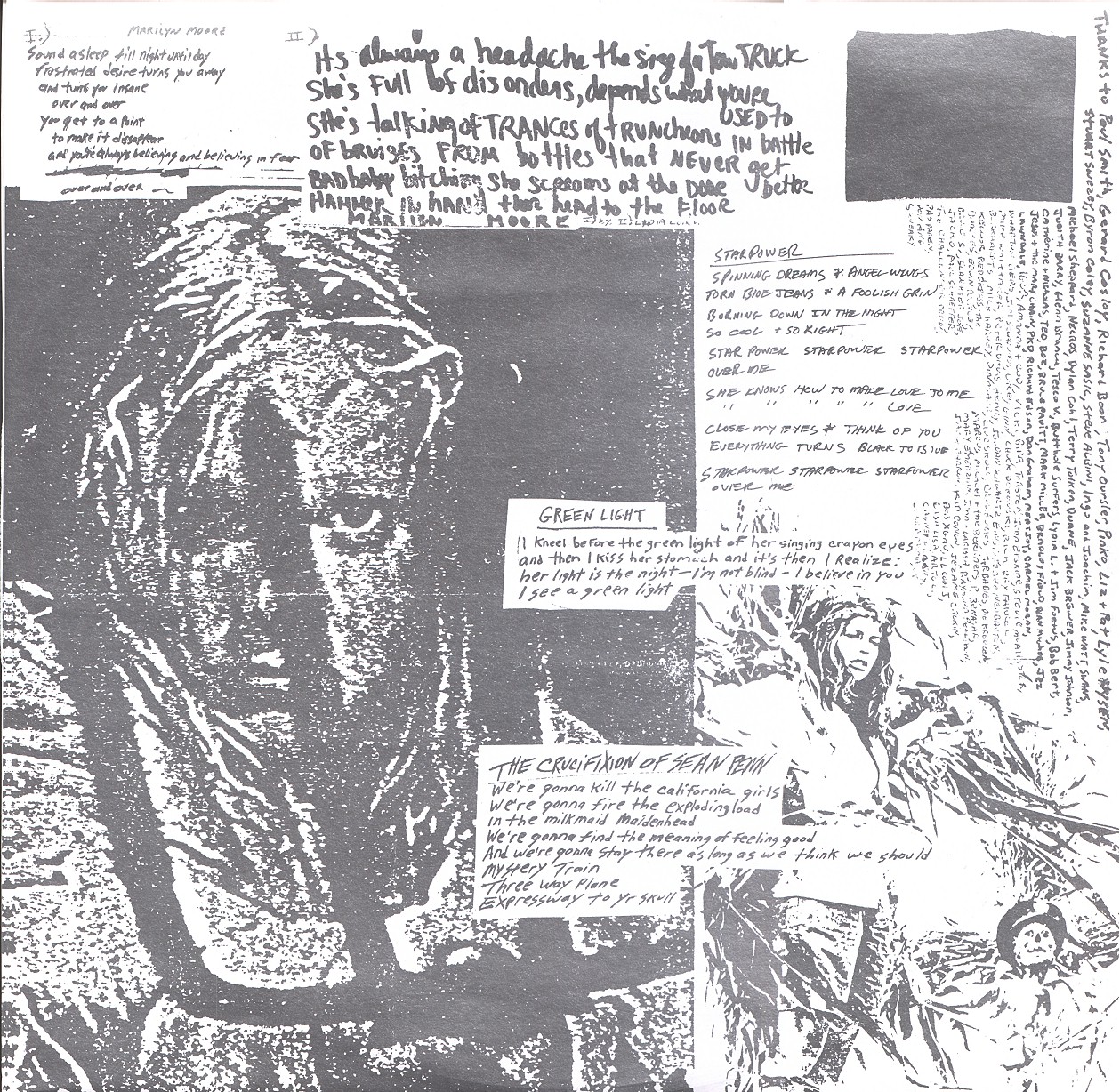
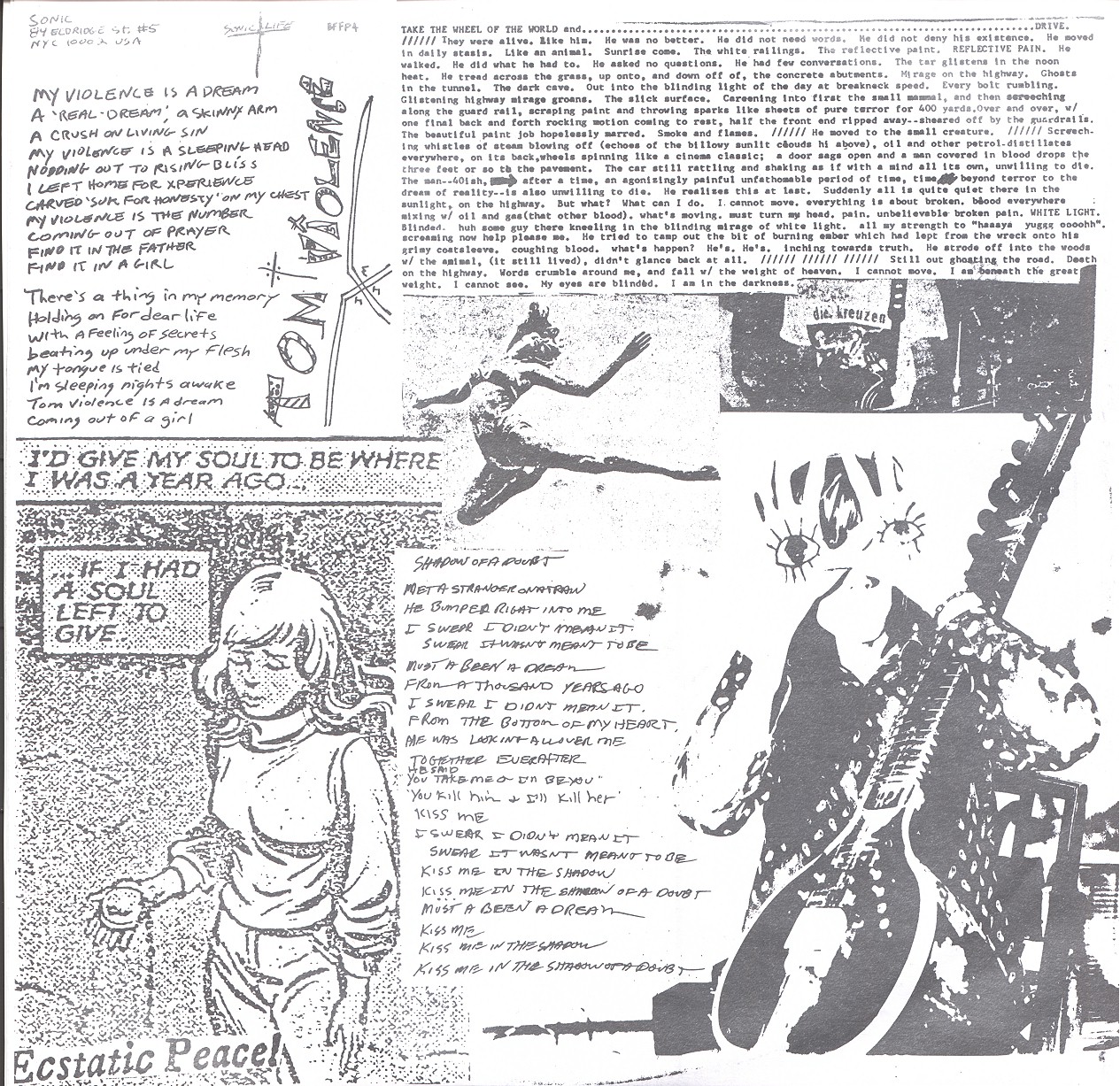
The album cover features a picture of model/actress Lung Leg, a still taken from the Richard Kern film Submit to Me.[3] Leg had previously appeared in the "Death Valley '69" music video (directed by Kern and Judith Barry). The back cover shows a black-and-white picture of the band in a heart-shaped frame. The album's 10 songs are listed in a different order than the actual track listing. The members' names are listed on the back cover as well, although no instruments are assigned for them. It reads "guitars, vocals, drums", with "bass" hidden beneath the photograph of the band.[6] The insert features the lyrics to the songs and the A-side depicts Thurston Moore, with eyes drawn on his hands, holding them up to his face. This photograph was later used for the cover of the "Starpower" single. To the left of this photograph is a panel from the Marvel comic book The New Mutants (found on the second page of issue #14, published April 1984). The other side contains pictures from horror movies Friday the 13th Part 2 and Children of the Corn, with a still photo from the 1962 film House of Women featuring stars Constance Ford (sticking out her tongue) and Barbara Nichols in the upper right corner. This image is only featured on the initial SST vinyl pressing and vinyl reissues after 2010. It was blacked out for all other releases.[7]
Promotion[edit]
Sonic Youth debuted the new material for EVOL on April 12, 1986 in Austin, Texas; a recording of that show was later released in 1992 as Live at the Continental Club. EVOL was released in May 1986 by SST on vinyl and cassette. The band toured Europe in May and June, performing tracks from the album (although "In the Kingdom #19" and "Bubblegum" were never played live). The band also debuted "White Kross", which was later featured on Sister. Following the European tour, they toured America in June and July.[2] In July, the band released the only single from EVOL, "Starpower". It was backed by "Bubblegum" and an edited version of "Expressway to Yr. Skull". A video was never released for "Starpower". However, a video for "Shadow of a Doubt" was released, directed by Kevin Kerslake and featuring Gordon sitting on a train.[8] After the tour, the band recorded the Made in USA soundtrack, but it was not released until 1995.[9] EVOL was released on CD in late 1986.
Critical reception[edit]
| Review scores | |
|---|---|
| Source | Rating |
| AllMusic |   [10] [10] |
| Blender |  [11] [11] |
| Chicago Tribune | [12] |
| Encyclopedia of Popular Music | [13] |
| Pitchfork | 9.4/10[14] |
| Q | [15] |
| The Rolling Stone Album Guide | [16] |
| Spin | [17] |
| Spin Alternative Record Guide | 8/10[18] |
| The Village Voice | B+[19] |
EVOL has been well received by critics. Robert Christgau, with whom the band had sparred in previous years, gave the album a B+.[19] It ranked number 4 among the "Albums of the Year" by NME.[20] Slant Magazine, who placed EVOL at number 82 on their Best Albums of the 1980s list, described it as "one of [Sonic Youth's] strangest albums" and "a difficult album that's nonetheless one of the best latter-day invocations of no wave chaos."[21] Pitchfork described the album as "the true departure point of Sonic Youth's musical evolution – in measured increments, Thurston Moore and Lee Ranaldo began to bring form to the formless, tune to the tuneless, and with the help of Steve Shelley's drums, they imposed melody and composition on their trademark dissonance." Pitchfork went on to say that EVOL "[was] where the seeds of greatness were sown",[1] and placed it 31st on their list of the Top 100 Albums of the 1980s.[1] Trouser Press labeled it "a near-masterpiece",[22] and Stephen Thomas Erlewine of AllMusic gave it a 4.5-star review, writing that EVOL is "a stunningly fluent mixture of avant-garde instrumentation and subversions of rock & roll."[10]
Track listing[edit]
All tracks are written by Sonic Youth (Thurston Moore, Kim Gordon, Lee Ranaldo, Steve Shelley), except where noted
| No. | Title | Lyrics | Vocals | Length |
|---|---|---|---|---|
| 1. | "Tom Violence" | Moore | Moore | 3:05 |
| 2. | "Shadow of a Doubt" | Gordon | Gordon | 3:32 |
| 3. | "Starpower" | Moore | Gordon | 4:48 |
| 4. | "In the Kingdom #19" | Ranaldo | Ranaldo | 3:24 |
| 5. | "Green Light" | Moore | Moore | 3:46 |
| No. | Title | Lyrics | Vocals | Length |
|---|---|---|---|---|
| 6. | "Death to Our Friends" | 3:16 | ||
| 7. | "Secret Girl" | Gordon | Gordon | 2:54 |
| 8. | "Marilyn Moore" | Lydia Lunch, Moore | Moore | 4:04 |
| 9. | "Expressway to Yr. Skull" | Moore | Moore | 7:19 |
| No. | Title | Writer(s) | Vocals | Length |
|---|---|---|---|---|
| 10. | "Bubblegum" (Kim Fowley cover) | Fowley | Gordon, Ranaldo | 2:49 |
| No. | Title | Length |
|---|---|---|
| 1. | "Green Light" | 3:37 |
| 2. | "Starpower" | 4:53 |
| 3. | "Secret Girl" | 2:54 |
| 4. | "Tom Violence" | 3:06 |
| 5. | "Death to Our Friends" | 3:15 |
| 6. | "Shadow of a Doubt" | 3:35 |
| 7. | "Marilyn Moore" | 4:04 |
| 8. | "In the Kingdom #19" | 3:24 |
| 9. | "Madonna, Sean and Me" | 7:20 |
| 10. | "Bubblegum" | 3:00 |
- Note: "Expressway to Yr. Skull" was listed on the back cover as "Madonna, Sean and Me" and on the lyric sheet as "The Crucifixion of Sean Penn".
- Note: "Secret Girl" was listed as "Secret Girls" on the inner label of the LP release.
Personnel[edit]
Sonic Youth
- Thurston Moore – vocals, guitar, synthesizer, production
- Kim Gordon – vocals, bass guitar, guitar, piano ("Shadow of a Doubt"), production
- Lee Ranaldo – guitar, vocals, production, sleeve photography
- Steve Shelley – drums, programming, production
Guest musicians
- Mike Watt – bass guitar ("In the Kingdom #19", "Bubblegum")
Production
- Martin Bisi – production, engineering
- JG (John Golden) – mastering
Release history[edit]
| Region | Date | Distributing label | Format[2] |
|---|---|---|---|
| US, UK | May, 1986 | SST Records, Blast First | Vinyl, cassette |
| UK | November, 1986 | Blast First | CD |
| US | 1987 | SST Records | CD |
| US | 1990 | SST Records | Pink vinyl |
| US | 1994 | DGC | CD, Cassette |
| Europe, Japan | 1994 | Geffen | CD |
| UK | April 1996 | Mute | Vinyl |
| US | 2010 | ORG Music | Pink vinyl |
References[edit]
- ^ a b c "Staff Lists: Top 100 Albums of the 1980s". Pitchfork. November 20, 2002. Archived from the original on August 15, 2014. Retrieved October 15, 2012.
- ^ a b c d "Sonic Youth EVOL". sonicyouth.com. Retrieved May 11, 2013.
- ^ a b Browne, David (2009). Goodbye 20th Century: A Biography of Sonic Youth. Da Capo Press. ISBN 978-0-306-81603-1.
- ^ Lawrence, Chris. "Flaming Telepaths Tour". The Sonic Youth Concert Chronology. Retrieved July 24, 2014.
- ^ "[September 1, 2008 episode]" (MP3). The Watt from Pedro Show. September 1, 2008. Retrieved October 15, 2012.
- ^ "Sonic Youth EVOL back cover". sonicyouth.com. Retrieved May 11, 2013.
- ^ "Sonic Youth EVOL inner A". sonicyouth.com. Retrieved May 11, 2013.
- "Sonic Youth EVOL inner B". sonicyouth.com. Retrieved May 11, 2013. - ^ "Sonic Youth Shadow of a Doubt". SonicyouthTV. Archived from the original on 2021-12-13. Retrieved May 11, 2013.
- ^ "Sonic Youth Discography - Made in USA". Retrieved March 12, 2008.
- ^ a b Erlewine, Stephen Thomas. "EVOL – Sonic Youth". AllMusic. Retrieved October 15, 2012.
- ^ Wolk, Douglas (October 2006). "Back Catalogue: Sonic Youth". Blender (52): 154–55.
- ^ Kot, Greg (September 27, 1992). "The Evolution Of Sonic Youth". Chicago Tribune. Retrieved June 20, 2013.
- ^ Larkin, Colin (2011). The Encyclopedia of Popular Music (5th concise ed.). Omnibus Press. ISBN 978-0-85712-595-8.
- ^ Pelly, Jenn (May 9, 2019). "Sonic Youth: EVOL". Pitchfork. Retrieved May 9, 2019.
- ^ "Sonic Youth: Evol". Q (118): 144. July 1996.
- ^ Sheffield, Rob (2004). "Sonic Youth". In Brackett, Nathan; Hoard, Christian (eds.). The New Rolling Stone Album Guide (4th ed.). Simon & Schuster. pp. 758–59. ISBN 0-7432-0169-8.
- ^ Azerrad, Michael (September 2007). "Discography: Thurston Moore". Spin. 23 (9): 74. Retrieved May 9, 2017.
- ^ Weisbard, Eric; Marks, Craig, eds. (1995). Spin Alternative Record Guide. Vintage Books. ISBN 0-679-75574-8.
- ^ a b Christgau, Robert (September 2, 1986). "Christgau's Consumer Guide". The Village Voice. Retrieved June 19, 2016.
- ^ "Albums and Tracks of the Year". NME. 2018. Retrieved September 19, 2018.
- ^ "Best Albums of the 1980s". Slant Magazine. March 5, 2012. Retrieved October 15, 2012.
- ^ Kot, Greg; Leland, John; Sheridan, David; Robbins, Ira; Pattyn, Jay. "Sonic Youth". trouserpress.com. Retrieved April 14, 2013.
External links[edit]
| Studio albums | |
|---|---|
| Extended plays | |
| Live albums | |
| Compilations | |
| Other albums | |
| SYR series | |
| Singles |
|
| Video albums | |
| Books | |
| Side projects | |
| Related articles | |