


Clupeiformes
| Clupeiformes Temporal range:
| |
|---|---|

| |
| Atlantic herring, Clupea harengus | |
Scientific classification 
| |
| Domain: | Eukaryota |
| Kingdom: | Animalia |
| Phylum: | Chordata |
| Class: | Actinopterygii |
| Cohort: | Otocephala |
| Superorder: | Clupeomorpha |
| Order: | Clupeiformes Goodrich, 1909 |
| Type species | |
| Clupea harengus | |
| Families | |
|
See text | |
Clupeiformes /ˈkluːpiːɪfɔːrmiːz/ is the order of ray-finned fish that includes the herring family, Clupeidae, and the anchovy family, Engraulidae. The group includes many of the most important forage and food fish.
Clupeiformes are physostomes, which means that their gas bladder has a pneumatic duct connecting it to the gut. They typically lack a lateral line, but still have the eyes, fins and scales that are common to most fish, though not all fish have these attributes. They are generally silvery fish with streamlined, spindle-shaped bodies, and they often school. Most species eat plankton which they filter from the water with their gill rakers.[2]
The former order of Isospondyli was subsumed mostly by Clupeiformes,[3] but some isospondylous fishes (isospondyls) were assigned to Osteoglossiformes, Salmoniformes, Cetomimiformes, etc.[4]
Their sister group were the extinct Ellimmichthyiformes, which were dominant throughout much of the Cretaceous and into the Paleogene,[5] and often coexisted with clupeiforms at many known localities. Both groups closely resembled each other morphologically, although the ellimmichthyiformes evolved some highly divergent body plans later in the Cretaceous.
Several fossil clupeiforms are known from the Early Cretaceous of South America that appear to be more closely allied with Clupeioidei over the Denticipitidae. This suggests a very deep divergence within the crown group Clupeiformes that must have occurred during the Early Cretaceous or before.[6][7]
Families[edit]
| Phylogeny of Clupeiformes by Lavoué et al 2014.[8] | |||||||||
|
The order includes about 405 species in eleven families:[9][10]
- Order Clupeiformes
- Genus †Histiothrissa
- Genus †Santanaclupea
- Genus †Spratticeps
- Suborder Denticipitoidei
- Family Denticipitidae (denticle herring)
- Suborder Clupeoidei
- Genus †Nolfia[11]
- Genus †Pseudoellima[6]
- Family †Cynoclupeidae[7]
- Family Engraulidae (anchovies)
- Subfamily Coiliinae
- Subfamily Engraulinae
- Family Spratelloididae
- Family Pristigasteridae (longfin herrings)
- Subfamily Pristigasterinae
- Subfamily Pelloninae
- Family Chirocentridae (wolf herrings)
- Family Dussumieriidae (round herrings)
- Family Clupeidae (herrings)
- Family Ehiravidae
- Family Alosidae (shads, sardines and menhadens)
- Family Dorosomatidae
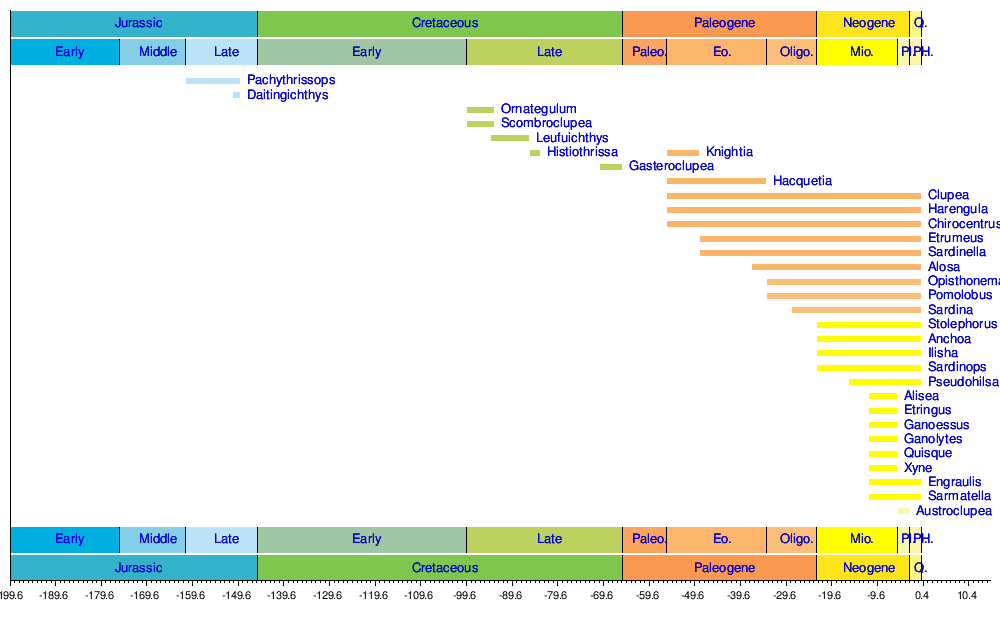
Timeline of genera[edit]
References[edit]
- ^ De Figueiredo, Francisco J. (2009-12-12). "A new clupeiform fish from the Lower Cretaceous (Barremian) of Sergipe-Alagoas Basin, northeastern Brazil". Journal of Vertebrate Paleontology. 29 (4): 993–1005. doi:10.1671/039.029.0402. ISSN 0272-4634.
- ^ Nelson, Gareth (1998). Paxton, J.R.; Eschmeyer, W.N. (eds.). Encyclopedia of Fishes. San Diego: Academic Press. pp. 91–95. ISBN 0-12-547665-5.
- ^ Journal of Ichthyology. Vol. 46. Scripta. 2006. p. S40.
within Isospondyli (= Clupeiformes s. lato)
- ^ lfonso L. Rojo (2017). Dictionary of Evolutionary Fish Osteology. CRC. p. 170. ISBN 978-1-351-36604-5.
Under the name Isospondyli, Regan (1909) grouped the fishes having the verterbrae immediately after the skull similar in shape to the remaining ones, in contrast to the ostariophysans, in which the anterior vertebrae are greatly modified. Modern classifications have rejected this artificially constructed group, and the fishes previously assigned to it have been distributed among different orders (Clupeiformes, Osteoglossiformes, Salmoniformes, Cetomimiformes, etc.)
- ^ Nelson, Joseph S.; Grande, Terry C.; Wilson, Mark V. H. (2016-02-22). Fishes of the World. Wiley. doi:10.1002/9781119174844. ISBN 978-1-118-34233-6.
- ^ a b Francisco J. De Figueiredo (2009). "A new clupeiform fish from the Lower Cretaceous (Barremian) of Sergipe-Alagoas Basin, Northeastern Brazil". Journal of Vertebrate Paleontology. 29 (4): 993–1005. Bibcode:2009JVPal..29..993D. doi:10.1671/039.029.0402. S2CID 220436023.
- ^ a b Malabarba, Maria C.; Dario, Fabio Di (2017). "A new predatory herring-like fish (Teleostei: Clupeiformes) from the early Cretaceous of Brazil, and implications for relationships in the Clupeoidei". Zoological Journal of the Linnean Society. 180 (1): 175–194.
- ^ Sébastien Lavoué, Peter Konstantinidis & Wei-Jen Chen: Progress in Clupeiform Systematics. in Konstantinos Ganias (Hrsg.): Biology and Ecology of Sardines and Anchovies. CRC Press, 2014, ISBN 978-1482228540
- ^ Froese, Rainer, and Daniel Pauly, eds. (2023). "Clupeiformes" in FishBase. July 2023 version.
- ^ Lavoue ´ S; Miya M; Musikasinthorn P; Chen W-J; Nishida M (2013). "Mitogenomic Evidence for an Indo-West Pacific Origin of the Clupeoidei (Teleostei: Clupeiformes)". PLOS ONE. 8 (2): e56485. Bibcode:2013PLoSO...856485L. doi:10.1371/journal.pone.0056485. PMC 3576394. PMID 23431379.
- ^ De Figueiredo, Francisco J. (2009-07-21). "A new marine clupeoid fish from the Lower Cretaceous of the Sergipe-Alagoas Basin, northeastern Brazil". Zootaxa. 2164 (1): 21–32. doi:10.11646/zootaxa.2164.1.2. ISSN 1175-5334.
- Sepkoski, Jack (2002). "A compendium of fossil marine animal genera". Bulletins of American Paleontology. 363: 1–560. Archived from the original on 2009-02-20. Retrieved 2011-05-17.
| About fish |  | ||||
|---|---|---|---|---|---|
| Anatomy and physiology | |||||
| Sensory systems | |||||
| Reproduction | |||||
| Locomotion | |||||
| Other behaviour | |||||
| By habitat | |||||
| Other types | |||||
| Commerce |
| ||||
| Major groups | |||||
| Lists | |||||


