


Eel
| Eels Temporal range:
| |
|---|---|

| |
| Anguilla japonica | |
Scientific classification 
| |
| Domain: | Eukaryota |
| Kingdom: | Animalia |
| Phylum: | Chordata |
| Class: | Actinopterygii |
| Superorder: | Elopomorpha |
| Order: | Anguilliformes L. S. Berg, 1943 |
| Type genus | |
| Anguilla | |
| Suborders | |
Eels are ray-finned fish belonging to the order Anguilliformes (/æŋˈɡwɪlɪfɔːrmiːz/), which consists of eight suborders, 20 families, 164 genera, and about 1000 species.[3][4] Eels undergo considerable development from the early larval stage to the eventual adult stage and are usually predators.
The term "eel" is also used for some other eel-shaped fish, such as electric eels (genus Electrophorus), swamp eels (order Synbranchiformes), and deep-sea spiny eels (family Notacanthidae). However, these other clades, with the exception of deep-sea spiny eels, whose order Notacanthiformes is the sister clade to true eels, evolved their eel-like shapes independently from the true eels. As a main rule, most eels are marine. Exceptions are the catadromous genus Anguilla and the freshwater moray,[5] which spend most of their life in freshwater, the anadromous rice-paddy eel, which spawns in freshwater, and the freshwater snake eel Stictorhinus.[6]
Description
[edit]
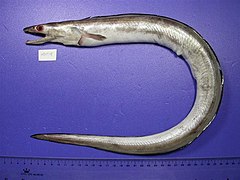
Eels are elongated fish, ranging in length from 5 cm (2 in) in the one-jawed eel (Monognathus ahlstromi) to 4 m (13 ft) in the slender giant moray.[7] Adults range in weight from 30 g (1 oz) to well over 25 kg (55 lb). They possess no pelvic fins, and many species also lack pectoral fins. The dorsal and anal fins are fused with the caudal fin, forming a single ribbon running along much of the length of the animal.[1] Eels swim by generating waves that travel the length of their bodies. They can swim backward by reversing the direction of the wave.[8]
Most eels live in the shallow waters of the ocean and burrow into sand, mud, or amongst rocks. Most eel species are nocturnal, and thus are rarely seen. Sometimes, they are seen living together in holes or "eel pits". Some eels also live in deeper water on the continental shelves and over the slopes deep as 4,000 m (13,000 ft). Only members of the Anguilla regularly inhabit fresh water, but they, too, return to the sea to breed.[9]
The heaviest true eel is the European conger. The maximum size of this species has been reported as reaching a length of 3 m (10 ft) and a weight of 110 kg (240 lb).[10] Other eels are longer, but do not weigh as much, such as the slender giant moray, which reaches 4 m (13 ft).[11]
Life cycle
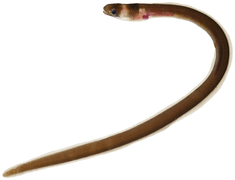
[edit]Eels begin life as flat and transparent larvae, called leptocephali. Eel larvae drift in the sea's surface waters, feeding on marine snow, small particles that float in the water. Eel larvae then metamorphose into glass eels and become elvers before finally seeking out their juvenile and adult habitats.[7] Some individuals of anguillid elvers remains in brackish and marine areas close to coastlines,[12] but most of them enter freshwater where they travel upstream and are forced to climb up obstructions, such as weirs, dam walls, and natural waterfalls.

-
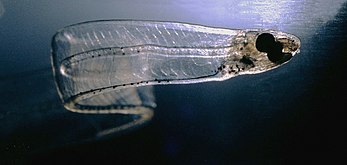 Eel eggs hatch firstly into the leptocephalus larval stage.
 -
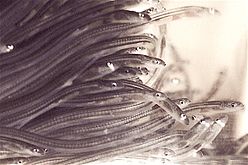 Larval eels become glass eels as they transition from the ocean to fresh water.


-
 As freshwater elvers, eels work their way upstream.
 -
 Mature silver stage eels migrate back to the ocean to mate.


Gertrude Elizabeth Blood found that the eel fisheries at Ballisodare were greatly improved by the hanging of loosely plaited grass ladders over barriers, enabling elvers to ascend more easily.[13]
Classification
[edit]| This article is part of a series on |
| Commercial fish |
|---|
 |
| Large predatory |
| Forage |
| Demersal |
| Mixed |
Several sets of classifications of eels exist; some, such as FishBase which divide eels into 20 families, whereas other classification systems such as ITIS and Systema Naturae 2000 include additional eel families, which are noted below.
Genomic studies indicate that there is a monophyletic group that originated among the deep-sea eels.[14]
Taxonomy
[edit]The earliest fossil eels are known from the Late Cretaceous (Cenomanian) of Lebanon. These early eels retain primitive traits such as pelvic fins and thus do not appear to be closely related to any extant taxa. Body fossils of modern eels do not appear until the Eocene, although otoliths assignable to extant eel families and even some genera have been recovered from the Campanian and Maastrichtian, indicating some level of diversification among the extant groups prior to the Cretaceous-Paleogene extinction, which is also supported by phylogenetic divergence estimates. One of these otolith taxa, the mud-dwelling Pythonichthys arkansasensis, appears to have thrived in the aftermath of the K-Pg extinction, based on its abundance.[15][16][17]
Extant taxa
[edit]
.jpg)
Taxonomy based on Nelson, Grande and Wilson 2016.[18]
- Suborder Protanguilloidei
- Family Protanguillidae
- Suborder Synaphobranchoidei
- Family Synaphobranchidae (cutthroat eels) [incl. Dysommidae, Nettodaridae, and Simenchelyidae]
- Suborder Muraenoidei
- Family Heterenchelyidae (mud eels)
- Family Myrocongridae (thin eels)
- Family Muraenidae (moray eels)
- Suborder Chlopsoidei
- Family Chlopsidae (false morays)
- Suborder Congroidei
- Family Colocongridae (froghead eels, short tail eels)
- Family Congridae (congers) [incl. Macrocephenchelyidae]
- Subfamily Heterocongrinae (garden eels)
- Family Derichthyidae (longneck eels) [incl. Nessorhamphidae]
- Family Muraenesocidae (pike congers)
- Family Nettastomatidae (duckbill eels)
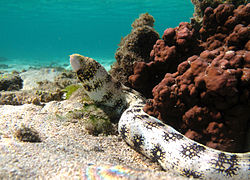
- Family Ophichthidae (snake eels)
- Suborder Moringuoidei
- Family Moringuidae (spaghetti eels)
- Suborder Saccopharyngoidei
- Family Eurypharyngidae (pelican eels, umbrellamouth gulpers)
- Family Saccopharyngidae
- Family Monognathidae (onejaw gulpers)
- Family Cyematidae (bobtail snipe eels)
- Suborder Anguilloidei
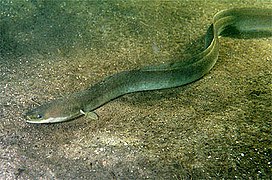
- Family Anguillidae (freshwater eels)
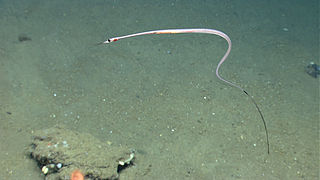
- Family Nemichthyidae (snipe eels)
- Family Serrivomeridae (sawtooth eels)
-
-
-

-

-

-
-
-
-

-

-
 Serrivomer sp., a Serrivomeridae
 -


.jpg)

.jpg)

.jpg)
In some classifications, the family Cyematidae of bobtail snipe eels is included in the Anguilliformes, but in the FishBase system that family is included in the order Saccopharyngiformes.
The electric eel of South America is not a true eel but is a South American knifefish more closely related to the carps and catfishes.
Phylogeny
[edit]Phylogeny based on Johnson et al. 2012.[19]
| Anguilliformes |
| ||||||||||||||||||||||||||||||||||||||||||


.jpg)

Extinct taxa
[edit]

Based on the Paleobiology Database:[20][21]
- Genus †Abisaadia
- Genus †Bolcanguilla
- Genus †Eomuraena
- Genus †Eomyrophis
- Genus †Gazolapodus
- Genus †Hayenchelys
- Genus †Luenchelys
- Genus †Mastygocercus
- Genus †Micromyrus
- Genus †Mylomyrus
- Genus †Palaeomyrus
- Genus †Parechelus
- Genus †Proserrivomer
- Family †Anguillavidae
- Family †Anguilloididae
- Family †Libanechelyidae
- Family †Milananguillidae
- Family †Paranguillidae
- Family †Patavichthyidae
- Family †Proteomyridae
- Family †Urenchelyidae
Commercial species
[edit]| Main commercial species | ||||||||||
|---|---|---|---|---|---|---|---|---|---|---|
| Common name | Scientific name | Maximum length |
Common length |
Maximum weight |
Maximum age |
Trophic level |
FishBase | FAO | ITIS | IUCN status |
| American eel | Anguilla rostrata (Lesueur, 1817) | 152 cm | 50 cm | 7.33 kg | 43 years | 3.7 | [22] | [23] |  Endangered[24] | |
| European eel | Anguilla anguilla (Linnaeus, 1758) | 150 cm | 35 cm | 6.6 kg | 88 years | 3.5 | [25] | [26] | [27] |  Critically endangered[28] |
| Japanese eel | Anguilla japonica Temminck & Schlegel, 1846 | 150 cm | 40 cm | 1.89 kg | 3.6 | [29] | [30] | [31] | Endangered[32] | |
| Short-finned eel | Anguilla australis Richardson, 1841 | 130 cm | 45 cm | 7.48 kg | 32 years | 4.1 | [33] | [34] |  Near Threatened[35] | |
Use by humans
[edit]


Freshwater eels (unagi) and marine eels (conger eel, anago) are commonly used in Japanese cuisine; foods such as unadon and unajū are popular, but expensive. Eels are also very popular in Chinese cuisine, and are prepared in many different ways. Hong Kong eel prices have often reached 1000 HKD (128.86 US Dollars) per kg, and once exceeded 5000 HKD per kg. In India, eels are popularly eaten in the Northeast.[citation needed] Freshwater eels, known as Kusia in Assamese, are eaten with curry,[36] often with herbs.[37] The European eel and other freshwater eels are mostly eaten in Europe and the United States, and is considered critically endangered.[38] A traditional east London food is jellied eels, although the demand has significantly declined since World War II. The Spanish cuisine delicacy angulas consists of elver (young eels) sautéed in olive oil with garlic; elvers usually reach prices of up to 1000 euro per kg.[39] New Zealand longfin eel is a traditional Māori food in New Zealand. In Italian cuisine, eels from the Valli di Comacchio, a swampy zone along the Adriatic coast, are especially prized, along with freshwater eels of Bolsena Lake and pond eels from Cabras, Sardinia. In northern Germany, the Netherlands, the Czech Republic, Poland, Denmark, and Sweden, smoked eel is considered a delicacy.
Elvers, often fried, were once a cheap dish in the United Kingdom. During the 1990s, their numbers collapsed across Europe.[40] They became a delicacy, and the UK's most expensive species.[41]
Eels, particularly the moray eel, are popular among marine aquarists.
Eel blood is toxic to humans[42] and other mammals,[43][44][45] but both cooking and the digestive process destroy the toxic protein.
High consumption of eels is seen in European countries leading to those eel species being considered endangered.
Sustainable consumption
[edit]In 2010, Greenpeace International added the European eel, Japanese eel, and American eel to its seafood red list.[46] Japan consumes more than 70% of the global eel catch.[47]
-
 Eel fishing boat in France
 -
 Special boats to transport live eels Comacchio
 -
 Eel trap in Denmark around 1900
 -
 Gerookte paling (Dutch for smoked eel)


Etymology
[edit]The English name "eel" descends from Old English ǣl, Common Germanic *ēlaz. Also from the common Germanic are West Frisian iel, Dutch aal, German Aal, and Icelandic áll. Katz (1998) identifies a number of Indo-European cognates, among them the second part of the Latin word for eels, anguilla, attested in its simplex form illa (in a glossary only), and the Greek word for "eel", egkhelys (the second part of which is attested in Hesychius as elyes).[48] The first compound member, anguis ("snake"), is cognate to other Indo-European words for "snake" (compare Old Irish escung "eel", Old High German unc "snake", Lithuanian angìs, Greek ophis, okhis, Vedic Sanskrit áhi, Avestan aži, Armenian auj, iž, Old Church Slavonic *ǫžь, all from Proto-Indo-European *h₁ogʷʰis). The word also appears in the Old English word for "hedgehog", which is igil (meaning "snake eater"), and perhaps in the egi- of Old High German egidehsa "wall lizard".[49][50]
According to this theory, the name Bellerophon (Βελλεροφόντης, attested in a variant Ἐλλεροφόντης in Eustathius of Thessalonica) is also related, translating to "the slayer of the serpent" (ahihán). In this theory, the ελλερο- is an adjective form of an older word, ελλυ, meaning "snake", which is directly comparable to Hittite ellu-essar- "snake pit". This myth likely came to Greece via Anatolia. In the Hittite version of the myth, the dragon is called Illuyanka: the illuy- part is cognate to the word illa, and the -anka part is cognate to angu, a word for "snake". Since the words for "snake" (and similarly shaped animals) are often subject to taboo in many Indo-European (and non-Indo-European) languages, no unambiguous Proto-Indo-European form of the word for eel can be reconstructed. It may have been *ēl(l)-u-, *ēl(l)-o-, or something similar.
Timeline of genera
[edit]| Timeline |
|---|
 |
In culture
[edit]The large lake of Almere, which existed in the early Medieval Netherlands, got its name from the eels which lived in its water (the Dutch word for eel is aal or ael, so: "ael mere" = "eel lake"). The name is preserved in the new city of Almere in Flevoland, given in 1984 in memory of this body of water on whose site the town is located.
The daylight passage in the spring of elvers upstream along the Thames was at one time called "eel fare". The word 'elver' is thought to be a corruption of "eel fare".[13]
A famous attraction on the French Polynesian island of Huahine (part of the Society Islands) is the bridge across a stream hosting three- to six-foot-long eels, deemed sacred by local culture.
Eel fishing in Nazi-era Danzig plays an important role in Günter Grass' novel The Tin Drum. The cruelty of humans to eels is used as a metaphor for Nazi atrocities, and the sight of eels being killed by a fisherman triggers the madness of the protagonist's mother.
Sinister implications of eels fishing are also referenced in Jo Nesbø's Cockroaches, the second book of the Harry Hole detective series. The book's background includes a Norwegian village where eels in the nearby sea are rumored to feed on the corpses of drowned humans, making the eating of these eels verge on cannibalism.
The 2019 book The Gospel of the Eels by Patrick Svensson commented on the 'eel question' (origins of the order) and its cultural history.
See also
[edit]References
[edit]- ^ a b Froese, Rainer; Pauly, Daniel (eds.). "Order Anguilliformes". FishBase. January 2009 version.
- ^ Pl. 661 in Garsault, F. A. P. de 1764. Les figures des plantes et animaux d'usage en medecine, décrits dans la Matiere Medicale de Mr. Geoffroy medecin, dessinés d'après nature par Mr. de Gasault, gravés par Mrs. Defehrt, Prevost, Duflos, Martinet &c. Niquet scrip. [5]. - pp. [1-4], index [1-20], Pl. 644–729. Paris.
- ^ "WoRMS - World Register of Marine Species - Anguilliformes". www.marinespecies.org.
- ^ "WoRMS - World Register of Marine Species - Saccopharyngiformes". www.marinespecies.org.
- ^ Ebner, Brendan C.; Donaldson, James A.; Courtney, Robert; Fitzpatrick, Richard; Starrs, Danswell; Fletcher, Cameron S.; Seymour, Jamie (23 September 2019). "Averting danger under the bridge: video confirms that adult small-toothed morays tolerate salinity before and during tidal influx". Pacific Conservation Biology. 26 (2): 182–189. doi:10.1071/PC19023. S2CID 204150660 – via www.publish.csiro.au.
- ^ "Family OPHICHTHIDAE" (PDF).
- ^ a b McCosker, John F. (1998). Paxton, J.R.; Eschmeyer, W.N. (eds.). Encyclopedia of Fishes. San Diego: Academic Press. pp. 86–90. ISBN 0-12-547665-5.
- ^ Long Jr, J. H., Shepherd, W., & Root, R. G. (Loot). Manueuverability and reversible propulsion: How eel-like fish swim forward and backward using travelling body waves". In: Proc. Special Session on Bio-Engineering Research Related to Autonomous Underwater Vehicles, 10th Int. Symp. (pp. 118–134).
- ^ Prosek, James (2010). Eels: An Exploration. New York: HarperCollins. ISBN 978-0-06-056611-1.
- ^ Conger conger, European conger: fisheries, gamefish, aquarium. Fishbase.org
- ^ FishBase Archived 10 November 2013 at the Wayback Machine. FishBase (15 November 2011).
- ^ Arai, Takaomi (1 October 2020). "Ecology and evolution of migration in the freshwater eels of the genus Anguilla Schrank, 1798". Heliyon. 6 (10): e05176. doi:10.1016/j.heliyon.2020.e05176. PMC 7553983. PMID 33083623.
- ^ a b Campbell, Lady Colin (1886). A Book of the Running Brook: and of Still Waters. New York: O. Judd Co. pp. 9, 18.
- ^ Inoue, Jun G.; et al. (2010). "Deep-ocean origin of the freshwater eels". Biol. Lett. 6 (3): 363–366. doi:10.1098/rsbl.2009.0989. PMC 2880065. PMID 20053660.
- ^ Pfaff, Cathrin; Zorzin, Roberto; Kriwet, Jürgen (11 August 2016). "Evolution of the locomotory system in eels (Teleostei: Elopomorpha)". BMC Evolutionary Biology. 16 (1): 159. doi:10.1186/s12862-016-0728-7. ISSN 1471-2148. PMC 4981956. PMID 27514517.
- ^ Near, Thomas J; Thacker, Christine E (18 April 2024). "Phylogenetic classification of living and fossil ray-finned fishes (Actinopterygii)". Bulletin of the Peabody Museum of Natural History. 65. doi:10.3374/014.065.0101.
- ^ Schwarzhans, Werner W.; Jagt, John W. M. (1 November 2021). "Silicified otoliths from the Maastrichtian type area (Netherlands, Belgium) document early gadiform and perciform fishes during the Late Cretaceous, prior to the K/Pg boundary extinction event". Cretaceous Research. 127: 104921. doi:10.1016/j.cretres.2021.104921. ISSN 0195-6671.
- ^ Nelson, Joseph S.; Grande, Terry C.; Wilson, Mark V. H. (2016). Fishes of the World (5th ed.). John Wiley & Sons. ISBN 9781118342336.
- ^ Johnson, G. D.; Ida H.; Sakaue J.; Sado T.; Asahida T.; Miya M. (2012). "A 'living fossil' eel (Anguilliformes: Protanguillidae, fam nov) from an undersea cave in Palau". Proceedings of the Royal Society. (in press) (1730): 934–943. doi:10.1098/rspb.2011.1289. PMC 3259923. PMID 21849321.

- ^ "PBDB". paleobiodb.org. Retrieved 21 February 2024.
- ^ Pfaff, Cathrin; Zorzin, Roberto; Kriwet, Jürgen (11 August 2016). "Evolution of the locomotory system in eels (Teleostei: Elopomorpha)". BMC Evolutionary Biology. 16 (1): 159. doi:10.1186/s12862-016-0728-7. ISSN 1471-2148. PMC 4981956. PMID 27514517.
- ^ Froese, Rainer; Pauly, Daniel (eds.). "Anguilla rostrata". FishBase. May 2012 version.
- ^ "Anguilla rostrata". Integrated Taxonomic Information System. Retrieved 20 May 2015.
- ^ Jacoby, D.; Casselman, J.; DeLucia, M.; Gollock, M. (2017) [amended version of 2014 assessment]. "Anguilla rostrata". IUCN Red List of Threatened Species. 2017: e.T191108A121739077. doi:10.2305/IUCN.UK.2017-3.RLTS.T191108A121739077.en. Retrieved 12 November 2021.
- ^ Froese, Rainer; Pauly, Daniel (eds.). "Anguilla anguilla". FishBase. May 2012 version.
- ^ Anguilla anguilla (Linnaeus, 1758) FAO, Species Fact Sheet. Retrieved 20 May 2012.
- ^ "Anguilla anguilla". Integrated Taxonomic Information System. Retrieved 20 May 2012.
- ^ Pike, C.; Crook, V.; Gollock, M. (2020). "Anguilla anguilla". IUCN Red List of Threatened Species. 2020: e.T60344A152845178. doi:10.2305/IUCN.UK.2020-2.RLTS.T60344A152845178.en. Retrieved 12 November 2021.
- ^ Froese, Rainer; Pauly, Daniel (eds.). "Anguilla japonica". FishBase. May 2012 version.
- ^ Anguilla japonica, Temminck & Schlegel, 1846 FAO, Species Fact Sheet. Retrieved May 2012.
- ^ "Anguilla japonica". Integrated Taxonomic Information System. Retrieved 20 May 2012.
- ^ Jacoby, D. & Gollock, M. (2014). "Anguilla japonica". IUCN Red List of Threatened Species. 2014: e.T166184A1117791. doi:10.2305/IUCN.UK.2014-1.RLTS.T166184A1117791.en. Retrieved 4 January 2018.
- ^ Froese, Rainer; Pauly, Daniel (eds.). "Anguilla australis". FishBase. May 2012 version.
- ^ "Anguilla australis". Integrated Taxonomic Information System. Retrieved 20 May 2012.
- ^ Pike, C.; Crook, V.; Gollock, M. (2019) [errata version of 2019 assessment]. "Anguilla australis". IUCN Red List of Threatened Species. 2019: e.T195502A154801652. doi:10.2305/IUCN.UK.2019-2.RLTS.T195502A154801652.en. Retrieved 12 November 2021.
- ^ "Swamp Eels". Encyclopedia of Life. Retrieved 24 June 2022.
- ^ Bhuyan, Avantika (30 March 2018). "The little fish in big rivers". The Live Mint. Retrieved 24 June 2022.
- ^ Acou, Anthony, et al. "Assessment of the Quality of European Silver Eels and Tentative Approach to Trace the Origin of Contaminants – A European Overview." The science of the total environment. 743 (2020): n. pag. Web.
- ^ "Buber's Basque Page: Angulas".
- ^ Champken, Neil (2 June 2006). "Would you pay £600 for a handful of baby eels?". theguardian.com. Retrieved 7 April 2015.
- ^ Leake, Jonathan (7 February 2015). "EU's eel edict costs UK £100m". The Sunday Times. Archived from the original on 10 July 2015. Retrieved 7 April 2015.
- ^ "Poison in the Blood of the Eel" (PDF). 9 April 1899. Retrieved 22 January 2010.
- ^ "The plight of the eel (mentions that "Only 0.1 ml/kg is enough to kill small mammals, such as a rabbit..." BBC online. Retrieved 22 January 2010.
- ^ "Blood serum of the eel." M. Sato. Nippon Biseibutsugakukai Zasshi (1917), 5 (No. 35), From: Abstracts Bact. 1, 474 (1917)
- ^ "Hemolytic and toxic properties of certain serums." Wm. J. Keffer, Albert E. Welsh. Mendel Bulletin (1936), 8 76–80.
- ^ "Greenpeace Seafood Red list". Greenpeace International.
- ^ "Indonesia eel hot item for smugglers". The Japan Times. 29 July 2013. Retrieved 30 July 2013.
- ^ Katz, J. (1998). "How to be a Dragon in Indo-European: Hittite illuyankas and its Linguistic and Cultural Congeners in Latin, Greek, and Germanic". In Jasanoff; Melchert; Oliver (eds.). Mír Curad. Studies in Honor of Calvert Watkins. Innsbruck. pp. 317–334. ISBN 3-85124-667-5.
{{cite book}}: CS1 maint: location missing publisher (link) - ^ Arai, Takaomi (22 February 2016). Biology and Ecology of Anguillid Eels. CRC Press. ISBN 978-1-4822-5516-4.
- ^ Ross, Stephen T.; Brenneman, William Max (2001). The Inland Fishes of Mississippi. Univ. Press of Mississippi. ISBN 978-1-57806-246-1.

Further references
[edit]- Tesch FW and White RJ (2008). The Eel. John Wiley & Sons. ISBN 9781405173438.
- Patrik Svensson (2019). The Book of Eels, English translation (2020) by Agnes Broomé, published by ecco, ISBN 9780062968814.
External links
[edit]
- Froese, Rainer; Pauly, Daniel (eds.). "Order Anguilliformes". FishBase. January 2006 version.
- "Anguilliformes". Integrated Taxonomic Information System. Retrieved 4 June 2008.
- . New International Encyclopedia. 1905.
- "The Natural History of the Eel", historical aspect, Scientific American, 10 August 1878, Vol. 39, No. 6, p. 79
| ||||||||||||||||||
| Families by suborder |
| | ||||||||||||||||
| ||||||||||||||||||


Principal commercial fishery species groups | ||||||||||||||||||||
|---|---|---|---|---|---|---|---|---|---|---|---|---|---|---|---|---|---|---|---|---|
| Wild |
|  .png)  | ||||||||||||||||||
| Farmed | ||||||||||||||||||||
