


James Montgomery Flagg
 |
James Montgomery Flagg | |
|---|---|
.jpg) Flagg in 1915, photographed by Arnold Genthe | |
| Born | June 18, 1877 Pelham, New York, U.S. |
| Died | May 27, 1960 (aged 82) New York City, U.S. |
| Occupation(s) | Artist and illustrator |
James Montgomery Flagg (June 18, 1877 – May 27, 1960) was an American artist, comics artist, and illustrator. He worked in media ranging from fine art painting to cartooning, but is best remembered for his political posters, particularly his 1917 poster of Uncle Sam created for United States Army recruitment during World War I.[1]

Life and career
[edit]Flagg was born on June 18, 1877, in Pelham, New York.[1] He was enthusiastic about drawing from a young age, and had illustrations accepted by national magazines by the age of 12. By 14, he was a contributing artist for Life magazine, and the following year was on the staff of another magazine, Judge.[3]
From 1894 through 1898, he attended the Art Students League of New York. He studied fine art in London and Paris from 1898 to 1900, after which he returned to the United States, where he produced countless illustrations for books, magazine covers, political and humorous cartoons, advertising, and spot drawings. Among his creations was a comic strip that appeared regularly in Judge from 1903 until 1907, about a tramp character titled Nervy Nat.[4][5]
In 1915, he accepted commissions from Calkins and Holden to create advertisements for Edison Photo and Adler Rochester Overcoats but only on the condition that his name would not be associated with the campaign.[6]

He created his most famous work in 1917, a poster to encourage recruitment in the United States Army during World War I. It showed Uncle Sam pointing at the viewer (inspired by a 1914 British recruitment poster showing Lord Kitchener in a similar pose) with the caption "I Want YOU for U.S. Army".[7] Flagg had first created the image for the July 6, 1916, cover of Frank Leslie's Illustrated Newspaper with the headline "What Are You Doing for Preparedness?"[8][9] Over four million copies of the poster were printed during World War I, and it was revived for World War II. Flagg used his own face for that of Uncle Sam (adding age and the white goatee), he said later, simply to avoid the trouble of arranging for a model.[8] President Franklin Delano Roosevelt praised his resourcefulness for using his own face as the model. Flagg had a neighbor, Walter Botts, pose as a model for the strong shoulders, and thrusting forefinger of the piece.[citation needed]
In 1917, he also attended the Illustrators' Ball, one of many annual masquerade balls in Manhattan, New York. The artists-only event was held in the 1845-built Hotel Brevoort in Greenwich Village, a neighborhood where many artists and cartoonists lived at the time. That year, the theme was "Kaleidoscopic Ball," with no specific requirements for costumes.[2] Flagg dressed as the Scottish sailor Captain William Kidd.
At his peak, Flagg was reported to have been the highest-paid magazine illustrator in America.[10] He worked for The Saturday Evening Post and Collier's, which were two of the most popular U.S. journals.[11] In 1946, Flagg published his autobiography, Roses and Buckshot. Apart from his work as an illustrator, Flagg painted portraits which reveal the influence of John Singer Sargent. Flagg's sitters included Mark Twain and Ethel Barrymore; his portrait of Jack Dempsey now hangs in the Great Hall of the National Portrait Gallery. In 1948, he appeared in a Pabst Blue Ribbon magazine ad which featured the illustrator working at an easel in his New York studio with a young lady standing at his side and a tray with an open bottle of Pabst and two filled glasses sat before them.[12]
Toward the end of his life, when deteriorating eyesight forced him to give up his art, "he often took out his frustrations on his friends and himself."[13] He died on May 27, 1960, in New York City.[1] He was interred at Woodlawn Cemetery in The Bronx, New York City.
Legacy
[edit]Fort Knox, Kentucky, has a parade field named for and dedicated to Flagg. It is called Flagg Field and located behind the Fort Knox Hotel. Fort Knox is also the home of U.S. Army Recruiting Command, which borders Flagg Field.[citation needed]
Flagg spent summers in Biddeford Pool, Maine, and his home, the James Montgomery Flagg House, was added to the National Register of Historic Places in 1980.[14]
Gallery
[edit]-
 Illustration in St. Nicholas Illustrated magazine, January 1898.
 -
 President McKinley, illustration in Vanity Fair magazine, 1899
 -
 The World (As Seen By Him), 1905
 -
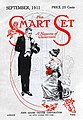 The Smart Set (Magazine cover) 1911
 -
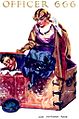 The cover of the popular novel Officer 666 by Barton Currie and Augustin MacHugh, 1912
 -
 Flagg's famous Uncle Sam recruitment poster (c. 1917)
 -
 Uncle Sam Boys and Girls! 1917 war poster
 -
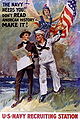 The Navy Needs You! Don't Read American History, Make It! (1917 or 1918)
 -
 Columbia urges planting victory gardens (1918)
 -
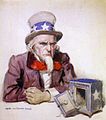 Uncle Sam with empty Treasury (1920)
 -
 Wake Up America, Civilization Calls Every Man Woman and Child! (1917)
 -
 Together We Win
(World War I, 1917 or 1918) -
 Wake Up America Day on April 19, 1917, with Jean Earle Mohle dressed as Paul Revere
 -
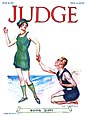 Judge cover from 1923. Flagg was a prolific cover artist for Judge.
 -
 World War II US Army poster showing Uncle Sam holding spanner. Presumably released between VE day and VJ day (1945)


.jpg)


_poster_celebrating_Wake_Up_America_Day_on_April_19,_1917_with_Jean_Earle_Mohle_dressed_as_Paul_Revere.jpg)


References
[edit]- ^ a b c "James Montgomery Flagg Dies. Illustrator and Author Was 82. Artist Was Noted for Patriotic War Posters and Magazine Drawings of Women". The New York Times. May 28, 1960. Retrieved September 17, 2015.
- ^ a b Cartoons Magazine. H. H. Windsor, Editor and Publisher. 1917. p. 360.
- ^ "The Price of Freedom: 'Together We Win' Poster". amhistory.si.edu. Retrieved November 1, 2018.
- ^ Marschall, Rick (May 1985). "The Comic Obsessions of James Montgomery Flagg". Nemo, the Classic Comics Library, No. 11.
- ^ "James Montgomery Flagg". lambiek.net.
- ^ Bogart, Michele Helene (December 18, 1995). Artists, advertising, and the borders of art (First ed.). University of Chicago Press. p. 444. ISBN 978-0-226-06307-2.
- ^ "Lest Liberty Perish from the Face of the Earth – Buy Bonds". World Digital Library. Retrieved February 10, 2013.
- ^ a b "The Great War: Part 1 – Transcript". American Experience. PBS. July 3, 2018. Retrieved May 7, 2019.
- ^ "What are YOU doing for preparedness?". Library of Congress: Prints & Photographs Online Catalog. Library of Congress. Retrieved May 7, 2019.
- ^ Smith, David S., "A Stately New Exhibition Space for New Boston Museum of American Art", Antiques and the Arts Online, April 11, 2006. accessed May 8, 2009.
- ^ Livingston, Alan (2012). The Thames & Hudson dictionary of graphic design and designers. London: Thames & Hudson Ltd. p. 96. ISBN 9780500204139.
- ^ the (May 1, 2013). "'Portrait by "Monty" Flagg...or You!', LIFE, May 3, 1948, Old Beer ads. Retrieved May 1, 2013". Oldbeerads.blogspot.com. Retrieved June 11, 2013.
- ^ "James Montgomery Flagg". Society of Illustrators. Retrieved September 13, 2021.
- ^ "National Register of Historic Places in York County, Maine". Nationalregisterofhistoricplaces.com. Retrieved June 11, 2013.
Further reading
[edit]- Flagg, James Montgomery. Roses and Buckshot. New York: G.P. Putnam's Sons, 1946. OCLC 517299
- Flagg, James Montgomery, and Susan E. Meyer. James Montgomery Flagg. New York: Watson-Guptill Publications, 1974. ISBN 0823018350
External links
[edit]
- Works by James Montgomery Flagg at Project Gutenberg
- Works by James Montgomery Flagg (illustrator) at Faded Page (Canada)
- Works by or about James Montgomery Flagg at the Internet Archive
- Works by James Montgomery Flagg at LibriVox (public domain audiobooks)

- "James Montgomery Flagg's 1917 "I Want You" Poster and other works". Archived from the original on October 28, 2004. Retrieved June 1, 2003.
{{cite web}}: CS1 maint: bot: original URL status unknown (link) - James Montgomery Flagg on JVJ Publishing site[usurped]
- James Montgomery Flagg artwork can be viewed at American Art Archives web site


- 1877 births
- 1960 deaths
- American editorial cartoonists
- American comics artists
- Burials at Woodlawn Cemetery (Bronx, New York)
- American poster artists
- People from Pelham, New York
- Art Students League of New York alumni
- Painters from New York City
- Vanity Fair (British magazine) artists
- 20th-century American painters
- American male painters
- Members of The Lambs Club
- 20th-century American male artists