


Violet Oakley
Violet Oakley Artist | |
|---|---|
 Violet Oakley, date unknown | |
| Born | June 10, 1874 Bergen Heights, New Jersey, U.S. |
| Died | February 25, 1961 (aged 86) Philadelphia, Pennsylvania, U.S. |
| Resting place | Green-Wood Cemetery |
| Known for | Painting, murals, stained glass, and animals |
| Notable work | Pennsylvania State Capital murals |
| Movement | Pre-Raphaelite influence |
| Partner | Edith Emerson |
Violet Oakley (June 10, 1874 – February 25, 1961) was an American artist. She was the first American woman to receive a public mural commission. During the first quarter of the twentieth century, she was renowned as a pathbreaker in mural decoration, a field that had been exclusively practiced by men. Oakley excelled at murals and stained glass designs that addressed themes from history and literature in Renaissance-revival styles.
Life[edit]
Oakley was born in Bergen Heights (a section of Jersey City), New Jersey, into a family of artists. Her parents were Arthur Edmund Oakley and Cornelia Swain. Both of her grandfathers were member of the National Academy of Design.[1] In 1892, she studied at the Art Students League of New York with James Carroll Beckwith and Irving R. Wiles. A year later, she studied in England and France, under Raphaël Collin and others. After her return to the United States in 1896, she studied briefly at the Pennsylvania Academy of the Fine Arts before she joined Howard Pyle's famous illustration class at Drexel Institute.[2] She had early success as a popular illustrator for magazines including The Century Magazine, Collier's Weekly, St. Nicholas Magazine, and Woman's Home Companion.[3] The style of her illustrations and stained glass reflects her emulation of the English Pre-Raphaelites. Oakley's commitment to Victorian aesthetics during the advent of Modernism led to the decline of her reputation by the middle of the twentieth century.

Oakley's political beliefs were shaped by the Quaker William Penn (1644–1718) whose ideals she represented in her murals at the Pennsylvania State Capitol. She became committed to the Quaker principles of pacifism, equality of the races and sexes, economic and social justice, and international government. When the United States refused to join the League of Nations after the Great War, Oakley went to Geneva, Switzerland, and spent three years drawing portraits of the League's delegates which she published in her portfolio, "Law Triumphant" (Philadelphia, 1932). She was an early advocate of nuclear disarmament after World War II.

Oakley was raised in the Episcopal church but in 1903 became a devoted student of Christian Science after a significant healing of asthma while she was doing preparatory study for the first set of Harrisburg murals in Florence, Italy.[4] She was a member of Second Church of Christ, Scientist, Philadelphia from 1912, when it was organized, until her death in 1961.[5]
She received many honors through her life including an honorary Doctorate of Laws Degree in 1948 from Drexel Institute.[1] At the 1904 Saint Louis International Exposition, Oakley won the gold medal in illustration for her watercolors for "The Story of Vashti," and the silver medal in mural decoration for her murals at All Angels' Church.[6] In 1905, she became the first woman to receive the Gold Medal of Honor from the Pennsylvania Academy of Fine Arts.[3] In 1915, Oakley was awarded the Medal of Honor in the painting category at the 1915 Panama–Pacific International Exposition in San Francisco for her 1912 portrait of Philadelphia poet Florence Van Leer Earle Coates as "The Tragic Muse".[7]


Around 1897, Oakley and her sister Hester rented a studio space at 1523 Chestnut Street, Philadelphia in the Love Building.[5] The sisters decorated the space with furniture loaned by their mother and a combination of antiques, fabric, and copies of Old Master paintings.[8] Oakley and her friends, the artists Elizabeth Shippen Green and Jessie Willcox Smith, all former students of Pyle, were named the Red Rose Girls by him. The three illustrators received the "Red Rose Girls" nickname while they lived together in the Red Rose Inn in Villanova, Pennsylvania from 1899 to 1901. They later lived, along with Henrietta Cozens, in a home in the Mt. Airy neighborhood of Philadelphia that they named Cogslea after their four surnames (Cozens, Oakley, Green and Smith). In 1996, Oakley was elected to the Society of Illustrators Hall of Fame, the last of the 'Red Rose Girls' to be inducted, but one of only ten women in the hall. Cogslea was added to the National Register of Historic Places in 1977 as the Violet Oakley Studio.[9] Her home and studio at Yonkers, New York, where she resided intermittently between 1912 and 1915 is also listed on the National Register of Historic Places as the Plashbourne Estate.[10]
Oakley was a member of Philadelphia's The Plastic Club, an organization established to promote "Art for art's sake". Other members included Elenore Abbott, Jessie Willcox Smith, and Elizabeth Shippen Green.[11] Many of the women who founded the organization had been students of Howard Pyle. It was founded to provide a means to encourage one another professionally and create opportunities to sell their works of art.[11][12]
On June 14, 2014, Miss Oakley was featured in the first gay-themed tour of Green-Wood Cemetery, where she is interred in the Oakley family plot, Section 63, Lot 14788.[13][14] Her life partner, Edith Emerson, was a painter and, at one time, a student of Oakley's. In 1916, Emerson moved into Oakley's Mount Airy home, Cogslea, where Oakley had formed a communal household with three other women artists, calling themselves the Red Rose Girls. Emerson and Oakley's relationship endured until Oakley's death and Emerson subsequently established a foundation to memorialize Oakley's life and legacy. The foundation dissolved in 1988 and the assets donated to the Smithsonian Museum.[15]

New Woman[edit]
As educational opportunities were made more available in the 19th century, women artists became part of professional enterprises, including founding their own art associations. Artwork made by women was considered to be inferior, and to help overcome that stereotype women became "increasingly vocal and confident" in promoting women's work, and thus became part of the emerging image of the educated, modern and freer "New Woman".[16] Artists "played crucial roles in representing the New Woman, both by drawing images of the icon and exemplifying this emerging type through their own lives." In the late 19th-century and early 20th century about 88% of the subscribers of 11,000 magazines and periodicals were women. As women entered the artist community, publishers hired women to create illustrations that depict the world through a woman's perspective. Other successful illustrators were Jennie Augusta Brownscombe, Jessie Wilcox Smith, Rose O'Neill, and Elizabeth Shippen Green.[17]
Work[edit]
Violet Oakley Studio | |
 | |
  | |
| Location | 627 St. George's Rd. Philadelphia, Pennsylvania |
|---|---|
| Coordinates | 40°3′8″N 75°12′20″W / 40.05222°N 75.20556°W |
| Built | 1902–05 |
| Architect | Day & Klauder |
| NRHP reference No. | 77001188[18] |
| Significant dates | |
| Added to NRHP | September 13, 1977 |
| Designated PHMC | October 20, 1998[19] |
Her teacher Howard Pyle recommended Oakley and fellow artist Jessie Wilcox Smith for their first important commission, a series of illustrations for Longfellow's Evangeline, that was published in 1897, numerous commissions followed.[20]
Oakley painted a series of 43 murals in the Pennsylvania State Capitol Building in Harrisburg for the Governors Grand Reception Room, the Senate and the Supreme Court. Oakley was originally commissioned in 1902 only for the murals in the Governor's Grand Reception Room, which she titled "The Founding of the State of Liberty Spiritual." In the reception room murals, Oakley depicts the story of William Penn and the founding of Pennsylvania. She conducted extensive research on the subject, even traveling to England. The series of murals were unveiled in the new Capitol Building in November 1906, shortly after the dedication of the building. When Edwin Austin Abbey died in 1911, Violet Oakley was offered the job of creating the murals for the Senate and Supreme Court Chambers, a 16-year project.[21]
Oakley's other work includes:
- Two murals and stained glass work for All Angels Church, New York City, her first commission, 1900[22]
- Murals for the Cuyahoga County Courthouse, Cleveland, Ohio,[23] her only major mural commission outside Pennsylvania[24]
- Panel for the living room of the Alumnae House at Vassar College[25]
- Eighteen mural panels on The Building of the House of Wisdom and stained glass dome for the Charlton Yarnell House, 1910, at 17th and Locust Street in Philadelphia (three lunettes, The Child and Tradition,[26] Youth and the Arts,[27] and Man and Science[28] were removed and in collection of Woodmere Art Museum).
- Great Women of the Bible murals, First Presbyterian Church in Germantown, 1945–1949[29]
- Three murals, David and Goliath, Christ Among the Doctors, and The Young Solomon appear in the library at Springside Chestnut Hill Academy[30]
- The Holy Experiment: A message to the World from Pennsylvania, published by the author in a limited edition of 1000, an Elephant Folio with 26 lithographic plates of the artist's mural work at the Senate Chambers, with text by the artist/author.[31]
- Life of Moses, commissioned by Samuel S. Fleisher in 1927, remains today as the altar piece for the Sanctuary of the Fleisher Art Memorial on Catharine Street in Philadelphia. It is dedicated to Fleisher's mother, Cecilia [sic] Hofheimer Fleisher and inscribed from Exodus 2: 'And the child grew and he became her song...' Oakley created the work while on sojourn in Italy, staying at a villa outside Florence.[32]
Exhibitions[edit]
- Lehigh University Professor Francis Quirk organized an exhibit of her work that opened with a reception for 500 people in 1950.[33]
- Violet Oakley's first major retrospective was organized by the Philadelphia Museum of Art in 1979.[34]
- The Woodmere Art Museum staged a major exhibit of Oakley's work from September 2017 to January 2018. In January 2020 the museum launched The Violet Oakley Experience, a digital resource that organizes and presents over 3,000 works of art by Violet Oakley in Woodmere's collection.
Gallery[edit]
-
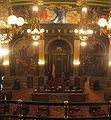 Senate mural, Pennsylvania State Capitol.
 -
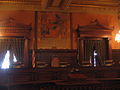 Supreme Court mural, Pennsylvania State Capitol.
 -
 Supreme Court mural, Pennsylvania State Capitol.
 -
 Divine Law mural in the Pennsylvania Supreme Court's chamber.


References[edit]
- ^ a b "Violet Oakley papers".
- ^ Abbott, Charles David (1935). "Howard Pyle". In Malone, Dumas (ed.). Dictionary of American Biography. Vol. V. 15. p. 289. OCLC 1256465953.
- ^ a b "Violet Oakley (1875–1961), Pennsylvania Capitol Preservation Committee". Archived from the original on February 5, 2007. Retrieved May 15, 2007.
- ^ Oakley, Violet (December 10, 1960). "Many years have passed since I..." The Christian Science Sentinel. 62 (50). Retrieved March 7, 2015.
- ^ a b Carter, Alice A. (2000). The Red Rose Girls: An Uncommon Story of Art and Love. New York: Harry N. Abrams. p. 35. ISBN 978-0-8109-4437-4.
- ^ Stryker, Catherine Connell (1976). The Studios at Cogslea. Wilmington: Delaware Art Museum. p. 30.
- ^ Williams, Michael (1915). A Brief Guide to the Department of Fine Arts Panama-Pacific International Exposition San Francisco, California, 1915. San Francisco: The Wahlgreen Company. p. 64.
- ^ Carter, Alice A. (2000). The Red Rose Girls: An Uncommon Story of Art and Love. New York: Harry N. Abrams, Inc., Publishers. pp. 46–47.
- ^ Joeckel, Jeff (March 1, 2007). "Violet Oakley Studio - Women's History Month 2008--A National Register of Historic Places Feature". www.nps.gov.
- ^ Phillip Seven Esser and Paul Graziano (August 2006). "National Register of Historic Places Registration: Plashbourne Estate". New York State Office of Parks, Recreation and Historic Preservation. Archived from the original on September 14, 2011. Retrieved January 1, 2011.
- ^ a b Jill P. May; Robert E. May; Howard Pyle. Howard Pyle: Imagining an American School of Art. University of Illinois Press; 2011. ISBN 978-0-252-03626-2. p. 89.
- ^ The Plastic Club. The Historical Society of Pennsylvania. Retrieved March 4, 2014.
- ^ "Gay Green-Wood Trolley Tour". Green-Wood.
- ^ "The Gay Graves Tour". Walk About New York. June 18, 2014. Retrieved October 16, 2014.
- ^ "Violet Oakley Memorial Foundation records, 1910-1987, bulk 1961-1987". www.aaa.si.edu.
- ^ Laura R. Prieto. At Home in the Studio: The Professionalization of Women Artists in America. Harvard University Press; 2001. ISBN 978-0-674-00486-3. pp. 145–146.
- ^ Laura R. Prieto. At Home in the Studio: The Professionalization of Women Artists in America. Harvard University Press; 2001. ISBN 978-0-674-00486-3. p. 160–161.
- ^ "National Register Information System". National Register of Historic Places. National Park Service. January 23, 2007.
- ^ "PHMC Historical Markers". Historical Marker Database. Pennsylvania Historical & Museum Commission. Retrieved December 10, 2013.
- ^ Carter (March 2000). The Red Rose Girls, An Uncommon Story of Art and Love. Harry N Abrams. pp. 45. ISBN 0-8109-4437-5.
- ^ Ricci, Patricia Likos (2002). "Violet Oakley: American Renaissance Woman". The Pennsylvania Magazine of History and Biography. 126: 217–248.
- ^ "The Heavenly Host (composition study for left mural, All Angels Church, New York)". Smithsonian American Art Museum. Retrieved January 9, 2020.
- ^ "The Old Courthouse Painting Project". Cuyahoga County Department of Public Works. Retrieved January 30, 2018.
- ^ "The Old Courthouse Painting Project - Cuyahoga County Department of Public Works". publicworks.cuyahogacounty.us. Retrieved January 9, 2020.
- ^ Mills, Sally (1984). Violet Oakley: The Decoration of the Alumnae House Living Room. Poughkeepsie, NY: Vassar College Art Gallery.
- ^ "The Child and Tradition". woodmereartmuseum.org. Retrieved March 21, 2017.
- ^ "Building And Preserving A "House Of Wisdom" | Hidden City Philadelphia". hiddencityphila.org. November 26, 2012. Retrieved March 21, 2017.
- ^ "Man and Science". woodmereartmuseum.org. Retrieved March 21, 2017.
- ^ Van Hook, Bailey (2016). Violet Oakley: An Artist's Life. Lanham, Maryland: University Press Copublishing Division / University of Delaware Press. p. 373. ISBN 978-1-61149-585-0.
- ^ "Chestnut Hill Academy Library | Encyclopedia of Greater Philadelphia". philadelphiaencyclopedia.org. Retrieved March 21, 2017.
- ^ Hedley H. Rhys. The Holy Experiment: Our Heritage from William Penn; Series of Mural Paintings in the Governor's Reception Room, in the Senate Chamber, and in the Supreme Courtroom of the State Capitol at Harrisburg, Pennsylvania, U. S. A. (review) Bulletin of Friends' Historical Association. Volume 40, Number 1, Spring 1951. pp. 54–55 | 10.1353/qkh.1951.0017
- ^ "Oakley Life of Moses" (PDF). Samuel S. Fleisher Art Memorial.
- ^ "Brown and White Vol. 61 no. 19". digital.lib.lehigh.edu. Retrieved November 20, 2017.
- ^ Likos, Patricia (January 1, 1979). "Violet Oakley (1874–1961)". Philadelphia Museum of Art Bulletin. 75 (325): 2–9. doi:10.2307/3795289. JSTOR 3795289.
Sources[edit]
- Patricia Likos Ricci (2017) A Grand Vision: Violet Oakley and the American Renaissance, exhibition catalog, Woodmere Art Museum, September 30, 2017 – January 21, 2018.
- Patricia Likos Ricci: "Violet Oakley, American Renaissance Woman", The Pennsylvania Magazine of History and Biography, Vol. cxxvi, No.2 (April 2002).
- Rowland Elzea and Elizabeth H. Hawkes (1980). A Small School of Art: The Students of Howard Pyle, Wilmington: Delaware Art Museum
- Violet Oakley (1950). The Holy Experiment, Our Heritage from William Penn: Series of Mural Paintings in the Governor's Reception Room, in the Senate Chamber and in the Supreme Courtroom of the State Capitol at Harrisburg, Pennsylvania. Philadelphia: Cogslea Studio Publications (limited edition, one thousand copies, hand-numbered by the author)
- Carter, Alice A. (2000). The Red Rose Girls: An Uncommon Story of Art and Love. New York: H. N. Abrams. ISBN 978-0-8109-4437-4.
- Sheets, Georg R (2002). A Sacred Challenge; Violet Oakley and the Pennsylvania Capital Murals. Harrisburg: Capitol Preservation Committee. ISBN 0-9643048-6-4.
- Van Hook, Bailey (2016). Violet Oakley: An Artist's Life. Newark DE: University of Delaware Press. ISBN 978-1611495850.
External links[edit]


- Cogslea Historic Marker
- Pennsylvania Capitol Preservation Committee's Violet Oakley Biography
- Artwork by the Red Rose Girls in Bryn Mawr College Art and Artifact Collections
- Finding Aid to Violet Oakley papers, 1841–1981 at Smithsonian Archives of American Art
- Violet Oakley Memorial Foundation records, 1910–1987, (bulk 1961–1987), Archives of American Art
- Prints, Drawings, and Photographs Department Records 1976–2000, Philadelphia Museum of Art
- Violet Oakley Papers Archived June 29, 2016, at the Wayback Machine, Delaware Art Museum
- Works by or about Violet Oakley at Internet Archive
- Violet Oakley at Find a Grave


| International | |
|---|---|
| National | |
| Artists | |
| Other | |

- 1874 births
- 1961 deaths
- American muralists
- Art Students League of New York alumni
- American women illustrators
- American illustrators
- American stained glass artists and manufacturers
- Drexel University alumni
- Artists from Pennsylvania
- American lesbian artists
- Pennsylvania Academy of the Fine Arts alumni
- Pennsylvania Academy of the Fine Arts faculty
- American Christian Scientists
- Artists from Jersey City, New Jersey
- Burials at Green-Wood Cemetery
- 20th-century American painters
- 20th-century American women painters
- American women muralists
- Converts to Christian Science from Anglicanism
- American women academics