Kinsey scale


| Sexual orientation |
|---|
.svg) |
| Sexual orientations |
| Related terms |
| Research |
| Animals |
| Related topics |

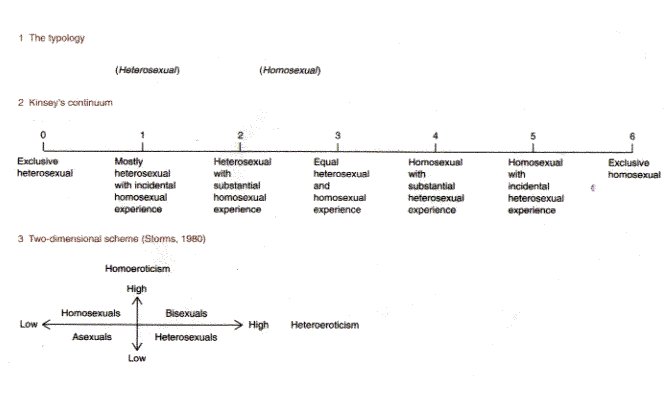
The Kinsey scale, also called the Heterosexual–Homosexual Rating Scale,[1] is used in research to describe a person's sexual orientation based on one's experience or response at a given time. The scale typically ranges from 0, meaning exclusively heterosexual, to a 6, meaning exclusively homosexual. In both the male and female volumes of the Kinsey Reports, an additional grade, listed as "X", indicated "no socio-sexual contacts or reactions" (asexuality). The reports were first published in Sexual Behavior in the Human Male (1948)[2] by Alfred Kinsey, Wardell Pomeroy, and others, and were also prominent in the complementary work Sexual Behavior in the Human Female (1953).[1]
History
Alfred Kinsey, the creator of the Kinsey scale, is known as "the father of the sexual revolution."[3] The Kinsey scale was created in order to demonstrate that sexuality does not fit into two strict categories: homosexual and heterosexual. Instead, Kinsey believed that sexuality is fluid and subject to change over time.[4]
Rather than using sociocultural labels, Kinsey primarily used assessments of behavior in order to rate individuals on the scale.[4] Kinsey's first rating scale had thirty categories that represented thirty different case studies, but his final scale has only seven categories.[5] Over 8,000 interviews were conducted throughout his research.[6]
Introducing the scale, Kinsey wrote:
Males do not represent two discrete populations, heterosexual and homosexual. The world is not to be divided into sheep and goats. It is a fundamental of taxonomy that nature rarely deals with discrete categories... The living world is a continuum in each and every one of its aspects. While emphasizing the continuity of the gradations between exclusively heterosexual and exclusively homosexual histories, it has seemed desirable to develop some sort of classification which could be based on the relative amounts of heterosexual and homosexual experience or response in each history [...] An individual may be assigned a position on this scale, for each period in his life. [...] A seven-point scale comes nearer to showing the many gradations that actually exist.
Table of the scale
The Kinsey scale ranges from 0 for those interviewed who solely had desires for or sexual experiences with the opposite sex, to 6 for those who had exclusively same sex desires or experiences, and 1–5 for those who had varying levels of desire or experiences with both sexes, including "incidental" or "occasional" desire for sexual activity with the same sex. It did not reference whether they "identified" as heterosexual, bisexual, or homosexual.[7]
| Rating | Description |
|---|---|
| 0 | Exclusively heterosexual |
| 1 | Predominantly heterosexual, only incidentally homosexual |
| 2 | Predominantly heterosexual, but more than incidentally homosexual |
| 3 | Equally heterosexual and homosexual |
| 4 | Predominantly homosexual, but more than incidentally heterosexual |
| 5 | Predominantly homosexual, only incidentally heterosexual |
| 6 | Exclusively homosexual |
| X | No socio-sexual contacts or reactions |
Kinsey recognized that the seven categories of the scale could not fully capture every individual's sexuality. He wrote that "it should be recognized that the reality includes individuals of every intermediate type, lying in a continuum between the two extremes and between each and every category on the scale."[8] Although sociologists Martin S. Weinberg and Colin J. Williams write that, in principle, people who rank anywhere from 1 to 5 could be considered bisexual,[9] Kinsey disliked the use of the term bisexual to describe individuals who engage in sexual activity with both males and females, preferring to use bisexual in its original, biological sense as hermaphroditic; he stated, "Until it is demonstrated [that] taste in a sexual relation is dependent upon the individual containing within his anatomy both male and female structures, or male and female physiological capacities, it is unfortunate to call such individuals bisexual."[10] Psychologist Jim McKnight writes that while the idea that bisexuality is a form of sexual orientation intermediate between homosexuality and heterosexuality is implicit in the Kinsey scale, that conception has been "severely challenged" since the publication of Homosexualities (1978), by Weinberg and the psychologist Alan P. Bell.[11]
Furthermore, although the additional X grade used to mean "no socio-sexual contacts or reactions" is today described as asexuality,[10] psychologist Justin J. Lehmiller stated, "the Kinsey X classification emphasized a lack of sexual behavior, whereas the modern definition of asexuality emphasizes a lack of sexual attraction. As such, the Kinsey Scale may not be sufficient for accurate classification of asexuality."[12]
Findings
Kinsey reports
The Kinsey Reports are two published works, Sexual Behavior in the Human Male (1948) and Sexual Behavior in the Human Female (1953). These reports discuss the sexual attractions, behaviors, and development of human males and females.[8][13] The data to scale the participants comes from their "psychosexual responses and/or overt experience" in relation to sexual attraction and activity with the same and opposite sexes.[8] The inclusion of psychosexual responses allows someone with less sexual experience to rank evenly with someone of greater sexual experience.[8]
- Men: 11.6% of white males aged 20–35 were given a rating of 3 for this period of their lives.[13] The study also reported that 10% of American males surveyed were "more or less exclusively homosexual for at least three years between the ages of 16 and 55" (in the 5 to 6 range).[13]
- Women: 7% of single females aged 20–35 and 4% of previously married females aged 20–35 were given a rating of 3 for this period of their lives.[14] 2% to 6% of females, aged 20–35, were given a rating of 5[15] and 1% to 3% of unmarried females aged 20–35 were rated as 6.[16]
The results found in "Sexual Behavior in the Human Female" show a higher number of men who lean towards homosexuality than recorded for the women.[8] Kinsey addresses that the result is contrary to reports that women have more homosexual leanings than men. He posits that such reports are due to the "wishful thinking on the part of such heterosexual males."[8]
Impact and later developments
General
The Kinsey scale is credited as one of the first attempts to "acknowledge the diversity and fluidity of human sexual behavior" by illustrating that "sexuality does not fall neatly into the dichotomous categories of exclusively heterosexual or exclusively homosexual."[17] Most studies regarding homosexuality, at the time, were conducted by medical professionals who were sought out by individuals that wanted to change their sexual orientation.[18] Alfred Kinsey's publications on human sexuality, which encompasses the Kinsey scale, were widely advertised and had a huge impact on society's modern conceptions of sexuality, post–World War II.[19]
Galupo et al. argued, "Despite the availability of the Kinsey Scale, assessment via sociocultural labels (i.e., heterosexual, homosexual, and bisexual) is the predominant modality for determining the sexual orientation of research participants."[17] Many sexologists see the Kinsey scale as relevant to sexual orientation, but not comprehensive enough to cover all sexual identity aspects. Measures of sexual orientation do not always correlate with individuals' self-identification labels.[17] As such, sexual identity involves more than one component and may also involve biological sex and gender identity.[20] However, Bullough et al. argued that this "wide-scale public discussion of human sexuality" ultimately led Americans to challenge traditional heteronormative behaviors. His research and findings encouraged gay men and lesbians to come out by debunking much of the stigma revolved around homosexuality.[21]
Others have further defined the scale. In 1980, Michael Storms proposed a two dimensional chart with an X and Y axis.[22] This scale explicitly takes into account the case of asexuality and the simultaneous expression of hetero-eroticism and homo-eroticism.[23] Fritz Klein, in his Klein Sexual Orientation Grid, included factors such as how orientation can change throughout a person's lifetime, as well as emotional and social orientation.[24] Kinsey, Storm, and Klein are only three of more than 200 scales to measure and describe sexual orientation.[25] For example, there are scales that rate homosexual behaviors from 1 to 14, and measures for gender, masculinity, femininity, and transgender identity.[26][27]
Surveys and other studies
There have been similar studies using a scale from 0 to 10. In such studies, the person would be asked a question such as "If 0 is completely gay and 10 is completely hetero, what is your orientation number?".[28]
A study published in 2014 aimed to explore "sexual minority individuals' qualitative responses regarding the ways in which the Kinsey Scale [...] captures (or fail to capture) their sexuality."[17] Participants completed the [Kinsey] scale and then were asked to respond to the following question: "In what ways did this scale capture or fail to capture your sexuality?"[17] "A diverse sample of sexual minority participants, including individuals who (1) identify outside the traditional sexual orientation labels (i.e. pansexual, queer, fluid, asexual) and (2) identify as transgender, were recruited to complete an online questionnaire."[17] Participants represented a convenience sample of 285 individuals who self-identified as non-heterosexual.[17] "Approximately one third of participants self-identified primarily as monosexual (31.5%), whereas 65.8% identified as nonmonosexual, and 2.8% identified as asexual. Monosexual participants represented those who self-identified as lesbian (18.5%) or gay (12.2%) or homosexual (0.8%). Nonmonosexual participants included bisexual (24.1%), pansexual (16.8%), queer (19.6%), and fluid (1.4%) participants. A small minority of participants identified as 'other' (3.8%)."[17] Participants represented all regions of the continental United States.[17] For this study, the use of "X" was intended to describe asexuality or individuals who identify as nonsexual.[17]
A study published in 2017 questioned how people who do not identify as heterosexual felt about their representation on the Kinsey scale.[29] The study takes a group of minority individuals who sexually identify as something other than heterosexual, and has them rate the Kinsey scale according to how well they feel represented by their value.[29] Each group gave it a rating between 1 and 5. In the results, the group that rated the scale the highest was the group that identified as lesbian or gay with a rating of 4.66.[29] The bisexual group rated it lower at 3.78, and the pansexual/queer group gave it the lowest rating at 2.68.[29] Another trend that the study noted was that cisgender participants on average rated themselves higher on the scale than transgender participants (where the authors use transgender as a category to describe participants of various trans and non-binary identities).[29] Namely, the cisgender participants average rating was 4.09 while the transgender participants was 2.78.[29] The authors also found that trans and non-binary participants rated the Kinsey scale to be a less valid measure of their sexual orientation than the cisgender participants, due to its reliance on binary terminology.[29]
See also

.svg)
- Bi-curious
- Bisexual erasure
- Bisexuality
- Gay sexual practices
- Gender binary
- Heterosexual–homosexual continuum
- Lesbian sexual practices
- Uranismus
References
- ^ a b "Kinsey's Heterosexual–Homosexual Rating Scale". The Kinsey Institute. Retrieved 8 September 2011.
- ^ Kinsey, Alfred C.; Pomeroy, Wardell R.; Martin, Clyde E. (June 2003). "Sexual Behavior in the Human Male". American Journal of Public Health. 93 (6): 894–898. doi:10.2105/ajph.93.6.894. ISSN 0090-0036. PMC 1447861. PMID 12773346.
- ^ "Kinsey History". www.kinseyinstitute.org. Retrieved 2018-04-09.
- ^ a b Galupo, M. Paz (June 2014). "Sexual Minority Reflections on the Kinsey Scale and the Klein Sexual Orientation Grid: Conceptualization and Measurement". Journal of Bisexuality. 14 (3–4): 404–432. doi:10.1080/15299716.2014.929553. S2CID 144321245.
- ^ "Archive for Sexology". www.sexarchive.info. Retrieved 2018-04-13.
- ^ Bullough, Vern L. (January 2010). "Alfred Kinsey and the Kinsey report: Historical overview and lasting contributions". The Journal of Sex Research. 35 (2): 127–131. doi:10.1080/00224499809551925.
- ^ "Kinsey Sexuality Rating Scale". The Kinsey Institute. Retrieved 2013-12-02.
- ^ a b c d e f Kinsey, Alfred C.; Pomeroy, Wardell B.; Martin, Clyde E.; Gebhard, Paul H. (1998-05-22). Sexual Behavior in the Human Female. Indiana University Press. ISBN 9780253019240.
- ^ Weinberg, Martin S.; Williams, Colin J.; Pryor, Douglas W. (1995). Dual Attraction: Understanding Bisexuality. New York: Oxford University Press. p. 41. ISBN 978-0-19-509841-9.
- ^ a b Mary Zeiss Stange; Carol K. Oyster; Jane E. Sloan (2011). Encyclopedia of Women in Today's World. Sage Pubns. p. 158. ISBN 978-1-4129-7685-5. Retrieved December 17, 2011.
- ^ McKnight, Jim. Straight Science: Homosexuality, Evolution and Adaptation. Routledge, 1997, p. 33.
- ^ Justin J. Lehmiller (2017). The Psychology of Human Sexuality. John Wiley & Sons. p. 250. ISBN 978-1119164708. Retrieved November 29, 2017.
- ^ a b c Kinsey, et al. 1948. Sexual Behavior in the Human Male, Table 147, p. 651
- ^ Kinsey, et al. 1953. Sexual Behavior in the Human Female, Table 142, p. 499
- ^ Kinsey, et al. 1953. Sexual Behavior in the Human Female, p. 488
- ^ Kinsey, et al. 1953. Sexual Behavior in the Human Female, Table 142, p. 499, and p. 474
- ^ a b c d e f g h i j Galupo, M. Paz (18 June 2014). "Sexual Minority Reflections on the Kinsey Scale and the Klein Sexual Orientation Grid: Conceptualization and Measurement". Journal of Bisexuality. 14 (3–4): 404–432. doi:10.1080/15299716.2014.929553. S2CID 144321245.
- ^ Sell, Randall L.; Petrulio, Christian (1996). "Sampling Homosexuals, Bisexuals, Gays, and Lesbians for Public Health Research". Journal of Homosexuality. 30 (4): 31–47. doi:10.1300/J082v30n04_02. PMID 8738743.
- ^ Sexual Revolution and the Politics of Gay Identity, by Jeffery Escoffier. p. 167.
- ^ "Sexual Orientation & Gender". Planned Parenthood. Retrieved 2012-09-06.
- ^ Bullough, Vern L. (2004). "Sex Will Never be the Same: The Contributions of Alfred C. Kinsey". Archives of Sexual Behavior. 33 (3): 277–286. doi:10.1023/B:ASEB.0000026627.24993.03. PMID 15129046. S2CID 45214914.
- ^ "Evaluation of Models of Sexual Orientation" (PDF). University of Wisconsin–La Crosse. Archived from the original (PDF) on July 15, 2012. Retrieved September 6, 2012.
- ^ "Graph of Michael Storm Scale versus Kinsey Scale". Southern Illinois University Edwardsville. Archived from the original on 2013-12-03. Retrieved 2012-09-06.
- ^ "The Klein Grid". AIB. Retrieved 2018-04-12.
- ^ Clive M. Davis; William L. Yarber; Robert Bauserman; George Schreer; Sandra L. Davis (2000). Handbook of Sexuality-Related Measures. Sage. ISBN 978-1-4129-1336-2.
- ^ "Kinsey's Heterosexual-Homosexual Rating Scale". The Kinsey Institute. Archived from the original on August 17, 2011. Retrieved September 6, 2012.
- ^ Clive M. Davis; William L. Yarber; Robert Bauserman; George Schreer; Sandra L. Davis (2000). Handbook of Sexuality-Related Measures. Sage. p. 137. ISBN 978-1-4129-1336-2.
- ^ Sexuality Now: Embracing Diversity (2006) – Janbell L Caroll
- ^ a b c d e f g Galupo, M. Paz; Mitchell, Renae C.; Davis, Kyle S. (2018-05-01). "Face Validity Ratings of Sexual Orientation Scales by Sexual Minority Adults: Effects of Sexual Orientation and Gender Identity". Archives of Sexual Behavior. 47 (4): 1241–1250. doi:10.1007/s10508-017-1037-y. ISSN 0004-0002. PMID 28733825. S2CID 4040021.
External links
| Sexual identities |  | |
|---|---|---|
| History | ||
| Study | ||
| Attitudes | ||
| Community | ||
| Organizations | ||
| Lists | ||