


Lady Madonna
| "Lady Madonna" | ||||
|---|---|---|---|---|
 US picture sleeve | ||||
| Single by the Beatles | ||||
| B-side | "The Inner Light" | |||
| Released | 15 March 1968 | |||
| Recorded | 3 and 6 February 1968 | |||
| Studio | EMI, London | |||
| Genre | ||||
| Length | 2:16 | |||
| Label |
| |||
| Songwriter(s) | Lennon–McCartney | |||
| Producer(s) | George Martin | |||
| The Beatles singles chronology | ||||
| ||||
| Promotional film | ||||
| "Lady Madonna" on YouTube | ||||
"Lady Madonna" is a song by the English rock band the Beatles, written primarily by Paul McCartney and credited to Lennon–McCartney. In March 1968 it was released as a mono non-album single, backed with "The Inner Light". The song was recorded on 3 and 6 February 1968, before the Beatles left for India, and its boogie-woogie style signalled a more conventional approach to writing and recording for the group following the psychedelic experimentation of the previous two years.
This single was the last release by the band on Parlophone in the United Kingdom, where it reached number 1 for the two weeks beginning 27 March, and Capitol Records in the United States, where it debuted at number 23 on the Billboard Hot 100 for the week ending 23 March and reached number 4 from the week ending 20 April through the week ending 4 May.[5][6] Subsequent releases, starting with "Hey Jude" in August 1968, were released on their own label, Apple Records, under EMI distribution, until the late 1970s, when Capitol and Parlophone re-released old material. The song's album appearance in stereo debuted on the 1970 collection Hey Jude.[5]
Inspiration[edit]
In the description of musicologist Walter Everett, "Lady Madonna" is a "raucous rock and roll" song.[1] As such, it heralded the Beatles' return to a more standard form of songwriting after their recent psychedelic productions, a back-to-basics approach that many other artists pursued throughout 1968.[7][8] According to one of Paul McCartney's neighbours at his farm in Scotland, McCartney previewed the song on a piano during a visit he and Jane Asher made from London in early December 1967.[9] Author Jonathan Gould views the timing as propitious, since the British music press in early 1968 "[began] to tout the idea of a 'rock-and-roll revival' as a corrective to the excesses of psychedelia".[10]

McCartney based his piano part for the song on Humphrey Lyttelton's trad jazz rendition of "Bad Penny Blues",[11] which was released on the Parlophone record label in 1956, soon after George Martin, the Beatles' producer, had taken over as head of the label.[12] McCartney recalled: "'Lady Madonna' was me sitting down at the piano trying to write a bluesy boogie-woogie thing ... It reminded me of Fats Domino for some reason, so I started singing a Fats Domino impression. It took my other voice to a very odd place."[13] Domino's 1956 hit "Blue Monday" conveys the plight of a working man through each day of the week, while "Lady Madonna" does the same from a female perspective.[14]
John Lennon helped write the lyrics, which give an account of an overworked, exhausted (possibly single) mother, facing a new problem each day of the week.[15] McCartney explained the song by saying: "'Lady Madonna' started off as the Virgin Mary, then it was a working-class woman, of which obviously there's millions in Liverpool. There are a lot of Catholics in Liverpool because of the Irish connection."[16] The lyrics include each day of the week except Saturday, which McCartney only noticed many years later: "I was writing the words out to learn it for an American TV show and I realised I missed out Saturday ... So I figured it must have been a real night out."[13] McCartney said his inspiration for the song came after seeing a photograph in National Geographic magazine of a woman breastfeeding, titled "Mountain Madonna".[17]
Speaking later about "Lady Madonna", Lennon said, "Good piano lick, but the song never really went anywhere",[18] adding: "Maybe I helped him on some of the lyrics, but I'm not proud of them either way."[5][15] Author Howard Sounes identifies both a relevance to McCartney's Catholic upbringing, and an autobiographical quality that belies the song's upbeat melody and delivery. He writes: "the lyric is also tender and personal, evoking the image of Mary McCartney as midwife, tending mothers and their babies in Liverpool as she had during Paul's childhood. The phrase 'Lady Madonna' also has a clear Christian meaning, of course, conflating Paul's memory of his mother with the Virgin Mary in what is a boogie-woogie hymn."[19]
Recording[edit]
The Beatles decided to record "Lady Madonna" for their first single of 1968. The release was intended to cover the group's absence while they attended a Transcendental Meditation course in India under the guidance of Maharishi Mahesh Yogi.[20][21] The sessions took place on 3 and 6 February at EMI Studios (subsequently Abbey Road Studios) in London.[22]

Although the song was a return to the Beatles' musical roots, this aesthetic was not carried over to the band taping the basic track as an ensemble.[23] McCartney first recorded his piano part, using EMI's "Mrs Mills" Steinway Vertegrand upright,[18] accompanied by Ringo Starr playing a snare drum with brushes.[24] Starr recalled that when recording the track the Beatles consulted Martin on how to re-create the sound that Lyttelton had achieved on "Bad Penny Blues".[25][nb 1] George Harrison and Lennon added the song's distorted guitar riffs, playing identical lines through the same amplifier; McCartney overdubbed bass guitar and Starr added more drums, played on a full drum kit.[26] McCartney sang his lead vocal in a style that author Ian MacDonald terms Presleyesque,[26] while Lennon, McCartney and Harrison contributed backing vocals, part of which consisted of the singers imitating brass instruments over the song's instrumental break.[27] Music journalist John Harris highlights the significance of McCartney's "salute" to Elvis Presley, who would make his comeback later in 1968 with a return to his formative, rock 'n' roll style. Harris also identifies the influence of the Mills Brothers, whose act included the four singers mimicking brass instruments, in the Beatles' "scat harmonies" on "Lady Madonna".[28] Early mixes of the song indicate that Mellotron and tambourine were cut from the completed track, along with extraneous vocals and dialogue that reveal the band in high spirits during the sessions.[23][29]
The overdubbing session for the four-piece horn section took place on 6 February.[22][30] The tenor saxophone solo on the track was played by British jazz musician and club owner Ronnie Scott. Harry Klein, who played baritone saxophone on the track, recalled that the session was organised at the last minute, while Bill Povey, the second tenor saxophonist, said that no music had been written out for the musicians to follow and McCartney offered them only vague instructions.[22] The second baritone saxophone was played by Bill Jackman. In his book Revolution in the Head, MacDonald writes that Scott's "audibly exasperated" solo was prompted by McCartney's "unprofessional" failure to provide the players with a proper horn arrangement.[31]
The song's selection as the single's A-side came at the expense of Lennon's "Across the Universe",[20][32] which Lennon also withdrew from contention as the B-side, since he was dissatisfied with the musical arrangement.[33] As a result, Harrison gained his first Beatles B-side as a songwriter, with "The Inner Light", the backing track of which he had recorded with several Indian classical musicians in Bombay, in January.[34]
Promotional films[edit]
The Beatles made two promotional films for "Lady Madonna", which were syndicated to television broadcasting companies.[35] The material was shot on 11 February 1968 at EMI Studios and was distributed by NEMS Enterprises to US and UK TV stations. Tony Bramwell directed the two films.[36]
Although the intention had been to show the Beatles miming to the single, the band decided they wanted to use the time to record a new song.[36][37] The footage therefore consisted of the Beatles recording Lennon's "Hey Bulldog",[38] which became the last of the four new songs they supplied United Artists for use in the Yellow Submarine animated film.[38] Little attempt was made to marry up the footage of the Beatles' playing and singing with the audio of "Lady Madonna"; in the second of the two clips, Harrison is shown eating a plate of beans, while both clips show Starr listening to a playback and the Beatles playing alternative instruments from those heard on the song.[35] The promos also included footage of McCartney at Chappell Studios in November 1967, from a session he produced for Cilla Black's single "Step Inside Love".[39]
A new edit of this footage, together with footage from the band's July 1968 rehearsals of "Hey Jude", was assembled for "Lady Madonna"'s segment in The Beatles Anthology in 1995.[39] In 1999, the material was re-edited by Apple to create a new clip for "Hey Bulldog", to help promote the reissue of the Yellow Submarine film.[39][40]
Release and reception[edit]
I describe it as "rock-as-swing". We've been trying to make a decent rock'n'roll record ever since we started, and as far as I know, we haven't done a decent one yet. This is another bash; it's pretty near it.[28]
– Ringo Starr, 1968
In Britain, Parlophone issued "Lady Madonna" backed by "The Inner Light" on 15 March 1968,[41] with the catalogue number R 5675.[42] The single was released three days later in the United States, as Capitol 2138.[42] One of the promo clips was aired by the BBC on the 14 March edition of Top of the Pops and then on Alan Freeman's All Systems Freeman the following day,[43] and in the US on ABC-TV's The Hollywood Palace on 30 March.[44] In Everett's description, the single was "at the forefront of a spring–summer 1968 rock-and-roll revival in the United Kingdom", which included UK-exclusive reissues of singles by Gene Vincent, Carl Perkins, Jerry Lee Lewis, Buddy Holly and Little Richard.[45]
Among contemporary reviews of the single, Billboard magazine described "Lady Madonna" as a "powerful blues rocker"[46] while Cash Box's reviewer wrote: "Take one step back, the Beatles ease their progressive pace with this knocking rhythm side that features Ringo Starr in a rare vocal showing with hard-rock and kazoo orking and lyrics that view working class hardship with a pinch of salt."[47][nb 2] Record World said it "is terrific rock and roll and pungent social comment."[49] Chris Welch of Melody Maker expressed doubts about the song, saying: "Best bit is the piano intro, then you can have fun wondering why Paul['s singing] sounds like Ringo … then go out and buy another record." Welch concluded: "I can't really see this being a hit, not when there's competition from the likes of Four Jacks and a Jill and Kay Starr."[50][51] Time magazine recognised the Beatles as the leaders of an "upsurge" of renewed interest in 1950s rock 'n' roll and said that the band had re-engaged with the "simple hard-driving style they left behind in Liverpool".[52][53] Author Bernard Gendron, paraphrasing a contention of the Time writers – who he says were ahead of the US rock press in recognising this trend – writes that by preceding the Rolling Stones' "similarly retrospective 'Jumpin' Jack Flash'", "Lady Madonna" was possibly "the first single by an elite rock band to signal the 'return to roots'".[54]
"Lady Madonna" topped the Record Retailer chart (subsequently adopted as the UK Singles Chart) for two weeks,[55] although on the national chart compiled by Melody Maker it peaked at number 2.[56] It was the first single by the Beatles not to make number 1 on Melody Maker's chart since the band's 1962 debut, "Love Me Do".[57][nb 3] In America, "Lady Madonna" peaked at number 4 on the Billboard Hot 100,[59] making it the first Beatles single not to top that chart since "Eleanor Rigby" in 1966,[60] and number 2 on the Cash Box Top 100.[61] Ian MacDonald considers this relative lack of success to be significant, and he described the song as "a moderately entertaining let-down after the psychedelic heights of early 1967".[60] In Jonathan Gould's opinion, the song is a "witty, powerful, yet willfully inconsequential track" with "all the makings of a classic Beatle B-side", whereas ideally the lead side of the single should have been a Lennon composition.[10][nb 4] Rob Sheffield of Rolling Stone considers that, at this stage in their career, "the Beatles didn't need to push – they could have hit #1 with a tape of themselves blowing their noses", which, he suggests, "would have been catchier" than "Lady Madonna" and the band's previous single, "Hello, Goodbye".[65] Music critic Tim Riley has similarly dismissed the song as a "trifle" and "something they could do with their left hand".[66]
Writing in 1988, Beatles historian Mark Lewisohn described "Lady Madonna" as a "terrific" single that was "curiously overlooked today by those analysing the group's output".[33] In his song review for AllMusic, Richie Unterberger attributes its standing as one of the band's less-celebrated singles partly to its failure to match the chart success usually associated with the Beatles, but he considers it an "excellent song". He adds that the lyrics, in their implication of the protagonist as a prostitute, are "more intriguing than anything Fats Domino was likely to come up with", while the Beatles' imitation of brass instruments was done "effectively and wittily".[67] Writing for Mojo in 2003, John Harris bemoaned that the song was overlooked as a key recording in the Beatles' development and "one of the foundation stones" for the late 1960s "roots-rock revival". He identified it as the precedent for the Rolling Stones' return to form on Beggars Banquet, for Eric Clapton to exchange Cream's "virtuoso head-rock" for a musical path that resulted in the formation of Derek and the Dominos, and for Chuck Berry and Little Richard to assume "the rarified pedestals where the British Invasion groups had originally placed them".[28][nb 5] In 2010, Rolling Stone ranked "Lady Madonna" at number 86 on its list of "The 100 Greatest Beatles Songs".[32]
Other releases[edit]
The Beatles' version of "Lady Madonna" has appeared on the following compilation albums, released by Apple Records: Hey Jude (1970), 1967–1970 (1973), 20 Greatest Hits (1982), Past Masters, Volume Two (1988), Anthology 2 (1996; takes 3 and 4 of the song), 1 (2000) and Love (2006).[69] The mix used in the 1968 single had obscured much of Ronnie Scott's saxophone; the versions subsequently issued on Anthology 2 and Love feature a more prominent use of his solo, at the end of the song. In the BBC documentary Timewatch, McCartney explained that Scott had not been impressed that his playing had been hidden behind the "imitation brass vocals" performed by McCartney, Lennon and Harrison, so McCartney had decided to fix it with the most recent mix.[citation needed] The Love version incorporates the percussion intro from "Why Don't We Do It in the Road?", the piano from "Ob-La-Di, Ob-La-Da", the guitar riff from "Hey Bulldog", Billy Preston's organ solo from "I Want You (She's So Heavy)" and Eric Clapton's guitar solo from "While My Guitar Gently Weeps"..[29]
Having been averse to performing compositions from the Beatles era following the band's break-up in 1970,[70] McCartney included "Lady Madonna" in the set list for his and Wings' 1975–76 world tour.[71] He continued to feature the song on many of his subsequent tours.[72] Live versions appear on the albums Wings over America, Paul Is Live, Back in the U.S., Back in the World and Good Evening New York City.[72] A variation of the song can be heard on his Chaos and Creation at Abbey Road DVD, where McCartney calls it "an old lady in new clothes".[72]
Cover versions[edit]
- Fats Domino covered the song on his 1968 album Fats Is Back.[28][73] McCartney says he may have told record producer Richard Perry that the song was "based on Fats", leading to Domino's version.[13] Also released as a single, Domino's recording peaked at number 100 on the Billboard 100 in September 1968, giving the singer his 77th and final US chart hit.[14]
- Cal Tjader performed this song on the album Cal Tjader Plugs In (1969) with a jazz approach.[74]
- Elvis Presley covered the song in 1971.[75] Presley's version was an impromptu studio jam that was not available until the release of his 1995 box set Walk a Mile in My Shoes. Harris writes that, just as Domino's cover "confirm[ed] Lady Madonna's rock 'n' roll credentials", Presley's performance served as "the greatest accolade".[28]
- A cover version of the song performed by Aretha Franklin was used as the theme song for the ABC sitcom Grace Under Fire from 1993 until 1996.[5]
- Romanian band Phoenix performed this song on their first EP, Vremuri ("Old times", 1968), because the Electrecord studios did not trust the sales success of the band's own songs ("Vremuri" and "Canarul"). This was a common practice in communist countries and the predominant way western music was reaching there officially.[76]
- Gordon Haskell covered the song on his live Polish album in 2008 entitled Gordon Haskell w Szczecinie Live![77]
- Lenny White covered the song on his 1978 album Streamline. This version features Chaka Khan on vocals.
Personnel[edit]
According to Ian MacDonald:[26]
The Beatles
- Paul McCartney – lead vocal, piano, bass, handclaps
- John Lennon – backing vocal, guitar, handclaps
- George Harrison – backing vocal, guitar, handclaps
- Ringo Starr – drums, drums (with brushes), handclaps
Additional musicians and production
- Ronnie Scott – tenor saxophone
- Bill Povey – tenor saxophone
- Harry Klein – baritone saxophone
- Bill Jackman – baritone saxophone
- George Martin – production
- Ken Scott – engineering
- Geoff Emerick – engineering
Charts[edit]
Weekly charts[edit]
|
Year-end charts[edit]
|
Certifications and sales[edit]
| Region | Certification | Certified units/sales |
|---|---|---|
| France | — | 200,000[103] |
| United Kingdom | — | 250,000[104] |
| United States (RIAA)[105] | Platinum | 1,000,000^ |
|
^ Shipments figures based on certification alone. | ||
See also[edit]
Notes[edit]
- ^ "Bad Penny Blues" was produced by Joe Meek rather than Martin, who had clashed with Lyttelton at a session in the early 1950s.[12]
- ^ Many listeners mistook McCartney's Presley-style vocal for Starr. On his return from India, Starr commented: "Yes, a lot of people did. It didn't sound like me to me."[48]
- ^ The song topped the NME's Top 30 on 27 March, its second week on that chart.[58]
- ^ Referring to his song "Glass Onion", which he began writing in India, Lennon said that the line "The walrus was Paul" was intended to acknowledge McCartney for his efforts in "holding us together".[62] Among its references to several past Beatles songs, the lyrics mention "Lady Madonna trying to make ends meet".[63][64]
- ^ Walter Everett writes that in addition to inaugurating pop music's "rock and roll revival", "Lady Madonna" anticipated the Beatles' formal attempt to re-engage with their teenage influences – namely, their January 1969 Get Back rehearsals.[68]
References[edit]
- ^ a b Everett 1999, p. 149.
- ^ Wyman, Bill (7 June 2017). "All 213 Beatles Songs, Ranked From Worst to Best". Vulture. Retrieved 31 December 2018.
- ^ Davies, Hunter. The Beatles Lyrics. p. 252.
- ^ "All 214 Beatles Songs, Ranked from Worst to Best". 2 November 2023.
- ^ a b c d Fontenot, Robert. "Lady Madonna: The history of this classic Beatles song". About.com. Archived from the original on 26 March 2013. Retrieved 27 January 2013.
- ^ "Billboard Hot 100 Chart 1968-03-23". Billboard. Retrieved 12 June 2014.
- ^ Schaffner 1978, pp. 95, 111–12.
- ^ Unterberger 2006, p. 191.
- ^ Sounes 2010, p. 199.
- ^ a b Gould 2007, p. 462.
- ^ Everett 1999, p. 153.
- ^ a b Womack, Ken (13 February 2018). "Everything Fab Four: The Beatles, Humphrey Lyttelton, and 'Mountain Madonna'". CultureSonar. Retrieved 14 December 2018.
- ^ a b c Miles 1997, pp. 449–50.
- ^ a b Havers, Richard (7 September 2018). "'Lady Madonna': From Fats Domino to the Beatles And Back". uDiscoverMusic. Retrieved 13 December 2018.
- ^ a b Sheff 2000, p. 201.
- ^ "86 – 'Lady Madonna'". 100 Greatest Beatles Songs. Rolling Stone. Retrieved 16 June 2012.
- ^ "Inspiration for the Beatles' Lady Madonna? National Geographic". The Guardian. 1 November 2017. Retrieved 2 November 2017.
- ^ a b Womack 2014, p. 513.
- ^ Sounes 2010, pp. 199–200.
- ^ a b Schaffner 1978, p. 95.
- ^ Gould 2007, pp. 461–62.
- ^ a b c Lewisohn 2005, p. 133.
- ^ a b Unterberger 2006, p. 193.
- ^ Winn 2009, p. 154.
- ^ Ryan, Kevin (2006). Recording the Beatles.
- ^ a b c MacDonald 1998, p. 241.
- ^ Babiuk 2002, p. 213.
- ^ a b c d e Harris, John. "Back to the Future". In: Mojo Special Limited Edition 2003, p. 19.
- ^ a b Winn 2009, p. 155.
- ^ Miles 2001, p. 292.
- ^ MacDonald 1998, pp. 241–42.
- ^ a b Womack 2014, p. 514.
- ^ a b Lewisohn 2005, p. 134.
- ^ Lewisohn 2005, pp. 133, 134.
- ^ a b Winn 2009, pp. 156–57.
- ^ a b Miles 2001, p. 293.
- ^ Cushley, Joe. "Boys on Film". In: Mojo Special Limited Edition 2003, p. 21.
- ^ a b Ingham 2006, p. 48.
- ^ a b c Winn 2009, p. 157.
- ^ Babiuk 2002, p. 214.
- ^ Miles 2001, p. 295.
- ^ a b Castleman & Podrazik 1976, p. 67.
- ^ Miles 2001, pp. 294–95.
- ^ Winn 2009, p. 156.
- ^ Everett 1999, p. 154.
- ^ Billboard staff (16 March 1968). "Spotlight Singles". Billboard. p. 78. Retrieved 12 December 2018.
- ^ Cash Box staff (16 March 1968). "Cash Box Record Reviews". Cash Box. p. 16.
- ^ "Melody Maker March 16". In: The History of Rock 1968, p. 62.
- ^ "Single Picks of the Week" (PDF). Record World. 16 March 1968. p. 1. Retrieved 8 June 2023.
- ^ Welch, Chris (9 March 1968). "Beatles Recall All Our Yesterdays". Melody Maker. p. 17.
- ^ Sutherland, Steve, ed. (2003). NME Originals: Lennon. London: IPC Ignite!. p. 50.
- ^ Gendron 2002, pp. 211–12.
- ^ Time staff (22 March 1968). "Tapping the Roots: Upsurge of Interest in Old-Fashioned Rock 'n' Roll". Time. p. 43.
- ^ Gendron 2002, p. 212.
- ^ a b "The Beatles". Official Charts Company. Retrieved 20 September 2015.
- ^ Castleman & Podrazik 1976, p. 338.
- ^ Everett 1999, pp. 154–55.
- ^ "January–March 1968". In: The History of Rock 1968, p. 9.
- ^ a b "The Beatles: Awards > Billboard Singles". AllMusic. Archived from the original on 2 June 2012. Retrieved 13 December 2018.
- ^ a b MacDonald 1998, p. 242.
- ^ Cash Box staff (27 April 1968). "Cash Box Top 100". Cash Box. p. 4.
- ^ Miles 2001, p. 316.
- ^ Schaffner 1978, p. 114.
- ^ MacDonald 1998, p. 275.
- ^ Brackett & Hoard 2004, p. 53.
- ^ Dillon, John (26 August 2013). "How 'Hey Jude' Marked a Change for the Beatles, America, and Music". The Atlantic. Retrieved 22 March 2019.
- ^ Unterberger, Richie. "The Beatles 'Lady Madonna'". AllMusic. Retrieved 14 December 2018.
- ^ Everett 1999, p. 213.
- ^ Womack 2014, pp. 88, 515.
- ^ Sounes 2010, p. 329.
- ^ Everett 1999, p. 155.
- ^ a b c Womack 2014, p. 515.
- ^ Gilliland 1969, show 54, track 2.
- ^ Yanow, Scott. "Plugs In – Cal Tjader". AllMusic. Retrieved 21 August 2011.
- ^ Miles 1997, pp. 450–51.
- ^ Nicolae Covaci, Phoenix, însă eu ... ("Phoenix, yet I ..."), Editura Nemira, București, 1994, OCLC 895583770
- ^ "ぷろぐれ者がゆく別館 PROG MAN GOING Annex:GORDON HASKELL w Szczecinie Live! (2008) CD - livedoor Blog(ブログ)". chop100.doorblog.jp. Retrieved 14 May 2021.
- ^ "Go-Set Australian charts – 8 May 1968". poparchives.com.au. Retrieved 21 September 2015.
- ^ "The Beatles – Lady Madonna". austriancharts.at. Retrieved 21 September 2015.
- ^ "The Beatles – Lady Madonna". ultratop.be. Retrieved 21 September 2015.
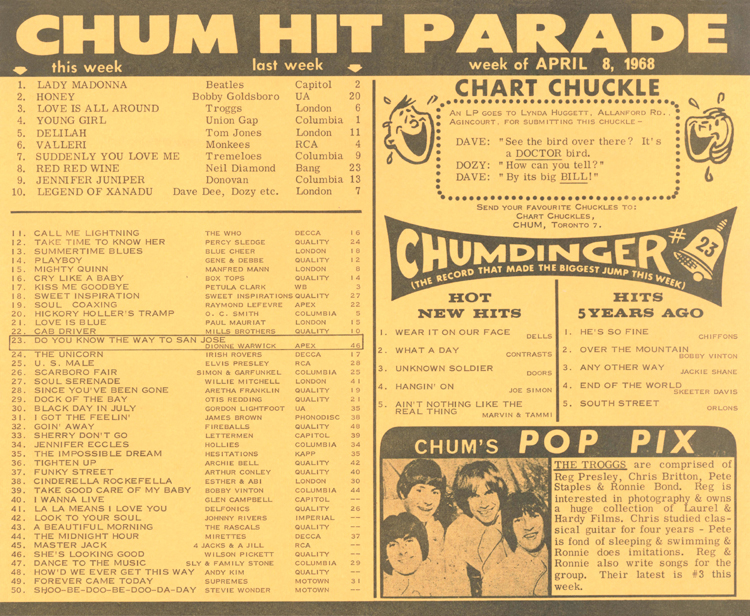
- ^ "CHUM Hit Parade (week of April 8, 1968)". CHUM. Retrieved 27 May 2022 – via chumtribute.com.
- ^ "RPM Top Singles – May 1968". Library and Archives Canada. 17 July 2013. Retrieved 21 September 2015.
- ^ "The Beatles – Lady Madonna". dutchcharts.nl. Retrieved 21 September 2015.
- ^ "Search: 'Lady Madonna'". irishcharts.ie. Archived from the original on 5 March 2016. Retrieved 21 September 2015.
- ^ "Classifiche". Musica e dischi (in Italian). Retrieved 31 May 2022. Set "Tipo" on "Singoli". Then, in the "Titolo" field, search "Lady Madonna".
- ^ "Search NZ Listener > 'The Beatles'". Flavour of New Zealand/Steve Kohler. Archived from the original on 3 June 2021. Retrieved 21 September 2015.
- ^ Nyman, Jake (2005). Suomi soi 4: Suuri suomalainen listakirja (in Finnish) (1st ed.). Helsinki: Tammi. ISBN 951-31-2503-3.
- ^ "The Beatles – Lady Madonna". norwegiancharts.com. Retrieved 21 September 2015.
- ^ Kimberley, C (2000). Zimbabwe: Singles Chart Book. p. 10.
- ^ Hallberg, Eric (1993). Eric Hallberg presenterar Kvällstoppen i P 3: Sveriges radios topplista över veckans 20 mest sålda skivor 10. 7. 1962 - 19. 8. 1975. Drift Musik. p. 130. ISBN 9163021404.
- ^ Hallberg, Eric; Henningsson, Ulf (1998). Eric Hallberg, Ulf Henningsson presenterar Tio i topp med de utslagna på försök: 1961 - 74. Premium Publishing. p. 53. ISBN 919727125X.
- ^ "The Beatles – Lady Madonna". hitparade.ch. Retrieved 21 September 2015.
- ^ "Cash Box Top 100" (PDF). Cash Box. 6 April 1968. p. 4.
- ^ "100 Top Pops (Week of April 13, 1968)" (PDF). Record World. p. 29.
- ^ "The Beatles Single-Chartverfolgung (in German)". musicline.de. Archived from the original on 13 December 2013. Retrieved 20 September 2015.
- ^ "Go-Set Australian charts – Top Records for the Year of 1968". poparchives.com.au. Retrieved 21 September 2015.
- ^ "Jahreshitparade 1968" (in German). austriancharts.at. Archived from the original on 5 September 2014. Retrieved 21 September 2015.
- ^ "Jaaroverzichten 1968" (in Dutch). ultratop.be. Retrieved 21 September 2015.
- ^ "The RPM 100 Top Singles of 1968". Library and Archives Canada. 17 July 2013. Retrieved 21 September 2015.
- ^ "Top 100-Jaaroverzicht van 1968" (in Dutch). top40.nl. Retrieved 21 September 2015.
- ^ Swiss Year-End Charts, 1968
- ^ "Top 100 Hits of 1968/Top 100 Songs of 1968". musicoutfitters.com. Archived from the original on 24 October 2004. Retrieved 18 June 2016.
- ^ Syndicat National de l'Édition Phonographique (SNEP). Fabrice Ferment (ed.). "TOP – 1968". 40 ans de tubes : 1960–2000 : les meilleures ventes de 45 tours & CD singles (in French). OCLC 469523661. Archived from the original on 27 February 2022. Retrieved 17 May 2023 – via Top-France.fr.
- ^ "Beatles - Tom chart fight" (PDF). Melody Maker. 23 March 1968. Retrieved 4 June 2021.
- ^ "American single certifications – The Beatles – Lady Madonna". Recording Industry Association of America. Retrieved 14 May 2016.
Sources[edit]
- Babiuk, Andy (2002). Beatles Gear: All the Fab Four's Instruments, from Stage to Studio. San Francisco, CA: Backbeat Books. ISBN 978-0-87930-731-8.
- Brackett, Nathan; Hoard, Christian, eds. (2004). The New Rolling Stone Album Guide (4th edn). New York, NY: Fireside/Simon & Schuster. ISBN 0-7432-0169-8.
- Castleman, Harry; Podrazik, Walter J. (1976). All Together Now: The First Complete Beatles Discography 1961–1975. New York, NY: Ballantine Books. ISBN 0-345-25680-8.
- Gilliland, John (1969). "Show 54 – Hail, Hail, Rock 'n' Roll: Getting back to rock's funky, essential essence. (Part 3)" (audio). Pop Chronicles. University of North Texas Libraries.
- Everett, Walter (1999). The Beatles as Musicians: Revolver Through the Anthology. New York, NY: Oxford University Press. ISBN 0-19-988093-X.
- Gendron, Bernard (2002). Between Montmartre and the Mudd Club: Popular Music and the Avant-Garde. Chicago, IL: University of Chicago Press. ISBN 978-0-226-28737-9.
- Gould, Jonathan (2007). Can't Buy Me Love: The Beatles, Britain and America. London: Piatkus. ISBN 978-0-7499-2988-6.
- The History of Rock 1968. London: Time Inc. 2015.
- Ingham, Chris (2006). The Rough Guide to the Beatles (2nd edn). London: Rough Guides/Penguin. ISBN 978-1-84836-525-4.
- Lewisohn, Mark (2005) [1988]. The Complete Beatles Recording Sessions: The Official Story of the Abbey Road Years 1962–1970. London: Bounty Books. ISBN 978-0-7537-2545-0.
- MacDonald, Ian (1998). Revolution in the Head: The Beatles' Records and the Sixties (1st rev. ed.). London: Pimlico. ISBN 0-7126-6697-4.
- Miles, Barry (1997). Paul McCartney: Many Years from Now. New York, NY: Henry Holt & Company. ISBN 0-8050-5249-6.
- Miles, Barry (2001). The Beatles Diary Volume 1: The Beatles Years. London: Omnibus Press. ISBN 0-7119-8308-9.
- Mojo Special Limited Edition: 1000 Days of Revolution (The Beatles' Final Years – Jan 1, 1968 to Sept 27, 1970). London: Emap. 2003.
- Schaffner, Nicholas (1978). The Beatles Forever. New York, NY: McGraw-Hill. ISBN 0-07-055087-5.
- Sheff, David (2000) [1981]. All We Are Saying: The Last Major Interview with John Lennon and Yoko Ono. New York: St. Martin's Press. ISBN 0-312-25464-4.
- Sounes, Howard (2010). Fab: An Intimate Life of Paul McCartney. London: HarperCollins. ISBN 978-0-00-723705-0.
- Unterberger, Richie (2006). The Unreleased Beatles: Music & Film. San Francisco, CA: Backbeat Books. ISBN 978-0-8793-0892-6.
- Winn, John C. (2009). That Magic Feeling: The Beatles' Recorded Legacy, Volume Two, 1966–1970. New York, NY: Three Rivers Press. ISBN 978-0-3074-5239-9.
- Womack, Kenneth (2014). The Beatles Encyclopedia: Everything Fab Four. Santa Barbara, CA: ABC-CLIO. ISBN 978-0-313-39171-2.
External links[edit]



- 1968 songs
- 1968 singles
- The Beatles songs
- Parlophone singles
- Capitol Records singles
- Songs written by Lennon–McCartney
- Song recordings produced by George Martin
- Songs published by Northern Songs
- Number-one singles in Australia
- Number-one singles in Austria
- Number-one singles in New Zealand
- Number-one singles in Sweden
- Number-one singles in Switzerland
- UK Singles Chart number-one singles
- Fats Domino songs
- Elvis Presley songs
- Aretha Franklin songs
- Gary Puckett & The Union Gap songs
- Songs about mothers
- Fats Domino
- British rhythm and blues songs
- British rock-and-roll songs