


I Saw Her Standing There
| "I Saw Her Standing There" | ||||
|---|---|---|---|---|
 US picture sleeve (reverse) | ||||
| Single by the Beatles | ||||
| A-side | "I Want to Hold Your Hand" | |||
| Released |
| |||
| Recorded | 11 February 1963 | |||
| Studio | EMI, London | |||
| Genre | Rock and roll | |||
| Length | 2:55 | |||
| Label | Capitol | |||
| Songwriter(s) | McCartney-Lennon | |||
| Producer(s) | George Martin | |||
| The Beatles US singles chronology | ||||
| ||||
| Music video | ||||
| "I Saw Her Standing There" (Remastered 2009) on YouTube | ||||
"I Saw Her Standing There" is a song by the English rock band the Beatles, written by Paul McCartney and John Lennon. It is the opening track on the band's 1963 debut UK album Please Please Me and their debut US album Introducing... The Beatles.
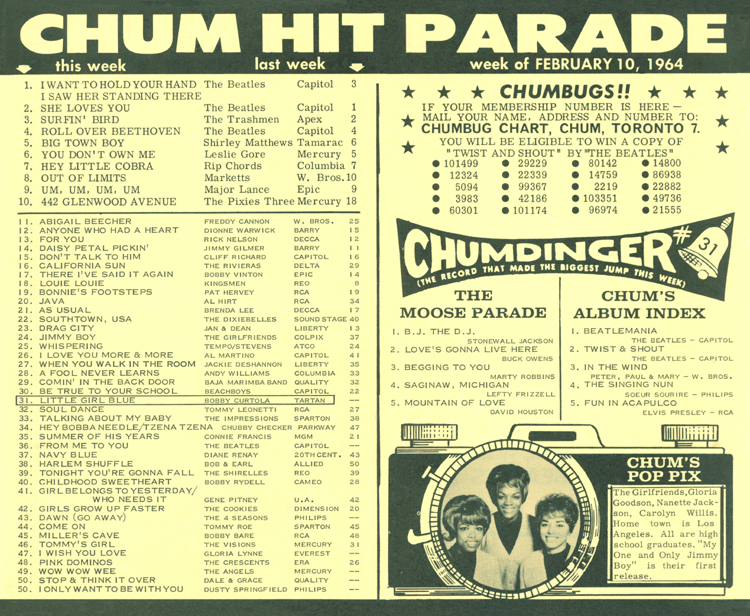
In December 1963, Capitol Records released the song in the United States as the B-side on the label's first single by the Beatles, "I Want to Hold Your Hand". While the A-side topped the US Billboard chart for seven weeks starting 1 February 1964, "I Saw Her Standing There" entered the Billboard Hot 100 on 8 February 1964, remaining there for 11 weeks, peaking at No. 14. The song placed on the Cashbox chart for only one week at No. 100 on the same week of its Billboard debut. In 2004, "I Saw Her Standing There" was ranked No. 139 on Rolling Stone's list of the 500 Greatest Songs of All Time.
Composition[edit]
Originally titled "Seventeen", the song was conceived by McCartney when driving home from a Beatles' concert in Southport, Merseyside[1] as a modern take on the traditional song "As I Roved Out", a version of "Seventeen Come Sunday" that he had heard in Liverpool in 1960.[2] According to Beatles biographer Mark Lewisohn, McCartney first worked out the chords and arrangement on an acoustic guitar at the family home of his Liverpool friend and fellow musician Rory Storm on the evening of 22 October 1962.[3] Two days later, McCartney was writing lines for the song during a visit to London with his then-girlfriend Celia Mortimer, who was seventeen at the time herself.[4] The song was completed about a month later at McCartney's Forthlin Road home in collaboration with Lennon[5] and performed as part of their set in December 1962 in the Star-Club in Hamburg. It is also possible John Lennon had more to contribute than has been reported since there is more than one photo of both John & Paul working on the song with guitars in hand taken by Michael McCartney. John very likely contributed some chord ideas as well since he was already actively writing songs on his own by late 1962.
McCartney later described in Beat Instrumental how he went about the song's composition: "Here's one example of a bit I pinched from someone: I used the bass riff from 'Talkin' About You' by Chuck Berry in 'I Saw Her Standing There'. I played exactly the same notes as he did and it fitted our number perfectly. Even now, when I tell people, I find few of them believe me; therefore, I maintain that a bass riff hasn't got to be original."[6] Berry's "I'm Talking About You" was performed by The Beatles and the song appears on their albums Live! at the Star-Club in Hamburg, Germany; 1962 and On Air – Live at the BBC Volume 2.[7]
The lyrics were written in a Liverpool Institute exercise book. Remember: The Recollections and Photographs of the Beatles, a book by McCartney's brother Mike McCartney, includes a photograph taken in the front room of his home of Lennon and McCartney writing the song while strumming their acoustic guitars and reading the exercise book. It typified how Lennon and McCartney would later work in partnership, as McCartney subsequently reflected: "I had 'She was just seventeen,' and then 'never been a beauty queen'. When I showed it to John, he screamed with laughter, and said 'You're joking about that line, aren't you?'"[1] According to McCartney, "We came up with, 'You know what I mean.' Which was good, because you don't know what I mean."[8][9] In a 1988 interview, McCartney stated that "It was one of the first times he ever went 'What? Must change that ...'"[10] Lennon said: "That's Paul doing his usual good job of producing what George Martin used to call a 'potboiler'. I helped with a couple of the lyrics."[9][11] The songwriting credit on the Please Please Me liner notes is "McCartney–Lennon" which differs from the more familiar "Lennon–McCartney" that appears on subsequent releases.[12]
Recording[edit]
The first live recording (a slow version of the song) was made at the Cavern Club at the end of 1962. Lennon did not play rhythm guitar; he played harmonica in the introduction and during the verses. Lennon and McCartney laughed when they sang "Well we danced all night/And I held her tight/And I held her hand in mine" the second time.[9][better source needed]
The song was recorded at EMI Studios on 11 February 1963 and engineered by Norman Smith, as part of the marathon recording session that produced 10 of the 14 songs on Please Please Me.[13] The Beatles were not present for the mixing session on 25 February 1963.[14] It was not common practice for bands to be present at such sessions at that time.
On the album, the song starts with a rousing "One, two, three, four!" count-in by McCartney. Usually count-ins are edited off the final audio mix; however, record producer George Martin wanted to create the effect that the album was a live performance: "I had been up to the Cavern and I'd seen what they could do, I knew their repertoire, and I said 'Let's record every song you've got, come down to the studios and we'll just whistle through them in a day'".[15] Martin took the count-in from take 9, which was considered 'especially spirited'[10] and spliced it onto take 1.[16] Music journalist Richard Williams suggested that this dramatic introduction to their debut album was just as stirring as Elvis Presley's "Well, it's one for the money, two for the show ..." on his opening track, "Blue Suede Shoes", for his debut album seven years earlier.[17] It also made the point that the Beatles were a live band as, at that time, they opened their set with this song.[18] On the first American release of the song, issued on Vee Jay Records, the count was edited out—but the "Four!" is still audible.
The full take 9 version of the song appears on the "Free as a Bird" CD single as a B side, released for the first time.
Take 2 of the song was released on The Beatles Bootleg Recordings 1963, which was an album released exclusively to iTunes in 2013.
Reception[edit]
In its contemporary review of the US single, Cash Box described it as an "engaging" song that is "hard-hitting teen stuff."[19]
Charts[edit]
Weekly charts[edit]
|
Year-end charts[edit]
|
Certifications[edit]
| Region | Certification | Certified units/sales |
|---|---|---|
| United Kingdom (BPI)[27] | Silver | 200,000‡ |
|
‡ Sales+streaming figures based on certification alone. | ||
Releases[edit]
- British LP: Please Please Me
- British EP: The Beatles (No. 1)
- American LP: Introducing... The Beatles
- American single: "I Want to Hold Your Hand"
- American LP: Meet the Beatles!
- Canadian LP: The Beatles' Long Tall Sally
Personnel[edit]
- Paul McCartney – lead vocals, bass guitar, hand claps
- John Lennon – rhythm guitar, harmony vocals, hand claps
- George Harrison – lead guitar, hand claps
- Ringo Starr – drums, hand claps
- Personnel per Ian MacDonald[28][9]
Later performances by Beatles[edit]
 | This section needs additional citations for verification. (September 2012) |
.jpg)
John Lennon[edit]
A live version was recorded at Madison Square Garden on 28 November 1974 by the Elton John Band with John Lennon, and released as the B-side to the former's "Philadelphia Freedom" single. The song is available on the Lennon box set, and on Elton John's To Be Continued... box set as well as the expanded CD edition of his 1976 live album Here and There and Elton John's Rare Masters. Lennon's introduction:
I'd like to thank Elton and the boys for having me on tonight. We tried to think of a number to finish off with so I can get out of here and be sick, and we thought we'd do a number of an old, estranged fiancé of mine, called Paul. This is one I never sang, it's an old Beatle number, and we just about know it.
This was the last major live performance by Lennon. After Lennon's death, the track was released as a single and reached No. 40 on the UK Singles Chart in March 1981, making it the first time that any version of the song had entered the UK charts.
Paul McCartney[edit]
McCartney included "I Saw Her Standing There" on his live albums Tripping the Live Fantastic (1990), Back in the US (2002) and Back in the World (2003). In 1987, he recorded a new version for his album CHOBA B CCCP, but left it to outtakes. The song has become a mainstay of McCartney's live sets, and a special version was played when McCartney and his band returned to Liverpool in June 2008. It featured special guest drummer Dave Grohl, the lead singer of the Foo Fighters and ex-drummer of Nirvana. In 2007, McCartney performed a secret gig at Amoeba Music in Hollywood – this performance appeared on the EP Amoeba's Secret and earned him a Grammy Award for Best Solo Rock Vocal Performance nomination in 2009.
McCartney performed "I Saw Her Standing There" at the 1986 Prince's Trust Rock Gala, as part of the 10th anniversary celebration of HRH Prince Charles' charity. He was supported by an all-star band featuring Elton John, Eric Clapton, Phil Collins, Mark Knopfler, and Ray King. Interviewed at the time, McCartney said: "It is a good thrill playing with musicians of this calibre ... since it was a birthday thing, they wanted to do something silly at the end, and that's me".[29]
George Harrison and Ringo Starr[edit]
George Harrison and Ringo Starr also performed the song with Bruce Springsteen, Billy Joel, Mick Jagger, and Bob Dylan, amongst others, at the Beatles' induction into the Rock and Roll Hall of Fame. This makes it the only song by the Beatles that all four members performed on stage during their respective solo careers to any extent.
Tiffany version[edit]
| "I Saw Him Standing There" | ||||
|---|---|---|---|---|
 | ||||
| Single by Tiffany | ||||
| from the album Tiffany | ||||
| B-side |
| |||
| Released | February 12, 1988 | |||
| Recorded | 1987 | |||
| Genre | ||||
| Length |
| |||
| Label | MCA | |||
| Songwriter(s) | Lennon–McCartney | |||
| Producer(s) | George Tobin | |||
| Tiffany singles chronology | ||||
| ||||
| Music video | ||||
| "I Saw Him Standing There" on YouTube | ||||
The song was covered by American pop singer Tiffany, released on February 12, 1988, as the third single from her first album Tiffany.[33][34] It was released in the United Kingdom on May 23, 1988.[35] Tiffany and her producer George Tobin changed the pronouns from "her" to "him".
The song peaked at number 7 on the Billboard Hot 100, and charted highly in seven other countries.
Critical reception[edit]
Richard Lowe of Smash Hits considered this cover "an affront to taste and decency and will visibly cringe every time they hear that nasty little 'synth' 'riff'. A truly shocking record which is a shame".[36]
Track listings and formats[edit]
Cassette single and 7-inch single
- "I Saw Him Standing There"
- "Gotta Be Love"
- "Mr. Mambo"
12-inch single
- "I Saw Him Standing There"
UK 7-inch single
- "I Saw Him Standing There"
- "Mr. Mambo"
Japanese 3-inch CD single
- "I Saw Him Standing There"
- "Can't Stop a Heartbeat"
Japanese CD EP
- "I Think We're Alone Now (extended version)"
- "I Saw Him Standing There (dance mix)"
- "Can't Stop a Heartbeat (long version)"
- "Mr. Mambo"
- "Can't Stop a Heartbeat (singalong version)"
Chart performance[edit]
Tiffany version
| Chart (1988) | Peak position |
|---|---|
| Australia (ARIA)[37] | 10 |
| Canada Top Singles (RPM)[38] | 4 |
| Denmark (Hitlisten)[39] | 49 |
| Ecuador (UPI)[40] | 3 |
| Ireland (IRMA) | 4 |
| Israel (IBA)[41] | 8 |
| Japan (Oricon) | 64 |
| New Zealand (Recorded Music NZ) | 3 |
| Netherlands (Dutch Top 40) | 40 |
| UK Singles (OCC) | 8 |
| US Billboard Hot 100 (Billboard) | 7 |
| US Contemporary Hit Radio (Radio & Records)[42] | 11 |
| West Germany (Official German Charts)[43] | 40 |
References[edit]
- ^ a b Badman 2000, p. 50.
- ^ Schofield 2012, p. 395.
- ^ Lewisohn, Mark. The Beatles: All These Years, Volume One – Tune In. Crown Archetype, 2013, ISBN 978-1-4000-8305-3, pp. 747–748
- ^ Lewisohn, Mark. The Beatles: All These Years, Volume One – Tune In. Crown Archetype, 2013, ISBN 978-1-4000-8305-3, p. 748
- ^ Miles 1997, pp. 93–94.
- ^ Harry 1992, p. 329.
- ^ The Beatles Encyclopedia: Everything Fab Four ISBN 978-1-440-84427-0 p. 228
- ^ Barry Miles. Paul McCartney: Many Years From Now
- ^ a b c d "I Saw Her Standing There". The Beatles Bible. 15 March 2008.
- ^ a b Lewisohn 1988, p. 9.
- ^ David Sheff. John Lennon: All We Are Saying
- ^ Parlophone 1963, p. 3.
- ^ Lewisohn 1988, p. 24.
- ^ Lewisohn 1988, p. 28.
- ^ The Beatles 2000, p. 92.
- ^ MacDonald 2005, p. 60.
- ^ Mojo 2002, p. 40.
- ^ MacDonald 2005, p. 68.
- ^ "CashBox Record Reviews" (PDF). Cash Box. 4 January 1964. p. 8. Retrieved 12 January 2022.
- ^ a b Kent 2009, p. 202.
- ^ "Flavour of New Zealand, 13 February 1964". Archived from the original on 24 February 2021. Retrieved 26 August 2018.
- ^ "CHUM Top 50 – February 10, 1964".
- ^ "The Beatles - Salgshitlisterne Top 20". Danske Hitlister. Archived from the original on 4 November 2013. Retrieved 2 August 2022.
- ^ "Swedish Charts 1962 – March 1966/Kvällstoppen – Listresultaten vecka för vecka > Januari 1964" (PDF) (in Swedish). hitsallertijden.nl. Retrieved 27 June 2018.
- ^ [Joel Whitburn's Top Pop Singles 1955–2002]
- ^ "Top 100 Hits of 1964/Top 100 Songs of 1964 | Music Outfitters".
- ^ "British single certifications – Beatles – I Saw Her Standing There". British Phonographic Industry. Retrieved 15 December 2021.
- ^ MacDonald 2005, p. 66.
- ^ YouTube 2009.
- ^ Willis, Cary (5 December 1987). "Reviews". The Courier-Journal. p. 52. Retrieved 15 October 2023.
- ^ Robins, Wayne (4 October 1987). "Two Pop Albums By and for Teens". Newsday. p. 31. ProQuest 277861878. Retrieved 15 October 2023.
- ^ a b "To see what 'Tiffany' is worth, look beyond the cover". The Knoxville News-Sentinel. 2 October 1987. p. 51. Retrieved 26 July 2023.
- ^ "The new hit single from her Triple Platinum album" (PDF). Radio & Records. No. 724. 12 February 1988. p. 29. Retrieved 16 April 2024.
- ^ Dion, Mike (19 February 1988). "Tuned In". Daily Hampshire Gazette. p. 64. Retrieved 28 October 2023.
- ^ "I Saw Him Standing There | On 7", 12", and CD single" (PDF). Smash Hits. Vol. 10, no. 10. 31 May 1988. p. 16. Retrieved 16 April 2024.
- ^ Lowe, Richard (18–31 May 1988). "Singles reviewed by Richard Lowe" (PDF). Smash Hits. Vol. 10, no. 10. p. 63. ISSN 0260-3004. Retrieved 16 November 2023 – via World Radio History.
- ^ "australian-charts.com > Discography Tiffany". Hung Medien. Retrieved 15 November 2015.
- ^ "RPM Top 100 Singles – May 7, 1988" (PDF).
- ^ Danish Charts Archive. 17 June 1988.
- ^ "Canciones de mayor popularidad en el hemisferio - Ecuador". UPI. 25 April 1988. p. 5. Retrieved 22 January 2024.
- ^ 8 May 1988
- ^ "Contemporary Hit Radio" (PDF). Radio & Records. No. 731. 1 April 1988. p. 110. Retrieved 16 April 2024.
- ^ "Offiziellecharts.de – Tiffany – I Saw Her Standing There" (in German). GfK Entertainment charts. Retrieved 26 February 2024.
Bibliography
- Badman, Keith (2000). The Beatles Off the Record. London: Omnibus. ISBN 0-7119-7985-5.
- "The Ladybugs Sing "I Saw Her Standing There"". Dailymotion. 2009. Retrieved 13 April 2009.
- Harry, Bill (1992). The Ultimate Beatles Encyclopedia. London: Virgin Books. ISBN 0-86369-681-3.
- Kent, David (2009). Australian Chart Book:Australian Chart Chronicles (1940–2008). Turramurra: Australian Chart Book. ISBN 9780646512037.
- Lewisohn, Mark (1988). The Beatles Recording Sessions. New York: Harmony Books. ISBN 0-517-57066-1.
- MacDonald, Ian (2005). Revolution in the Head: The Beatles' Records and the Sixties (Second Revised ed.). London: Pimlico (Rand). ISBN 1-84413-828-3.
- Miles, Barry (1997). Paul McCartney: Many Years From Now. New York: Henry Holt & Company. ISBN 0-8050-5249-6.
- Mojo Special Limited Edition # M-04951. London. 2002.
{{cite book}}:|work=ignored (help)CS1 maint: location missing publisher (link) - Schofield, Nigel (2012). Fairport by Fairport. London: Rocket 88. ISBN 978-1-906615-47-5.
- Please Please Me (booklet). The Beatles. London: Parlophone. 1963. CDP 7 46435 2.
{{cite AV media notes}}: CS1 maint: others in cite AV media (notes) (link) - "The Prince's Trust 1986, "I Saw Her Standing There" by Paul McCartney". 2009. Archived from the original on 21 December 2021. Retrieved 6 December 2009 – via YouTube.
- The Beatles (2000). The Beatles Anthology. London: Cassell & Co. ISBN 0-304-35605-0.
External links[edit]


- Songs about teenagers
- 1963 songs
- The Beatles songs
- Song recordings produced by George Martin
- Songs written by Lennon–McCartney
- Elton John songs
- The Supremes songs
- Songs published by Northern Songs
- 1988 singles
- Tiffany Darwish songs
- MCA Records singles
- Capitol Records singles
- Parlophone singles
- Songs about dancing
- 1963 singles
- British rock-and-roll songs
- The Crickets songs