


List of monarchs of Sardinia

The following is a list of rulers of Sardinia, in particular, of the monarchs of the Kingdom of Sardinia and Corsica from 1323 and then of the Kingdom of Sardinia from 1479 to 1861.
Early history[edit]
Owing to the absence of written sources, little is known of the history of the Nuraghic civilization which constructed impressive megalithic structures between the 18th and the 12th centuries BCE. The first accounts of Sardinia are from Greek sources, but relate more to myth than to historical reality; an African or Iberian hero, Norax, named the city of Nora; Sardo, a son of Hercules, gave the island its name; one of his nephews, Iolaus, founded the city of Olbia.[1] Greek colonization of the city of Olbia has been confirmed by recent archaeological excavations.[2] Towards the end of the 6th century BC, Sardinia was conquered by the Carthaginians and in 238 BC it was occupied by the Romans for c.1000 years, with a period under the dominion of the Vandals in the 5th and 6th centuries CE.
Early medieval rulers[edit]
- Godas 533–535
According to Procopius,[3] Godas was a Vandal governor of Sardinia who rebelled against his king, Gelimer, who ruled northern Africa and Sardinia. Procopius wrote that Godas behaved like a king, but it was a short-lived kingdom.[4] Godas was defeated and killed after two years by an expedition from Carthage led by King Gelimer's brother, Tzazo. Shortly afterwards, Roman troops sent by Emperor Justinianus and led by General Belisarius, totally annihilated the Vandal kingdom and Sardinia returned to Roman administration.
-
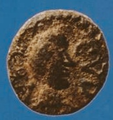 Vandal coin found in Sardinia depicting Godas (REX CVDA).

Judges[edit]
Before the Kingdom of Sardinia was founded, the rulers of the island were known as archons (ἄρχοντες in Greek) or "judges" (iudices in Latin, judices in Sardinian, giudici in Italian).[5][6] The island was organized into one "judicatus" from the 9th century. After the Muslim conquest of Sicily in the 9th century, the Byzantines (who ruled Sardinia) could no longer defend their isolated far western province. In all likelihood a local noble family came to power, still identifying themselves as vassals of the Byzantines but in reality independent since communication with Constantinople was very difficult.
Of those rulers, only two names are known: Salusios (Σαλούσιος) and the protospatharios Turcoturios (Tουρκοτούριος),[7][8][9] who probably reigned some time in the 10th and 11th centuries. They were still closely linked to the Byzantines, both by a pact of ancient vassalage[10] and culturally, with the use of the Greek language (in a country of the Romance language) and Byzantine art.
In the early 11th century, Muslims based in Spain attempted to conquer the island.[11] The only records of that war are from Pisan and Genoese chronicles.[12] The Christians won but afterwards the previous Sardinian kingdom had been undermined and was divided into four small judicati: Cagliari (Calari), Arborea (Arbaree), Gallura, Torres or Logudoro.
- List of judges of Arborea, c. 1070–1410
- List of judges of Cagliari, c. 1060–1258
- List of judges of Gallura, c. 1070–1288
- List of judges of Logudoro, c. 1060–1259
Occasionally, these rulers took the style of king (rex):
- 1113–1128 Constantine I, Judge of Torres
- 1128–1150 Gonario II, Judge of Torres
Nominal kings[edit]
Some rulers obtained the title King of Sardinia (Rex Sardiniae) by grant of the Holy Roman Emperor, despite the emperor itself not having any sovereignty over the island, which made this a mere title with no effective authority over Sardinia:[13]
- Barisone II of Arborea,[14] 1164–1165 (by Emperor Frederick I, who officially renounced his title in a peace treaty with the other judices in 1165);
- Enzo of Logudoro Hohenstaufen, 1238–1245, was the illegitimate son of Emperor Frederick II and was appointed by his father. In 1249, he was captured by his enemies and imprisoned in Bologna, where he died 23 years later.
Kings of Sardinia and Corsica[edit]
James II of Aragon received royal investiture from Pope Boniface VIII in 1297 as Rex Sardiniae et Corsicae. The Aragonese did not take possession of the island until 1323, after a victorious military campaign against the Pisans. However, the Sardinian royal title did not have a specific line of succession and all kings used their own primary title.[citation needed]
House of Barcelona (Aragon), 1323–1410[edit]
| Name | Portrait | Birth | Marriage(s) | Death |
|---|---|---|---|---|
| James II of Aragon 1323–1327 |
.png) |
10 August 1267 Valencia son of Peter I and Constance of Sicily |
Isabella of Castile 1 December 1291 No children Blanche of Anjou 29 October 1295 10 children Marie de Lusignan 15 June 1315 No children Elisenda de Montcada 25 December 1322 No children |
5 November 1327 Barcelona aged 60 |
| Alfonso IV of Aragon 1327–1336 |
 |
1299 Naples son of James II of Aragon and Blanche of Anjou |
Teresa d'Entença 1314 7 children Eleanor of Castile 2 children |
27 January 1336 Barcelona aged 37 |
| Peter IV of Aragon 1336–1387 |
 |
5 October 1319 Balaguer son of Alfonso IV and Teresa d'Entença |
Maria of Navarre 1338 2 children Leonor of Portugal 1347 No children Eleanor of Sicily 27 August 1349 4 children |
5 January 1387 Barcelona aged 68 |
| John I of Aragon 1387–1396 |
_-_Monastery_of_Poblet_-_Catalonia_2014.JPG) |
27 December 1350 Perpignan son of Peter IV of Aragon and Eleanor of Sicily |
Martha of Armagnac 27 March 1373 1 child Yolande of Bar 1380 3 children |
19 May 1396 Foixà aged 46 |
| Martin of Aragon 1396–1410 |
 |
1356 Girona son of Peter IV of Aragon and Eleanor of Sicily |
Maria de Luna 13 June 1372 4 children Margarita of Aragon-Prades 17 September 1409 No children |
31 May 1410 Barcelona aged 54 |
Coat of arms[edit]
-
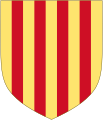 Arms of the House of Barcelona
 -
 The king of Aragon in Le grand armorial équestre de la Toison d'or


House of Trastámara, 1412–1516[edit]
| Name | Portrait | Birth | Marriage(s) | Death |
|---|---|---|---|---|
| Ferdinand I of Aragon 1412–1416 |
.jpg) |
27 November 1380 Medina del Campo son of John I of Castile and Eleanor of Aragon |
Eleanor of Alburquerque 1394 8 children |
2 April 1416 Igualada aged 36 |
| Alfonso V of Aragon 1416–1458 |
 |
1396 Medina del Campo son of Ferdinand I and Eleanor of Alburquerque |
Maria of Castile 1415 No children |
27 June 1458 Naples aged 52 |
Coat of arms[edit]
-
 Arms of the Aragonese House of Trastámara
.svg)
Kings of Sardinia[edit]
House of Trastámara, 1412–1516[edit]
| Name | Portrait | Birth | Marriage(s) | Death |
|---|---|---|---|---|
| John II of Aragon 1458–1479 |
.jpg) |
29 June 1398 Medina del Campo son of Ferdinand I and Eleanor of Alburquerque |
Blanche I of Navarre 6 November 1419 4 children Juana Enríquez April 1444 2 children |
20 January 1479 Barcelona aged 80 |
| Ferdinand II of Aragon 1479–1516 |
 |
10 March 1452 son of John II of Aragon and Juana Enriquez |
Isabella I of Castile 19 October 1469 5 children Germaine of Foix 1505 No children |
23 January 1516 Madrigalejo aged 63 |
| Joanna of Castile 1516–1555 |
 |
6 November 1479 daughter of Ferdinand II of Aragon and Isabella I of Castile |
Philip IV of Burgundy, 1496 6 children |
12 April 1555 Madrigalejo aged 75 |
Nominally co-monarch of her son Charles, Joanna was kept imprisoned almost during her whole reign.
House of Habsburg (Spanish branch), 1516–1700[edit]
| Name | Portrait | Birth | Marriage(s) | Death |
|---|---|---|---|---|
| Charles I of Spain co-king with his mother Joanna 1516–1556 |
 |
24 February 1500 Ghent son of Philip I of Castile and Joanna of Castile |
Isabella of Portugal 10 March 1526 3 children |
21 September 1558 Yuste aged 58 |
| Philip II of Spain 1556–1598 |
 |
21 May 1527 Valladolid son of Charles IV and Isabella of Portugal |
Maria of Portugal 1543 1 child Mary I of England 1554 No children Elisabeth of Valois 1559 2 children Anna of Austria 4 May 1570 5 children |
13 September 1598 Madrid aged 71 |
| Philip III of Spain 1598–1621 |
 |
14 April 1578 Madrid son of Philip I and Anna of Austria |
Margaret of Austria 18 April 1599 5 children |
31 March 1621 Madrid aged 42 |
| Philip IV of Spain 1621–1665 |
 |
8 April 1605 Valladolid son of Philip II and Margaret of Austria |
Elisabeth of Bourbon 1615 7 children Mariana of Austria 1649 5 children |
17 September 1665 Madrid aged 60 |
| Charles II of Spain 1665–1700 |
 |
6 November 1661 Madrid son of Philip III and Mariana of Austria |
Maria Luisa of Orléans 19 November 1679 No children Maria Anna of Neuburg 14 May 1690 No children |
1 November 1700 Madrid aged 38 |
Coat of arms[edit]
-
 Flag of the Kingdom of Sardinia, middle of 16th century
 -
 Coat of Arms of Charles V Emperor
 -
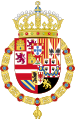 Coat of arms of the House of Habsburg, Spanish branch (Sardinian variant)


_-_Sardinia_Variant.svg)
House of Bourbon (Spanish branch) 1700–1708[edit]
| Name | Portrait | Birth | Marriage(s) | Death |
|---|---|---|---|---|
| Philip V of Spain 1700–1708 |
_-_Google_Art_Project.jpg) |
19 December 1683 Versailles son of Louis, Dauphin of France and Maria Anna of Bavaria |
Maria Luisa of Savoy 2 November 1701 4 children Elisabeth of Parma 24 December 1714 7 children |
9 July 1746 Madrid aged 62 |
Sardinia was taken over by Habsburg troops in 1708 during the War of the Spanish Succession in the name of the Habsburg claimant to the Spanish throne, "Charles III". At the end of the war, Sardinia remained in Charles' possession and, by the Treaty of Rastatt, was ceded to him.
Coat of arms[edit]
-
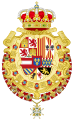 Coat of arms of Philip V of Spain
_Version_with_Golden_Fleece_and_Holy_Spirit_Collars.svg)
House of Habsburg (Austrian branch), 1708–1720[edit]
| Name | Portrait | Birth | Marriage(s) | Death |
|---|---|---|---|---|
| Emperor Charles VI 1708–1720 |
 |
1 October 1685 Vienna son of Leopold I, Holy Roman Emperor and Eleonore-Magdalena of Pfalz-Neuburg |
Elisabeth Christine 1 August 1708 4 children |
20 October 1740 Vienna aged 55 |
Spanish forces invaded the kingdom in 1717 during the War of the Quadruple Alliance. The island was under Spanish military occupation until 1720, when it was given back to Emperor Charles VI who in turn ceded it to the Duke of Savoy by the Treaty of The Hague.
Coat of arms[edit]
-
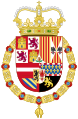 Coat of Arms of Archduke Charles of Austria
.svg)
House of Savoy, 1720–1861[edit]
The monarchs of the House of Savoy ruled from their mainland capital of Turin, but styled themselves primarily with the royal title of Sardinia as superior to their original lesser dignity as Dukes of Savoy. However, their numeral order continued the Savoyard list.


In 1861, after the annexation of other states in the Italian peninsula, the parliament of the Kingdom of Sardinia passed a law (Legge n. 4671, 17 marzo 1861) adding to the style of the sovereign the title of King of Italy. The monarchs retained the designation of King of Sardinia.
Coat of arms[edit]
-
 Coats of arms of the House of Savoy
 -
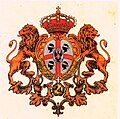 Coats of arms of the Kingdom of Sardinia until 1848


Kings of Italy[edit]
House of Savoy, 1861–1946[edit]
| Name | Portrait | Birth | Marriage(s) | Death |
|---|---|---|---|---|
| Victor Emmanuel II of Savoy 17 March 1861 – 9 January 1878 |
 |
14 March 1820 Turin son of Charles Albert of Sardinia and Maria Theresa of Austria |
Adelaide of Austria 12 April 1842 8 children Rosa Vercellana 18 October 1869 2 children |
9 January 1878 Rome aged 57 |
| Umberto I of Italy 9 January 1878 – 29 July 1900 |
 |
14 March 1844 Turin son of Victor Emmanuel II of Savoy and Adelaide of Austria |
Margherita of Savoy 21 April 1868 1 child |
29 July 1900 Monza aged 56 |
| Victor Emmanuel III of Italy 29 July 1900 – 9 May 1946 |
 |
11 November 1869 Naples son of Umberto I of Italy and Margherita of Savoy |
Elena of Montenegro 24 October 1896 5 children |
28 December 1947 Alexandria aged 78 |
| Umberto II of Italy 9 May 1946 – 12 June 1946 |
 |
15 September 1904 Racconigi son of Victor Emmanuel III of Italy and Elena of Montenegro |
Marie José of Belgium 8 January 1930 4 children |
18 March 1983 Geneva aged 78 |
The Kingdom of Italy was disestablished by an institutional referendum on 2 June 1946 and the Italian Republic was proclaimed.
Coat of arms[edit]
-
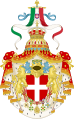 Coats of arms of the Kingdom of Italy (1890–1929 and 1943–1946)
.svg)
Notes[edit]
- ^ Perra Mario, 1993, La Sardegna nelle fonti classiche (Sardinia in classical sources), Editrice S'Alvure, Oristano
- ^ "Archived copy" (PDF). Archived from the original (PDF) on 4 March 2016. Retrieved 12 January 2016.
{{cite web}}: CS1 maint: archived copy as title (link) - ^ De bello Gothico, IV 24
- ^ De bello Wandalico
- ^ C. Zedda and R. Pinna (2007), La nascita dei giudicati, proposta per lo scioglimento di un enigma storiografico, Archivio Storico Giuridico Sardo di Sassari, vol. 12. http://www.archiviogiuridico.it/Archivio_12/Zedda_Pinna.pdf Archived 16 May 2018 at the Wayback Machine
- ^ F. Pinna (2010), "Le testimonianze archeologiche relative ai rapporti tra gli arabi e la Sardegna nel medioevo", Rivista dell'Istituto di storia dell'Europa mediterranea, Consiglio Nazionale delle Ricerche, 4.
- ^ 1) Κύριε βοήθε τοῦ δοῦλου σου Tουρκοτουρίου ἅρχωντος Σαρδινίας καί τής δούλης σου Γετιτ 2) Tουρκοτουρίου βασιλικου πρωτοσπαθαρίου και Σαλουσίου των ευγενεστάτων αρχόντων.) R. CORONEO, Scultura mediobizantina in Sardegna, Nuoro, Poliedro, 2000
- ^ Antiquitas nostra primum Calarense iudicatum, quod tunc erat caput tocius Sardinie, armis subiugavit, et regem Sardinie Musaitum nomine civitati Ianue captum adduxerunt, quem per episcopum qui tunc Ianue erat, aule sacri palatii in Alamanniam mandaverunt, intimantes regnum illius nuper esse additum ditioni Romani imperii." - Oberti Cancellarii, Annales p 71, Georg Heinrich (a cura di) MGH, Scriptores, Hannoverae, 1863, XVIII, pp. 56-96
- ^ Crónica del califa 'Abd ar-Rahmân III an-Nâsir entre los años 912-942,(al-Muqtabis V), édicion. a cura de P. CHALMETA - F. CORRIENTE, Madrid,1979, p. 365 Tuesday, August 24th 942 (A.D.), a messenger of the Lord of the island of Sardinia appeared at the gate of al-Nasir (...) asking for a treaty of peace and friendship. With him were the merchants, people Malfat, known in al-Andalus as from Amalfi, with the whole range of their precious goods, ingots of pure silver, brocades etc. ... transactions which drew gain and great benefits
- ^ To the Archont of Sardinia: a bulla with two gold bisolida with this written: from the very Christian Lord to the Archont of Sardinia. (εὶς τὸν ἄρχοντα Σαρδανίας. βούλλα κρυσῆ δισολδία. "κέλευσις ὲκ τῶν φιλοχρίστων δεσποτῶν πρὸς τὸν ἄρχοντα Σαρδανίας".) Reiske, Johann Jakob: Leich, Johannes Heinrich, eds. (1829). Constantini Porphyrogeniti Imperatoris De Ceremoniis Aulae Byzantinae libri duo graece et latini e recensione Io. Iac. Reiskii cum eiusdem commentariis integris. Corpus Scriptorum Historiae Byzantinae 1 (Leipzig (1751-54) ed.). Bonn: Weber. pag. 690
- ^ F. CODERA, Mochéid, conquistador de Cerdeña, in Centenario della nascita di Michele Amari. Scritti di filologia e storia araba; geografia, storia, diritto della Sicilia medioevale; studi bizantini e giudaici relativi all’Italia meridionale nel medio evo; documenti sulle relazioni fra gli Stati italiani e il Levante, vol. II, Palermo 1910, pp. 115-33, p. 124
- ^ B. MARAGONIS, Annales pisani a.1004-1175, ed. K. PERTZ, in MGH, Scriptores, 19,Hannoverae, 1861/1963, pp. 236-2 and Gli Annales Pisani di Bernardo Maragone, a cura di M. L.GENTILE, in Rerum Italicarum Scriptores, n.e., VI/2, Bologna 1930, pp. 4-7. 1017. Fuit Mugietus reversus in Sardineam, et cepit civitatem edificare ibi atque homines Sardos vivos in cruce murare. Et tunc Pisani et Ianuenses illuc venere, et ille propter pavorem eorum fugit in Africam. Pisani vero et Ianuenses reversi sunt Turrim, in quo insurrexerunt Ianuenses in Pisanos, et Pisani vicerunt illos et eiecerunt eos de Sardinea
- ^ Atzeni, Sergio (2020). I Giudicati Sardi. Storia dei quattro Regni Medievali (in Italian). Youcanprint. p. 16.
- ^ G. Seche, L'incoronazione di Barisone "Re di Sardegna" in due fonti contemporanee: gli Annales genovesi e gli Annales pisani, in Rivista dell'Istituto di storia dell'Europa mediterranea, Consiglio Nazionale delle Ricerche, n°4, 2010
|  | |

