


Mendoza, Argentina
Mendoza
Huentota | |
|---|---|
| City of Mendoza Ciudad de Mendoza (Spanish) | |
 Mendoza skyline | |
 Coat of arms  Logo | |
  Mendoza Location in Argentina | |
| Coordinates: 32°53′23″S 68°50′40″W / 32.88972°S 68.84444°W | |
| Country |  Argentina Argentina |
| Province |  Mendoza Mendoza |
| Department | Capital |
| Settled | 1561 |
| Founded by | Pedro del Castillo |
| Named for | García Hurtado de Mendoza, 5th Marquis of Cañete |
| Government | |
| • Mayor | Alfredo Cornejo (UCR) |
| Area | |
| • City | 54 km2 (21 sq mi) |
| Elevation | 746.5 m (2,449.1 ft) |
| Population (2010 census) | |
| • Density | 2,055.4/km2 (5,323/sq mi) |
| • Urban | 115,041 |
| • Metro | 1,033,000 (2,021 est.)[1] |
| • Demonym | Mendozan (Mendocino/-a Spanish) |
| GDP (PPP, constant 2015 values) | |
| • Year | 2023 |
| • Total | $28.7 billion[2] |
| • Per capita | $23,400 |
| Time zone | UTC-3 (ART) |
| CPA Base | M 5500 |
| Area code | +54 261 |
| Climate | BWk |
| Website | ciudaddemendoza.gov.ar |
Mendoza (Latin American Spanish: [menˈdosa]), officially the City of Mendoza (Spanish: Ciudad de Mendoza), is the capital of the province of Mendoza in Argentina. It is located in the northern-central part of the province, in a region of foothills and high plains, on the eastern side of the Andes. As of the 2010 census [INDEC], Mendoza had a population of 115,041 with a metropolitan population of 1,055,679, making Greater Mendoza the fourth largest census metropolitan area in the country.
Ruta Nacional 7, the major road running between Buenos Aires and Santiago, runs through Mendoza. The city is a frequent stopover for climbers on their way to Aconcagua (the highest mountain in the Western and Southern Hemispheres) and for adventure travelers interested in mountaineering, hiking, horse riding, rafting, and other sports. In the winter, skiers come to the city for easy access to the Andes.
Two of the main industries of the Mendoza area are olive oil production and Argentine wine. The region around Greater Mendoza is the largest wine-producing area in South America. As such, Mendoza is one of the eleven Great Wine Capitals,[3] and the city is an emerging enotourism destination and base for exploring the region's hundreds of wineries located along the Argentina Wine Route.
History[edit]

On 2 March 1561, Pedro del Castillo founded the city and named it Ciudad de Mendoza del Nuevo Valle de La Rioja after the governor of Chile, Don García Hurtado de Mendoza.[4] Before the 1560s the area was populated by tribes known as the Huarpes and Puelches. The Huarpes devised a system of irrigation that was later developed by the Spanish. This allowed for an increase in population that might not have otherwise occurred. The system is still evident today in the wide trenches (acequias), which run along all city streets, watering the approximately 100,000 trees that line every street in Mendoza.
It is estimated that fewer than 80 Spanish settlers lived in the area before 1600, but later prosperity increased due to the use of indigenous and slave labor, and the Jesuit presence in the region. When nearby rivers were tapped as a source of irrigation in 1788 agricultural production increased. The extra revenues generated from this, and the ensuing additional trade with Buenos Aires, Viceroyalty on which it depended since its creation and transfer from the Captaincy General of Chile in 1776, no doubt led to the creation of the state of Cuyo in 1813 with José de San Martín as governor. It was from Mendoza that San Martín and other Argentinian and Chilean patriots organized the army with which they won the independence of Chile and Peru.[5] Mendoza suffered a severe earthquake in 1861 that killed at least 5,000 people. The city was rebuilt, incorporating innovative urban designs that would better tolerate such seismic activity. Mendoza was rebuilt with large squares and wider streets and sidewalks than any other city in Argentina. Avenue Bartolomé Mitre and additional small squares are examples of that design.
Tourism, wine production, and more recently the exploitation of commodities such as oil[6] and uranium[7] ensure Mendoza's status as a key regional centre. Important suburbs such as Godoy Cruz, Guaymallén, Las Heras and Luján de Cuyo have in recent decades far outpaced the city proper in population. Comprising half the metro population of 212,000 in 1947, these suburbs grew to nearly seven-eighths of the total metro area of over 1,000,000 by 2015, making Mendoza the most dispersed metro area in Argentina.[8]
Culture[edit]
Mendoza has several museums, including the Museo Cornelio Moyano, a natural history museum, and the Museo del Área Fundacional (Historical Regional Foundation Museum) on Pedro del Castillo Square. The Museo Nacional del Vino (National Wine Museum), focusing on the history of winemaking in the area, is 17 kilometres (11 miles) southeast of Mendoza in Maipú. The Casa de Fader, a historic house museum, is an 1890 mansion once home to artist Fernando Fader in nearby Mayor Drummond, 14 kilometres (9 miles) south of Mendoza. The mansion is home to many of the artist's paintings.
The Fiesta Nacional de la Vendimia (The National Grape Harvest Festival) occurs in early March each year. Part of the festivities include a beauty pageant, where 17 beauty queens from each department of Mendoza Province compete, and one winner is selected by a panel of about 50 judges. The queen of Mendoza city's department does not compete and acts as host for the other queens.
In 2008, National Geographic listed Mendoza as one of the top 10 historic destinations in the world.[9]
Urban structure[edit]

The city is centred around Plaza Independencia (Independence Plaza) with Avenida Sarmiento running through its centre east–west, with the east side pedestrianized (peatonal). Other major streets, running perpendicular to Sarmiento, include Bartolomé Mitre, San Martín, and 9 de Julio (9 July), those running parallel include Colón, and Las Heras. Four smaller plazas, San Martín, Chile, Italia, and España, are located 2 blocks off each corner of Independence Plaza. Unique to Mendoza are the exposed stone ditches, essentially small canals, which run alongside many of the roads supplying water to the thousands of trees.

Parque General San Martín (General San Martín Park) was designed by Carlos Thays. Its grounds include the Mendoza Zoological Park and a football stadium, and it is also the home of the Universidad Nacional de Cuyo. A view of the city is available from the top of Cerro de la Gloria (Mt. Glory).[10]
One common point of interest is the Teatro Independencia ("Independence Theatre"), the premier performing arts venue in Mendoza. Supervised by the nation's Ministry of Public Works, the project was commissioned to architect Alfredo Israel, and its plans were approved in October 1923. The theatre was, as were many public works of this type in Argentina at the time, designed in a French Academy style. Its façade included a Neoclassical frontis featuring four Corinthian columns on a green marble base, a rococo frieze, the provincial escutcheon in bas-relief, and a balustrade above. The design for the interiors was based on those prevailing in Italian opera houses, and the formal vestibule is overlooked by grand marble steps leading to the concert hall. The auditorium itself includes four tiers of balconies, and its seating capacity is 730. The theatre serves as the home of the Provincial Philharmonic Orchestra. In addition, the theatre has received international personalities such as Erlend Øye and John Malkovich.
Education[edit]
Mendoza has a number of universities, including the major Universidad Nacional de Cuyo, as well as University of Mendoza, a branch of Universidad Congreso, Aconcagua University, UTN (Universidad Tecnologica Nacional) and Champagnat University.
Mendoza is a popular place to learn Spanish, and there are a number of Spanish language schools, including Intercultural, Green Fields and SIMA.[11]
Transportation[edit]
Mendoza is 1,037 km (644 mi) from Buenos Aires (14 hours by bus) and 380 km (236 mi) from Santiago, Chile (6–7 hours by bus). Gov. Francisco Gabrielli International Airport serves Mendoza, with flights to/from Buenos Aires taking less than 2 hours and less than 1 hour to/from Santiago.
The public transport system includes buses, the Mendoza trolleybus system, and taxis. The trolleybuses are more comfortable than the diesel buses, but are slower, not as numerous nor is the system as extensive. In 2008, TransLink of Vancouver, British Columbia, Canada, sold most of its old trolleybus fleet to Mendoza.[12]
A heritage railway, El Tren del Vino (The Wine Train), is being planned which will also provide local transportation; it will run through wine-producing districts of Mendoza.[needs update][13]
Metrotranvía[edit]
A 17-kilometre (11 mi) light rail line, the Metrotranvía Mendoza, opened for regular service in October 2012.[14] It serves the areas of Las Heras, Godoy Cruz and Maipú in the Greater Mendoza conurbation, as well as the central area of Mendoza itself. The line runs from Avellaneda station in the Panquehua neighborhood of Las Heras to Gutiérrez in Maipú, stopping also at the Mendoza Railway Station at the site of the former intercity passenger train station, near the city centre. The bright red railcars, Siemens-Duewag U2s, were purchased from the San Diego Metropolitan Transit System (MTS) in 2010. They were built in 1980.
Transandine Railway[edit]
Mendoza's development was helped partly due to its position at the start of the Transandine Railway linking it to Santa Rosa de Los Andes in Chile. The only railway operable between Argentina and Chile, after many years of inactivity, it remains currently abandoned.[15][16][17][18]
The railway is a 1,000 mm (3 ft 3+3⁄8 in) metre gauge line, with sections of Abt rack, whilst the railways it links with are both 1,676 mm (5 ft 6 in) broad gauge. A journey from Buenos Aires to Chile involved two breaks-of-gauge, and therefore two changes of train, one at Mendoza, and the other at Santa Rosa de Los Andes.
Wine industry[edit]

Argentina's Malbec wines originate from Mendoza's high-altitude wine regions of Lujan de Cuyo and the Uco Valley. These districts are located in the foothills of the Andes mountains between 2,800 and 5,000 feet elevation.[19][20][21][22] Vintner Nicolas Catena Zapata is considered the pioneer of high-altitude growing and was the first, in 1994, to plant a malbec vineyard at 5,000 feet above sea level in the Mendoza region. His family is also credited with making world-class wines and giving status to the wines of Argentina.[23]
The subject of elevation is of much interest to the wine world because with increased altitude, the intensity of the sunlight increases. The role of this increased light intensity is currently being investigated by Catena Zapata's research and development department headed up by Laura Catena, Alejandro Vigil and Fernando Buscema.
In film[edit]
Seven Years in Tibet, directed by French director Jean-Jacques Annaud and starring Brad Pitt, was shot in and around Mendoza. Several dozens of sets were built, ranging from a 220-yard (200 m) long recreation of the Tibetan capital city of Lhasa (built in the foothills of the Andes), to a 9,000-square-foot (840 m2) recreation of the Hall of Good Deeds in the Potala, the ancient palace of the Dalai Lama (built in an abandoned garlic warehouse outside the city).
In video games[edit]
Mendoza appears as the penultimate level in the video game Hitman 3. It contains hints of Argentine culture, such as mate, tango, and wine production.
Climate[edit]
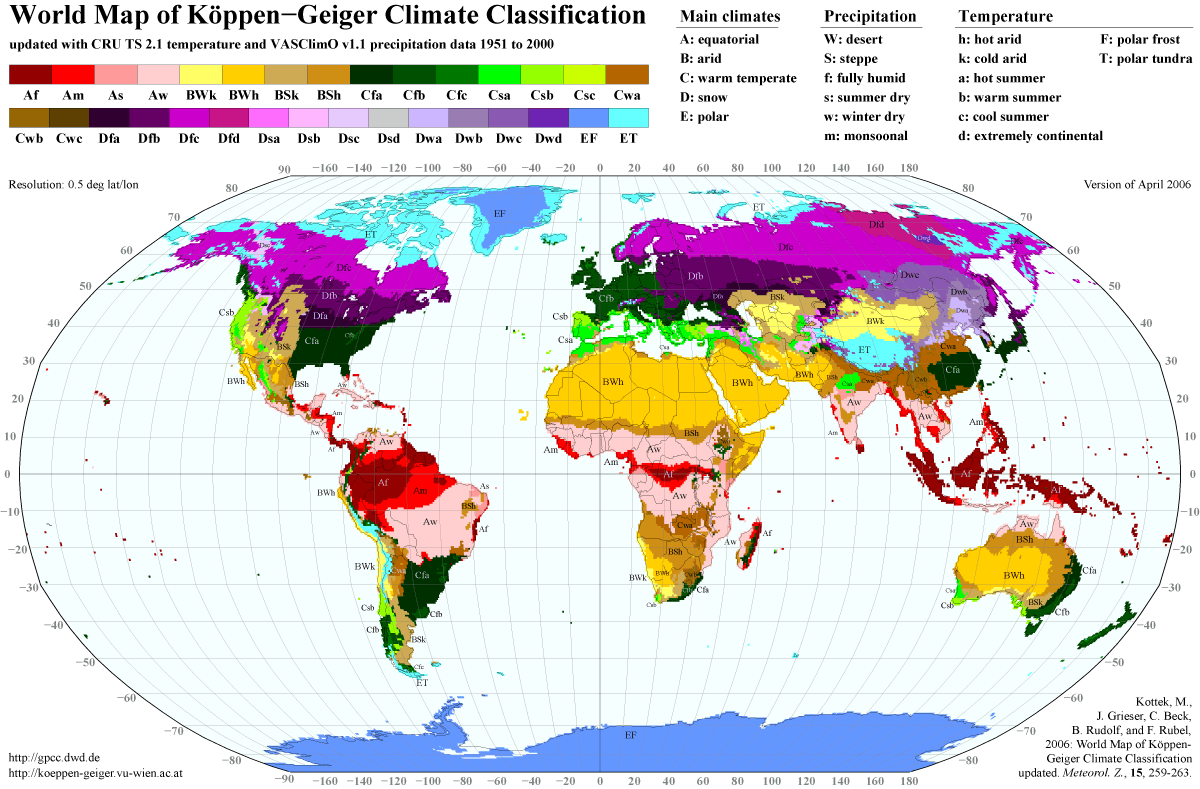
Mendoza's climate is characterised as an arid (Köppen climate classification BWk);[24] with continental characteristics.[25] Most precipitation in Mendoza falls in the summer months (November–March).[25] Summers are hot and humid where mean temperatures exceed 25 °C (77 °F).[25] Average temperatures for January (summer) are 32 °C (90 °F) during daytime, and 18.4 °C (65.1 °F) at night.[26] Winters are cold and dry with mean temperatures below 8 °C (46.4 °F).[25] Night time temperatures can occasionally fall below freezing during the winter.[25] Because winters are dry with little precipitation, snowfall is uncommon, occurring once per year.[25] July (winter) the average temperatures are 14.7 °C (58.5 °F) and 2.4 °C (36 °F), day and night respectively.[26] Mendoza's annual rainfall is only 223.2 mm (8.8 in), so extensive farming is made possible by irrigation from major rivers. The highest temperature recorded was 44.4 °C (111.9 °F) on 30 January 2003, This previous record was surpassed by the new temperature record of 44.9 °C (112.8 °F) recorded on 16 December 2023,[27] while the lowest temperature recorded was −7.8 °C (18.0 °F) on 10 July 1976.[28]
| Climate data for Mendoza Airport, Argentina (1991–2020, extremes 1949–present) | |||||||||||||
|---|---|---|---|---|---|---|---|---|---|---|---|---|---|
| Month | Jan | Feb | Mar | Apr | May | Jun | Jul | Aug | Sep | Oct | Nov | Dec | Year |
| Record high °C (°F) | 44.4 (111.9) |
40.6 (105.1) |
37.8 (100.0) |
34.0 (93.2) |
33.0 (91.4) |
30.4 (86.7) |
33.0 (91.4) |
34.4 (93.9) |
36.0 (96.8) |
40.1 (104.2) |
40.8 (105.4) |
44.9 (112.8) |
44.9 (112.8) |
| Mean daily maximum °C (°F) | 32.8 (91.0) |
31.0 (87.8) |
28.1 (82.6) |
23.3 (73.9) |
18.7 (65.7) |
15.9 (60.6) |
15.3 (59.5) |
18.6 (65.5) |
21.8 (71.2) |
25.7 (78.3) |
29.2 (84.6) |
32.0 (89.6) |
24.4 (75.9) |
| Daily mean °C (°F) | 25.9 (78.6) |
24.1 (75.4) |
21.5 (70.7) |
16.5 (61.7) |
12.1 (53.8) |
8.7 (47.7) |
7.9 (46.2) |
10.8 (51.4) |
14.5 (58.1) |
18.7 (65.7) |
22.3 (72.1) |
25.1 (77.2) |
17.3 (63.1) |
| Mean daily minimum °C (°F) | 19.3 (66.7) |
17.8 (64.0) |
15.7 (60.3) |
10.8 (51.4) |
6.8 (44.2) |
2.9 (37.2) |
2.0 (35.6) |
4.3 (39.7) |
7.8 (46.0) |
11.9 (53.4) |
15.4 (59.7) |
18.1 (64.6) |
11.1 (52.0) |
| Record low °C (°F) | 7.5 (45.5) |
4.8 (40.6) |
0.6 (33.1) |
−2.3 (27.9) |
−4.3 (24.3) |
−7.2 (19.0) |
−7.8 (18.0) |
−5.9 (21.4) |
−4.6 (23.7) |
0.1 (32.2) |
2.7 (36.9) |
5.3 (41.5) |
−7.8 (18.0) |
| Average precipitation mm (inches) | 47.2 (1.86) |
40.8 (1.61) |
31.6 (1.24) |
18.5 (0.73) |
11.0 (0.43) |
5.7 (0.22) |
5.0 (0.20) |
7.9 (0.31) |
12.3 (0.48) |
11.2 (0.44) |
22.1 (0.87) |
24.7 (0.97) |
238.0 (9.37) |
| Average precipitation days (≥ 0.1 mm) | 5.9 | 5.6 | 4.8 | 3.6 | 1.8 | 2.1 | 2.3 | 2.0 | 3.0 | 3.0 | 4.3 | 4.3 | 44.4 |
| Average snowy days | 0.0 | 0.0 | 0.0 | 0.0 | 0.1 | 0.1 | 0.7 | 0.2 | 0.1 | 0.0 | 0.0 | 0.0 | 1.1 |
| Average relative humidity (%) | 48.4 | 53.8 | 59.7 | 64.6 | 69.1 | 66.9 | 62.1 | 53.2 | 48.3 | 45.3 | 43.5 | 43.8 | 54.9 |
| Mean monthly sunshine hours | 316.2 | 257.1 | 241.8 | 210.0 | 189.1 | 183.0 | 204.6 | 232.5 | 228.0 | 275.9 | 309.0 | 328.6 | 2,975.8 |
| Mean daily sunshine hours | 10.2 | 9.1 | 7.8 | 7.0 | 6.1 | 6.1 | 6.6 | 7.5 | 7.6 | 8.9 | 10.3 | 10.6 | 8.1 |
| Percent possible sunshine | 67 | 69 | 61 | 64 | 60 | 56 | 58 | 68 | 63 | 70 | 70 | 64 | 64 |
| Source 1: Servicio Meteorológico Nacional[29][30][31] | |||||||||||||
| Source 2: NOAA (percent sun 1961–1990),[26] Meteo climat (record highs and lows),[32] Oficina de Riesgo Agropecuario (November and December record high and May record low only)[28][27] | |||||||||||||
| Climate data for Mendoza Observatory (1991–2020, extremes 1961–present) | |||||||||||||
|---|---|---|---|---|---|---|---|---|---|---|---|---|---|
| Month | Jan | Feb | Mar | Apr | May | Jun | Jul | Aug | Sep | Oct | Nov | Dec | Year |
| Record high °C (°F) | 40.2 (104.4) |
38.2 (100.8) |
34.6 (94.3) |
31.5 (88.7) |
29.7 (85.5) |
29.5 (85.1) |
33.0 (91.4) |
33.6 (92.5) |
35.2 (95.4) |
37.0 (98.6) |
39.4 (102.9) |
40.1 (104.2) |
40.2 (104.4) |
| Mean daily maximum °C (°F) | 30.7 (87.3) |
29.2 (84.6) |
26.5 (79.7) |
22.0 (71.6) |
18.0 (64.4) |
15.3 (59.5) |
14.7 (58.5) |
17.6 (63.7) |
20.5 (68.9) |
24.0 (75.2) |
27.3 (81.1) |
30.0 (86.0) |
23.0 (73.4) |
| Daily mean °C (°F) | 24.4 (75.9) |
22.6 (72.7) |
20.2 (68.4) |
15.5 (59.9) |
11.4 (52.5) |
8.2 (46.8) |
7.4 (45.3) |
10.1 (50.2) |
13.5 (56.3) |
17.4 (63.3) |
20.8 (69.4) |
23.5 (74.3) |
16.3 (61.3) |
| Mean daily minimum °C (°F) | 18.3 (64.9) |
16.9 (62.4) |
15.0 (59.0) |
10.9 (51.6) |
7.2 (45.0) |
3.9 (39.0) |
2.9 (37.2) |
4.9 (40.8) |
7.7 (45.9) |
11.2 (52.2) |
14.4 (57.9) |
17.1 (62.8) |
10.9 (51.6) |
| Record low °C (°F) | 6.2 (43.2) |
7.7 (45.9) |
1.5 (34.7) |
−1.3 (29.7) |
−3.6 (25.5) |
−6.9 (19.6) |
−6.0 (21.2) |
−5.5 (22.1) |
−2.6 (27.3) |
0.6 (33.1) |
3.2 (37.8) |
4.7 (40.5) |
−6.9 (19.6) |
| Average precipitation mm (inches) | 39.6 (1.56) |
44.3 (1.74) |
35.7 (1.41) |
23.3 (0.92) |
14.8 (0.58) |
8.1 (0.32) |
8.3 (0.33) |
10.1 (0.40) |
14.6 (0.57) |
13.9 (0.55) |
26.5 (1.04) |
27.8 (1.09) |
267.0 (10.51) |
| Average precipitation days (≥ 0.1 mm) | 6.7 | 6.3 | 6.8 | 4.7 | 4.6 | 2.7 | 3.0 | 3.3 | 4.2 | 4.3 | 4.9 | 5.4 | 56.8 |
| Average snowy days | 0.0 | 0.0 | 0.0 | 0.0 | 0.1 | 0.2 | 0.8 | 0.6 | 0.4 | 0.0 | 0.0 | 0.0 | 2.1 |
| Average relative humidity (%) | 54.3 | 59.7 | 64.1 | 66.7 | 70.4 | 67.6 | 63.5 | 56.4 | 53.9 | 52.2 | 51.3 | 51.5 | 59.3 |
| Mean monthly sunshine hours | 279.0 | 220.4 | 210.8 | 183.0 | 179.8 | 150.0 | 182.9 | 207.7 | 222.0 | 248.0 | 270.0 | 282.1 | 2,635.7 |
| Percent possible sunshine | 64.6 | 59.1 | 55.9 | 54.9 | 56.3 | 50.6 | 58.0 | 61.5 | 62.0 | 62.0 | 64.9 | 64.1 | 58.7 |
| Source: Servicio Meteorológico Nacional (sun 1991–2000)[29][30][31][33] | |||||||||||||
Sports[edit]
See Category:Sport in Mendoza, Argentina
In 1978 Mendoza hosted six matches of the 1978 FIFA World Cup. The six were played at the Malvinas Argentinas Stadium.
In 1982, Mendoza was one of the hosts of the 1982 FIVB Men's Volleyball World Championship. It was also the host of the 1994 Padel World Championship.
The city boasts at least two significant football clubs—Independiente Rivadavia and Gimnasia y Esgrima de Mendoza, although neither currently plays in the Primera División. A club from the nearby city of Godoy Cruz, Godoy Cruz Antonio Tomba, is currently in the 1st division.
International rugby test matches featuring the Argentina national rugby team have also been held in Mendoza.
People[edit]
See Category:People from Mendoza, Argentina
International relations[edit]
Mendoza is twinned with:


See also[edit]

References[edit]
- ^ "Mercado de trabajo. Tasas e indicadores socioeconómicos (EPH)" (PDF). Indec. March 2022. p. 17. Archived (PDF) from the original on 24 May 2022. Retrieved 22 May 2022.
- ^ "TelluBase—Argentina Fact Sheet (Tellusant Public Service Series)" (PDF). Tellusant. Archived (PDF) from the original on 16 January 2024. Retrieved 11 January 2024.
- ^ "The Great Wine Capitals". Archived from the original on 7 August 2019. Retrieved 30 September 2019.
- ^ "welcomeargentina.com: Land of the good wine". Archived from the original on 18 October 2007. Retrieved 7 November 2007.
- ^ "Morris Charles – The Hannibal of the Andes and the Freedom of Chile". Archived from the original on 10 June 2011. Retrieved 7 November 2007.
- ^ "Baldwin Harry L. – Tupungato oil field". Archived from the original on 21 July 2011. Retrieved 7 November 2007.
- ^ "New uranium mining projects". Archived from the original on 3 May 2013. Retrieved 7 November 2007.
- ^ "Encuesta Permanente de Hogares" (PDF). Indec. 23 August 2015. p. 3. Archived from the original (PDF) on 18 August 2018. Retrieved 2 June 2016.
- ^ "National Geographic – 2008 Ranking of Historic Places". Archived from the original on 27 October 2008. Retrieved 4 November 2008.
- ^ "Barrio la gloria by Estudio Rodante". El Viento. 3:02 minutes in. Radio Comunitaria. Archived from the original on 6 March 2007. Retrieved 22 January 2019.
- ^ "SIMA: Spanish in Mendoza Argentina". Spanishinmendozaargentina.greenash.net.au. Archived from the original on 9 April 2013. Retrieved 26 March 2013.
- ^ Aged trolleys sold to Argentine city Archived 5 November 2012 at the Wayback Machine
- ^ "Mendoza Wine Train". Archived from the original on 25 June 2009. Retrieved 8 June 2008.
- ^ "Mendoza light rail service begins" (December 2012). Tramways & Urban Transit, p. 451. LRTA Publishing. ISSN 1460-8324.
- ^ www.diariodecuyo.com.ar El tren trasandino Archived 31 May 2011 at the Wayback Machine Accessed 22 June 2009
- ^ Volvió el ferrocarril a Mendoza Archived 11 June 2011 at the Wayback Machine (in Spanish)
- ^ En julio se licitará tren Los Andes - Mendoza Archived 10 March 2007 at the Wayback Machine (in Spanish)
- ^ Revisiting the Transandine Railway Accessed 22 June 2009
- ^ Catena, Laura (2010). Vino Argentino, An Insiders Guide to the Wines and Wine Country of Argentina. Chronicle Books. ISBN 978-0811873307.
- ^ Rolland, Michel (2006). Wines of Argentina. Mirroll. ISBN 978-9872092634.
- ^ Wine Tours: Argentina – Mendoza Archived 12 January 2011 at the Wayback Machine, "Fly Fishing Patagonia"
- ^ Wine Tip: Malbec Madness Archived 2 August 2015 at the Wayback Machine Archived 2 August 2015 at the Wayback Machine, "Wine Spectator", 12 April 2010
- ^ Malbec wines have rich history and flavor, "Argus leader"
- ^ M. Kottek; J. Grieser; C. Beck; B. Rudolf; F. Rubel (2006). "World Map of the Köppen-Geiger climate classification updated". Meteorol. Z. 15 (3): 259–263. Bibcode:2006MetZe..15..259K. doi:10.1127/0941-2948/2006/0130. Archived from the original on 17 October 2011. Retrieved 22 April 2009.
- ^ a b c d e f "Clima" (in Spanish). Municipalidad de la Ciudad de Mendoza. Archived from the original on 5 October 2015. Retrieved 6 October 2015.
- ^ a b c "Mendoza AERO Climate Normals 1961–1990". National Oceanic and Atmospheric Administration. Archived from the original on 20 March 2024. Retrieved 29 March 2015.
- ^ a b "87418: Mendoza Aerodrome (Argentina)". ogimet.com. OGIMET. 16 December 2023. Archived from the original on 17 December 2023. Retrieved 17 December 2023.
- ^ a b "Mendoza (Aero), Mendoza". Estadísticas meteorológicas decadiales (in Spanish). Oficina de Riesgo Agropecuario. Archived from the original on 30 June 2015. Retrieved 11 June 2015.
- ^ a b "Estadísticas Climatológicas Normales - período 1991-2020" (in Spanish). Servicio Meteorológico Nacional. Archived from the original on 3 March 2023. Retrieved 13 April 2023.
- ^ a b Nacional, Servicio Meteorológico (2023). "Estadísticas Climatológicas Normales – período 1991–2020" (PDF) (in Spanish). Servicio Meteorológico Nacional. Archived from the original on 8 July 2023. Retrieved 1 August 2023.
- ^ a b "Estadística climatológica de la República Argentina Período 1991-2000" (in Spanish). Servicio Meteorológico Nacional. doi:10.35537/10915/78367. Archived from the original on 9 May 2023. Retrieved 17 May 2023.
- ^ "STATION Mendoza" (in French). Météoclimat. Archived from the original on 29 March 2020. Retrieved 11 June 2015.
- ^ "Clima en la Argentina: Guia Climática por localidades". Caracterización: Estadísticas de largo plazo (in Spanish). Servicio Meteorológico Nacional. Archived from the original on 7 February 2019. Retrieved 13 April 2023.
- ^ "El País - Noticias Tarija Bolivia - Uriondo y Mendoza suscriben Acuerdo de Hermanamiento". Archived from the original on 24 January 2022. Retrieved 24 January 2022.
- ^ "Pesquisa de Legislação Municipal – No 14471" [Research Municipal Legislation – No 14471]. Prefeitura da Cidade de São Paulo [Municipality of the City of São Paulo] (in Portuguese). Archived from the original on 18 October 2011. Retrieved 23 August 2013.
- ^ Lei Municipal de São Paulo 14471 de 2007 Archived 28 September 2013 at the Wayback Machine WikiSource (in Portuguese)
- ^ "Sister Cities of Nashville". SCNashville.org. Archived from the original on 28 July 2011. Retrieved 3 August 2011.
Sources[edit]
- V. Letelier (1907). Apuntes sobre el terremoto de Mendoza. Santiago
- V. Blasco Ibánez (1910). Argentina y sus Grandezas. Madrid
External links[edit]

- Official website
 (in Spanish)
 - Audio slideshow: Mendoza City, Argentina- An earthquake hotspot. Travel writer Christabelle Dilks discusses how earthquakes have shaped the city of Mendoza. Royal Geographical Society's Hidden Journeys project
- Universidad Nacional de Cuyo
- Tourism office
- Municipal information: Municipal Affairs Federal Institute (IFAM), Municipal Affairs Secretariat, Ministry of Interior, Argentina. (in Spanish)
 Mendoza travel guide from Wikivoyage



| International | |
|---|---|
| National | |
| Geographic | |
| Other | |