


Welsh Government
| Welsh Government | |
|---|---|
| Welsh: Llywodraeth Cymru | |
 | |
| Overview | |
| Established | 12 May 1999 |
| Country | Wales |
| Leader | First Minister (Vaughan Gething) |
| Appointed by | First Minister approved by the Senedd, ceremonially appointed by the monarch |
| Main organ | Cabinet |
| Responsible to | Senedd |
| Annual budget | £18.4 billion (2019/20) |
| Headquarters | Crown Buildings, Cathays Park, Cardiff, Wales |
| Website | gov |

The Welsh Government (Welsh: Llywodraeth Cymru) is the devolved government of Wales. The government consists of ministers and deputy ministers. It is led by the first minister, usually the leader of the largest party in the Senedd (Welsh Parliament; Welsh: Senedd Cymru), who selects ministers and deputy ministers with the approval of the Senedd. The government is responsible for tabling policy in devolved areas (such as health, education, economic development, transport and local government) for consideration by the Senedd and implementing policy that has been approved by it.[1][2]
The current Welsh Government is a Labour minority administration, following the 2021 Senedd election. Vaughan Gething has been the first minister of Wales since March 2024.
History[edit]
The Welsh Office[edit]
Prior to devolution in 1999 many executive functions for Wales were carried out by the Secretary of State for Wales and the Welsh Office. The Welsh Office was a department in the Government of the United Kingdom with responsibilities for Wales. It was established in April 1965 to execute government policy in Wales, and was headed by the Secretary of State for Wales, a post which had been created in October 1964. The post however had no Welsh electoral mandate, and over the ensuing years there were complaints of a "democratic deficit". For eleven years prior to 1997 Wales had been represented in the Cabinet of the United Kingdom by a Secretary of State who did not represent a Welsh constituency at Westminster. These factors led to growing calls for political devolution. The Welsh Office was disbanded on 1 July 1999 when most of its powers were transferred to the National Assembly for Wales.
Executive Committee of the National Assembly for Wales 1999 to 2007[edit]
| This article is part of a series within the Politics of the United Kingdom on the |
| Politics of Wales |
|---|
 |

The National Assembly was created by the Government of Wales Act 1998, which followed a referendum in 1997. As initially established, the Welsh Government had no independent executive powers in law (unlike, for instance, the Scottish ministers and British government ministers). The National Assembly was established as a body corporate by the Government of Wales Act 1998 and the executive, as a committee of the assembly, only had those powers that the assembly as a whole voted to delegate to ministers.
The Government of Wales Act 2006 formally separated the National Assembly for Wales and the Welsh Government, giving Welsh ministers independent executive authority, this taking effect following the May 2007 elections. Following separation, the Welsh ministers exercise functions in their own right. Further transfers of executive functions from the British government can be made directly to the Welsh ministers (with their consent) by an Order in Council approved by the British parliament.
Separation was designed to clarify the respective roles of the assembly and the government. Under the structures established by the Government of Wales Act 2006, the role of Welsh ministers is to make decisions; develop and implement policy; exercise executive functions and make statutory instruments. The remainder of the 60 assembly members in the National Assembly scrutinise the government's decisions and policies; hold ministers to account; approve budgets for the Welsh Government's programmes; and enact acts of assembly on subjects that have been devolved to the Welsh administration.
The result mirrored much more closely the relationship between the British government and British parliament and that between the Scottish Government and the Scottish Parliament.
After the 2007 election of the National Assembly for Wales[edit]
Legal separation[edit]
The new arrangements provided for in the Government of Wales Act 2006 created a formal legal separation between the National Assembly for Wales, comprising 60 assembly members, and the Welsh Assembly Government, comprising the first minister, Welsh ministers, deputy ministers and the counsel general. This separation between the two bodies took effect on the appointment of the first minister by Queen Elizabeth II following the assembly election on 3 May 2007.
Separation was meant to clarify the respective roles of the assembly and the government. The role of the government is to make decisions; develop and implement policy; exercise executive functions and make statutory instruments. The 60 assembly members in the National Assembly scrutinise the Welsh Government's decisions and policies; hold ministers to account; approve budgets for the Welsh Government's programmes; and have the power to enact assembly measures on certain matters. Assembly measures can now go further than the subordinate legislation which the assembly had the power to make prior to 2007.
Transfer of functions[edit]
The assembly's functions, including that of making subordinate legislation, in the main, transferred to the Welsh ministers upon separation. A third body was also established under the 2006 Act from May 2007, called the National Assembly for Wales Commission. It employs the staff supporting the new National Assembly for Wales, and holds property, enters into contracts and provides support services on its behalf.
Welsh ministers[edit]
The 2006 Act made new provision for the appointment of Welsh ministers. The first minister is nominated by the Senedd and then appointed by His Majesty the King. The first minister then appoints the Welsh ministers and the deputy Welsh ministers with the approval of the monarch. The Act created a new post of Counsel General for Wales, the principal source of legal advice to the Welsh Government. The counsel general is appointed by the monarch, on the nomination of the first minister, whose recommendation must be agreed by the Senedd and who cannot be dismissed without the Senedd's consent, but automatically leaves office when a new first minister is nominated. The counsel general may be, but does not have to be, a member of the Senedd. The Act permits a maximum of 12 Welsh ministers, which includes deputy Welsh ministers, but excludes the first minister and the counsel general. Accordingly, the maximum size of the Welsh Government is 14.
In Acts of the Senedd and of the UK Parliament, the expression "the Welsh Ministers" is used to refer to the Welsh government in similar contexts to those where "the Secretary of State" would be used to refer to the British government; it is defined to include only the first minister and ministers, not the deputy ministers or the counsel general.[3]
2011 referendum on law-making powers[edit]
Functions and areas of competence[edit]
Following the "yes" vote in the referendum on further law-making powers for the assembly on 3 March 2011, the Welsh Government is now entitled to propose bills to the National Assembly for Wales on subjects within 20 fields of policy. Subject to limitations prescribed by the Government of Wales Act 2006, Acts of the National Assembly may make any provision that could be made by Act of Parliament. The 20 areas of responsibility devolved to the National Assembly for Wales (and within which Welsh ministers exercise executive functions) are:
- Agriculture, fisheries, forestry and rural development
- Ancient monuments and historical buildings
- Culture
- Economic development
- Education and training
- Environment
- Fire and rescue services and promotion of fire safety
- Food
- Health and social services
- Highways and transport
- Housing
- Local government
- National Assembly for Wales
- Public administration
- Social welfare
- Sport and recreation
- Tourism
- Town and country planning
- Water and flood defences
- Welsh language
Renaming[edit]
The Welsh Assembly Government was renamed Welsh Government (Llywodraeth Cymru) in practice in 2011, and in law by the Wales Act 2014.[4][5]
Cabinet secretaries and ministers[edit]
The government is composed of cabinet secretaries and ministers. The counsel general is also a member of the Cabinet. The current government is a minority by Welsh Labour.
| Portfolio | Name | Constituency | Party | Term | ||
|---|---|---|---|---|---|---|
| First Minister | .jpg)
|
Vaughan Gething
MS |
Cardiff South and Penarth | Labour | 2024– | |
| Cabinet Secretary for Finance, Constitution and Cabinet Office | _(cropped).jpg)
|
Rebecca Evans MS | Gower | Labour | 2024– | |
| Cabinet Secretary for Housing, Local Government, and Planning | .jpg)
|
Julie James MS | Swansea West | Labour | 2024– | |
| Cabinet Secretary for Health and Social Care | _(cropped).jpg)
|
The Baroness Morgan of Ely MS | Mid & West Wales | Labour | 2021– | |
| Cabinet Secretary for Economy, Energy and Welsh Language | .png)
|
Jeremy Miles MS | Neath | Labour | 2024– | |
| Cabinet Secretary for North Wales and Transport | .jpg)
|
Ken Skates MS | Clwyd South | Labour | 2024– | |
| Cabinet Secretary for Climate Change and Rural Affairs | .jpg)
|
Huw Irranca-Davies
MS |
Ogmore | Labour | 2024– | |
| Trefnydd (House Leader) and Chief Whip | .JPG)
|
Jane Hutt MS | Vale of Glamorgan | Labour | 2024– | |
| Cabinet Secretary for Culture and Social Justice | .JPG)
|
Lesley Griffiths MS | Wrexham | Labour | 2024– | |
| Cabinet Secretary for Education | .JPG)
|
Lynne Neagle MS | Torfaen | Labour | 2024– | |
| Counsel General | .JPG)
|
Mick Antoniw MS | Pontypridd | Labour | 2021– | |
Ministers[edit]
| Portfolio | Name | Constituency | Party | Term | ||
|---|---|---|---|---|---|---|
| Minister for Mental Health and Early Years | .jpg)
|
Jayne Bryant MS | Newport West | Labour | 2024– | |
| Minister for Social Care | .JPG)
|
Dawn Bowden MS | Merthyr Tydfil and Rhymney | Labour | 2024– | |
| Minister for Social Partnership | .jpg)
|
Hannah Blythyn MS | Delyn | Labour | 2024– | |
Civil service[edit]
The Welsh Government also includes a civil service that supports the Welsh ministers. As of March 2018, there are 5,015 full-time equivalent civil servants working across Wales.[6] The civil service is a matter reserved to the British Parliament at Westminster: Welsh Government civil servants work within the rules and customs of His Majesty's Civil Service, but serve the devolved administration rather than the British Government.[7]
Permanent secretary[edit]
The Permanent secretary heads the civil service of the Welsh Government and chairs the Strategic Delivery and Performance Board.
The Permanent Secretary is a member of His Majesty's Civil Service, and therefore takes part in the Permanent Secretaries Management Group of the Civil Service[8] and is answerable to the most senior civil servant in Britain, the Cabinet Secretary, for professional conduct. The permanent secretary remains, however, at the direction of the Welsh ministers.
- Sir Jon Shortridge (May 1999 to April 2008)
- Dame Gillian Morgan (May 2008 to August 2012)
- Sir Derek Jones (October 2012 to February 2017)[9]
- Dame Shan Elizabeth Morgan (February 2017 to 31 October 2021)[9]
- Andrew Goodall (November 2021 to date)
Departments[edit]
- Permanent Secretary's Office[10]
- Propriety and Ethics Directorate
- Office of the First Minister Directorate
- Co-operation Agreement Unit Directorate
- Chief Operating Officer's Group[11]
- Finance Directorate
- People and Places Directorate
- Care Inspectorate Wales
- Healthcare Inspectorate Wales
- Commercial and Procurement Directorate
- Continuous Improvement Directorate
- Digital, Data & Technology & Knowledge and Analytical Services Directorate
- Climate Change & Rural Affairs Group[11]
- Transport & Digital Connectivity Directorate
- Climate Change, Energy & Planning Directorate
- Housing & Regeneration Directorate
- Office of the Chief Veterinary Officer
- Environmental Sustainability Directorate
- Rural Affairs Directorate
- Finance and Operations Directorate
- Economy, Treasury & Constitution Group[11]
- Welsh Treasury
- International Relations & Trade Directorate
- Regional Investment & Borders Directorate
- Constitution & Justice Directorate
- Legal Services Directorate
- Office of the Legislative Counsel
- Welsh Government Office for Science
- Business & Regions Directorate
- Culture, Sport & Tourism Directorate
- Finance and Operations Directorate
- Education, Social Justice & Welsh Language Group[11]
- Public Services and Welsh Language Group[11]
- Local Government Directorate
- Social Partnership and Fair Work Directorate
- Education & Welsh Language Directorate
- Communities & Tackling Poverty Directorate
- Operations Directorate
- Skills, Higher Education & Lifelong Learning Directorate
- Risk, Resilience and Community Safety Directorate
- Ukraine Response Directorate
- Commission for Tertiary Education and Research
- Health & Social Services Group[11]
- Office of the Deputy Chief Executive of NHS Wales
- Office of the Chief Medical Officer for Wales
- Office of the Chief Nursing Officer for Wales
- Office of the Chief Social Care Officer for Wales
- Health and Wellbeing Directorate
- Public Health Protection Directorate
- NHS Wales Executive Implementation Programme Directorate
- NHS Finance Directorate
- Primary Care and Mental Health Directorate
- Digital, Technology & Innovation Directorate
- Workforce & Corporate Business Directorate
- CAFCASS Cymru
- Covid Recovery & Local Government Group[11]
The Board[edit]
The Welsh Government Board translates the strategic direction set by the Welsh cabinet and its committees into work that is joined up across Welsh Government departments and makes the best use of its resources. The board is made up of six directors general, six directors and four non-executive directors, and is chaired by the permanent secretary.
Board members are appointed at the discretion of and by the permanent secretary. Membership is not wholly dependent on functional responsibilities; it is designed to provide balanced advice and support to the permanent secretary, and collective leadership to the organisation as a whole.[12][needs update]
| Position | Name | Notes |
|---|---|---|
| Permanent secretary | Andrew Goodall | [11] |
| Director General, Chief Operating Officer | Tim Moss | [11] |
| Director General, Climate Change & Rural Affairs Group | Tracey Burke | [11] |
| Director General, Economy, Treasury & Constitution Group | Andrew Slade | [11] |
| Director General, Health & Social Services Group and Chief Executive of NHS Wales | Judith Paget | [11] |
| Director General, Public Services & Welsh Language Group | Sioned Evans | [11] |
| Director, Office of the First Minister | Des Clifford | [11] |
| Director, Legal Services | Vacant | [11] |
| Director, Propriety & Ethics | David Richards | [11] |
| Director, Finance | Gawain Evans | [11] |
| Director, People and Places | Dominic Houlihan | [11] |
| Director, Treasury | Andrew Jeffreys | [11] |
| Board Equality and Diversity Champion | Amelia John | |
| non-executive director | Gareth Lynn | |
| non-executive director | Meena Upadhyaya | |
| non-executive director | Aled Edwards | |
| non-executive director | Carys Williams |
Welsh Government sponsored bodies[edit]
The Welsh Government is responsible for a number of Welsh Government sponsored bodies (WGSBs). These are, respectively,
- executive WGSBs, which are non-departmental public bodies such as the Arts Council of Wales;
- advisory WGSBs, which are non-departmental public bodies; and
- tribunals such as the Mental Health Review Tribunal for Wales.
WGSBs are staffed by public servants rather than civil servants.
The Welsh Government is also responsible for some public bodies that are not classed as WGSBs, such as NHS Wales, and the Welsh Offices of England and Wales legal offices.
Estate[edit]
The Welsh Government has a total of 18 core and operational offices across Wales. It also has an office based in Westminster. Additionally, it has 7 specialist properties across Wales, which include stores, traffic management centres and the pavilion at the Royal Welsh Showground.
The Government also has 21 offices located in 11 countries outside the United Kingdom: Belgium; Canada; China; France; Germany; Ireland; India; Japan; Qatar; United Arab Emirates, and the United States of America.[13]
Historically, most Welsh Office staff were based in Cardiff, especially in Cathays Park. However, in 2002, the Fullerton Review concluded that "the Assembly could no longer sustain having the majority of its operational functions located in and around Cardiff".[14] Since 2004, Welsh Government civil servants have been relocated across Wales as part of the Location Strategy, which involved the creation of new offices at Merthyr Tydfil, Aberystwyth and Llandudno Junction.[15] In 2006, the mergers of Education and Learning Wales, the Wales Tourist Board and the Welsh Development Agency into the Welsh Government brought these agencies' offices into the Welsh Government estate.
The office of the First Minister is in Tŷ Hywel in Cardiff Bay; an office is also kept at the Welsh Government building in Cathays Park where the majority of Cardiff-based Welsh Government civil servants are located.
-
 Cathays Park 1, Cathays Park, Cardiff – the original home of the Welsh Office
 -
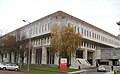 Cathays Park 2, Cathays Park is the home to many of the Welsh Government's civil servants
 -
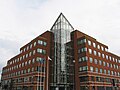 Tŷ Hywel, the office of the First Minister of Wales
 -
 Llandudno Junction offices
 -
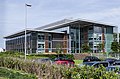 Aberystwyth offices


.jpg)

Budget[edit]
Wales receives a budget allocation from the UK Government[16] determined by the Barnett formula, which makes up roughly 80% of the Welsh budget. The remaining 20% comes from devolved taxes such as non-domestic rates, land transaction tax, landfill disposal tax and the Welsh rates of income tax. These taxes are collected and managed by the Welsh Revenue Authority, except for income tax which is collected by His Majesty’s Revenue and Customs on behalf of the Welsh Government.
The Welsh Government sets out its spending and financing plans for the forthcoming financial year in the autumn.
The Senedd scrutinises the budget and associated taxation and spending plans.
List of successive Welsh Governments[edit]
See also[edit]


- List of political parties in Wales
- List of Wales-related topics
- Government spending in the United Kingdom
- Welsh Youth Parliament
- Welsh devolution
- Marine and Fisheries Division (Wales)
References[edit]
- ^ "Welsh Government: a quick guide" (PDF). Welsh Government. 2015. Retrieved 13 January 2016.
- ^ "Welsh Government: about". Welsh Government. 2016. Retrieved 22 May 2016.
- ^ Government of Wales Act 2006, s. 45(2). "... the First Minister and the Welsh Ministers appointed under section 48 ..."
- ^ "Welsh assembly report damns Cardiff government for failure to cut poverty". The Guardian website. Guardian News & Media. 19 June 2015. Retrieved 15 January 2016.
- ^ "Law Wales - Welsh Government". Retrieved 11 May 2020.
- ^ "Welsh Government | Number of staff at the Welsh Government". gov.wales. Retrieved 27 January 2018.
- ^ "Welsh Government civil service: how we work". Welsh Government. 11 November 2013. Retrieved 13 January 2016.
- ^ "Civil Service. PSMG Membership". Archived from the original on 8 June 2011. Retrieved 14 May 2011.
- ^ a b "Diplomat to be new Welsh Government permanent secretary". BBC News. 9 November 2016. Retrieved 3 February 2017.
- ^ "Welsh Government organisation chart | GOV.WALES". www.gov.wales. 2 January 2024. Retrieved 16 January 2024.
- ^ a b c d e f g h i j k l m n o p q r s "Welsh Government organisation chart | GOV.WALES". www.gov.wales. 2 January 2024. Retrieved 16 January 2024.
- ^ Welsh Government | Membership Archived 30 March 2012 at the Wayback Machine. Wales.gov.uk (18 March 2013). Retrieved on 24 August 2013.
- ^ "State of the estate report 2018 to 2019". GOV.WALES. Retrieved 13 November 2019.
- ^ "Welsh Government – Update on Location Strategy". Archived from the original on 15 March 2012. Retrieved 3 August 2010.
- ^ "Welsh Government – Location Strategy". Archived from the original on 3 April 2009.
- ^ Welsh Government | Budgets. Wales.gov.uk (8 July 2013). Retrieved on 24 August 2013.
External links[edit]
| |||||||||||||||||||||||||||||||||||||||||||||||||||||||||||


| International | |
|---|---|
| National | |