


Île-de-France
Île-de-France | |
|---|---|
 .JPG)  .jpg) Clockwise from top: western Paris and La Défense in the distance; the Viaduc of Saint-Mammès; the Palace of Versailles; and the UNESCO World Heritage Site of Provins | |
 Interactive map of Île-de-France | |
 | |
| Country | France |
| Prefecture | Paris |
| Departments | 8
|
| Government | |
| • President of the Regional Council | Valérie Pécresse (LR) |
| Area | |
| • Total | 12,012 km2 (4,638 sq mi) |
| • Rank | 13th |
| Population (1 January 2023) | |
| • Total | 12,271,794[1] |
| • Density | 1,022/km2 (2,650/sq mi) |
| Demonym | French: Francilien |
| GDP | |
| • Total | €782.639 billion (2022) |
| Time zone | UTC+01:00 (CET) |
| • Summer (DST) | UTC+02:00 (CEST) |
| ISO 3166 code | FR-IDF |
| NUTS Region | FR1 |
| Website | www |
.svg)
The Île-de-France (/ˌiːl də ˈfrɒ̃s/, French: [il də fʁɑ̃s] ⓘ; literally "Island of France") is the most populous of the eighteen regions of France, with an official estimated population of 12,271,794 residents on 1 January 2023.[1] Centred on the capital Paris, it is located in the north-central part of the country and often called the Paris Region[3] (French: Région parisienne, pronounced [ʁeʒjɔ̃ paʁizjɛn]). Île-de-France is densely populated and retains a prime economic position on the national stage, but it covers only 12,012 square kilometres (4,638 square miles), about 2% of metropolitan French territory. Its 2017 population was nearly one-fifth of the national total.[4]
The region is made up of eight administrative departments: Paris, Essonne, Hauts-de-Seine, Seine-Saint-Denis, Seine-et-Marne, Val-de-Marne, Val-d'Oise and Yvelines. It was created as the "District of the Paris Region" in 1961. In 1976, when its status was aligned with the French administrative regions created in 1972, it was renamed after the historic province of Île-de-France. Residents are sometimes referred to as Franciliens, an administrative word created in the 1980s. The GDP of the region in 2019 was nearly one-third of the French,[5]: 12 and 5% of the European Union's.[5]: 12 It has the highest per capita GDP of any French region and the third highest of any region in the European Union.[citation needed]
Beyond the city limits of Paris, the region has many other important historic sites, including the palaces of Versailles and Fontainebleau, as well as the most-visited tourist attraction in France, Disneyland Paris. Although it is the richest French region, a significant number of residents live in poverty. The official poverty rate in the Île-de-France was 15.9% in 2015. The region has witnessed increasing income inequality in recent decades, and rising housing prices have pushed the less affluent outside Paris.[6]
Etymology[edit]
 |
Although the modern name Île-de-France literally means Island of France, its etymology is unclear. The "island" may refer to the land between the rivers Oise, Marne and Seine, or it may also have been a reference to the Île de la Cité, where the French royal palace and cathedral were located.[citation needed]
Alternatively, the name may refer to the lands that were under the direct rule of the Capetian kings during the Middle Ages; thus, the lands were an "island" in a sea of various feudal territories ruled by vassals of the king.[7]
Departments[edit]
.jpg)
| Department | Area km2 | Population | GDP[8] | GDP per capita |
|---|---|---|---|---|
 Paris Paris |
105 | 2,133,111 | €253.101 billion | €118,653 |
 Hauts-de-Seine Hauts-de-Seine |
176 | 1,635,291 | €188.333 billion | €115,168 |
 Seine-Saint-Denis Seine-Saint-Denis |
236 | 1,668,670 | €66.227 billion | €39,688 |
 Val-de-Marne Val-de-Marne |
245 | 1,415,367 | €56.818 billion | €40,144 |
 Val-d'Oise Val-d'Oise |
1,246 | 1,256,607 | €38.861 billion | €30,925 |
 Seine-et-Marne Seine-et-Marne |
5,915 | 1,438,100 | €42.983 billion | €29,889 |
 Essonne Essonne |
1,804 | 1,313,768 | €58.462 billion | €44,500 |
 Yvelines Yvelines |
2,284 | 1,456,365 | €60.058 billion | €42,238 |
| Île-de-France | 12,012 | 12,317,279 | €764.844 billion | €62,095 |
History[edit]
-
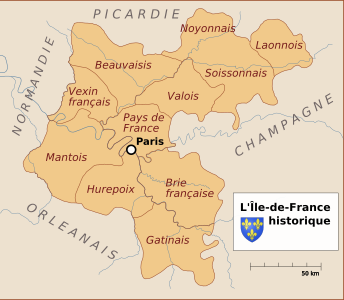 Historic province of Île-de-France before the French Revolution
 -
 The modern départements covered by the historical Île-de-France
 -
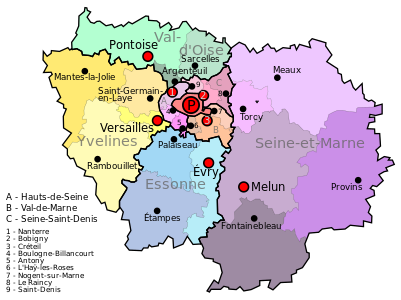 Modern region of Île-de-France and départements


The Île-de-France was inhabited by the Parisii, a sub-tribe of the Celtic Senones, from around the middle of the 3rd-century BC.[9][10] One of the area's major north–south trade routes crossed the Seine on the île de la Cité; the meeting place of land and water trade routes gradually became an important trading centre.[11] The Parisii traded with many river towns (some as far away as the Iberian Peninsula) and minted their own coins for that purpose.[12]
The Romans conquered the area in 52 BC and began their settlement on Paris's Left Bank.[13] It became a prosperous city with a forum, baths, temples, theatres, and an amphitheatre.[14] Christianity was introduced in the middle of the 3rd century AD by Saint Denis, the first Bishop of Paris. According to legend, when Denis refused to renounce his faith before Roman authorities, he was beheaded on the hill that became known as Mons Martyrum (Latin "Hill of Martyrs"), later "Montmartre". The legend further states that Denis walked headless from this hill to the north of the city. The place that he finally fell and was buried became an important religious shrine, the Basilica of Saint-Denis.[15]
Clovis the Frank, the first king of the Merovingian dynasty, made the city his capital in 508. As the Frankish domination of Gaul began, there was a gradual immigration by the Franks to Paris and the Parisian Francien dialects were born. Fortification of the Île de la Cité failed to avert sacking by Vikings in 845, but Paris's strategic importance—with its bridges preventing ships from passing—was established by successful defence in the Siege of Paris (885–86). In 987, Hugh Capet, Count of Paris (comte de Paris) and Duke of the Franks (duc des Francs), was elected King of the Franks (roi des Francs). Under the rule of the Capetian kings, Paris gradually became the largest and most prosperous city in France.[15]
The Kings of France enjoyed getting away from Paris and hunting in the game-filled forests of the region. They built palatial hunting lodges, most notably Palace of Fontainebleau and the Palace of Versailles. From the time of Louis XIV to the French Revolution, Versailles was the official residence of the Kings and the seat of the French government. Île-de-France became the term used for the territory of Paris and the surrounding province, which was administered directly by the King.
During the French Revolution, the royal provinces were abolished and divided into departments, and the city and region were governed directly by the national government. After World War II, as Paris faced a major housing shortage, hundreds of massive apartment blocks for low-income residents were built around the edges of Paris. In the 1950s and the 1960s, thousands of immigrants settled in the communes bordering the city. In 1959, under President Charles De Gaulle, a new region was created out of six departments, which corresponded approximately with the historic region, with the name District de la région de Paris ("District of the Paris Region"). On 6 May 1976, as part of the process of regionalisation, the district was reconstituted with increased administrative and political powers and renamed the Île-de-France region.
Geography[edit]
Île-de-France is in the north of France, neighboring Hauts-de-France to the north, Grand Est to the east, Bourgogne-Franche-Comté to the southeast, Centre-Val-de-Loire to the southwest, and Normandy to the west.
-
 View of the forest of Fontainebleau in Seine-et-Marne
 -
 The Seine in Paris
 -
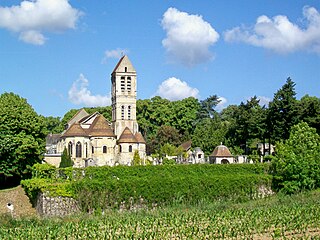 Vineyard in Luzarches, Val-d'Oise
 -
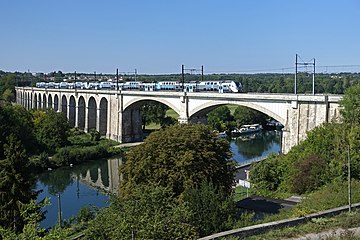


,_%C3%A9glise_St-C%C3%B4me-St-Damien_depuis_le_chemin_de_la_Paroisse.jpg)
Departments[edit]
Île-de-France has a land area of 12,011 km2 (4,637 sq mi). It is composed of eight departments centred on its innermost department and capital, Paris. Around the department and municipality of Paris, urbanisation fills a first concentric ring of three departments commonly known as the petite couronne ("small ring"); it extends into a second outer ring of four departments known as the grande couronne ("large ring"). The former department of Seine, abolished in 1968, included the city proper and parts of the petite couronne.
The petite couronne consists of the departments of Hauts-de-Seine, Seine-Saint-Denis and Val-de-Marne; the grande couronne consists of those of Seine-et-Marne, Yvelines, Essonne and Val-d'Oise. Politically, the region is divided into 8 departments, 25 arrondissements, 155 cantons and 1,276 communes, out of the total of 35,416 in metropolitan France.[4]
Topography[edit]
The outer parts of the Île-de-France remain largely rural. Agricultural land, forest and natural spaces occupy 78.9 percent of the region, and 28 percent of the region's land is in urban use. the remaining 24 percent[clarification needed] is rivers, forests, woods, and ponds.[4]
The River Seine flows through the middle of the region, which is crisscrossed by its tributaries and sub-tributaries, including the Rivers Marne, Oise and Epte. The River Eure does not cross the region but receives water from several rivers in the Île-de-France, including the Drouette and the Vesgre. The major rivers are navigable, and, because of the modest variations of altitude in the region (between 10 metres (33 ft) and 200 metres (660 ft)), they have a tendency to meander and curve. They also create many lakes and ponds, some of which have been transformed into recreation areas, including Moisson-Mousseaux, Cergy-Neuville and Villeneuve-Saint-Georges.
Economy[edit]

Paris region (Île-de-France) produced €742 billion (Gross domestic product)[5] or around 1/3 of the economy of France in 2019.[5]: 12
The regional economy has gradually shifted toward high-value-added service industries (finance, IT services, etc.) and high-tech manufacturing (electronics, optics, aerospace, etc.).[17] In 2014, industry represented just under five percent of active enterprises in the region, and 10.2 percent of salaried workers. Commerce and services account for 84 percent of the business establishments in the region, and have 83.3 percent of the salaried employees.[18]
Financial services and insurance are important sectors of the regional economy; the major French banks and insurance companies, including BNP Paribas, Société Générale, and Crédit Agricole, all have their headquarters in the region. The region also hosts the headquarters of the top French telecom companies and utilities, including Orange S.A., Veolia, and EDF. The French stock market, the Bourse de Paris, now known as Euronext Paris, occupies a historical building in the center of Paris and is ranked fourth among global stock markets, after New York, Tokyo and London.[19]
Other major sectors of the regional economy include energy companies (Orano, Engie, Électricité de France, and Total S.A.). The two major French automobile manufacturers, Renault at Flins-sur-Seine and Groupe PSA at Poissy, do much of their assembly work outside of France but still have research centre and large plants in the region. The leading French and European aerospace and defense companies, including Airbus, Thales Group, Dassault Aviation, Safran Aircraft Engines, the European Space Agency, Alcatel-Lucent, and Arianespace, have a large presence in the region.[19]
The energy sector is also well established in the region. The nuclear power industry, with its major firm Orano, has its headquarters in Île-de-France, as does the main French oil company Total S.A., the top French company in the Fortune Global 500, and the main electric utility, Électricité de France. The energy firm Engie also has its main offices in the region at La Défense.
-
 Headquarters of Total in La Défense
 -
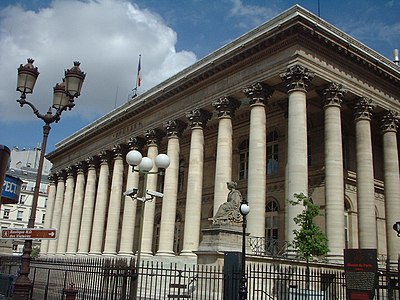 The historic Bourse de Paris, or Paris stock market, now called Euronext Paris
 -
 Headquarters of Société Générale in La Défense


Employment[edit]
In 2018 just 7.2 percent of employees in the region were engaged in industry; 62.3 percent were engaged in commerce and market services; 25.5 percent in non-market services, including government, health and education; 4.8 percent in construction; and 0.2 percent in agriculture.[20]
The largest non-government employers in the region as of the end of 2015 were the airline Air France (40,657); the SNCF (French Railways, 31,955); the telecom firm Orange S.A. (31,497); the bank Société Générale (27,361); the automotive firm Groupe PSA (19,648); EDF (Electricité de France, 18,199); and Renault (18,136).[21] While the Petite Couronne, or departments closest to Paris, previously employed the most industrial workers, the largest number is now in the Grande Couronne, the outer departments.[20]
The unemployment rate in the region stood at 8.6% at the end of 2016. It varied within the region from 7.8 percent in the city of Paris, to a high of 12.7 percent in Seine-Saint-Denis, and 10 percent in Val-d'Oise; to regional lows of 7.4 percent in Yvelines; 7.5 percent in Hauts-de-Seine; 7.7 percent in Essonne; 7.9 percent in Seine et Marne, and 8.8 percent in Val de Marne.[22]
Agriculture[edit]
In 2018, 48 percent of the land of the Île-de-France was devoted to agriculture; 569,000 hectares were cultivated. The most important crops are grains (66 percent), followed by beets (7 percent), largely for industrial use, and grass for grazing. In 2014, 9,495 hectares were devoted to bio-agriculture. However, the number of persons employed in agriculture in the region dropped 33 percent between 2000 and 2015 to just 8,460 persons in 2015.[23]
Tourism[edit]
The Île-de-France is one of the world's top tourist destinations, with a record 23.6 million hotel arrivals in 2017, and an estimated 50 million visitors in all types of accommodation. The largest number of visitors came from the United States, followed by England, Germany and China.[24] [25][26] The top tourist attraction in the region in 2017 was Disneyland Paris, which received 14.8 million visitors in 2017, followed by the Cathedral of Notre-Dame (est. 12 million) and the Basilica of Sacre-Coeur at Montmartre (est. 11.1 million visitors).[27]
-
 Notre-Dame Cathedral (12 million visitors in 2017)
 -
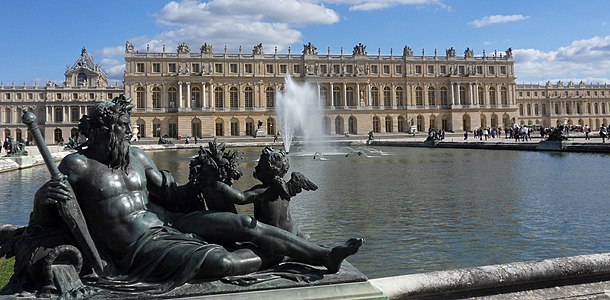 Palace of Versailles (7.7 million visitors in 2017)
 -
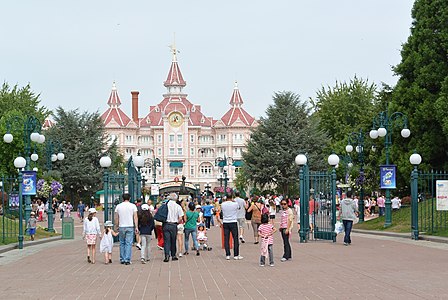 Disneyland Paris (14.8 million visitors in 2017)
 -
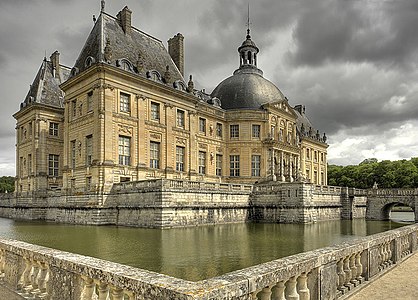


Notable historic monuments in the Region outside of Paris include the Palace of Versailles (7,700,000 visitors), the Palace of Fontainebleau (500,000 visitors), the chateau of Vaux-le-Vicomte (300,000 visitors), and the Château de Malmaison, Napoleon's former country house; and the Basilica of Saint-Denis, where the Kings of France were interred before the French Revolution.[28]
Regional government and politics[edit]

The Regional Council is the legislative body of the region. Its seat is in Saint-Ouen-sur-Seine, at 2 rue Simone-Veil. On 15 December 2015, a list of candidates of the Union of the Right, a coalition of centrist and right-wing parties, led by Valérie Pécresse, narrowly won the regional election, defeating the Union of the Left, a coalition of socialists and ecologists. The socialists had governed the region for the preceding 17 years.
Since 2016 the regional council has 121 members from the Union of the Right, 66 from the Union of the Left and 22 from the far-right National Front.[29]
Holders of the executive office[edit]
- Delegates General for the District of the Paris Region
- 1961–1969: Paul Delouvrier (civil servant) – Very influential term. Responsible for the creation of the RER express subway network in the Île-de-France and beyond.
- 1969–1975: Maurice Doublet (civil servant)
- 1975–1976: Lucien Lanier (civil servant)
- Presidents of the Regional Council of Île-de-France
- 1976–1988: Michel Giraud (RPR politician) – (1st time)
- 1988–1992: Pierre-Charles Krieg (RPR politician)
- 1992–1998: Michel Giraud (RPR politician) – (2nd time)
- 1998–2015: Jean-Paul Huchon (PS)
- 2016– Valérie Pécresse (Union of the Centre-Right)
Demographics[edit]

Population density[edit]
As of 1 January 2017[update], the population density of the region was 1010.9 inhabitants per square kilometer. The densest department is Paris itself, with 21,066 inhabitants per square kilometer. The least dense département is Seine-et-Marne with 239 residents per square kilometer.[30]
Wealth and poverty[edit]
As of 2015[update] according to the official government statistics agency INSEE, 15.9 percent of residents of the region had an income below the poverty level; for residents of the city of Paris, this proportion was 16.2 percent. Poverty was highest in the departments of Seine-Saint-Denis (29 percent), Val-d'Oise (17.1 percent), and Val-de-Marne (16.8 percent). It was lowest in Yvelines (9.7 percent); Seine-et-Marne (11.8 percent), Essonne (12.9 percent), and Hauts-de-Seine (12.4 percent). The department of Hauts-de-Seine is the wealthiest in France in terms of per capita GDP.[31]
Immigration[edit]
| 2019 Census Paris Region | |||||||||||||||||||||||||||||||||||||||||
|---|---|---|---|---|---|---|---|---|---|---|---|---|---|---|---|---|---|---|---|---|---|---|---|---|---|---|---|---|---|---|---|---|---|---|---|---|---|---|---|---|---|
| (Île-de-France)[32][33] | |||||||||||||||||||||||||||||||||||||||||
| |||||||||||||||||||||||||||||||||||||||||
| |||||||||||||||||||||||||||||||||||||||||


.svg)


At the 2019 census, 75.1% of the inhabitants of Île-de-France were natives of Metropolitan France, 1.7% were born in Overseas France, and 23.1% were born in foreign countries.[34] A quarter of the immigrants living in the Île-de-France were born in Europe (38% of whom in Portugal), 29% were born in the Maghreb and 22% in the rest of Africa (in particular West and Central Africa), 3% were born in Turkey and 15% in the rest of Asia, 5% were born in the Americas (not counting those born in the French overseas departments in the Americas, who are not legally immigrants), and 0.1% in Oceania (not counting those born in the French territories of the South Pacific, who are not legally immigrants).[35]
In 2013, 2,206,000 residents of the Île-de-France were immigrants, born outside of France. This amounted to 18.5% of the population of the region, twice the national average. Four out of ten immigrants living in France reside in the region. The immigrant population of the Île-de-France has a higher proportion of non-Europeans, as well as a higher proportion of immigrants with an advanced level of education, than the rest of France. The population of immigrants is more widely distributed throughout the region than it was in the early 2000s, but the concentrations remain high in certain areas, particularly Paris and the department of Seine-Saint-Denis. The proportion of residents born outside of Metropolitan France rose between the 1999 (19.7%) and 2019 censuses (24.9%).[36][34]
| Census | Born in Metropolitan France |
Born in Overseas France |
Born in foreign countries with French citizenship at birth[a] |
Immigrants[b] | |||||
|---|---|---|---|---|---|---|---|---|---|
| 2019 | 75.1% | 1.7% | 3.4% | 19.8% | |||||
| from Europe | from the Maghreb[c] | from Africa (excl. Maghreb) | |||||||
| 5.0% | 5.8% | 4.4% | |||||||
| from Turkey | from Asia (excl. Turkey) | from the Americas & Oceania | |||||||
| 0.6% | 3.0% | 1.1% | |||||||
| 2013 | 76.3% | 1.7% | 3.5% | 18.5% | |||||
| from Europe | from the Maghreb[c] | from Africa (excl. Maghreb) | |||||||
| 5.0% | 5.4% | 3.8% | |||||||
| from Turkey | from Asia (excl. Turkey) | from the Americas & Oceania | |||||||
| 0.6% | 2.8% | 1.0% | |||||||
| 2008 | 77.4% | 1.7% | 3.5% | 17.4% | |||||
| from Europe | from the Maghreb[c] | from Africa (excl. Maghreb) | |||||||
| 4.9% | 5.1% | 3.3% | |||||||
| from Turkey | from Asia (excl. Turkey) | from the Americas & Oceania | |||||||
| 0.6% | 2.5% | 0.9% | |||||||
| 1999 | 80.3% | 1.8% | 3.2% | 14.7% | |||||
| 1990 | 80.4% | 1.9% | 3.7% | 14.0% | |||||
| 1982 | 81.1% | 1.7% | 3.9% | 13.3% | |||||
| 1975 | 82.9% | 1.0% | 3.9% | 12.2% | |||||
| 1968 | 85.3% | 0.5% | 4.0% | 10.2% | |||||
| ^a Persons born abroad of French parents, such as Pieds-Noirs and children of French expatriates. ^b An immigrant is by French definition a person born in a foreign country and who did not have French citizenship at birth. An immigrant may have acquired French citizenship since moving to France, but is still listed as an immigrant in French statistics. On the other hand, persons born in France with foreign citizenship (the children of immigrants) are not listed as immigrants. ^c Morocco, Tunisia, Algeria | |||||||||
| Source: INSEE[34][35][36][37][38] | |||||||||
Petite Couronne[edit]


The Petite Couronne[39] (literally "Little Crown" or inner ring) is formed by the three departments bordering Paris, forming a geographical crown around it. These departments, until 1968 part of the disbanded Seine department, are Hauts-de-Seine, Seine-Saint-Denis and Val-de-Marne. The most populated towns of the Petite Couronne are Boulogne-Billancourt, Montreuil, Saint-Denis, Nanterre and Créteil.
The Métropole du Grand Paris is an administrative structure that comprises Paris and the three departments of the Petite Couronne, plus seven additional communes in the Grande Couronne.
The table below shows some statistical information about the area including Paris:
| Department | Area (km2) | Population (2011)[40] | Municipalities |
|---|---|---|---|
| Paris (75) | 105.4
|
2 249 975
|
1 (Paris)
|
| Hauts-de-Seine (92) | 176
|
1 581 628
|
|
| Seine-Saint-Denis (93) | 236
|
1 529 928
|
|
| Val-de-Marne (94) | 245
|
1 333 702
|
|
| Petite Couronne | 657
|
4 445 258
|
123
|
| Paris + Petite Couronne | 762.4
|
6 695 233
|
124
|
Grande Couronne[edit]
The Grande Couronne[41] (Large Crown, i.e. outer ring) includes the outer four departments of Île-de-France not bordering Paris. They are Seine-et-Marne (77), Yvelines (78), Essonne (91) and Val-d'Oise (95). The last three departments formed the Seine-et-Oise department until this was disbanded in 1968. The city of Versailles is part of this area.
Historical population[edit]
|
|
| |||||||||||||||||||||||||||||||||||||||||||||||||||||||||||||||||||||||||||||||||||||||||||||||||||||||||||||||||||||||||||
| Census returns from INSEE | |||||||||||||||||||||||||||||||||||||||||||||||||||||||||||||||||||||||||||||||||||||||||||||||||||||||||||||||||||||||||||||
International relations[edit]
Twin regions[edit]
Île-de-France is twinned with:
 Comunidad de Madrid in Spain (since 2000)
 Yerevan in Armenia (since 2011)[44]
 Hanoi in Vietnam (since 2013)[45]

See also[edit]

- List of European Union regions by GDP
- Véligo
- Kalos, a fictional region in the Pokémon franchise based on Île-de-France and surrounding provinces
References[edit]
- ^ a b "Populations légales des régions en 2020". insee.fr (in French). Institut national de la statistique et des études économiques. 19 December 2022. Populations légales des régions en vigueur au 1er janvier 2023. Archived from the original on 23 January 2023. Retrieved 27 March 2023.
- ^ "EU regions by GDP, Eurostat". Retrieved 18 September 2023.
- ^ "Region Ile-de-France - The Essentials in English (June 2018)". Région Île-de-France. 2018. idf_essential_2018.pdf p3. Archived from the original on 19 October 2021. Retrieved 17 October 2022.
Paris Region (Île-de-France)
- ^ a b c "Ile-de-France- Portrait of the Region- Key figures (in French)". Regional Council of the Ile-de-France. Archived from the original on 17 June 2022. Retrieved 24 November 2018.
- ^ a b c d "Paris Region Facts & Figures 2022 (Version anglaise)" (PDF). Paris Île-de-France Regional Chamber of Commerce and Industry. 4 April 2022. pp. 6, 12. Archived (PDF) from the original on 1 November 2022. Retrieved 1 November 2022. (web page Archived 27 January 2023 at the Wayback Machine)
- ^ "En quinze ans, Paris s'est enrichi, mais sa région s'est appauvrie, révèle une étude". France Info (in French). 3 June 2019. Archived from the original on 3 June 2019. Retrieved 3 June 2019.
- ^ Bloch, Marc (1971). The Ile-de-France, the country around Paris. Cornell University Press. ISBN 0-8014-0640-4.
- ^ "Gross domestic product (GDP) at current market prices by NUTS 3 regions". ec.europa.eu.
- ^ Arbois de Jubainville & Dottin 1889, p. 132.
- ^ Cunliffe 2004, p. 201.
- ^ Lawrence & Gondrand 2010, p. 25.
- ^ Schmidt 2009, pp. 65–70.
- ^ Schmidt 2009, pp. 88–104.
- ^ Schmidt 2009, pp. 154–167.
- ^ a b Schmidt 2009, pp. 210–11.
- ^ Paris Chamber of Commerce and Industry, Contribution des CCI de Paris - Île-de-France à la révision du SDRIF, page 110. "TEM Paris – La Défense – QCA" (PDF) (in French). Archived from the original (PDF) on 2 March 2007. Retrieved 1 September 2007.
{{cite web}}: CS1 maint: multiple names: authors list (link) CS1 maint: numeric names: authors list (link) - ^ "L'Industrie en Île-de-France, Principaux Indicateurs Régionaux" (PDF). INSEE. Archived (PDF) from the original on 23 February 2015. Retrieved 24 November 2014.
- ^ "Top 100 des usines dans la region Île-de-France - Industrie Explorer". industrie.usinenouvelle.com. Archived from the original on 3 December 2018. Retrieved 3 December 2018.
- ^ a b "Key figures on economy of Ile-de-France (2018) (in French)" (PDF). Archived (PDF) from the original on 1 December 2018. Retrieved 30 November 2018.
- ^ a b "Key Figures 2018: Employment statistics from Government of the Ile-de-France, retrieved December 1, 2018" (PDF). Archived (PDF) from the original on 1 December 2018. Retrieved 30 November 2018.
- ^ "Chamber of Commerce and Industry of Ile-de-France, retrieved 12-2-2018)" (PDF). Archived (PDF) from the original on 3 December 2018. Retrieved 3 December 2018.
- ^ "INSEE report, Unemployment in Ile-de-France, by department, end of 2016". Archived from the original on 19 December 2018. Retrieved 3 December 2018.
- ^ "Ile-de-France- une region plus agricole que on ne le croit". Regional Council of the Ile-de-France. Archived from the original on 26 November 2018. Retrieved 24 November 2018.
- ^ "Tourism statistics, Paris Region tourism office". Archived from the original on 1 December 2018. Retrieved 1 December 2018.
- ^ Key Figures: Paris Convention and Visitors Bureau Key
- ^ Vers une fréquentation touristique record à Paris en 2017 Archived 17 January 2018 at the Wayback Machine on Les Echos
- ^ Key Figures 2017: Paris Convention and Visitors Bureau
- ^ Annual Report of the Regional Committee on Tourism of the Ile-de-France Region, cited in La Croix, 22 February 2018.
- ^ Île-de-France Region official site. "Results of 2015 Regional Elections". Archived from the original on 19 December 2015. Retrieved 16 December 2015.
- ^ "Site of Ile-de-France Region" (PDF). Archived (PDF) from the original on 29 November 2018. Retrieved 29 November 2018.
- ^ "Level of poverty according to age and fiscal reference in 2015" (in French). INSEE. Archived from the original on 30 November 2018. Retrieved 29 November 2018.
- ^ INSEE. "Individus localisés à la région en 2019 - Recensement de la population - Fichiers détail" (in French). Retrieved 15 February 2023.
- ^ INSEE. "IMG1B - Population immigrée par sexe, âge et pays de naissance en 2019 - Région d'Île-de-France (11)" (in French). Retrieved 15 February 2023.
- ^ a b c Institut national de la statistique et des études économiques. "Individus localisés à la région en 2019 - Recensement de la population - Fichiers détail" (in French). Archived from the original on 10 February 2023. Retrieved 19 February 2022.
- ^ a b Institut national de la statistique et des études économiques. "IMG1B - Population immigrée par sexe, âge et pays de naissance en 2019 Région d'Île-de-France (11)" (in French). Archived from the original on 19 February 2023. Retrieved 19 February 2022.
- ^ a b Institut national de la statistique et des études économiques. "Données harmonisées des recensements de la population 1968-2018" (in French). Archived from the original on 4 February 2022. Retrieved 19 February 2022.
- ^ Institut national de la statistique et des études économiques. "IMG1B - Population immigrée par sexe, âge et pays de naissance en 2013 Région d'Île-de-France (11" (in French). Archived from the original on 19 February 2023. Retrieved 19 February 2022.
- ^ Institut national de la statistique et des études économiques. "IMG1B - Population immigrée par sexe, âge et pays de naissance en 2008 Région d'Île-de-France (11)" (in French). Archived from the original on 19 February 2023. Retrieved 19 February 2022.
- ^ "CIG "Petite Couronne" website (Centre Interdépartemental de Gestion)". Archived from the original on 22 September 2013. Retrieved 21 September 2013.
- ^ INSEE. "Estimation de population au 1er janvier, par département, sexe et grande classe d'âge – Année 2011" (in French). Archived from the original on 8 April 2016. Retrieved 20 February 2014.
- ^ (in French) CIG "Grande Couronne" website (Centre Interdépartemental de Gestion) Archived 22 September 2013 at the Wayback Machine
- ^ a b "Population légale de l'Île-de-France12 174 880 habitants au 1er janvier 2017". insee.fr (in French). INSEE. 30 December 2019. Archived from the original on 10 September 2022. Retrieved 17 October 2022.
- ^ "Populations légales des régions en 2019". insee.fr (in French). INSEE. 12 January 2022. Archived from the original on 22 September 2022. Retrieved 17 October 2022.
- ^ "Yerevan - Partner Cities". Yerevan Municipality Official Website. Technology Management Center of Yerevan. Archived from the original on 5 November 2013. Retrieved 4 November 2013.
- ^ "Hanoi strengthens ties with Ile-de-France". Voice of Vietnam. Archived from the original on 29 May 2021. Retrieved 4 May 2018.
Bibliography[edit]
- Arbois de Jubainville, Henry; Dottin, George (1889). Les premiers habitants de l'Europe (in French). E. Thorin. Retrieved 25 October 2015.
- Cunliffe, Barry (2004). Iron Age communities in Britain : an account of England, Scotland and Wales from the seventh century BC until the Roman conquest (4th ed.). London: Routledge. ISBN 978-0-415-34779-2.
- Fierro, Alfred (1996). Histoire et dictionnaire de Paris. Lafont. ISBN 978-0-7859-9300-1.
- Lawrence, Rachel; Gondrand, Fabienne (2010). Paris (City Guide) (12th ed.). London: Insight Guides. ISBN 978-981-282-079-2.
- Schmidt, Joël (2009). Lutèce: Paris, des origines à Clovis. Perrin. ISBN 978-2-262-03015-5.
- Bloch, Marc (1971). The Ile-de-France, the country around Paris. Cornell University Press. ISBN 0-8014-0640-4.
External links[edit]


- Paris Region Map, the interactive economic map of Paris Region Archived 14 April 2016 at the Wayback Machine
- Regional Council of Île-de-France (in French)
- Île-de-France at Curlie


| International | |
|---|---|
| National | |
| Geographic | |

- Île-de-France
- Regions of France
- NUTS 1 statistical regions of the European Union
- NUTS 2 statistical regions of the European Union
- Former provinces of France
- History of Île-de-France
- History of Centre-Val de Loire
- History of Hauts-de-France
- History of Grand Est
- History of Bourgogne-Franche-Comté
- History of Aisne
- History of Ardennes (department)
- History of Essonne
- History of Eure-et-Loir
- History of Hauts-de-Seine
- History of Loiret
- History of Oise
- History of Paris
- History of Seine-et-Marne
- History of Seine-Saint-Denis
- History of Somme (department)
- History of Val-de-Marne
- History of Val-d'Oise
- History of Yonne
- History of Yvelines