


ALBA
Bolivarian Alliance for the Peoples of Our America – Peoples' Trade Treaty Alianza Bolivariana para los Pueblos de Nuestra América – Tratado de Comercio de los Pueblos (Spanish) | |
|---|---|
 Emblem
| |
_Without_Honduras.svg) | |
| Headquarters | Caracas |
| Official languages |
|
| Member states |
|
| Leaders | |
 Félix Plasencia[1] Félix Plasencia[1] | |
| Establishment | |
• Cuba–Venezuela Agreement | 14 December 2004 |
• People's Trade Agreement | 29 April 2006 |
| Area | |
• Total | 2,513,337[2] km2 (970,405 sq mi) |
| Population | |
• 2008 estimate | 69,513,221 |
• Density | 27.65/km2 (71.6/sq mi) |
| GDP (PPP) | 2008 estimate |
• Total | $636.481 billion |
• Per capita | $9,156 |
| Currency | |
| Time zone | UTC-4 to -6 |
| Internet TLD | |
Website albatcp.org | |

ALBA or ALBA–TCP, formally the Bolivarian Alliance for the Peoples of Our America (Spanish: Alianza Bolivariana para los Pueblos de Nuestra América) or the Bolivarian Alliance for the Peoples of Our America – Peoples' Trade Treaty (Spanish: Alianza Bolivariana para los Pueblos de Nuestra América – Tratado de Comercio de los Pueblos), is an intergovernmental organization based on the idea of political and economic integration of Latin American and Caribbean countries.
Founded initially by Cuba and Venezuela in 2004, it is associated with socialist and social democratic governments wishing to consolidate regional economic integration based on a vision of social welfare, bartering and mutual economic aid. The ten member countries are Antigua and Barbuda, Bolivia, Cuba, Dominica, Grenada, Nicaragua, Saint Kitts and Nevis, Saint Lucia, Saint Vincent and the Grenadines and Venezuela.[3] Suriname was admitted to ALBA as a guest country at a February 2012 summit.[citation needed]
History[edit]

The agreement was proposed by the government of Venezuela, led by Hugo Chávez[4] as an alternative to the Free Trade Area of the Americas (FTAA or ALCA in Spanish, an agreement proposed by the United States), which never materialized.[citation needed]
This Cuba–Venezuela Agreement,[5] signed on 14 December 2004, by Presidents Chávez and Fidel Castro, was aimed at the exchange of medical and educational resources and petroleum between the two nations. Venezuela began to deliver about 96,000 barrels of oil per day from its state-owned oil company, PDVSA, to Cuba at very favorable prices. In exchange, Cuba sent 20,000 state-employed medical staff and thousands of teachers to Venezuela's poorest states. The agreement also made it possible for Venezuelans to travel to Cuba for specialized medical care, free of charge.[6][7][self-published source?]
When it was launched in 2004, ALBA had only two member states, Venezuela and Cuba.[7][8] Subsequently, a number of other Latin American and Caribbean nations entered into this 'Peoples' Trade Agreement' (Spanish: Tratado de Comercio de los Pueblos, or TCP), which aims to implement the principles of ALBA. Bolivia under Evo Morales joined in 2006, Nicaragua under Daniel Ortega in 2007, and Ecuador under Rafael Correa in 2009. Honduras, under Manuel Zelaya, joined in 2008, but withdrew in 2010 after the 2009 Honduran coup d'état.[9] The Caribbean nations Antigua and Barbuda, Dominica, Saint Vincent and the Grenadines and Saint Lucia also joined.[10]
Jamaica, at the invitation of Chávez,[11] and Mexico, at the invitation of Ortega,[12] were invited to join the ALBA countries. Chávez also invited the countries of Central America to join ALBA,[13] and invited Argentina to use SUCRE.[14] In the 11th Summit of ALBA in February 2012, Suriname, Saint Lucia and Haiti requested admission to the organization. Haiti was granted the special status of permanent member and the other two countries were named special members, while awaiting their full incorporation.[7]
In July 2013, Chávez was honored posthumously by the nine member countries of the group and special guests Uruguay, Argentina, Brazil, Suriname, Guyana and Haiti at the group's 12th Presidential Summit in Guayaquil, Ecuador.[15]
In December 2014, Grenada and Saint Kitts and Nevis were accepted as full members during the 13th Summit of the Alliance, which occurred in Havana, Cuba.[16]
Ecuador withdrew from ALBA in August 2018.[17] Bolivia's interim government withdrew in November 2019 during the political crisis,[18] but the newly elected government of Luis Arce rejoined following the 2020 Bolivian general election.[19][20]
Amid the international isolation Russia is facing due to the invasion of Ukraine, ALBA invited Russia to participate at the 2023 ALBA Games.[21]
Virtual currency[edit]
In October 2009, ALBA leaders agreed at a summit in Bolivia to create a virtual currency, named the SUCRE. "The document is approved," said Bolivian President Evo Morales, the summit host. President of Venezuela Hugo Chávez announced "The sucre [is] an autonomous and sovereign monetary system that will be agreed upon today so that it can be implemented in 2010."[22] As of 2015, the virtual currency is being used to compensate trade between Bolivia, Cuba, Nicaragua, and especially Ecuador and Venezuela.[7]
Summits of heads of state and government[edit]
| Summit |
Date |
Location |
Country |
Decisions | |
|---|---|---|---|---|---|
| I Ordinary | 14 December 2004 | Havana |  Cuba Cuba
|
Founding summit of ALBA. Cuba-Venezuela Agreement signed by presidents Hugo Chávez and Fidel Castro. | |
| II Ordinary | 27–28 April 2005 | Havana | Cuba
|
Attended by presidents Hugo Chávez and Fidel Castro. | |
| III Ordinary | 29 April 2006 | Havana | Cuba
|
Attended by presidents Hugo Chávez, Fidel Castro and Evo Morales from Bolivia, who joins the group. The TCP is signed. | |
| IV Ordinary | 10 January 2007 | Managua |  Nicaragua Nicaragua
|
Meeting coinciding with inauguration as president of Nicaragua of Daniel Ortega, who announces the entry in the bloc as fourth country member. | |
| V Ordinary | 28–29 April 2007 | Barquisimeto | Venezuela
|
||
| VI Ordinary | 24–26 January 2008 | Caracas | Venezuela
|
Dominica joins the bloc. | |
| I Extraordinary | 22 April 2008 | Caracas | Venezuela
|
||
| II Extraordinary | 25 August 2008 | Tegucigalpa |  Honduras Honduras
|
Honduras joins the bloc. | |
| III Extraordinary | 26 November 2008 | Caracas | Venezuela
|
||
| IV Extraordinary | 2 February 2009 | Caracas | Venezuela
|
Celebration of the tenth anniversary of Bolivarian Revolution. | |
| V Extraordinary | 16–17 April 2009 | Cumaná | Venezuela
|
||
| VI Extraordinary | 24 June 2009 | Maracay | Venezuela
|
Antigua and Barbuda, Ecuador and Saint Vincent and the Grenadines join the bloc. | |
| VII Extraordinary | 29 June 2009 | Managua | Nicaragua
|
Condemnation of the coup d'état in Honduras and demand of restoration of deposed president Manuel Zelaya. | |
| VII Ordinary | 16–17 October 2009 | Cochabamba |  Bolivia Bolivia
|
The Unified System for Regional Compensation (SUCRE) is adopted. | |
| VIII Ordinary | 13–14 December 2009 | Havana | Cuba
|
Celebration of the fifth anniversary of the bloc. | |
| IX Ordinary | 19 April 2010 | Caracas | Venezuela
|
Honduras had left the group.[23] | |
| X Ordinary | 25 June 2010 | Otavalo |  Ecuador Ecuador
|
||
| XI Ordinary | 4–5 February 2012 | Caracas | Venezuela
|
||
| XII Ordinary | 30 July 2013 | Guayaquil | Ecuador
|
Saint Lucia joins the bloc. | |
| VIII Extraordinary | 20 October 2014 | Havana | Cuba
|
Summit to deal with the Ebola crisis. | |
| XIII Ordinary | 14 December 2014 | Havana | Cuba
|
Grenada and Saint Kitts and Nevis join the bloc. Celebration of the tenth anniversary of the bloc. | |
| IX Extraordinary | 17 March 2015 | Caracas | Venezuela
|
||
| XIV Ordinary | 5 March 2017 | Caracas | Venezuela
|
||
| XV Ordinary | 5 March 2018 | Caracas | Venezuela
| ||
| XVI Ordinary | 14 December 2018[24] | Havana | Cuba
| ||
| XVII Ordinary | 14 December 2019[25] | Havana | Cuba
|
Celebration of the fifteenth anniversary of the bloc. | |
| XVIII Ordinary | 14 December 2020[26] | videoconference | Celebration of the sixteenth anniversary of the bloc and of the rejoining of Bolivia into it. | ||
| XIX Ordinary | 24 June 2021[27] | Caracas | Venezuela
|
Celebration of the 200th anniversary of the Battle of Carabobo. | |
| XX Ordinary | 14 December 2021[28][29] | Havana | Cuba
| ||
| XXI Ordinary | 27 May 2022[30][31] | Havana | Cuba
| ||
| XXII Ordinary | 14 December 2022[32][33] | Havana | Cuba
|
Celebration of the eighteenth anniversary of the bloc. | |
| XXIII Ordinary | 24 April 2024[34] | Caracas | Venezuela
|
Membership[edit]
Full members[edit]
| Common name |
Official name |
Join date |
Population |
Area (km2) |
E.E.Z + Area (km2) |
GDP PPP (US$ bn) |
Capital |
|---|---|---|---|---|---|---|---|
 Antigua and Barbuda Antigua and Barbuda
|
Antigua and Barbuda | 24 June 2009 | 97,118 | 442 | 110,531 | 1.575 | St. John's |
| Bolivia
|
Plurinational State of Bolivia | 29 April 2006 | 9,119,152 | 1,098,581 | 50.904 | Sucre | |
| Cuba
|
Republic of Cuba | 14 December 2004 | 11,451,652 | 110,861 | 460,637 | 114.100 | Havana |
 Dominica Dominica
|
Commonwealth of Dominica | 20 January 2008 | 72,660 | 754 | 29,736 | 0.977 | Roseau |
 Grenada[3][35] Grenada[3][35]
|
Grenada | 14 December 2014 | 111,454 | 348.5 | 27,770 | 1.467 | St. George's |
| Nicaragua
|
Republic of Nicaragua | 11 January 2007[36] | 6,466,199 | 129,495 | 254,254 | 18.878 | Managua |
 Saint Kitts and Nevis[3][37] Saint Kitts and Nevis[3][37]
|
Federation of Saint Christopher and Nevis | 14 December 2014 | 54,961 | 261 | 10,235 | 1.087 | Basseterre |
 Saint Lucia Saint Lucia
|
Saint Lucia | 20 July 2013 | 180,870 | 617 | 16,156 | 2.101 | Castries |
 St. Vincent and the Grenadines St. Vincent and the Grenadines
|
Saint Vincent and the Grenadines | 24 June 2009 | 120,000 | 389 | 36,691 | 1.259 | Kingstown |
| Venezuela
|
Bolivarian Republic of Venezuela | 14 December 2004 | 28,199,825 | 916,445 | 1,387,952 | 374.111 | Caracas |
| ALBA–TCP totals | 10 countries | 46,166,389 | 1,159,612.5 | 2,333,962 | 515.555 |
Observer members[edit]
| Common name | Official name | Population | Capital |
|---|---|---|---|
 Haiti[38] Haiti[38]
|
Republic of Haiti | 10,847,334 | Port-au-Prince |
 Iran[38] Iran[38]
|
Islamic Republic of Iran | 81,672,300 | Tehran |
 Syria[38] Syria[38]
|
Syrian Arab Republic | 18,284,407 | Damascus |
Former members[edit]
| Common name | Official name | Join year | Withdrawal year | Population | Capital |
|---|---|---|---|---|---|
 Honduras Honduras
|
Republic of Honduras | 2008 | 2010 | 9,112,867 | Tegucigalpa |
| Ecuador
|
Republic of Ecuador | 2009 | 2018 | 16,385,068 | Quito |
In addition, Suriname is a "special guest member" that intends to become a full member.[39]
Other ALBA initiatives[edit]
 |
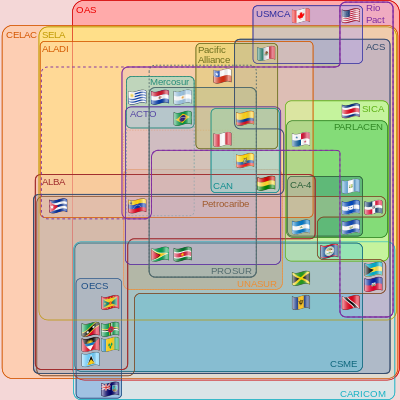

PetroCaribe[edit]
Based on the earlier San José Accords (1980) and Caracas Energy Accords (2000) between Venezuela and a number of Caribbean states, Petrocaribe was founded in 2005 to facilitate oil trade under a concessionary financial agreement. The initiative has provided the Caribbean member states with important hydrocarbon resources, which many do not possess on their territories, in exchange for services and goods. In the case of Cuba, a nation largely deprived of oil since the fall of the Soviet Union in 1991, Petrocaribe has provided oil in exchange for medical doctors.[40]
Other energy initiatives[edit]
As part of Cuba's efforts to spread its Energy Revolution campaign through ALBA, Cuban social workers traveled to 11 countries in the Caribbean and Latin America to help develop energy efficiency projects in those countries.[41]: 294
TeleSUR[edit]
Launched in 2005, TeleSUR is a media conglomerate that provides news and current affairs broadcasts throughout the ALBA bloc. The program is based on an internet based television channel and is a cooperative effort between the governments of Venezuela, Cuba and Nicaragua.
PETROSUR[edit]
PETROSUR is an inter-governmental energy alliance between Venezuelan PDVSA, Argentinean YPF, and Brazilian Petrobras nationalized oil companies. The goal of this initiative is to provide funding for social welfare programs within these nations.[citation needed]
Criticism[edit]
In July 2018, President Lenín Moreno of Ecuador distanced himself from ALBA, stating that the organization "has not worked for a while."[42] In August 2018, Ecuador officially withdrew from ALBA.
Karen Longaric, appointed as foreign minister by Jeanine Áñez's interim government, announced the formal departure of the country from ALBA in November 2019 over "interference" in Bolivia's political crisis.[43] However, as a consequence of the electoral collapse of the Áñez government, the country remained in ALBA.
See also[edit]
- Latin American integration
- Community of Latin American and Caribbean States (CELAC)
- Association of Caribbean States
- CARIFORUM
- Warsaw Pact
- Belt and Road Initiative
- Pacific Alliance
- Mercosur
- Andean Community of Nations
- Union of South American Nations
- Foro de São Paulo
- Pink tide
- Latin American Free Trade Agreement
- North American Free Trade Agreement
- Non Aligned Movement
- PetroCaribe
- Lima Group
- SUCRE
- Copenhagen Accord
- Free Trade Area of the Americas (FTAA or ALCA)
- International trade
- Social security
- Trade bloc
- Eurasian Economic Union
References[edit]
- ^ "Declaración del ALBA-TCP: Justicia social y cooperación". ACN (in Spanish). 16 December 2022. Retrieved 17 December 2022.
- ^ The total area of ALBA reaches 5,057,735 km2 if the maritime areas is included .
- ^ a b c "Declaration of the ALBA-TCP XIII Summit and commemoration of its tenth anniversary, December 14, 2014 – ALBA TCP". Archived from the original on 20 December 2014. Retrieved 28 June 2016.
- ^ Arana, Marie (18 April 2013). "Opinion – Bolívar, Latin America's Go-To Hero". The New York Times. Retrieved 24 August 2018.
- ^ "Cuba-Venezuela Agreement - December 14, 2004". Archived from the original on 2005-11-04. Retrieved 2005-12-02. initial Cuba-Venezuela TCP
- ^ Ted Piccone; Harold Trinkunas (June 2014). "The Cuba-Venezuela Alliance: The Beginning of the End? Line" (PDF). brookings.edu. Retrieved 5 April 2023.
- ^ a b c d Inc, IBP (20 March 2009). Latin America Energy Policy and Regulations Handbook Volume 1 Strategic Information and Programs. Lulu.com. ISBN 9781438728360. Retrieved 24 August 2018 – via Google Books.
{{cite book}}:|last=has generic name (help)[self-published source] - ^ Monthly Review, 2 July 2008, ALBA: Creating a Regional Alternative to Neo-liberalism?
- ^ "Honduran Congress Approves Withdrawal From ALBA - Americas Quarterly". Retrieved 5 April 2023.
- ^ "Two more Caribbean Nations join ALBA". 26 June 2009.
- ^ "Cuba Revolución: Chávez invita a Jamaica a sumarse al ALBA". Retrieved 28 June 2016.
- ^ Diario, El Nuevo. "El Nuevo Diario". Archived from the original on 8 September 2008. Retrieved 28 June 2016.
- ^ (ABN), Agencia Bolivariana de Noticias (20 July 2007). "Chávez invitó a toda Centroamérica a unirse al ALBA". Retrieved 28 June 2016.
- ^ "Chávez invita a Argentina a sumarse a la moneda virtual sucre – Radio La Primerísima". Archived from the original on 2016-05-27. Retrieved 28 June 2016.
- ^ "Twelfth ALBA Presidential Summit Takes Place in Ecuador". americasquarterly.org. Retrieved 24 August 2018.
- ^ "Grenada Joins ALBA | NOW Grenada". www.nowgrenada.com. December 15, 2014.
- ^ "Ecuador leaves Venezuelan-run regional alliance". AP NEWS. Associated Press. 2018-08-24. Retrieved 2018-12-18.
- ^ "Bolivia rompe relaciones con Venezuela y se retira de la Alianza Bolivariana ALBA | DW | 15.11.2019". Deutsche Welle (in European Spanish). 15 November 2019. Retrieved 2019-11-16.
- ^ "Bolivia reanuda su participación en Unasur, Celac y Alba". France 24. 2020-11-20. Retrieved 2020-11-21.
- ^ "ALBA-TCP member countries celebrate 16 years of regional integration". 14 December 2020.
- ^ "Россию пригласили на самые антиамериканские старты мира. Что это такое?". sport-express.ru (in Russian). 23 February 2023. Retrieved 5 April 2023.
- ^ "Bolivia summit adopts new currency". Retrieved 28 June 2016.
- ^ "Honduras se retira de Alba". Honduras se retira de Alba. 13 January 2010.
- ^ "Inicia hoy XVI Cumbre del ALBA-TCP en La Habana. In: albatcp.cubaminrex.cu 12/14/2018". Archived from the original on 2018-12-14. Retrieved 2018-12-14.
- ^ "17th Summit of ALBA-TCP in Cuba focuses on regional situation". Prensa Latina. 14 December 2019. Retrieved 14 December 2019.
- ^ "ALBA-TCP celebra su 16 aniversario vía videoconferencia con presidentes de países miembros". ABI (in Spanish). 13 December 2020. Archived from the original on 14 December 2020. Retrieved 14 December 2020.
- ^ "Venezuela acoge la XIX Cumbre del ALBA-TCP en el marco del Bicentenario de la Batalla de Carabobo". ABI (in Spanish). 24 June 2021. Retrieved 1 July 2021.
- ^ "Inaugura Presidente cubano la XX Cumbre del ALBA-TCP (+Fotos)". ACN (in Spanish). 14 December 2021. Retrieved 14 December 2021.
- ^ "ALBA-TCP Summit Declaration endorses independent politics". Prensa Latina. 14 December 2021. Retrieved 15 December 2021.
- ^ "ALBA-TCP Summit in Havana without exclusions". PL. 27 May 2022. Retrieved 27 May 2022.
- ^ "ALBA-TCP Summit in Cuba rejects exclusion and discrimination". PL. 27 May 2022. Retrieved 28 May 2022.
- ^ "ALBA-TCP chief arrives in Cuba to attend 22nd Summit (+Photo)". PL. 13 December 2022. Retrieved 14 December 2022.
- ^ "ALBA-TCP define fortalecer liderazgo y actuar en bloque en la cumbre de la CELAC". Bolivia TV (in Spanish). 15 December 2022. Retrieved 15 December 2022.
- ^ "Declaración final de la XXIII Cumbre del ALBA-TCP". El Universal (in Spanish). 2024-04-25. Retrieved 2024-04-25.
- ^ "Granada – ALBA TCP". Archived from the original on 20 July 2016. Retrieved 28 June 2016.
- ^ "Nicaragua celebra 14 años de solidaridad y respeto como parte del ALBA-TCP". La Voz del Sandinismo (in Spanish). 11 January 2021. Retrieved 12 January 2021.
- ^ "San Cristóbal y Nieves – ALBA TCP". Archived from the original on 20 July 2016. Retrieved 28 June 2016.
- ^ a b c Hirst, Joel D. (15 August 2019). "A Guide to ALBA". Americas Quarterly. Retrieved 25 October 2022.
- ^ El Universal, 6 February 2012, ALBA summit ends with entry of guest countries
- ^ Cederlöf, Gustav; Kingsbury, Donald V. (2019). "On PetroCaribe: Petropolitics, Energopower, and Post-Neoliberal Development in the Caribbean Energy Region". Political Geography. 72: 124–133. doi:10.1016/j.polgeo.2019.04.006. S2CID 164598358.
- ^ Yaffee, Helen (2020). We Are Cuba! How a Revolutionary People Have Survived in a Post-Soviet World (hardcover ed.). USA: Yale University Press. ISBN 978-0-300-23003-1.
- ^ "Lenin Moreno ordenó a la UNASUR desalojar edificio en Ecuador". La Prensa (in Spanish). Retrieved 2018-07-07.
- ^ "La política internacional de Añez: anunció la salida de Bolivia del Alba, de la Unasur y rompió relaciones con Venezuela". Latinomerica Piensa (in Spanish). 15 November 2019.
External links[edit]

- (in English) Official website
- (in Spanish) Official website
- (in Spanish) Portal ALBA


| International | |
|---|---|
| National | |
