


Champ Clark
Champ Clark | |
|---|---|
 Champ Clark, c. 1915 | |
| 36th Speaker of the United States House of Representatives | |
| In office April 4, 1911 – March 3, 1919[1] | |
| Preceded by | Joseph G. Cannon |
| Succeeded by | Frederick H. Gillett |
| Leader of the House Democratic Caucus | |
| In office March 4, 1909 – March 2, 1921 | |
| Preceded by | John Sharp Williams |
| Succeeded by | Claude Kitchin |
| Member of the U.S. House of Representatives from Missouri's 9th district | |
| In office March 4, 1897 – March 2, 1921[1] | |
| Preceded by | William M. Treloar |
| Succeeded by | Theodore W. Hukriede |
| In office March 4, 1893 – March 3, 1895 | |
| Preceded by | Seth W. Cobb |
| Succeeded by | William M. Treloar |
| Personal details | |
| Born | James Beauchamp Clark March 7, 1850 Lawrenceburg, Kentucky, U.S. |
| Died | March 2, 1921 (aged 70) Washington, D.C., U.S. |
| Political party | Democratic |
| Spouse | Genevieve Davis Bennett |
| Children | 2 |
| Alma mater | Bethany College University of Cincinnati College of Law |
| Profession | Lawyer |
| Signature |  |
James Beauchamp Clark (March 7, 1850 – March 2, 1921) was an American politician and attorney who represented Missouri in the United States House of Representatives for thirteen terms between 1893 and 1921 and served as Speaker of the House from 1911 to 1919.
Born in Kentucky, Clark established a law practice in Bowling Green, Missouri. After serving in local, county, and state office, he won election to the U.S. House in 1892, lost his seat in 1894, and won the seat back in 1896. He became the House Minority Leader in 1908 and was elevated to Speaker after Democrats took control of the House in the 1910 elections. He inadvertently helped defeat the Canadian–American Reciprocity Treaty of 1911 by arguing that ratification of the treaty would lead to the incorporation of Canada into the United States.
Entering the 1912 Democratic National Convention, Clark had won the backing of a majority of the delegates, but lacked the necessary two-thirds majority to win the presidential nomination. After dozens of ballots, Woodrow Wilson emerged as the Democratic presidential nominee, and went on to win the 1912 presidential election. Clark helped Wilson pass much of his progressive agenda but opposed U.S. entry into World War I. In the 1918 midterm elections, Democrats lost their control of the House of Representatives, ending Clark's tenure as Speaker. The 1920 House elections saw the defeat of numerous Democrats, including Clark. He died the following March, two days before he would have left office.
Early life and education[edit]
Clark was born in Lawrenceburg, Kentucky, to John Hampton Clark and Aletha Beauchamp. Through his mother, he was the first cousin twice removed of the famous lawyer-turned-murderer Jereboam O. Beauchamp. He is also directly descended from the famous John Beauchamp (Plymouth Company) through his mother. He graduated from Bethany College in 1873, and from Cincinnati Law School in 1875.[2][3]
Career[edit]
Clark served as president of Marshall College (now Marshall University) from 1873 to 1874. In 1875, he was admitted to the bar, and the following year he moved to Bowling Green, Missouri, the county seat of Pike County, where he practiced law. He was city attorney from 1878 to 1881, and prosecuting attorney of Pike County from 1885 to 1889.[2]
Politics[edit]
Clark was a member of the Missouri House of Representatives in 1889 and 1891.[2] Clark was elected to the United States House of Representatives in 1892. After a surprise loss in 1894 to William M. Treloar, he regained the seat in 1896, and remained in the House until his death, the day before he was to leave office.
Clark ran for House Minority Leader in 1903 but was defeated by John Sharp Williams of Mississippi. After Williams ran for the Senate in 1908, Clark ran again for the position and won. When the Democrats won control of the House in 1911, Clark became Speaker.[4]
Canadian reciprocity treaty[edit]
.jpg)
In 1911, Clark gave a speech that helped to decide the election in Canada. On the floor of the House, Clark argued for the recent Canadian–American Reciprocity Treaty of 1911 and declared: "I look forward to the time when the American flag will fly over every square foot of British North America up to the North Pole."[5]
Clark went on to suggest in his speech that the treaty was the first step towards the end of Canada, a speech that was greeted with "prolonged applause" according to the Congressional Record.[6] The Washington Post reported, "Evidently, then, the Democrats generally approved of Mr. Clark's annexation sentiments and voted for the reciprocity bill because, among other things, it improves the prospect of annexation."[6]
The Chicago Tribune condemned Clark in an editorial, predicting that Clark's speech might have fatally damaged the treaty in Canada; "He lets his imagination run wild like a Missouri mule on a rampage. Remarks about the absorption of one country by another grate harshly on the ears of the smaller."[6] The Conservative Party of Canada, which opposed the treaty, won the Canadian election in large part because of Clark's speech.
Later career[edit]
In 1912, Clark was the frontrunner for the Democratic presidential nomination, coming into the convention with a majority of delegates pledged to him, but he failed to receive the necessary two-thirds of the vote on the first several ballots. After lengthy negotiation, clever management by supporters of New Jersey Governor Woodrow Wilson, with widespread allegations of influence by special interests, delivered the nomination instead to Wilson.
Clark's speakership was notable for his skill from 1910 to 1914 in maintaining party unity to block William Howard Taft's legislation and then pass Wilson's. Clark split the party in 1917 and 1918, when he opposed Wilson's decision to bring the United States into World War I.
In addition, Clark opposed the Federal Reserve Act, which concentrated financial power in the hands of eastern banks (mostly centered in New York City). Clark's opposition to the Federal Reserve Act is said to be the reason that Missouri is the only state granted two Federal Reserve Banks (one in St. Louis and one in Kansas City).
Clark was defeated in the Republican landslide of 1920 and died shortly thereafter in his home in Washington, D.C.
Champ Clark is the namesake of the small community of Champ, Audrain County, Missouri.[7] The former Clark National Forest likewise was named after him.[8]
Personal life[edit]

Clark married Genevieve Bennett Clark on December 14, 1881. Together, they had two children, Joel Bennett Clark and Genevieve Clark Thomson.[9] Bennet served as a United States senator from Missouri from 1933 to 1945. Genevieve was a suffragette and a candidate for the House of Representatives for Louisiana.[10]
He was an adherent of the Disciples of Christ.[11]
Champ Clark Bridge[edit]
A bridge in Louisiana, Missouri that connects Missouri to neighboring Illinois was originally built in 1928. It bears the name Champ Clark. In late 2019, another bridge of the same name was constructed to replace the structurally deficient original bridge.[12]
Gallery[edit]
-
 Speaker Clark's official portrait
 -
 Speaker Clark (left) with Representative James R. Mann of Illinois
 -
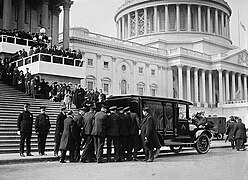 Champ Clark's casket being loaded into a hearse outside the United States Capitol, flag at half staff, March 5, 1921
 -
 Clark about a month before his death, wearing an antique-style beaver hat.
 -
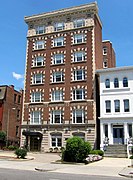 Clark's former residence in Washington, D.C.
 -
 Bennet and Genevieve Clark
 -
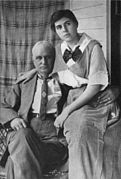 Champ Clark and daughter Genevieve
 -
 Champ Clark, left, examining marble bust of himself, made by Moses Wainer-Dykaar, right.


See also[edit]
References[edit]
- ^ a b Biographical Directory of the United States Congress
- ^ a b c "Clark, James Beauchamp (Champ)". Biographical Directory of the United States Congress. United States Congress. Retrieved 21 March 2021.
- ^ Engel, Brent (March 20, 2020). "'Lion of Democracy': Champ Clark emerges from a humble start". Pike County News. No. online edition. Retrieved 21 March 2021.
- ^ "CLARK, James Beauchamp (Champ)". house.gov.
- ^ Allan, Chantal Bomb Canada: And Other Unkind Remarks in the American Media Athabasca: Athabasca University Press, 2009 p. 17.
- ^ a b c Allan, Bomb Canada: And Other Unkind Remarks in the American Media page 18.
- ^ "Audrain County Place Names, 1928-1945 (archived)". The State Historical Society of Missouri. Archived from the original on 24 June 2016. Retrieved 30 August 2016.
{{cite web}}: CS1 maint: bot: original URL status unknown (link) - ^ "St. Francois County Place Names, 1928–1945". The State Historical Society of Missouri. Archived from the original on June 24, 2016. Retrieved November 27, 2016.
- ^ "S. Doc. 58-1 - Fifty-eighth Congress. (Extraordinary session -- beginning November 9, 1903.) Official Congressional Directory for the use of the United States Congress. Compiled under the direction of the Joint Committee on Printing by A.J. Halford. Special edition. Corrections made to November 5, 1903". GovInfo.gov. U.S. Government Printing Office. November 9, 1903. p. 64. Retrieved July 2, 2023.
Married Miss Genevieve Bennett; has had four children born to him: Little Champ, Ann Hamilton, Bennett, and Genevieve, the two latter still living.
- ^ Waal, Carla; Korner, Barbara Oliver (1997-01-01). Hardship and Hope: Missouri Women Writing about Their Lives, 1820-1920. University of Missouri Press. ISBN 9780826211200.
- ^ "The Religious Affiliation of U.S. Congressman Rep. Champ Clark". Adherents.com. Archived from the original on February 11, 2006. Retrieved 2011-04-13.
{{cite web}}: CS1 maint: unfit URL (link) - ^ "History". www.champclarkbridge.com. Retrieved 2021-01-12.
Further reading[edit]
- Chiu, Chang-wei. The Speaker of the House of Representatives since 1896.
- Gould, Louis. "Clark, Champ" in John A. Garraty, and Mark C. Carnes, eds. American National Biography (1999), vol. 4, . New York: Oxford Univ. Press; also online..
- Krahn, Carole Ellen (1965). Champ Clark: Presidential Candidate. S. Ill. Univ. Press.
- Morrison, Geoffrey F. (1979). A Political Biography of Champ Clark. St. Louis Univ. Press.
- Webb, William Larkin (1912). Champ Clark. New York: Neale Pub. Co.
- White, Hollis Lee (1950). A Rhetorical Criticism of the Speeches of Speaker Champ Clark. Univ. of Missouri Press.
Primary sources[edit]
- Clark, Champ (1920). My Quarter Century of American Politics. Harper.
- Clark, Champ. "The Work of the Democratic House" The North American Review (Sept 1911) pp 337–343. online
External links[edit]


- United States Congress. "Champ Clark (id: C000437)". Biographical Directory of the United States Congress.
- James Beauchamp Clark at Find a Grave
- Chisholm, Hugh, ed. (1922). . Encyclopædia Britannica. Vol. 30 (12th ed.). London & New York: The Encyclopædia Britannica Company. p. 701.)
- James Beauchamp Clark's Signature on the 17th Amendment to the constitution Image of original document
- Champ Clark, late a representative from Missouri, Memorial addresses delivered in the House of Representatives and Senate frontispiece 1922
|  | |


 | ||
 | ||
| International | |
|---|---|
| National | |
| People | |
| Other | |

- 1850 births
- 1921 deaths
- American Disciples of Christ
- Bethany College (West Virginia) alumni
- Minority leaders of the United States House of Representatives
- Missouri lawyers
- People from Lawrenceburg, Kentucky
- Speakers of the United States House of Representatives
- Candidates in the 1912 United States presidential election
- 20th-century American legislators
- University of Cincinnati College of Law alumni
- Democratic Party members of the United States House of Representatives from Missouri
- Presidents of Marshall University
- People from Bowling Green, Missouri
- 19th-century American lawyers