


1932 Democratic National Convention
 | This article needs additional citations for verification. (June 2008) |
| 1932 presidential election | |
.jpg) .jpg) Nominees Roosevelt and Garner | |
| Convention | |
|---|---|
| Date(s) | June 27 – July 2, 1932 |
| City | Chicago, Illinois |
| Venue | Chicago Stadium |
| Candidates | |
| Presidential nominee | Franklin D. Roosevelt of New York |
| Vice presidential nominee | John N. Garner of Texas |
The 1932 Democratic National Convention was held in Chicago, Illinois June 27 – July 2, 1932. The convention resulted in the nomination of Governor Franklin D. Roosevelt of New York for president and Speaker of the House John N. Garner from Texas for vice president. Beulah Rebecca Hooks Hannah Tingley was a member of the Democratic National Committee and Chair of the Democratic Party of Florida. She seconded the nomination of Franklin Delano Roosevelt, becoming the second woman to address a Democratic National Convention. According to the White House Historical Association, Happy Days Are Here Again was the campaign song of the convention.[1]
The candidates[edit]
The three major candidates:
| Candidate | Born [2] | Office Held | State | Delegates, 1st ballot | Final ballot |
|---|---|---|---|---|---|
 Franklin D. Roosevelt |
January 30, 1882 (age 50) Hyde Park, New York |
44th Governor of New York (1929–1932) |
 New York |
666.25 | 945 |
 Al Smith (campaign) |
December 30, 1873 (age 58) Manhattan, New York |
42nd Governor of New York (1919–1920, 1923–1928) |
New York |
201.75 | 190.25 |
 John Nance Garner |
November 22, 1868 (age 63) Detroit, Texas |
39th Speaker of the House of Representatives (1931–1933) |
 Texas |
90.25 | Nominated for Vice President |
Convention[edit]
.jpg)
The three major contenders for the presidential nomination were Roosevelt, Garner and former Governor of New York and 1928 presidential candidate, Al Smith, who roughly represented three competing factions of the Democratic Party:
- Smith was supported by the Tammany Hall machine in New York City, and had many supporters in the Democratic National Committee, as well as in Chicago, where Chicago mayor Anton Cermak packed the hall with Smith supporters.
- Roosevelt was supported by a solid majority of the delegates, and had the support of Senators Burton Wheeler, Cordell Hull, Alben Barkley, and Huey Long, who held the Deep South for Roosevelt.
- Garner had support from two powerful individuals: California newspaper magnate William Randolph Hearst and Senator William Gibbs McAdoo. While he was never a serious threat, and never bothered to campaign for the position, the faction that supported Garner was important because it could break a potential deadlock between Smith and Roosevelt.
The new Democratic coalition would begin at this convention: Roosevelt brought into the Democratic fold western progressives, ethnic minorities, rural farmers, and intellectuals. Supporters of Roosevelt pushed for the abolition of the two-thirds rule (which required the presidential nominee to win at least two-thirds of the delegate votes), but backlash from Southern delegates forced them to drop the idea.[3]
After three ballots, Roosevelt was 86.25 votes short of the 769 votes required for the nomination, and his campaign feared that his support had peaked: as none of New York, New Jersey, Massachusetts or Connecticut supported Roosevelt, he needed McAdoo, who had the California delegation, and Garner, who had the Texas delegation.
Roosevelt's campaign was able to persuade Garner to have his delegates vote for Roosevelt, possibly with the help of Hearst: while Hearst disliked Roosevelt, he hated Smith and Newton D. Baker, a possible compromise candidate. After McAdoo (who himself had been denied the nomination by the two-thirds rule at the 1924 convention) announced that California would back Roosevelt, the convention realized Roosevelt had reached the required 769 delegates to win the nomination, which was greeted by wild celebrations. Roosevelt received 945 votes on the fourth ballot to Smith's 190.5.[3]
Garner was nominated for vice-president by acclamation, likely as part of a deal for his delegates.[4] McAdoo had hoped to be on the ticket, but he withdrew after his inclusion was opposed by Hearst.[5]
| Presidential Balloting | ||||
|---|---|---|---|---|
| Candidate | 1st | 2nd | 3rd | 4th |
| Roosevelt | 666.25 | 677.75 | 682.75 | 945 |
| Smith | 201.75 | 194.25 | 190.25 | 190.50 |
| Garner | 90.25 | 90.25 | 101.25 | 0 |
| White | 52 | 50.50 | 52.50 | 3 |
| Traylor | 42.25 | 40.25 | 40.25 | 0 |
| Reed | 24 | 18 | 27.50 | 0 |
| Byrd | 25 | 24 | 25 | 0 |
| Ritchie | 21 | 23.50 | 23.50 | 3.50 |
| Murray | 23 | 0 | 0 | 0 |
| Rogers | 0 | 22 | 0 | 0 |
| Baker | 8.50 | 8 | 8.50 | 5.50 |
| Cox | 0 | 0 | 0 | 1 |
| Not Voting | 0 | 5.50 | 2.50 | 5.50 |
Presidential Balloting / 5th Day of Convention (July 1, 1932)
-
 1st Presidential Ballot
 -
 2nd Presidential Ballot
 -
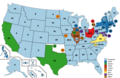 3rd Presidential Ballot
 -
 4th Presidential Ballot


Roosevelt's acceptance speech[edit]
For his acceptance speech, Roosevelt broke tradition and established the precedent of formally accepting the nomination in person at the convention. In his speech, he pledged "a New Deal for the American people".[4]
See also[edit]
- History of the United States Democratic Party
- Democratic Party presidential primaries, 1932
- List of Democratic National Conventions
- U.S. presidential nomination convention
- 1932 Republican National Convention
- Happy Days Are Here Again
- 1932 United States presidential election
References[edit]
- ^ "Franklin Delano Roosevelt's Historic First Inauguration". WHHA (en-US). Retrieved 2024-03-11.
- ^ Candidate ages listed as they were during the convention in 1932
- ^ a b Krock, Arthur (2 July 1932). "Roosevelt Nominated on Fourth Ballot; Garner Expected to be His Running Mate; Governor Will Fly to Convention Today". The New York Times. Retrieved 8 October 2015.
- ^ a b Gunther, John (1950). Roosevelt in Retrospect. Harper & Brothers. pp. 270–272.
- ^ Krock, Arthur (3 July 1932). "Roosevelt Puts Economic Recovery First in His Acceptance Speech at Convention; Garner for Vice President by Acclamation". The New York Times. Retrieved 8 October 2015.
Pietrusza, David 1932: The Rise of Hitler & FDR: Two Tales of Politics, Betrayal, and Unlikely Destiny Guilford CT: Lyons Press, 2015.
External links[edit]
- 1932 Democratic Convention
- Roosevelt Nomination Acceptance Speech for President at DNC (transcript) at The American Presidency Project
- Democratic Party Platform of 1932 at The American Presidency Project
| Preceded by 1928 Houston, Texas |
Democratic National Conventions | Succeeded by 1936 Philadelphia, Pennsylvania |

- 1932 United States presidential election
- 1932 in Illinois
- 20th century in Chicago
- Political conventions in Chicago
- Democratic Party of Illinois
- Political events in Illinois
- Democratic National Conventions
- 1932 conferences
- June 1932 events
- July 1932 events
- Franklin D. Roosevelt
- Al Smith
- 1930s political conferences