


Folding@home

 | |
| Original author(s) | Vijay Pande |
|---|---|
| Developer(s) | Pande Laboratory, Sony, Nvidia, ATI Technologies, Joseph Coffland, Cauldron Development[1] |
| Initial release | October 1, 2000 |
| Stable release | 7.6.21
/ October 23, 2020[2] |
| Preview release | 8.1.18
/ April 18, 2023[2] |
| Operating system | Microsoft Windows, macOS, Linux, PlayStation 3 (discontinued as of firmware version 4.30) |
| Platform | IA-32, x86-64, ARM64, CUDA[3] |
| Available in | English, French, Spanish, Swedish |
| Type | Distributed computing |
| License | Proprietary software[4] |
| Website | foldingathome |
Folding@home (FAH or F@h) is a distributed computing project aimed to help scientists develop new therapeutics for a variety of diseases by the means of simulating protein dynamics. This includes the process of protein folding and the movements of proteins, and is reliant on simulations run on volunteers' personal computers.[5] Folding@home is currently based at the University of Pennsylvania and led by Greg Bowman, a former student of Vijay Pande.[6]
The project utilizes graphics processing units (GPUs), central processing units (CPUs), and ARM processors like those on the Raspberry Pi for distributed computing and scientific research. The project uses statistical simulation methodology that is a paradigm shift from traditional computing methods.[7] As part of the client–server model network architecture, the volunteered machines each receive pieces of a simulation (work units), complete them, and return them to the project's database servers, where the units are compiled into an overall simulation. Volunteers can track their contributions on the Folding@home website, which makes volunteers' participation competitive and encourages long-term involvement.
Folding@home is one of the world's fastest computing systems. With heightened interest in the project as a result of the COVID-19 pandemic,[8] the system achieved a speed of approximately 1.22 exaflops by late March 2020 and reached 2.43 exaflops by April 12, 2020,[9] making it the world's first exaflop computing system. This level of performance from its large-scale computing network has allowed researchers to run computationally costly atomic-level simulations of protein folding thousands of times longer than formerly achieved. Since its launch on October 1, 2000, Folding@home was involved in the production of 226 scientific research papers.[10] Results from the project's simulations agree well with experiments.[11][12][13]
Background
[edit]
Proteins are an essential component to many biological functions and participate in virtually all processes within biological cells. They often act as enzymes, performing biochemical reactions including cell signaling, molecular transportation, and cellular regulation. As structural elements, some proteins act as a type of skeleton for cells, and as antibodies, while other proteins participate in the immune system. Before a protein can take on these roles, it must fold into a functional three-dimensional structure, a process that often occurs spontaneously and is dependent on interactions within its amino acid sequence and interactions of the amino acids with their surroundings. Protein folding is driven by the search to find the most energetically favorable conformation of the protein, i.e., its native state. Thus, understanding protein folding is critical to understanding what a protein does and how it works, and is considered a holy grail of computational biology.[14][15] Despite folding occurring within a crowded cellular environment, it typically proceeds smoothly. However, due to a protein's chemical properties or other factors, proteins may misfold, that is, fold down the wrong pathway and end up misshapen. Unless cellular mechanisms can destroy or refold misfolded proteins, they can subsequently aggregate and cause a variety of debilitating diseases.[16] Laboratory experiments studying these processes can be limited in scope and atomic detail, leading scientists to use physics-based computing models that, when complementing experiments, seek to provide a more complete picture of protein folding, misfolding, and aggregation.[17][18]
Due to the complexity of proteins' conformation or configuration space (the set of possible shapes a protein can take), and limits in computing power, all-atom molecular dynamics simulations have been severely limited in the timescales that they can study. While most proteins typically fold in the order of milliseconds,[17][19] before 2010, simulations could only reach nanosecond to microsecond timescales.[11] General-purpose supercomputers have been used to simulate protein folding, but such systems are intrinsically costly and typically shared among many research groups. Further, because the computations in kinetic models occur serially, strong scaling of traditional molecular simulations to these architectures is exceptionally difficult.[20][21] Moreover, as protein folding is a stochastic process (i.e., random) and can statistically vary over time, it is challenging computationally to use long simulations for comprehensive views of the folding process.[22][23]
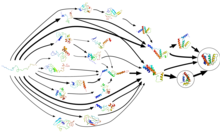
Protein folding does not occur in one step.[16] Instead, proteins spend most of their folding time, nearly 96% in some cases,[24] waiting in various intermediate conformational states, each a local thermodynamic free energy minimum in the protein's energy landscape. Through a process known as adaptive sampling, these conformations are used by Folding@home as starting points for a set of simulation trajectories. As the simulations discover more conformations, the trajectories are restarted from them, and a Markov state model (MSM) is gradually created from this cyclic process. MSMs are discrete-time master equation models which describe a biomolecule's conformational and energy landscape as a set of distinct structures and the short transitions between them. The adaptive sampling Markov state model method significantly increases the efficiency of simulation as it avoids computation inside the local energy minimum itself, and is amenable to distributed computing (including on GPUGRID) as it allows for the statistical aggregation of short, independent simulation trajectories.[25] The amount of time it takes to construct a Markov state model is inversely proportional to the number of parallel simulations run, i.e., the number of processors available. In other words, it achieves linear parallelization, leading to an approximately four orders of magnitude reduction in overall serial calculation time. A completed MSM may contain tens of thousands of sample states from the protein's phase space (all the conformations a protein can take on) and the transitions between them. The model illustrates folding events and pathways (i.e., routes) and researchers can later use kinetic clustering to view a coarse-grained representation of the otherwise highly detailed model. They can use these MSMs to reveal how proteins misfold and to quantitatively compare simulations with experiments.[7][22][26]
Between 2000 and 2010, the length of the proteins Folding@home has studied have increased by a factor of four, while its timescales for protein folding simulations have increased by six orders of magnitude.[27] In 2002, Folding@home used Markov state models to complete approximately a million CPU days of simulations over the span of several months,[13] and in 2011, MSMs parallelized another simulation that required an aggregate 10 million CPU hours of computing.[28] In January 2010, Folding@home used MSMs to simulate the dynamics of the slow-folding 32-residue NTL9 protein out to 1.52 milliseconds, a timescale consistent with experimental folding rate predictions but a thousand times longer than formerly achieved. The model consisted of many individual trajectories, each two orders of magnitude shorter, and provided an unprecedented level of detail into the protein's energy landscape.[7][11][29] In 2010, Folding@home researcher Gregory Bowman was awarded the Thomas Kuhn Paradigm Shift Award from the American Chemical Society for the development of the open-source MSMBuilder software and for attaining quantitative agreement between theory and experiment.[30][31] For his work, Pande was awarded the 2012 Michael and Kate Bárány Award for Young Investigators for "developing field-defining and field-changing computational methods to produce leading theoretical models for protein and RNA folding",[32] and the 2006 Irving Sigal Young Investigator Award for his simulation results which "have stimulated a re-examination of the meaning of both ensemble and single-molecule measurements, making Pande's efforts pioneering contributions to simulation methodology."[33]
Examples of application in biomedical research
[edit]Protein misfolding can result in a variety of diseases including Alzheimer's disease, cancer, Creutzfeldt–Jakob disease, cystic fibrosis, Huntington's disease, sickle-cell anemia, and type II diabetes.[16][34][35] Cellular infection by viruses such as HIV and influenza also involve folding events on cell membranes.[36] Once protein misfolding is better understood, therapies can be developed that augment cells' natural ability to regulate protein folding. Such therapies include the use of engineered molecules to alter the production of a given protein, help destroy a misfolded protein, or assist in the folding process.[37] The combination of computational molecular modeling and experimental analysis has the possibility to fundamentally shape the future of molecular medicine and the rational design of therapeutics,[18] such as expediting and lowering the costs of drug discovery.[38] The goal of the first five years of Folding@home was to make advances in understanding folding, while the current goal is to understand misfolding and related disease, especially Alzheimer's.[39]
The simulations run on Folding@home are used in conjunction with laboratory experiments,[22] but researchers can use them to study how folding in vitro differs from folding in native cellular environments. This is advantageous in studying aspects of folding, misfolding, and their relationships to disease that are difficult to observe experimentally. For example, in 2011, Folding@home simulated protein folding inside a ribosomal exit tunnel, to help scientists better understand how natural confinement and crowding might influence the folding process.[40][41] Furthermore, scientists typically employ chemical denaturants to unfold proteins from their stable native state. It is not generally known how the denaturant affects the protein's refolding, and it is difficult to experimentally determine if these denatured states contain residual structures which may influence folding behavior. In 2010, Folding@home used GPUs to simulate the unfolded states of Protein L, and predicted its collapse rate in strong agreement with experimental results.[42]
The large data sets from the project are freely available for other researchers to use upon request and some can be accessed from the Folding@home website.[43][44] The Pande lab has collaborated with other molecular dynamics systems such as the Blue Gene supercomputer,[45] and they share Folding@home's key software with other researchers, so that the algorithms which benefited Folding@home may aid other scientific areas.[43] In 2011, they released the open-source Copernicus software, which is based on Folding@home's MSM and other parallelizing methods and aims to improve the efficiency and scaling of molecular simulations on large computer clusters or supercomputers.[46][47] Summaries of all scientific findings from Folding@home are posted on the Folding@home website after publication.[48]
Alzheimer's disease
[edit]


Alzheimer's disease is an incurable neurodegenerative disease which most often affects the elderly and accounts for more than half of all cases of dementia. Its exact cause remains unknown, but the disease is identified as a protein misfolding disease. Alzheimer's is associated with toxic aggregations of the amyloid beta (Aβ) peptide, caused by Aβ misfolding and clumping together with other Aβ peptides. These Aβ aggregates then grow into significantly larger senile plaques, a pathological marker of Alzheimer's disease.[49][50][51] Due to the heterogeneous nature of these aggregates, experimental methods such as X-ray crystallography and nuclear magnetic resonance (NMR) have had difficulty characterizing their structures. Moreover, atomic simulations of Aβ aggregation are highly demanding computationally due to their size and complexity.[52][53]
Preventing Aβ aggregation is a promising method to developing therapeutic drugs for Alzheimer's disease, according to Naeem and Fazili in a literature review article.[54] In 2008, Folding@home simulated the dynamics of Aβ aggregation in atomic detail over timescales of the order of tens of seconds. Prior studies were only able to simulate about 10 microseconds. Folding@home was able to simulate Aβ folding for six orders of magnitude longer than formerly possible. Researchers used the results of this study to identify a beta hairpin that was a major source of molecular interactions within the structure.[55] The study helped prepare the Pande lab for future aggregation studies and for further research to find a small peptide which may stabilize the aggregation process.[52]
In December 2008, Folding@home found several small drug candidates which appear to inhibit the toxicity of Aβ aggregates.[56] In 2010, in close cooperation with the Center for Protein Folding Machinery, these drug leads began to be tested on biological tissue.[35] In 2011, Folding@home completed simulations of several mutations of Aβ that appear to stabilize the aggregate formation, which could aid in the development of therapeutic drug therapies for the disease and greatly assist with experimental nuclear magnetic resonance spectroscopy studies of Aβ oligomers.[53][57] Later that year, Folding@home began simulations of various Aβ fragments to determine how various natural enzymes affect the structure and folding of Aβ.[58][59]
Huntington's disease
[edit]Huntington's disease is a neurodegenerative genetic disorder that is associated with protein misfolding and aggregation. Excessive repeats of the glutamine amino acid at the N-terminus of the huntingtin protein cause aggregation, and although the behavior of the repeats is not completely understood, it does lead to the cognitive decline associated with the disease.[60] As with other aggregates, there is difficulty in experimentally determining its structure.[61] Scientists are using Folding@home to study the structure of the huntingtin protein aggregate and to predict how it forms, assisting with rational drug design methods to stop the aggregate formation.[35] The N17 fragment of the huntingtin protein accelerates this aggregation, and while there have been several mechanisms proposed, its exact role in this process remains largely unknown.[62] Folding@home has simulated this and other fragments to clarify their roles in the disease.[63] Since 2008, its drug design methods for Alzheimer's disease have been applied to Huntington's.[35]
Cancer
[edit]More than half of all known cancers involve mutations of p53, a tumor suppressor protein present in every cell which regulates the cell cycle and signals for cell death in the event of damage to DNA. Specific mutations in p53 can disrupt these functions, allowing an abnormal cell to continue growing unchecked, resulting in the development of tumors. Analysis of these mutations helps explain the root causes of p53-related cancers.[64] In 2004, Folding@home was used to perform the first molecular dynamics study of the refolding of p53's protein dimer in an all-atom simulation of water. The simulation's results agreed with experimental observations and gave insights into the refolding of the dimer that were formerly unobtainable.[65] This was the first peer reviewed publication on cancer from a distributed computing project.[66] The following year, Folding@home powered a new method to identify the amino acids crucial for the stability of a given protein, which was then used to study mutations of p53. The method was reasonably successful in identifying cancer-promoting mutations and determined the effects of specific mutations which could not otherwise be measured experimentally.[67]
Folding@home is also used to study protein chaperones,[35] heat shock proteins which play essential roles in cell survival by assisting with the folding of other proteins in the crowded and chemically stressful environment within a cell. Rapidly growing cancer cells rely on specific chaperones, and some chaperones play key roles in chemotherapy resistance. Inhibitions to these specific chaperones are seen as potential modes of action for efficient chemotherapy drugs or for reducing the spread of cancer.[68] Using Folding@home and working closely with the Center for Protein Folding Machinery, the Pande lab hopes to find a drug which inhibits those chaperones involved in cancerous cells.[69] Researchers are also using Folding@home to study other molecules related to cancer, such as the enzyme Src kinase, and some forms of the engrailed homeodomain: a large protein which may be involved in many diseases, including cancer.[70][71] In 2011, Folding@home began simulations of the dynamics of the small knottin protein EETI, which can identify carcinomas in imaging scans by binding to surface receptors of cancer cells.[72][73]
Interleukin 2 (IL-2) is a protein that helps T cells of the immune system attack pathogens and tumors. However, its use as a cancer treatment is restricted due to serious side effects such as pulmonary edema. IL-2 binds to these pulmonary cells differently than it does to T cells, so IL-2 research involves understanding the differences between these binding mechanisms. In 2012, Folding@home assisted with the discovery of a mutant form of IL-2 which is three hundred times more effective in its immune system role but carries fewer side effects. In experiments, this altered form significantly outperformed natural IL-2 in impeding tumor growth. Pharmaceutical companies have expressed interest in the mutant molecule, and the National Institutes of Health are testing it against a large variety of tumor models to try to accelerate its development as a therapeutic.[74][75]
Osteogenesis imperfecta
[edit]Osteogenesis imperfecta, known as brittle bone disease, is an incurable genetic bone disorder which can be lethal. Those with the disease are unable to make functional connective bone tissue. This is most commonly due to a mutation in Type-I collagen,[76] which fulfills a variety of structural roles and is the most abundant protein in mammals.[77] The mutation causes a deformation in collagen's triple helix structure, which if not naturally destroyed, leads to abnormal and weakened bone tissue.[78] In 2005, Folding@home tested a new quantum mechanical method that improved upon prior simulation methods, and which may be useful for future computing studies of collagen.[79] Although researchers have used Folding@home to study collagen folding and misfolding, the interest stands as a pilot project compared to Alzheimer's and Huntington's research.[35]
Viruses
[edit]Folding@home is assisting in research towards preventing some viruses, such as influenza and HIV, from recognizing and entering biological cells.[35] In 2011, Folding@home began simulations of the dynamics of the enzyme RNase H, a key component of HIV, to try to design drugs to deactivate it.[80] Folding@home has also been used to study membrane fusion, an essential event for viral infection and a wide range of biological functions. This fusion involves conformational changes of viral fusion proteins and protein docking,[36] but the exact molecular mechanisms behind fusion remain largely unknown.[81] Fusion events may consist of over a half million atoms interacting for hundreds of microseconds. This complexity limits typical computer simulations to about ten thousand atoms over tens of nanoseconds: a difference of several orders of magnitude.[55] The development of models to predict the mechanisms of membrane fusion will assist in the scientific understanding of how to target the process with antiviral drugs.[82] In 2006, scientists applied Markov state models and the Folding@home network to discover two pathways for fusion and gain other mechanistic insights.[55]
Following detailed simulations from Folding@home of small cells known as vesicles, in 2007, the Pande lab introduced a new computing method to measure the topology of its structural changes during fusion.[83] In 2009, researchers used Folding@home to study mutations of influenza hemagglutinin, a protein that attaches a virus to its host cell and assists with viral entry. Mutations to hemagglutinin affect how well the protein binds to a host's cell surface receptor molecules, which determines how infective the virus strain is to the host organism. Knowledge of the effects of hemagglutinin mutations assists in the development of antiviral drugs.[84][85] As of 2012, Folding@home continues to simulate the folding and interactions of hemagglutinin, complementing experimental studies at the University of Virginia.[35][86]
In March 2020, Folding@home launched a program to assist researchers around the world who are working on finding a cure and learning more about the coronavirus pandemic. The initial wave of projects simulate potentially druggable protein targets from SARS-CoV-2 virus, and the related SARS-CoV virus, about which there is significantly more data available.[87][88][89]
Drug design
[edit]Drugs function by binding to specific locations on target molecules and causing some desired change, such as disabling a target or causing a conformational change. Ideally, a drug should act very specifically, and bind only to its target without interfering with other biological functions. However, it is difficult to precisely determine where and how tightly two molecules will bind. Due to limits in computing power, current in silico methods usually must trade speed for accuracy; e.g., use rapid protein docking methods instead of computationally costly free energy calculations. Folding@home's computing performance allows researchers to use both methods, and evaluate their efficiency and reliability.[39][90][91] Computer-assisted drug design has the potential to expedite and lower the costs of drug discovery.[38] In 2010, Folding@home used MSMs and free energy calculations to predict the native state of the villin protein to within 1.8 angstrom (Å) root mean square deviation (RMSD) from the crystalline structure experimentally determined through X-ray crystallography. This accuracy has implications to future protein structure prediction methods, including for intrinsically unstructured proteins.[55] Scientists have used Folding@home to research drug resistance by studying vancomycin, an antibiotic drug of last resort, and beta-lactamase, a protein that can break down antibiotics like penicillin.[92][93]
Chemical activity occurs along a protein's active site. Traditional drug design methods involve tightly binding to this site and blocking its activity, under the assumption that the target protein exists in one rigid structure. However, this approach works for approximately only 15% of all proteins. Proteins contain allosteric sites which, when bound to by small molecules, can alter a protein's conformation and ultimately affect the protein's activity. These sites are attractive drug targets, but locating them is very computationally costly. In 2012, Folding@home and MSMs were used to identify allosteric sites in three medically relevant proteins: beta-lactamase, interleukin-2, and RNase H.[93][94]
Approximately half of all known antibiotics interfere with the workings of a bacteria's ribosome, a large and complex biochemical machine that performs protein biosynthesis by translating messenger RNA into proteins. Macrolide antibiotics clog the ribosome's exit tunnel, preventing synthesis of essential bacterial proteins. In 2007, the Pande lab received a grant to study and design new antibiotics.[35] In 2008, they used Folding@home to study the interior of this tunnel and how specific molecules may affect it.[95] The full structure of the ribosome was determined only as of 2011, and Folding@home has also simulated ribosomal proteins, as many of their functions remain largely unknown.[96]
Patterns of participation
[edit]Like other distributed computing projects, Folding@home is an online citizen science project. In these projects non-specialists contribute computer processing power or help to analyze data produced by professional scientists. Participants receive little or no obvious reward.
Research has been carried out into the motivations of citizen scientists and most of these studies have found that participants are motivated to take part because of altruistic reasons; that is, they want to help scientists and make a contribution to the advancement of their research.[97][98][99][100] Many participants in citizen science have an underlying interest in the topic of the research and gravitate towards projects that are in disciplines of interest to them. Folding@home is no different in that respect.[101] Research carried out recently on over 400 active participants revealed that they wanted to help make a contribution to research and that many had friends or relatives affected by the diseases that the Folding@home scientists investigate.
Folding@home attracts participants who are computer hardware enthusiasts. These groups bring considerable expertise to the project and are able to build computers with advanced processing power.[102][need quotation to verify] Other distributed computing projects attract these types of participants and projects are often used to benchmark the performance of modified computers, and this aspect of the hobby is accommodated through the competitive nature of the project. Individuals and teams can compete to see who can process the most computer processing units (CPUs).
This latest research on Folding@home involving interview and ethnographic observation of online groups showed that teams of hardware enthusiasts can sometimes work together, sharing best practice with regard to maximizing processing output. Such teams can become communities of practice, with a shared language and online culture. This pattern of participation has been observed in other distributed computing projects.[103][104]
Another key observation of Folding@home participants is that many are male.[101] This has also been observed in other distributed projects. Furthermore, many participants work in computer and technology-based jobs and careers.[101][105][106]
Not all Folding@home participants are hardware enthusiasts. Many participants run the project software on unmodified machines and do take part competitively. By January 2020, the number of users was down to 30,000.[107] However, it is difficult to ascertain what proportion of participants are hardware enthusiasts. Although, according to the project managers, the contribution of the enthusiast community is substantially larger in terms of processing power.[108]
Performance
[edit]
Supercomputer FLOPS performance is assessed by running the legacy LINPACK benchmark. This short-term testing has difficulty in accurately reflecting sustained performance on real-world tasks because LINPACK more efficiently maps to supercomputer hardware. Computing systems vary in architecture and design, so direct comparison is difficult. Despite this, FLOPS remain the primary speed metric used in supercomputing.[109][need quotation to verify] In contrast, Folding@home determines its FLOPS using wall-clock time by measuring how much time its work units take to complete.[110]
On September 16, 2007, due in large part to the participation of PlayStation 3 consoles, the Folding@home project officially attained a sustained performance level higher than one native petaFLOPS, becoming the first computing system of any kind to do so.[111][112] Top500's fastest supercomputer at the time was BlueGene/L, at 0.280 petaFLOPS.[113] The following year, on May 7, 2008, the project attained a sustained performance level higher than two native petaFLOPS,[114] followed by the three and four native petaFLOPS milestones in August 2008[115][116] and September 28, 2008 respectively.[117] On February 18, 2009, Folding@home achieved five native petaFLOPS,[118][119] and was the first computing project to meet these five levels.[120][121] In comparison, November 2008's fastest supercomputer was IBM's Roadrunner at 1.105 petaFLOPS.[122] On November 10, 2011, Folding@home's performance exceeded six native petaFLOPS with the equivalent of nearly eight x86 petaFLOPS.[112][123] In mid-May 2013, Folding@home attained over seven native petaFLOPS, with the equivalent of 14.87 x86 petaFLOPS. It then reached eight native petaFLOPS on June 21, followed by nine on September 9 of that year, with 17.9 x86 petaFLOPS.[124] On May 11, 2016 Folding@home announced that it was moving towards reaching the 100 x86 petaFLOPS mark.[125]
Further use grew from increased awareness and participation in the project from the coronavirus pandemic in 2020. On March 20, 2020 Folding@home announced via Twitter that it was running with over 470 native petaFLOPS,[126] the equivalent of 958 x86 petaFLOPS.[127] By March 25 it reached 768 petaFLOPS, or 1.5 x86 exaFLOPS, making it the first exaFLOP computing system.[128]
As of 20 July 2024[update], the computing power of Folding@home stands at 13.8 petaFLOPS, or 26.9 x86 petaFLOPS.[129]
Points
[edit]Similarly to other distributed computing projects, Folding@home quantitatively assesses user computing contributions to the project through a credit system.[130] All units from a given protein project have uniform base credit, which is determined by benchmarking one or more work units from that project on an official reference machine before the project is released.[130] Each user receives these base points for completing every work unit, though through the use of a passkey they can receive added bonus points for reliably and rapidly completing units which are more demanding computationally or have a greater scientific priority.[131][132] Users may also receive credit for their work by clients on multiple machines.[133] This point system attempts to align awarded credit with the value of the scientific results.[130]
Users can register their contributions under a team, which combine the points of all their members. A user can start their own team, or they can join an existing team. In some cases, a team may have their own community-driven sources of help or recruitment such as an Internet forum.[134] The points can foster friendly competition between individuals and teams to compute the most for the project, which can benefit the folding community and accelerate scientific research.[130][135][136] Individual and team statistics are posted on the Folding@home website.[130]
If a user does not form a new team, or does not join an existing team, that user automatically becomes part of a "Default" team. This "Default" team has a team number of "0". Statistics are accumulated for this "Default" team as well as for specially named teams.
Software
[edit]Folding@home software at the user's end involves three primary components: work units, cores, and a client.
Work units
[edit]A work unit is the protein data that the client is asked to process. Work units are a fraction of the simulation between the states in a Markov model. After the work unit has been downloaded and completely processed by a volunteer's computer, it is returned to Folding@home servers, which then award the volunteer the credit points. This cycle repeats automatically.[135] All work units have associated deadlines, and if this deadline is exceeded, the user may not get credit and the unit will be automatically reissued to another participant. As protein folding occurs serially, and many work units are generated from their predecessors, this allows the overall simulation process to proceed normally if a work unit is not returned after a reasonable period of time. Due to these deadlines, the minimum system requirement for Folding@home is a Pentium 3 450 MHz CPU with Streaming SIMD Extensions (SSE).[133] However, work units for high-performance clients have a much shorter deadline than those for the uniprocessor client, as a major part of the scientific benefit is dependent on rapidly completing simulations.[137]
Before public release, work units go through several quality assurance steps to keep problematic ones from becoming fully available. These testing stages include internal, beta, and advanced, before a final full release across Folding@home.[138] Folding@home's work units are normally processed only once, except in the rare event that errors occur during processing. If this occurs for three different users, the unit is automatically pulled from distribution.[139][140] The Folding@home support forum can be used to differentiate between issues arising from problematic hardware and bad work units.[141]
Cores
[edit]Specialized molecular dynamics programs, referred to as "FahCores" and often abbreviated "cores", perform the calculations on the work unit as a background process. A large majority of Folding@home's cores are based on GROMACS,[135] one of the fastest and most popular molecular dynamics software packages, which largely consists of manually optimized assembly language code and hardware optimizations.[142][143] Although GROMACS is open-source software and there is a cooperative effort between the Pande lab and GROMACS developers, Folding@home uses a closed-source license to help ensure data validity.[144] Less active cores include ProtoMol and SHARPEN. Folding@home has used AMBER, CPMD, Desmond, and TINKER, but these have since been retired and are no longer in active service.[4][145][146] Some of these cores perform explicit solvation calculations in which the surrounding solvent (usually water) is modeled atom-by-atom; while others perform implicit solvation methods, where the solvent is treated as a mathematical continuum.[147][148] The core is separate from the client to enable the scientific methods to be updated automatically without requiring a client update. The cores periodically create calculation checkpoints so that if they are interrupted they can resume work from that point upon startup.[135]
Client
[edit]
A Folding@home participant installs a client program on their personal computer. The user interacts with the client, which manages the other software components in the background. Through the client, the user may pause the folding process, open an event log, check the work progress, or view personal statistics.[149] The computer clients run continuously in the background at a very low priority, using idle processing power so that normal computer use is unaffected.[133] The maximum CPU use can be adjusted via client settings.[149][150] The client connects to a Folding@home server and retrieves a work unit and may also download the appropriate core for the client's settings, operating system, and the underlying hardware architecture. After processing, the work unit is returned to the Folding@home servers. Computer clients are tailored to uniprocessor and multi-core processor systems, and graphics processing units. The diversity and power of each hardware architecture provides Folding@home with the ability to efficiently complete many types of simulations in a timely manner (in a few weeks or months rather than years), which is of significant scientific value. Together, these clients allow researchers to study biomedical questions formerly considered impractical to tackle computationally.[39][135][137]
Professional software developers are responsible for most of Folding@home's code, both for the client and server-side. The development team includes programmers from Nvidia, ATI, Sony, and Cauldron Development.[151] Clients can be downloaded only from the official Folding@home website or its commercial partners, and will only interact with Folding@home computer files. They will upload and download data with Folding@home's data servers (over port 8080, with 80 as an alternate), and the communication is verified using 2048-bit digital signatures.[133][152] While the client's graphical user interface (GUI) is open-source,[153] the client is proprietary software citing security and scientific integrity as the reasons.[154][155][156]
However, this rationale of using proprietary software is disputed since while the license could be enforceable in the legal domain retrospectively, it does not practically prevent the modification (also known as patching) of the executable binary files. Likewise, binary-only distribution does not prevent the malicious modification of executable binary-code, either through a man-in-the-middle attack while being downloaded via the internet,[157] or by the redistribution of binaries by a third-party that have been previously modified either in their binary state (i.e. patched),[158] or by decompiling[159] and recompiling them after modification.[160][161] These modifications are possible unless the binary files – and the transport channel – are signed and the recipient person/system is able to verify the digital signature, in which case unwarranted modifications should be detectable, but not always.[162] Either way, since in the case of Folding@home the input data and output result processed by the client-software are both digitally signed,[133][152] the integrity of work can be verified independently from the integrity of the client software itself.
Folding@home uses the Cosm software libraries for networking.[135][151] Folding@home was launched on October 1, 2000, and was the first distributed computing project aimed at bio-molecular systems.[163] Its first client was a screensaver, which would run while the computer was not otherwise in use.[164][165] In 2004, the Pande lab collaborated with David P. Anderson to test a supplemental client on the open-source BOINC framework. This client was released to closed beta in April 2005;[166] however, the method became unworkable and was shelved in June 2006.[167]
Graphics processing units
[edit]The specialized hardware of graphics processing units (GPU) is designed to accelerate rendering of 3-D graphics applications such as video games and can significantly outperform CPUs for some types of calculations. GPUs are one of the most powerful and rapidly growing computing platforms, and many scientists and researchers are pursuing general-purpose computing on graphics processing units (GPGPU). However, GPU hardware is difficult to use for non-graphics tasks and usually requires significant algorithm restructuring and an advanced understanding of the underlying architecture.[168] Such customization is challenging, more so to researchers with limited software development resources. Folding@home uses the open-source OpenMM library, which uses a bridge design pattern with two application programming interface (API) levels to interface molecular simulation software to an underlying hardware architecture. With the addition of hardware optimizations, OpenMM-based GPU simulations need no significant modification but achieve performance nearly equal to hand-tuned GPU code, and greatly outperform CPU implementations.[147][169]
Before 2010, the computing reliability of GPGPU consumer-grade hardware was largely unknown, and circumstantial evidence related to the lack of built-in error detection and correction in GPU memory raised reliability concerns. In the first large-scale test of GPU scientific accuracy, a 2010 study of over 20,000 hosts on the Folding@home network detected soft errors in the memory subsystems of two-thirds of the tested GPUs. These errors strongly correlated to board architecture, though the study concluded that reliable GPU computing was very feasible as long as attention is paid to the hardware traits, such as software-side error detection.[170]
The first generation of Folding@home's GPU client (GPU1) was released to the public on October 2, 2006,[167] delivering a 20–30 times speedup for some calculations over its CPU-based GROMACS counterparts.[171] It was the first time GPUs had been used for either distributed computing or major molecular dynamics calculations.[172][173] GPU1 gave researchers significant knowledge and experience with the development of GPGPU software, but in response to scientific inaccuracies with DirectX, on April 10, 2008, it was succeeded by GPU2, the second generation of the client.[171][174] Following the introduction of GPU2, GPU1 was officially retired on June 6.[171] Compared to GPU1, GPU2 was more scientifically reliable and productive, ran on ATI and CUDA-enabled Nvidia GPUs, and supported more advanced algorithms, larger proteins, and real-time visualization of the protein simulation.[175][176] Following this, the third generation of Folding@home's GPU client (GPU3) was released on May 25, 2010. While backward compatible with GPU2, GPU3 was more stable, efficient, and flexibile in its scientific abilities,[177] and used OpenMM on top of an OpenCL framework.[177][178] Although these GPU3 clients did not natively support the operating systems Linux and macOS, Linux users with Nvidia graphics cards were able to run them through the Wine software application.[179][180] GPUs remain Folding@home's most powerful platform in FLOPS. As of November 2012, GPU clients account for 87% of the entire project's x86 FLOPS throughput.[181]
Native support for Nvidia and AMD graphics cards under Linux was introduced with FahCore 17, which uses OpenCL rather than CUDA.[182]
PlayStation 3
[edit]
From March 2007 until November 2012, Folding@home took advantage of the computing power of PlayStation 3s. At the time of its inception, its main streaming Cell processor delivered a 20 times speed increase over PCs for some calculations, processing power which could not be found on other systems such as the Xbox 360.[39][183] The PS3's high speed and efficiency introduced other opportunities for worthwhile optimizations according to Amdahl's law, and significantly changed the tradeoff between computing efficiency and overall accuracy, allowing the use of more complex molecular models at little added computing cost.[184] This allowed Folding@home to run biomedical calculations that would have been otherwise infeasible computationally.[185]
The PS3 client was developed in a collaborative effort between Sony and the Pande lab and was first released as a standalone client on March 23, 2007.[39][186] Its release made Folding@home the first distributed computing project to use PS3s.[187] On September 18 of the following year, the PS3 client became a channel of Life with PlayStation on its launch.[188][189] In the types of calculations it can perform, at the time of its introduction, the client fit in between a CPU's flexibility and a GPU's speed.[135] However, unlike clients running on personal computers, users were unable to perform other activities on their PS3 while running Folding@home.[185] The PS3's uniform console environment made technical support easier and made Folding@home more user friendly.[39] The PS3 also had the ability to stream data quickly to its GPU, which was used for real-time atomic-level visualizing of the current protein dynamics.[184]
On November 6, 2012, Sony ended support for the Folding@home PS3 client and other services available under Life with PlayStation. Over its lifetime of five years and seven months, more than 15 million users contributed over 100 million hours of computing to Folding@home, greatly assisting the project with disease research. Following discussions with the Pande lab, Sony decided to terminate the application. Pande considered the PlayStation 3 client a "game changer" for the project.[190][191][192]
Multi-core processing client
[edit]Folding@home can use the parallel computing abilities of modern multi-core processors. The ability to use several CPU cores simultaneously allows completing the full simulation far faster. Working together, these CPU cores complete single work units proportionately faster than the standard uniprocessor client. This method is scientifically valuable because it enables much longer simulation trajectories to be performed in the same amount of time, and reduces the traditional difficulties of scaling a large simulation to many separate processors.[193] A 2007 publication in the Journal of Molecular Biology relied on multi-core processing to simulate the folding of part of the villin protein approximately 10 times longer than was possible with a single-processor client, in agreement with experimental folding rates.[194]
In November 2006, first-generation symmetric multiprocessing (SMP) clients were publicly released for open beta testing, referred to as SMP1.[167] These clients used Message Passing Interface (MPI) communication protocols for parallel processing, as at that time the GROMACS cores were not designed to be used with multiple threads.[137] This was the first time a distributed computing project had used MPI.[195] Although the clients performed well in Unix-based operating systems such as Linux and macOS, they were troublesome under Windows.[193][195] On January 24, 2010, SMP2, the second generation of the SMP clients and the successor to SMP1, was released as an open beta and replaced the complex MPI with a more reliable thread-based implementation.[132][151]
SMP2 supports a trial of a special category of bigadv work units, designed to simulate proteins that are unusually large and computationally intensive and have a great scientific priority. These units originally required a minimum of eight CPU cores,[196] which was raised to sixteen later, on February 7, 2012.[197] Along with these added hardware requirements over standard SMP2 work units, they require more system resources such as random-access memory (RAM) and Internet bandwidth. In return, users who run these are rewarded with a 20% increase over SMP2's bonus point system.[198] The bigadv category allows Folding@home to run especially demanding simulations for long times that had formerly required use of supercomputing clusters and could not be performed anywhere else on Folding@home.[196] Many users with hardware able to run bigadv units have later had their hardware setup deemed ineligible for bigadv work units when CPU core minimums were increased, leaving them only able to run the normal SMP work units. This frustrated many users who invested significant amounts of money into the program only to have their hardware be obsolete for bigadv purposes shortly after. As a result, Pande announced in January 2014 that the bigadv program would end on January 31, 2015.[199]
V7
[edit]
The V7 client is the seventh and latest generation of the Folding@home client software, and is a full rewrite and unification of the prior clients for Windows, macOS, and Linux operating systems.[200][201] It was released on March 22, 2012.[202] Like its predecessors, V7 can run Folding@home in the background at a very low priority, allowing other applications to use CPU resources as they need. It is designed to make the installation, start-up, and operation more user-friendly for novices, and offer greater scientific flexibility to researchers than prior clients.[203] V7 uses Trac for managing its bug tickets so that users can see its development process and provide feedback.[201]
V7 consists of four integrated elements. The user typically interacts with V7's open-source GUI, named FAHControl.[153][204] This has Novice, Advanced, and Expert user interface modes, and has the ability to monitor, configure, and control many remote folding clients from one computer. FAHControl directs FAHClient, a back-end application that in turn manages each FAHSlot (or slot). Each slot acts as replacement for the formerly distinct Folding@home v6 uniprocessor, SMP, or GPU computer clients, as it can download, process, and upload work units independently. The FAHViewer function, modeled after the PS3's viewer, displays a real-time 3-D rendering, if available, of the protein currently being processed.[200][201]
Google Chrome
[edit]In 2014, a client for the Google Chrome and Chromium web browsers was released, allowing users to run Folding@home in their web browser. The client used Google's Native Client (NaCl) feature on Chromium-based web browsers to run the Folding@home code at near-native speed in a sandbox on the user's machine.[205] Due to the phasing out of NaCL and changes at Folding@home, the web client was permanently shut down in June 2019.[206]
Android
[edit]In July 2015, a client for Android mobile phones was released on Google Play for devices running Android 4.4 KitKat or newer.[207][208]
On February 16, 2018, the Android client, which was offered in cooperation with Sony, was removed from Google Play. Plans were announced to offer an open source alternative in the future.[209]
Comparison to other molecular simulators
[edit]Rosetta@home is a distributed computing project aimed at protein structure prediction and is one of the most accurate tertiary structure predictors.[210][211] The conformational states from Rosetta's software can be used to initialize a Markov state model as starting points for Folding@home simulations.[25] Conversely, structure prediction algorithms can be improved from thermodynamic and kinetic models and the sampling aspects of protein folding simulations.[212] As Rosetta only tries to predict the final folded state, and not how folding proceeds, Rosetta@home and Folding@home are complementary and address very different molecular questions.[25][213]
Anton is a special-purpose supercomputer built for molecular dynamics simulations. In October 2011, Anton and Folding@home were the two most powerful molecular dynamics systems.[214] Anton is unique in its ability to produce single ultra-long computationally costly molecular trajectories,[215] such as one in 2010 which reached the millisecond range.[216][217] These long trajectories may be especially helpful for some types of biochemical problems.[218][219] However, Anton does not use Markov state models (MSM) for analysis. In 2011, the Pande lab constructed a MSM from two 100-μs Anton simulations and found alternative folding pathways that were not visible through Anton's traditional analysis. They concluded that there was little difference between MSMs constructed from a limited number of long trajectories or one assembled from many shorter trajectories.[215] In June 2011 Folding@home added sampling of an Anton simulation in an effort to better determine how its methods compare to Anton's.[220][221] However, unlike Folding@home's shorter trajectories, which are more amenable to distributed computing and other parallelizing methods, longer trajectories do not require adaptive sampling to sufficiently sample the protein's phase space. Due to this, it is possible that a combination of Anton's and Folding@home's simulation methods would provide a more thorough sampling of this space.[215]
See also
[edit]

References
[edit]- ^ foldingathome.org (September 27, 2016). "About Folding@home Partners". Archived from the original on April 23, 2020. Retrieved September 2, 2019.
- ^ a b "Folding@home 7.6 releases for Windows". Retrieved May 11, 2020.
- ^ "Alternative Downloads".
- ^ a b Pande lab (August 2, 2012). "Folding@home Open Source FAQ". Folding@home. foldingathome.org. Archived from the original (FAQ) on March 3, 2020. Retrieved July 8, 2013.
- ^ Folding@home n.d.e: "Folding@home (FAH or F@h) is a distributed computing project for simulating protein dynamics, including the process of protein folding and the movements of proteins implicated in a variety of diseases. It brings together citizen scientists who volunteer to run simulations of protein dynamics on their personal computers. Insights from this data are helping scientists to better understand biology, and providing new opportunities for developing therapeutics."
- ^ Julia Evangelou Strait (February 26, 2019). "Computational biology project aims to better understand protein folding". Retrieved March 8, 2020.
- ^ a b c V. S. Pande; K. Beauchamp; G. R. Bowman (2010). "Everything you wanted to know about Markov State Models but were afraid to ask". Methods. 52 (1): 99–105. doi:10.1016/j.ymeth.2010.06.002. PMC 2933958. PMID 20570730.
- ^ News 12 Long Island 2020: "Since the start of the COVID-19 pandemic, Folding@home has seen a significant surge in downloads, a clear indication that people around the world are concerned about doing their part to help researchers find a remedy to this virus," said Dr. Sina Rabbany, dean of the DeMatteis School."
- ^ Pande lab. "Client Statistics by OS". Archive.is. Archived from the original on April 12, 2020. Retrieved April 12, 2020.
- ^ "Papers & Results". Folding@home.org. Retrieved December 9, 2021.
- ^ a b c Vincent A. Voelz; Gregory R. Bowman; Kyle Beauchamp; Vijay S. Pande (2010). "Molecular simulation of ab initio protein folding for a millisecond folder NTL9(1–39)". Journal of the American Chemical Society. 132 (5): 1526–1528. doi:10.1021/ja9090353. PMC 2835335. PMID 20070076.
- ^ Gregory R. Bowman; Vijay S. Pande (2010). "Protein folded states are kinetic hubs". Proceedings of the National Academy of Sciences. 107 (24): 10890–5. Bibcode:2010PNAS..10710890B. doi:10.1073/pnas.1003962107. PMC 2890711. PMID 20534497.
- ^ a b Christopher D. Snow; Houbi Nguyen; Vijay S. Pande; Martin Gruebele (2002). "Absolute comparison of simulated and experimental protein-folding dynamics" (PDF). Nature. 420 (6911): 102–106. Bibcode:2002Natur.420..102S. doi:10.1038/nature01160. PMID 12422224. S2CID 1061159. Archived from the original (PDF) on March 24, 2012.
- ^ Fabrizio Marinelli, Fabio Pietrucci, Alessandro Laio, Stefano Piana (2009). Pande, Vijay S. (ed.). "A Kinetic Model of Trp-Cage Folding from Multiple Biased Molecular Dynamics Simulations". PLOS Computational Biology. 5 (8): e1000452. Bibcode:2009PLSCB...5E0452M. doi:10.1371/journal.pcbi.1000452. PMC 2711228. PMID 19662155.
{{cite journal}}: CS1 maint: multiple names: authors list (link) - ^ "So Much More to Know". Science. 309 (5731): 78–102. 2005. doi:10.1126/science.309.5731.78b. PMID 15994524. S2CID 33234834.
- ^ a b c Heath Ecroyd; John A. Carver (2008). "Unraveling the mysteries of protein folding and misfolding". IUBMB Life (review). 60 (12): 769–774. doi:10.1002/iub.117. PMID 18767168. S2CID 10115925.
- ^ a b Yiwen Chen; Feng Ding; Huifen Nie; Adrian W. Serohijos; Shantanu Sharma; Kyle C. Wilcox; Shuangye Yin; Nikolay V. Dokholyan (2008). "Protein folding: Then and now". Archives of Biochemistry and Biophysics. 469 (1): 4–19. doi:10.1016/j.abb.2007.05.014. PMC 2173875. PMID 17585870.
- ^ a b Leila M Luheshi; Damian Crowther; Christopher Dobson (2008). "Protein misfolding and disease: from the test tube to the organism". Current Opinion in Chemical Biology. 12 (1): 25–31. doi:10.1016/j.cbpa.2008.02.011. PMID 18295611.
- ^ C. D. Snow; E. J. Sorin; Y. M. Rhee; V. S. Pande. (2005). "How well can simulation predict protein folding kinetics and thermodynamics?". Annual Review of Biophysics (review). 34: 43–69. doi:10.1146/annurev.biophys.34.040204.144447. PMID 15869383.
- ^ A. Verma; S.M. Gopal; A. Schug; J.S. Oh; K.V. Klenin; K.H. Lee; W. Wenzel (2008). "Massively Parallel All Atom Protein Folding in a Single Day". In C. Bischof; M. Brückner; P. Gibbon; G.R. Joubert; T. Lippert; B. Mohr; F. Peters (eds.). Parallel Computing: Architectures Algorithms and Applications. Advances in Parallel Computing. Vol. 15. IOS Press. pp. 527–534. ISBN 978-1-58603-796-3. ISSN 0927-5452.
- ^ Vijay S. Pande; Ian Baker; Jarrod Chapman; Sidney P. Elmer; Siraj Khaliq; Stefan M. Larson; Young Min Rhee; Michael R. Shirts; Christopher D. Snow; Eric J. Sorin; Bojan Zagrovic (2002). "Atomistic protein folding simulations on the submillisecond timescale using worldwide distributed computing". Biopolymers. 68 (1): 91–109. doi:10.1002/bip.10219. PMID 12579582.
- ^ a b c G. Bowman; V. Volez; V. S. Pande (2011). "Taming the complexity of protein folding". Current Opinion in Structural Biology. 21 (1): 4–11. doi:10.1016/j.sbi.2010.10.006. PMC 3042729. PMID 21081274.
- ^ Chodera, John D.; Swope, William C.; Pitera, Jed W.; Dill, Ken A. (January 1, 2006). "Long-Time Protein Folding Dynamics from Short-Time Molecular Dynamics Simulations". Multiscale Modeling & Simulation. 5 (4): 1214–1226. doi:10.1137/06065146X. S2CID 17825277.
- ^ Robert B Best (2012). "Atomistic molecular simulations of protein folding". Current Opinion in Structural Biology (review). 22 (1): 52–61. doi:10.1016/j.sbi.2011.12.001. PMID 22257762.
- ^ a b c TJ Lane; Gregory Bowman; Robert McGibbon; Christian Schwantes; Vijay Pande; Bruce Borden (September 10, 2012). "Folding@home Simulation FAQ". Folding@home. foldingathome.org. Archived from the original on September 13, 2012. Retrieved July 8, 2013.
- ^ Gregory R. Bowman; Daniel L. Ensign; Vijay S. Pande (2010). "Enhanced Modeling via Network Theory: Adaptive Sampling of Markov State Models". Journal of Chemical Theory and Computation. 6 (3): 787–794. doi:10.1021/ct900620b. PMC 3637129. PMID 23626502.
- ^ Vijay Pande (June 8, 2012). "FAHcon 2012: Thinking about how far FAH has come". Folding@home. typepad.com. Archived from the original on October 3, 2012. Retrieved June 12, 2012.
- ^ Kyle A. Beauchamp; Daniel L. Ensign; Rhiju Das; Vijay S. Pande (2011). "Quantitative comparison of villin headpiece subdomain simulations and triplet–triplet energy transfer experiments". Proceedings of the National Academy of Sciences. 108 (31): 12734–9. Bibcode:2011PNAS..10812734B. doi:10.1073/pnas.1010880108. PMC 3150881. PMID 21768345.
- ^ Timothy H. Click; Debabani Ganguly; Jianhan Chen (2010). "Intrinsically Disordered Proteins in a Physics-Based World". International Journal of Molecular Sciences. 11 (12): 919–27. doi:10.3390/ijms11125292. PMC 3100817. PMID 21614208.
- ^ "Greg Bowman awarded the 2010 Kuhn Paradigm Shift Award". simtk.org. SimTK: MSMBuilder. March 29, 2010. Archived from the original on April 7, 2012. Retrieved September 20, 2012.
- ^ "MSMBuilder Source Code Repository". MSMBuilder. simtk.org. 2012. Archived from the original on December 28, 2012. Retrieved October 12, 2012.
- ^ "Biophysical Society Names Five 2012 Award Recipients". Biophysics.org. Biophysical Society. August 17, 2011. Archived from the original on March 27, 2012. Retrieved September 20, 2012.
- ^ "Folding@home – Awards". Folding@home. foldingathome.org. August 2011. Archived from the original (FAQ) on July 12, 2012. Retrieved July 8, 2013.
- ^ Vittorio Bellotti; Monica Stoppini (2009). "Protein Misfolding Diseases" (PDF). The Open Biology Journal. 2 (2): 228–234. doi:10.2174/1874196700902020228 (inactive November 1, 2024). Archived from the original on February 22, 2014.
{{cite journal}}: CS1 maint: DOI inactive as of November 2024 (link) CS1 maint: bot: original URL status unknown (link) - ^ a b c d e f g h i Pande lab (May 30, 2012). "Folding@home Diseases Studied FAQ". Folding@home. foldingathome.org. Archived from the original (FAQ) on August 25, 2012. Retrieved July 8, 2013.
- ^ a b Collier, Leslie; Balows, Albert; Sussman, Max (1998). Mahy, Brian; Collier, Leslie (eds.). Topley and Wilson's Microbiology and Microbial Infections. Vol. 1, Virology (ninth ed.). London: Arnold. pp. 75–91. ISBN 978-0-340-66316-5.
- ^ Fred E. Cohen; Jeffery W. Kelly (2003). "Therapeutic approaches to protein misfolding diseases". Nature (review). 426 (6968): 905–9. Bibcode:2003Natur.426..905C. doi:10.1038/nature02265. PMID 14685252. S2CID 4421600.
- ^ a b Chun Song; Shen Lim; Joo Tong (2009). "Recent advances in computer-aided drug design". Briefings in Bioinformatics (review). 10 (5): 579–91. doi:10.1093/bib/bbp023. PMID 19433475.
- ^ a b c d e f Pande lab (2012). "Folding@Home Press FAQ". Folding@home. foldingathome.org. Archived from the original (FAQ) on August 25, 2012. Retrieved July 8, 2013.
- ^ Christian "schwancr" Schwantes (Pande lab member) (August 15, 2011). "Projects 7808 and 7809 to full fah". Folding@home. phpBB Group. Archived from the original on January 31, 2013. Retrieved October 16, 2011.
- ^ Del Lucent; V. Vishal; Vijay S. Pande (2007). "Protein folding under confinement: A role for solvent". Proceedings of the National Academy of Sciences of the United States of America. 104 (25): 10430–10434. Bibcode:2007PNAS..10410430L. doi:10.1073/pnas.0608256104. PMC 1965530. PMID 17563390.
- ^ Vincent A. Voelz; Vijay R. Singh; William J. Wedemeyer; Lisa J. Lapidus; Vijay S. Pande (2010). "Unfolded-State Dynamics and Structure of Protein L Characterized by Simulation and Experiment". Journal of the American Chemical Society. 132 (13): 4702–4709. doi:10.1021/ja908369h. PMC 2853762. PMID 20218718.
- ^ a b Vijay Pande (April 23, 2008). "Folding@home and Simbios". Folding@home. typepad.com. Archived from the original on October 18, 2012. Retrieved November 9, 2011.
- ^ Vijay Pande (October 25, 2011). "Re: Suggested Changes to F@h Website". Folding@home. phpBB Group. Archived from the original on March 31, 2012. Retrieved October 25, 2011.
- ^ Caroline Hadley (2004). "Biologists think bigger". EMBO Reports. 5 (3): 236–238. doi:10.1038/sj.embor.7400108. PMC 1299019. PMID 14993921.
- ^ S. Pronk; P. Larsson; I. Pouya; G.R. Bowman; I.S. Haque; K. Beauchamp; B. Hess; V.S. Pande; P.M. Kasson; E. Lindahl (2011). "Copernicus: A new paradigm for parallel adaptive molecular dynamics". 2011 International Conference for High Performance Computing, Networking, Storage and Analysis: 1–10, 12–18.
- ^ Sander Pronk; Iman Pouya; Per Larsson; Peter Kasson; Erik Lindahl (November 17, 2011). "Copernicus Download". copernicus-computing.org. Copernicus. Archived from the original on October 7, 2012. Retrieved October 2, 2012.
- ^ Pande lab (July 27, 2012). "Papers & Results from Folding@home". Folding@home. foldingathome.org. Archived from the original on July 17, 2012. Retrieved February 1, 2019.
- ^ G Brent Irvine; Omar M El-Agnaf; Ganesh M Shankar; Dominic M Walsh (2008). "Protein Aggregation in the Brain: The Molecular Basis for Alzheimer's and Parkinson's Diseases". Molecular Medicine (review). 14 (7–8): 451–464. doi:10.2119/2007-00100.Irvine. PMC 2274891. PMID 18368143.
- ^ Claudio Soto; Lisbell D. Estrada (2008). "Protein Misfolding and Neurodegeneration". Archives of Neurology (review). 65 (2): 184–189. doi:10.1001/archneurol.2007.56. PMID 18268186.
- ^ Robin Roychaudhuri; Mingfeng Yang; Minako M. Hoshi; David B. Teplow (2008). "Amyloid β-Protein Assembly and Alzheimer Disease". Journal of Biological Chemistry. 284 (8): 4749–53. doi:10.1074/jbc.R800036200. PMC 3837440. PMID 18845536.
- ^ a b Nicholas W. Kelley; V. Vishal; Grant A. Krafft; Vijay S. Pande. (2008). "Simulating oligomerization at experimental concentrations and long timescales: A Markov state model approach". Journal of Chemical Physics. 129 (21): 214707. Bibcode:2008JChPh.129u4707K. doi:10.1063/1.3010881. PMC 2674793. PMID 19063575.
- ^ a b P. Novick, J. Rajadas, C.W. Liu, N. W. Kelley, M. Inayathullah, and V. S. Pande (2011). Buehler, Markus J. (ed.). "Rationally Designed Turn Promoting Mutation in the Amyloid-β Peptide Sequence Stabilizes Oligomers in Solution". PLOS ONE. 6 (7): e21776. Bibcode:2011PLoSO...621776R. doi:10.1371/journal.pone.0021776. PMC 3142112. PMID 21799748.
{{cite journal}}: CS1 maint: multiple names: authors list (link) - ^ Aabgeena Naeem; Naveed Ahmad Fazili (2011). "Defective Protein Folding and Aggregation as the Basis of Neurodegenerative Diseases: The Darker Aspect of Proteins". Cell Biochemistry and Biophysics (review). 61 (2): 237–50. doi:10.1007/s12013-011-9200-x. PMID 21573992. S2CID 22622999.
- ^ a b c d Gregory R Bowman; Xuhui Huang; Vijay S Pande (2010). "Network models for molecular kinetics and their initial applications to human health". Cell Research (review). 20 (6): 622–630. doi:10.1038/cr.2010.57. PMC 4441225. PMID 20421891.
- ^ Vijay Pande (December 18, 2008). "New FAH results on possible new Alzheimer's drug presented". Folding@home. typepad.com. Archived from the original on September 8, 2012. Retrieved September 23, 2011.
- ^ Paul A. Novick; Dahabada H. Lopes; Kim M. Branson; Alexandra Esteras-Chopo; Isabella A. Graef; Gal Bitan; Vijay S. Pande (2012). "Design of β-Amyloid Aggregation Inhibitors from a Predicted Structural Motif". Journal of Medicinal Chemistry. 55 (7): 3002–10. doi:10.1021/jm201332p. PMC 3766731. PMID 22420626.
- ^ yslin (Pande lab member) (July 22, 2011). "New project p6871 [Classic]". Folding@home. phpBB Group. Archived from the original on October 30, 2013. Retrieved March 17, 2012.(registration required)
- ^ Pande lab. "Project 6871 Description". Folding@home. foldingathome.org. Archived from the original on January 6, 2016. Retrieved September 27, 2011.
- ^ Walker FO (2007). "Huntington's disease". Lancet. 369 (9557): 218–28 [220]. doi:10.1016/S0140-6736(07)60111-1. PMID 17240289. S2CID 46151626.
- ^ Nicholas W. Kelley; Xuhui Huang; Stephen Tam; Christoph Spiess; Judith Frydman; Vijay S. Pande (2009). "The predicted structure of the headpiece of the Huntingtin protein and its implications on Huntingtin aggregation". Journal of Molecular Biology. 388 (5): 919–27. doi:10.1016/j.jmb.2009.01.032. PMC 2677131. PMID 19361448.
- ^ Susan W Liebman; Stephen C Meredith (2010). "Protein folding: Sticky N17 speeds huntingtin pile-up". Nature Chemical Biology. 6 (1): 7–8. doi:10.1038/nchembio.279. PMID 20016493.
- ^ Diwakar Shukla (Pande lab member) (February 10, 2012). "Project 8021 released to beta". Folding@home. phpBB Group. Archived from the original on August 9, 2014. Retrieved March 17, 2012.(registration required)
- ^ M Hollstein; D Sidransky; B Vogelstein; CC Harris (1991). "p53 mutations in human cancers". Science. 253 (5015): 49–53. Bibcode:1991Sci...253...49H. doi:10.1126/science.1905840. PMID 1905840. S2CID 38527914.
- ^ L. T. Chong; C. D. Snow; Y. M. Rhee; V. S. Pande. (2004). "Dimerization of the p53 Oligomerization Domain: Identification of a Folding Nucleus by Molecular Dynamics Simulations". Journal of Molecular Biology. 345 (4): 869–878. CiteSeerX 10.1.1.132.1174. doi:10.1016/j.jmb.2004.10.083. PMID 15588832.
- ^ mah3, Vijay Pande (September 24, 2004). "F@H project publishes results of cancer related research". MaximumPC.com. Future US, Inc. Archived from the original on October 29, 2013. Retrieved September 20, 2012.
{{cite news}}: CS1 maint: numeric names: authors list (link) To our knowledge, this is the first peer-reviewed results from a distributed computing project related to cancer. - ^ Lillian T. Chong; William C. Swope; Jed W. Pitera; Vijay S. Pande (2005). "Kinetic Computational Alanine Scanning: Application to p53 Oligomerization". Journal of Molecular Biology. 357 (3): 1039–1049. doi:10.1016/j.jmb.2005.12.083. PMID 16457841. S2CID 16156007.
- ^ Almeida MB, do Nascimento JL, Herculano AM, Crespo-López ME (2011). "Molecular chaperones: toward new therapeutic tools". Journal of Molecular Biology (review). 65 (4): 239–43. doi:10.1016/j.biopha.2011.04.025. PMID 21737228.
- ^ Vijay Pande (September 28, 2007). "Nanomedicine center". Folding@home. typepad.com. Archived from the original on October 18, 2012. Retrieved September 23, 2011.
- ^ Vijay Pande (December 22, 2009). "Release of new Protomol (Core B4) WUs". Folding@home. typepad.com. Archived from the original on October 3, 2012. Retrieved September 23, 2011.
- ^ Pande lab. "Project 180 Description". Folding@home. foldingathome.org. Archived from the original on January 6, 2016. Retrieved September 27, 2011.
- ^ TJ Lane (Pande lab member) (June 8, 2011). "Project 7600 in Beta". Folding@home. phpBB Group. Archived from the original on August 10, 2014. Retrieved September 27, 2011.(registration required)
- ^ TJ Lane (Pande lab member) (June 8, 2011). "Project 7600 Description". Folding@home. foldingathome.org. Archived from the original on January 6, 2016. Retrieved March 31, 2012.
- ^ "Scientists boost potency, reduce side effects of IL-2 protein used to treat cancer". MedicalXpress.com. Medical Xpress. March 18, 2012. Archived from the original on October 3, 2012. Retrieved September 20, 2012.
- ^ Aron M. Levin; Darren L. Bates; Aaron M. Ring; Carsten Krieg; Jack T. Lin; Leon Su; Ignacio Moraga; Miro E. Raeber; Gregory R. Bowman; Paul Novick; Vijay S. Pande; C. Garrison Fathman; Onur Boyman; K. Christopher Garcia (2012). "Exploiting a natural conformational switch to engineer an interleukin-2 'superkine'". Nature. 484 (7395): 529–33. Bibcode:2012Natur.484..529L. doi:10.1038/nature10975. PMC 3338870. PMID 22446627.
- ^ Rauch F, Glorieux FH (2004). "Osteogenesis imperfecta". Lancet. 363 (9418): 1377–85. doi:10.1016/S0140-6736(04)16051-0. PMID 15110498. S2CID 24081895.
- ^ Fratzl, Peter (2008). Collagen: structure and mechanics. Springer. ISBN 978-0-387-73905-2. Retrieved March 17, 2012.
- ^ Gautieri A, Uzel S, Vesentini S, Redaelli A, Buehler MJ (2009). "Molecular and mesoscale disease mechanisms of Osteogenesis Imperfecta". Biophysical Journal. 97 (3): 857–865. Bibcode:2009BpJ....97..857G. doi:10.1016/j.bpj.2009.04.059. PMC 2718154. PMID 19651044.
- ^ Sanghyun Park; Randall J. Radmer; Teri E. Klein; Vijay S. Pande (2005). "A New Set of Molecular Mechanics Parameters for Hydroxyproline and Its Use in Molecular Dynamics Simulations of Collagen-Like Peptides". Journal of Computational Chemistry. 26 (15): 1612–1616. CiteSeerX 10.1.1.142.6781. doi:10.1002/jcc.20301. PMID 16170799. S2CID 13051327.
- ^ Gregory Bowman (Pande lab Member). "Project 10125". Folding@home. phpBB Group. Retrieved December 2, 2011.(registration required)
- ^ Hana Robson Marsden; Itsuro Tomatsu; Alexander Kros (2011). "Model systems for membrane fusion". Chemical Society Reviews (review). 40 (3): 1572–1585. doi:10.1039/c0cs00115e. PMID 21152599.
- ^ Peter Kasson (2012). "Peter M. Kasson". Kasson lab. University of Virginia. Archived from the original on September 3, 2012. Retrieved September 20, 2012.
- ^ Peter M. Kasson; Afra Zomorodian; Sanghyun Park; Nina Singhal; Leonidas J. Guibas; Vijay S. Pande (2007). "Persistent voids: a new structural metric for membrane fusion". Bioinformatics. 23 (14): 1753–1759. doi:10.1093/bioinformatics/btm250. PMID 17488753.
- ^ Peter M. Kasson; Daniel L. Ensign; Vijay S. Pande (2009). "Combining Molecular Dynamics with Bayesian Analysis To Predict and Evaluate Ligand-Binding Mutations in Influenza Hemagglutinin". Journal of the American Chemical Society. 131 (32): 11338–11340. doi:10.1021/ja904557w. PMC 2737089. PMID 19637916.
- ^ Peter M. Kasson; Vijay S. Pande (2009). "Combining mutual information with structural analysis to screen for functionally important residues in influenza hemagglutinin". Pacific Symposium on Biocomputing: 492–503. doi:10.1142/9789812836939_0047. ISBN 978-981-283-692-2. PMC 2811693. PMID 19209725.
- ^ Vijay Pande (February 24, 2012). "Protein folding and viral infection". Folding@home. typepad.com. Archived from the original on October 3, 2012. Retrieved March 4, 2012.
- ^ Broekhuijsen, Niels (March 3, 2020). "Help Cure Coronavirus with Your PC's Leftover Processing Power". Tom's Hardware. Retrieved March 12, 2020.
- ^ Bowman, Greg (February 27, 2020). "Folding@home takes up the fight against COVID-19 / 2019-nCoV". Folding@home. Retrieved March 12, 2020.
- ^ "Folding@home Turns Its Massive Crowdsourced Computer Network Against COVID-19". March 16, 2020.
- ^ Vijay Pande (February 27, 2012). "New methods for computational drug design". Folding@home. typepad.com. Archived from the original on September 23, 2012. Retrieved April 1, 2012.
- ^ Guha Jayachandran; M. R. Shirts; S. Park; V. S. Pande (2006). "Parallelized-Over-Parts Computation of Absolute Binding Free Energy with Docking and Molecular Dynamics". Journal of Chemical Physics. 125 (8): 084901. Bibcode:2006JChPh.125h4901J. doi:10.1063/1.2221680. PMID 16965051.
- ^ Pande lab. "Project 10721 Description". Folding@home. foldingathome.org. Archived from the original on January 6, 2016. Retrieved September 27, 2011.
- ^ a b Gregory Bowman (July 23, 2012). "Searching for new drug targets". Folding@home. typepad.com. Archived from the original on September 21, 2012. Retrieved September 27, 2011.
- ^ Gregory R. Bowman; Phillip L. Geissler (July 2012). "Equilibrium fluctuations of a single folded protein reveal a multitude of potential cryptic allosteric sites". PNAS. 109 (29): 11681–6. Bibcode:2012PNAS..10911681B. doi:10.1073/pnas.1209309109. PMC 3406870. PMID 22753506.
- ^ Paula M. Petrone; Christopher D. Snow; Del Lucent; Vijay S. Pande (2008). "Side-chain recognition and gating in the ribosome exit tunnel". Proceedings of the National Academy of Sciences. 105 (43): 16549–54. Bibcode:2008PNAS..10516549P. doi:10.1073/pnas.0801795105. PMC 2575457. PMID 18946046.
- ^ Pande lab. "Project 5765 Description". Folding@home. foldingathome.org. Archived from the original on January 6, 2016. Retrieved December 2, 2011.
- ^ Raddick, M. Jordan; Bracey, Georgia; Gay, Pamela L.; Lintott, Chris J.; Murray, Phil; Schawinski, Kevin; Szalay, Alexander S.; Vandenberg, Jan (December 2010). "Galaxy Zoo: Exploring the Motivations of Citizen Science Volunteers". Astronomy Education Review. 9 (1): 010103. arXiv:0909.2925. Bibcode:2010AEdRv...9a0103R. doi:10.3847/AER2009036. S2CID 118372704.
- ^ Vickie, Curtis (April 20, 2018). Online citizen science and the widening of academia : distributed engagement with research and knowledge production. Cham, Switzerland. ISBN 9783319776644. OCLC 1034547418.
{{cite book}}: CS1 maint: location missing publisher (link) - ^ Nov, Oded; Arazy, Ofer; Anderson, David (2011). "Dusting for science". Proceedings of the 2011 iConference. IConference '11. Seattle, Washington: ACM Press. pp. 68–74. doi:10.1145/1940761.1940771. ISBN 9781450301213. S2CID 12219985.
- ^ Curtis, Vickie (December 2015). "Motivation to Participate in an Online Citizen Science Game: A Study of Foldit" (PDF). Science Communication. 37 (6): 723–746. doi:10.1177/1075547015609322. ISSN 1075-5470. S2CID 1345402.
- ^ a b c Curtis, Vickie (April 27, 2018). "Patterns of Participation and Motivation in Folding@home: The Contribution of Hardware Enthusiasts and Overclockers". Citizen Science: Theory and Practice. 3 (1): 5. doi:10.5334/cstp.109. ISSN 2057-4991.
- ^ Colwell, B. (March 2004). "The Zen of overclocking". Computer. 37 (3): 9–12. doi:10.1109/MC.2004.1273994. ISSN 0018-9162. S2CID 21582410.
- ^ Kloetzer, Laure; Da Costa, Julien; Schneider, Daniel K. (December 31, 2016). "Not so passive: engagement and learning in Volunteer Computing projects". Human Computation. 3 (1): 25–68. doi:10.15346/hc.v3i1.4. ISSN 2330-8001.
- ^ Darch Peter; Carusi Annamaria (September 13, 2010). "Retaining volunteers in volunteer computing projects". Philosophical Transactions of the Royal Society A: Mathematical, Physical and Engineering Sciences. 368 (1926): 4177–4192. Bibcode:2010RSPTA.368.4177D. doi:10.1098/rsta.2010.0163. PMID 20679130. S2CID 1675353.
- ^ "2013 Member Study: Findings and Next Steps". World Community Grid.
- ^ Krebs, Viola (January 31, 2010). "Motivations of cybervolunteers in an applied distributed computing environment: MalariaControl.net as an example". First Monday. 15 (2). doi:10.5210/fm.v15i2.2783.
- ^ "The coronavirus pandemic turned Folding@Home into an exaFLOP supercomputer". April 14, 2020.
- ^ Curtis, Vickie (2015). Online citizen science projects: an exploration of motivation, contribution and participation, PhD Thesis (PDF). United Kingdom: The Open University.
- ^ Mims 2010
- ^ Pande 2008: "Wall clock time is in the end the only thing that matters and that's why we benchmark on wall clock (and why in our papers, we emphasize wall clock)."
- ^ Vijay Pande (September 16, 2007). "Crossing the petaFLOPS barrier". Folding@home. typepad.com. Archived from the original on April 3, 2012. Retrieved August 28, 2011.
- ^ a b Michael Gross (2012). "Folding research recruits unconventional help". Current Biology. 22 (2): R35–R38. Bibcode:2012CBio...22..R35G. doi:10.1016/j.cub.2012.01.008. PMID 22389910.
- ^ "TOP500 List — June 2007". top500.org. Top500. June 2007. Archived from the original on September 30, 2007. Retrieved September 20, 2012.
- ^ "Folding@Home reach 2 Petaflops". n4g.com. HAVAmedia. May 8, 2008. Archived from the original on June 10, 2012. Retrieved September 20, 2012.
- ^ "NVIDIA Achieves Monumental Folding@Home Milestone With Cuda". nvidia.com. NVIDIA Corporation. August 26, 2008. Retrieved September 20, 2012.
- ^ "3 PetaFLOP barrier". longecity.org. Longecity. August 19, 2008. Archived from the original on August 30, 2012. Retrieved September 20, 2012.
- ^ "Increase in 'active' PS3 folders pushes Folding@home past 4 Petaflops!". team52735.blogspot.com. Blogspot. September 29, 2008. Archived from the original on December 22, 2013. Retrieved September 20, 2012.
- ^ Vijay Pande (February 18, 2009). "Folding@home Passes the 5 petaFLOP Mark". Folding@home. typepad.com. Archived from the original on September 8, 2012. Retrieved August 31, 2011.
- ^ "Crossing the 5 petaFLOPS barrier". longecity.org. Longecity. February 18, 2009. Archived from the original on August 30, 2012. Retrieved September 20, 2012.
- ^ Dragan Zakic (May 2009). "Community Grid Computing — Studies in Parallel and Distributed Systems" (PDF). Massey University College of Sciences. Massey University. Archived from the original (PDF) on March 23, 2012. Retrieved September 20, 2012.
- ^ William Ito. "A review of recent advances in ab initio protein folding by the Folding@home project" (PDF). foldingathome.org. Archived from the original (PDF) on March 31, 2011. Retrieved September 22, 2012.
- ^ "TOP500 List — November 2008". top500.org. Top500. November 2008. Archived from the original on December 9, 2008. Retrieved September 20, 2012.
- ^ Jesse Victors (November 10, 2011). "Six Native PetaFLOPS". Folding@home. phpBB Group. Archived from the original on July 31, 2013. Retrieved November 11, 2011.
- ^ Risto Kantonen (September 23, 2013). "Folding@home Stats - Google Docs". Folding@home. Retrieved September 23, 2013.
- ^ "100 Petaflops nearly reached". foldingathome.org. May 11, 2016. Retrieved August 9, 2016.
- ^ Bowman, Greg (March 20, 2020). "Amazing! @foldingathome now has over 470 petaFLOPS of compute power. To put that in perspective, that's more than 2x the peak performance of the Summit super computer!". @drGregBowman. Retrieved March 20, 2020.
- ^ "Folding@home stats report". March 20, 2020. Archived from the original on March 20, 2020. Retrieved March 20, 2020.
- ^ Shilov, Anton (March 25, 2020). "Folding@Home Reaches Exascale: 1,500,000,000,000,000,000 Operations Per Second for COVID-19". Anandtech. Retrieved March 26, 2020.
- ^ "Folding@home stats report". Retrieved July 20, 2024.
- ^ a b c d e Pande lab (August 20, 2012). "Folding@home Points FAQ". Folding@home. foldingathome.org. Archived from the original (FAQ) on July 17, 2012. Retrieved July 8, 2013.
- ^ Pande lab (July 23, 2012). "Folding@home Passkey FAQ". Folding@home. foldingathome.org. Archived from the original (FAQ) on September 22, 2012. Retrieved July 8, 2013.
- ^ a b Peter Kasson (Pande lab member) (January 24, 2010). "upcoming release of SMP2 cores". Folding@home. phpBB Group. Archived from the original on November 30, 2012. Retrieved September 30, 2011.
- ^ a b c d e Pande lab (August 18, 2011). "Folding@home Main FAQ" (FAQ). Folding@home. foldingathome.org. Archived from the original on November 20, 2012. Retrieved July 8, 2013.
- ^ "Official Extreme Overclocking Folding@home Team Forum". forums.extremeoverclocking.com. Extreme Overclocking. Archived from the original on September 21, 2012. Retrieved September 20, 2012.
- ^ a b c d e f g Adam Beberg; Daniel Ensign; Guha Jayachandran; Siraj Khaliq; Vijay Pande (2009). "Folding@home: Lessons from eight years of volunteer distributed computing" (PDF). 2009 IEEE International Symposium on Parallel & Distributed Processing. pp. 1–8. doi:10.1109/IPDPS.2009.5160922. ISBN 978-1-4244-3751-1. ISSN 1530-2075. S2CID 15677970.
- ^ Norman Chan (April 6, 2009). "Help Maximum PC's Folding Team Win the Next Chimp Challenge!". Maximumpc.com. Future US, Inc. Archived from the original on July 7, 2012. Retrieved September 20, 2012.
- ^ a b c Pande lab (June 11, 2012). "Folding@home SMP FAQ". Folding@home. foldingathome.org. Archived from the original (FAQ) on September 22, 2012. Retrieved July 8, 2013.
- ^ Vijay Pande (April 5, 2011). "More transparency in testing". Folding@home. typepad.com. Archived from the original on October 18, 2012. Retrieved October 14, 2011.
- ^ Bruce Borden (August 7, 2011). "Re: Gromacs Cannot Continue Further". Folding@home. phpBB Group. Archived from the original on March 31, 2012. Retrieved August 7, 2011.
- ^ PantherX (October 1, 2011). "Re: Project 6803: (Run 4, Clone 66, Gen 255)". Folding@home. phpBB Group. Archived from the original on March 31, 2012. Retrieved October 9, 2011.
- ^ PantherX (October 31, 2010). "Troubleshooting Bad WUs". Folding@home. phpBB Group. Archived from the original on October 7, 2012. Retrieved August 7, 2011.
- ^ Carsten Kutzner; David Van Der Spoel; Martin Fechner; Erik Lindahl; Udo W. Schmitt; Bert L. De Groot; Helmut Grubmüller (2007). "Speeding up parallel GROMACS on high-latency networks". Journal of Computational Chemistry. 28 (12): 2075–2084. doi:10.1002/jcc.20703. hdl:11858/00-001M-0000-0012-E29A-0. PMID 17405124. S2CID 519769.
- ^ Berk Hess; Carsten Kutzner; David van der Spoel; Erik Lindahl (2008). "GROMACS 4: Algorithms for Highly Efficient, Load-Balanced, and Scalable Molecular Simulation". Journal of Chemical Theory and Computation. 4 (3): 435–447. doi:10.1021/ct700301q. hdl:11858/00-001M-0000-0012-DDBF-0. PMID 26620784. S2CID 1142192.
- ^ Pande lab (August 19, 2012). "Folding@home Gromacs FAQ". Folding@home. foldingathome.org. Archived from the original (FAQ) on July 17, 2012. Retrieved July 8, 2013.
- ^ Pande lab (August 7, 2012). "Folding@home Frequently Asked Questions (FAQ) Index". Folding@home. foldingathome.org. Archived from the original on October 25, 2012. Retrieved July 8, 2013.
- ^ Vijay Pande (September 25, 2009). "Update on new FAH cores and clients". Folding@home. typepad.com. Archived from the original on October 3, 2012. Retrieved February 24, 2012.
- ^ a b M. S. Friedrichs; P. Eastman; V. Vaidyanathan; M. Houston; S. LeGrand; A. L. Beberg; D. L. Ensign; C. M. Bruns; V. S. Pande (2009). "Accelerating Molecular Dynamic Simulation on Graphics Processing Units". Journal of Computational Chemistry. 30 (6): 864–72. doi:10.1002/jcc.21209. PMC 2724265. PMID 19191337.
- ^ Pande lab (August 19, 2012). "Folding@home Petaflop Initiative". Folding@home. foldingathome.org. Archived from the original (FAQ) on July 13, 2012. Retrieved July 8, 2013.
- ^ a b Pande lab (February 10, 2011). "Windows Uniprocessor Client Installation Guide". Folding@home. foldingathome.org. Archived from the original (Guide) on November 20, 2012. Retrieved July 8, 2013.
- ^ PantherX (September 2, 2010). "Re: Can Folding@home damage any part of my PC?". Folding@home. phpBB Group. Archived from the original on November 30, 2012. Retrieved February 25, 2012.
- ^ a b c Vijay Pande (June 17, 2009). "How does FAH code development and sysadmin get done?". Folding@home. typepad.com. Archived from the original on October 3, 2012. Retrieved October 14, 2011.
- ^ a b Pande lab (May 30, 2012). "Uninstalling Folding@home Guide". Folding@home. foldingathome.org. Archived from the original (Guide) on July 17, 2012. Retrieved July 8, 2013.
- ^ a b Folding@home developers. "FAHControl source code repository". foldingathome.org. Archived from the original on December 12, 2012. Retrieved October 15, 2012.
- ^ Pande lab. "Folding@home Distributed Computing Client". Folding@home. foldingathome.org. Archived from the original on June 26, 2012. Retrieved July 8, 2013.
- ^ Vijay Pande (June 28, 2008). "Folding@home's End User License Agreement (EULA)". Folding@home. Archived from the original on October 9, 2012. Retrieved May 15, 2012.
- ^ unikuser (August 7, 2011). "FoldingAtHome". Ubuntu Documentation. help.ubuntu.com. Archived from the original on April 22, 2012. Retrieved September 22, 2012.
- ^ "The Case of the Modified Binaries". Leviathan Security.
- ^ "Fixing/Making Holes in ELF Binaries/Programs - Black Hat".
- ^ probably using tools such as ERESI Archived July 7, 2018, at the Wayback Machine
- ^ "x86 - How to disassemble, modify and then reassemble a Linux executable?". Stack Overflow.
- ^ "linux - How do I add functionality to an existing binary executable?". Reverse Engineering Stack Exchange.
- ^ "Certificate Bypass: Hiding and Executing Malware from a Digitally Signed Executable" (PDF). BlackHat.com. Deep Instinct. August 2016.
- ^ Phineus R. L. Markwick; J. Andrew McCammon (2011). "Studying functional dynamics in bio-molecules using accelerated molecular dynamics". Physical Chemistry Chemical Physics. 13 (45): 20053–65. Bibcode:2011PCCP...1320053M. doi:10.1039/C1CP22100K. PMID 22015376.
- ^ M. R. Shirts; V. S. Pande. (2000). "Screen Savers of the World, Unite!". Science. 290 (5498): 1903–1904. doi:10.1126/science.290.5498.1903. PMID 17742054. S2CID 2854586.
- ^ Pande lab. "Folding@Home Executive summary" (PDF). Folding@home. foldingathome.org. Archived (PDF) from the original on October 7, 2012. Retrieved October 4, 2011.
- ^ Rattledagger, Vijay Pande (April 1, 2005). "Folding@home client for BOINC in beta "soon"". Boarddigger.com. Anandtech.com. Archived from the original on September 17, 2012. Retrieved September 20, 2012.
- ^ a b c Pande lab (May 30, 2012). "High Performance FAQ". Folding@home. foldingathome.org. Archived from the original (FAQ) on August 19, 2012. Retrieved July 8, 2013.
- ^ John D. Owens; David Luebke; Naga Govindaraju; Mark Harris; Jens Krüger; Aaron Lefohn; Timothy J. Purcell (2007). "A Survey of General-Purpose Computation on Graphics Hardware". Computer Graphics Forum. 26 (1): 80–113. CiteSeerX 10.1.1.215.426. doi:10.1111/j.1467-8659.2007.01012.x. S2CID 62756490.
- ^ P. Eastman; V. S. Pande (2010). "OpenMM: A Hardware-Independent Framework for Molecular Simulations". Computing in Science and Engineering. 12 (4): 34–39. Bibcode:2010CSE....12d..34E. doi:10.1109/MCSE.2010.27. ISSN 1521-9615. PMC 4486654. PMID 26146490.
- ^ I. Haque; V. S. Pande (2010). "Hard Data on Soft Errors: A Large-Scale Assessment of Real-World Error Rates in GPGPU". 2010 10th IEEE/ACM International Conference on Cluster, Cloud and Grid Computing. pp. 691–696. arXiv:0910.0505. doi:10.1109/CCGRID.2010.84. ISBN 978-1-4244-6987-1. S2CID 10723933.
- ^ a b c Pande lab (March 18, 2011). "ATI FAQ". Folding@home. foldingathome.org. Archived from the original (FAQ) on October 28, 2012. Retrieved July 8, 2013.
- ^ Vijay Pande (May 23, 2008). "GPU news (about GPU1, GPU2, & NVIDIA support)". Folding@home. typepad.com. Archived from the original on October 18, 2012. Retrieved September 8, 2011.
- ^ Travis Desell; Anthony Waters; Malik Magdon-Ismail; Boleslaw K. Szymanski; Carlos A. Varela; Matthew Newby; Heidi Newberg; Andreas Przystawik; David Anderson (2009). "Accelerating the MilkyWay@Home volunteer computing project with GPUs". 8th International Conference on Parallel Processing and Applied Mathematics (PPAM 2009) Part I. Springer. pp. 276–288. CiteSeerX 10.1.1.158.7614. ISBN 978-3-642-14389-2.
- ^ Vijay Pande (April 10, 2008). "GPU2 open beta". Folding@home. typepad.com. Archived from the original on July 9, 2012. Retrieved September 7, 2011.
- ^ Vijay Pande (April 15, 2008). "Updates to the Download page/GPU2 goes live". Folding@home. typepad.com. Archived from the original on October 18, 2012. Retrieved September 7, 2011.
- ^ Vijay Pande (April 11, 2008). "GPU2 open beta going well". Folding@home. typepad.com. Archived from the original on September 22, 2012. Retrieved September 7, 2011.
- ^ a b Vijay Pande (April 24, 2010). "Prepping for the GPU3 rolling: new client and NVIDIA FAH GPU clients will (in the future) need CUDA 2.2 or later". Folding@home. typepad.com. Archived from the original on October 18, 2012. Retrieved September 8, 2011.
- ^ Vijay Pande (May 25, 2010). "Folding@home: Open beta release of the GPU3 client/core". Folding@home. typepad.com. Archived from the original on October 3, 2012. Retrieved September 7, 2011.
- ^ Joseph Coffland (CEO of Cauldron Development LLC & lead developer at Folding@home) (October 13, 2011). "Re: FAHClient V7.1.38 released (4th Open-Beta)". Folding@home. phpBB Group. Archived from the original on March 31, 2012. Retrieved October 15, 2011.
- ^ "NVIDIA GPU3 Linux/Wine Headless Install Guide". Folding@home. phpBB Group. November 8, 2008. Archived from the original on October 9, 2012. Retrieved September 5, 2011.
- ^ Pande lab. "Client Statistics by OS". Folding@home. foldingathome.org. Archived from the original on September 3, 2015. Retrieved July 8, 2013.
- ^ Bruce Borden (June 25, 2013). "GPU FahCore_17 is now available on Windows & native Linux". Folding@home. phpBB Group. Retrieved September 30, 2014.
- ^ "Futures in Biotech 27: Folding@home at 1.3 Petaflops". Castroller.com. CastRoller. December 28, 2007. Archived from the original (Interview, webcast) on November 29, 2011. Retrieved September 20, 2012.
- ^ a b Edgar Luttmann; Daniel L. Ensign; Vishal Vaidyanathan; Mike Houston; Noam Rimon; Jeppe Øland; Guha Jayachandran; Mark Friedrichs; Vijay S. Pande (2008). "Accelerating Molecular Dynamic Simulation on the Cell processor and PlayStation 3". Journal of Computational Chemistry. 30 (2): 268–274. doi:10.1002/jcc.21054. PMID 18615421. S2CID 33047431.
- ^ a b David E. Williams (October 20, 2006). "PlayStation's serious side: Fighting disease". CNN. Archived from the original on June 22, 2012. Retrieved September 20, 2012.
- ^ Jerry Liao (March 23, 2007). "The Home Cure: PlayStation 3 to Help Study Causes of Cancer". mb.com. Manila Bulletin Publishing Corporation. Archived from the original on July 1, 2012. Retrieved September 20, 2012.
- ^ Lou Kesten, Associated Press (March 26, 2007). "Week in video-game news: 'God of War II' storms the PS2; a PS3 research project". Post-Gazette.com. Pittsburgh Post-Gazette. Archived from the original on June 20, 2012. Retrieved September 20, 2012.
- ^ Elaine Chow (September 18, 2008). "PS3 News Service, Life With Playstation, Now Up For Download". Gizmodo.com. Gizmodo. Archived from the original on June 20, 2012. Retrieved September 20, 2012.
- ^ Vijay Pande (September 18, 2008). "Life with Playstation – a new update to the FAH/PS3 client". Folding@home. typepad.com. Archived from the original on October 18, 2012. Retrieved February 24, 2012.
- ^ Pande lab (May 30, 2012). "PS3 FAQ". Folding@home. foldingathome.org. Archived from the original (FAQ) on May 13, 2013. Retrieved July 8, 2013.
- ^ Eric Lempel (October 21, 2012). "PS3 System Software Update (v4.30)". PlayStation blog. Sony. Archived from the original on October 24, 2012. Retrieved October 21, 2012.
- ^ "Termination of Life with PlayStation". Life with PlayStation. Sony. November 6, 2012. Archived from the original on November 13, 2012. Retrieved November 8, 2012.
- ^ a b Vijay Pande (June 15, 2008). "What does the SMP core do?". Folding@home. typepad.com. Archived from the original on October 3, 2012. Retrieved September 7, 2011.
- ^ Daniel L. Ensign; Peter M. Kasson; Vijay S. Pande (2007). "Heterogeneity Even at the Speed Limit of Folding: Large-scale Molecular Dynamics Study of a Fast-folding Variant of the Villin Headpiece". Journal of Molecular Biology. 374 (3): 806–816. doi:10.1016/j.jmb.2007.09.069. PMC 3689540. PMID 17950314.
- ^ a b Vijay Pande (March 8, 2008). "New Windows client/core development (SMP and classic clients)". Folding@home. typepad.com. Archived from the original on October 15, 2012. Retrieved September 30, 2011.
- ^ a b Peter Kasson (Pande lab member) (July 15, 2009). "new release: extra-large work units". Folding@home. phpBB Group. Archived from the original on November 11, 2012. Retrieved October 9, 2011.
- ^ Vijay Pande (February 7, 2012). "Update on "bigadv-16", the new bigadv rollout". Folding@home. typepad.com. Archived from the original on October 3, 2012. Retrieved February 9, 2012.
- ^ Vijay Pande (July 2, 2011). "Change in the points system for bigadv work units". Folding@home. typepad.com. Archived from the original on October 18, 2012. Retrieved February 24, 2012.
- ^ Vijay Pande (January 15, 2014). "Revised plans for BigAdv (BA) experiment". Retrieved October 6, 2014.
- ^ a b Pande lab (March 23, 2012). "Windows (FAH V7) Installation Guide". Folding@home. foldingathome.org. Archived from the original (Guide) on October 28, 2012. Retrieved July 8, 2013.
- ^ a b c Vijay Pande (March 29, 2011). "Client version 7 now in open beta". Folding@home. typepad.com. Archived from the original on October 3, 2012. Retrieved August 14, 2011.
- ^ Vijay Pande (March 22, 2012). "Web page revamp and v7 rollout". Folding@home. typepad.com. Archived from the original on October 3, 2012. Retrieved March 22, 2012.
- ^ Vijay Pande (March 31, 2011). "Core 16 for ATI released; also note on NVIDIA GPU support for older boards". Folding@home. typepad.com. Archived from the original on October 3, 2012. Retrieved September 7, 2011.
- ^ aschofield and jcoffland (October 3, 2011). "Ticket #736 (Link to GPL in FAHControl)". Folding@home. Trac. Archived from the original on May 28, 2012. Retrieved October 12, 2012.
- ^ Pande, Vijay (February 24, 2014). "Adding a completely new way to fold, directly in the browser". foldingathome.org. Pande Lab, Stanford University. Retrieved February 13, 2015.
- ^ "NaCL Web Client Shutdown Notice". Folding@Home. Archived from the original on April 12, 2019. Retrieved August 29, 2019.
- ^ Pande, Vijay (July 7, 2015). "First full version of our Folding@Home client for Android Mobile phones". Folding@Home. foldingathome.org. Retrieved May 31, 2016.
- ^ "Folding@Home". Google Play. 2016. Retrieved May 31, 2016.
- ^ "Android client overhaul". Folding@home. February 2, 2018. Retrieved July 22, 2019.
- ^ Lensink MF, Méndez R, Wodak SJ (December 2007). "Docking and scoring protein complexes: CAPRI 3rd Edition". Proteins. 69 (4): 704–18. doi:10.1002/prot.21804. PMID 17918726. S2CID 25383642.
- ^ Gregory R. Bowman; Vijay S. Pande (2009). "Simulated tempering yields insight into the low-resolution Rosetta scoring function". Proteins: Structure, Function, and Bioinformatics. 74 (3): 777–88. doi:10.1002/prot.22210. PMID 18767152. S2CID 29895006.
- ^ G. R. Bowman and V. S. Pande (2009). Hofmann, Andreas (ed.). "The Roles of Entropy and Kinetics in Structure Prediction". PLOS ONE. 4 (6): e5840. Bibcode:2009PLoSO...4.5840B. doi:10.1371/journal.pone.0005840. PMC 2688754. PMID 19513117.
- ^ Gen_X_Accord, Vijay Pande (June 11, 2006). "Folding@home vs. Rosetta@home". Rosetta@home forums. University of Washington. Archived from the original on August 8, 2014. Retrieved September 20, 2012.
- ^ Vijay Pande (October 13, 2011). "Comparison between FAH and Anton's approaches". Folding@home. typepad.com. Archived from the original on October 5, 2012. Retrieved February 25, 2012.
- ^ a b c Thomas J. Lane; Gregory R. Bowman; Kyle A Beauchamp; Vincent Alvin Voelz; Vijay S. Pande (2011). "Markov State Model Reveals Folding and Functional Dynamics in Ultra-Long MD Trajectories". Journal of the American Chemical Society. 133 (45): 18413–9. doi:10.1021/ja207470h. PMC 3227799. PMID 21988563.
- ^ David E. Shaw; et al. (2009). "Millisecond-scale molecular dynamics simulations on Anton". Proceedings of the Conference on High Performance Computing Networking, Storage and Analysis - SC '09. pp. 1–11. doi:10.1145/1654059.1654099. ISBN 978-1-60558-744-8. S2CID 53234452.
- ^ David E. Shaw; et al. (2010). "Atomic-Level Characterization of the Structural Dynamics of Proteins". Science. 330 (6002): 341–346. Bibcode:2010Sci...330..341S. doi:10.1126/science.1187409. PMID 20947758. S2CID 3495023.
- ^ David E. Shaw; Martin M. Deneroff; Ron O. Dror; Jeffrey S. Kuskin; Richard H. Larson; John K. Salmon; Cliff Young; Brannon Batson; Kevin J. Bowers; Jack C. Chao; Michael P. Eastwood; Joseph Gagliardo; J. P. Grossman; C. Richard Ho; Douglas J. Ierardi; et al. (2008). "Anton, A Special-Purpose Machine for Molecular Dynamics Simulation". Communications of the ACM. 51 (7): 91–97. doi:10.1145/1364782.1364802.
- ^ Ron O. Dror; Robert M. Dirks; J.P. Grossman; Huafeng Xu; David E. Shaw (2012). "Biomolecular Simulation: A Computational Microscope for Molecular Biology". Annual Review of Biophysics. 41: 429–52. doi:10.1146/annurev-biophys-042910-155245. PMID 22577825.
- ^ TJ Lane (Pande lab member) (June 6, 2011). "Project 7610 & 7611 in Beta". Folding@home. phpBB Group. Archived from the original on August 9, 2014. Retrieved February 25, 2012.(registration required)
- ^ Pande lab. "Project 7610 Description". Folding@home. Archived from the original on January 6, 2016. Retrieved February 26, 2012.
Sources
[edit]- Folding@home (n.d.e), "About", Folding@home, retrieved April 26, 2020
- Mims, Christopher (November 8, 2010), "Why China's New Supercomputer Is Only Technically the World's Fastest", Technology Review, MIT, archived from the original on October 21, 2012, retrieved September 20, 2012
- News 12 Long Island (May 13, 2020), Hofstra University lends resource lab for worldwide COVID-19 research, retrieved May 24, 2020
{{citation}}: CS1 maint: numeric names: authors list (link) - Pande, Vijay S. (November 10, 2008), "Re: ATI and NVIDIA stats vs. PPD numbers", Folding Forum, the fifth post from below, archived from the original on March 31, 2012, retrieved April 26, 2020
External links
[edit]


| Hardware | |
|---|---|
| Accessories | |
| Software | |
| Network | |
| Games | |
| Media | |
| Related | |
| |

- Bioinformatics
- Computational biology
- Computational chemistry
- 2000 software
- Cross-platform software
- Data mining and machine learning software
- Distributed computing projects
- Hidden Markov models
- Mathematical and theoretical biology
- Medical technology
- Medical research organizations
- Molecular dynamics software
- Molecular modelling
- Molecular modelling software
- PlayStation 3 software
- Proprietary cross-platform software
- Protein folds
- Protein structure
- Simulation software
- Science software for Linux
- Science software for macOS
- Science software for Windows
- University of Pennsylvania