


Clinton National Airport
Clinton National Airport Adams Field | |||||||||||||||||||
|---|---|---|---|---|---|---|---|---|---|---|---|---|---|---|---|---|---|---|---|
 | |||||||||||||||||||
 | |||||||||||||||||||
| Summary | |||||||||||||||||||
| Airport type | Public | ||||||||||||||||||
| Owner | City of Little Rock | ||||||||||||||||||
| Operator | Little Rock Municipal Airport Commission | ||||||||||||||||||
| Serves | Little Rock | ||||||||||||||||||
| Opened | June 19, 1931[1] | ||||||||||||||||||
| Elevation AMSL | 266 ft / 81 m | ||||||||||||||||||
| Coordinates | 34°43′48″N 92°13′12″W / 34.73000°N 92.22000°W | ||||||||||||||||||
| Website | clintonairport | ||||||||||||||||||
| Maps | |||||||||||||||||||
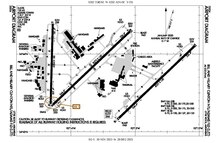 FAA airport diagram | |||||||||||||||||||
 | |||||||||||||||||||
| Runways | |||||||||||||||||||
| |||||||||||||||||||
| Helipads | |||||||||||||||||||
| |||||||||||||||||||
| Statistics (2023) | |||||||||||||||||||
| |||||||||||||||||||
Bill and Hillary Clinton National Airport (IATA: LIT, ICAO: KLIT, FAA LID: LIT), also known as Adams Field, is a joint civil-military airport on the east side of Little Rock, Arkansas, United States.[3][4] It is operated by the Little Rock Municipal Airport Commission.[5]
The largest commercial airport in Arkansas, it served more than 2.1 million passengers in the year spanning from March 2009 through to February 2010.[6] While Clinton National Airport does not have direct international passenger flights, more than 50 flights arrive or depart at Little Rock each day, with nonstop service to 14 cities.[7] The airport is included in the Federal Aviation Administration (FAA) National Plan of Integrated Airport Systems for 2019–2023, in which it is categorized as a small-hub primary commercial service facility.[8]
History[edit]

The airport was originally named Adams Field after Captain George Geyer Adams, 154th Observation Squadron, Arkansas National Guard, who was killed in the line of duty on September 4, 1937.[4] He was a strong advocate for the airport, and also a Little Rock city councilor.
American Airlines was the first airline to serve Little Rock when it first landed at Adams Field on June 19, 1931.[1]
During World War II the airfield was used by the United States Army Air Forces Third Air Force for antisubmarine patrols and training.
In 1972 the airport opened its current 12-gate terminal.[4]
In August 2008, the airport approved a plan to renovate the terminal over a 15-year period. This would expand the terminal from 12 to 16 gates.[9]
On March 20, 2012, the municipal airport commission voted to rename the airport the Bill and Hillary Clinton National Airport, named after Arkansas native, former Governor and United States President Bill Clinton and his wife, United States Secretary of State Hillary Clinton.[10] The name Adams Field will continue to be used when referring to the airport's runways and air traffic, and will be the airport's official designator. In 2017, Republican state Sen. Jason Rapert filed a bill that would have forced the airport's renaming but relented when he found little support for the measure.[11]
In October 2013, Travel + Leisure released a survey of travelers that ranked Clinton National Airport as the worst of the 67 domestic airports considered in the survey. The survey report cited long lines and few food and shopping choices, among other criticisms.[12] A survey commissioned by the airport contradicted Travel + Leisure's claim, finding that more than 90% of passengers were satisfied with their experience.[13]
In March 2024, the Clinton National Airport's executive director Bryan Malinowski died following a shootout with ATF agents after being charged with allegedly selling illegal guns.[14][15]
Facilities and aircraft[edit]

Clinton National Airport covers 2,000 acres (809 ha) at an elevation of 266 feet (81 m) above mean sea level. It has three concrete runways: 4L/22R is 8,273 by 150 feet (2,522 x 46 m); 4R/22L is 8,251 by 150 feet (2,515 x 46 m); 18/36 is 6,224 by 150 feet (1,897 x 46 m). It has one concrete helipad 50 by 50 feet (15 x 15 m).[3][16]
In the year ending February 28, 2023, the airport had 83,217 aircraft operations, an average of 228 per day: 47% general aviation, 26% scheduled commercial, 16% air taxi, and 10% military. The military operations are mostly C-130 transports from nearby Little Rock Air Force Base practicing touch-and-go landings. At that time, 122 aircraft were based at this airport: 42 single-engine, 22 multi-engine, 54 jet, and 4 helicopter.[3]
There are two fixed-base operators (FBOs) on the field: Signature Flight Support and Atlantic Aviation. Central Flying Service, under new ownership, operates on the field offering aircraft maintenance, sales and flight training.
Dassault Aircraft Services (DAS), a subsidiary of Dassault Aviation, operates a large facility at the airport. It is the site of two Falcon aircraft operations: the main Completion Center for all Falcon jets worldwide, and the company-owned Service Center.
Current production model Falcons are manufactured in France, then flown in "green" condition to the Completion Center where optional avionics and custom interiors are installed, and exteriors are painted. Dassault Aircraft Services (DAS) – Little Rock provides inspection, maintenance, modification, completion and repair needs for the Falcon product line.
The Dassault Aircraft Services (DAS) – Little Rock Service Center and Completion Center employs nearly 1,600 people and has a combined occupance of nearly 1,250,000 square feet (116,000 m2), making Little Rock the largest Dassault facility in the world.
Terminal[edit]
The single terminal has twelve gates. Six gates are along the length of the terminal (three on either side) and a rotunda at the end has six more.
Airlines and destinations[edit]
Passenger[edit]
| Airlines | Destinations |
|---|---|
| Allegiant Air | Orlando/Sanford Seasonal: Destin/Fort Walton Beach, Los Angeles, St. Petersburg/Clearwater |
| American Airlines | Charlotte, Dallas/Fort Worth |
| American Eagle | Charlotte, Chicago–O'Hare, Dallas/Fort Worth, New York–LaGuardia, Washington–National Seasonal: Miami |
| Delta Air Lines | Atlanta |
| Delta Connection | New York–LaGuardia |
| Frontier Airlines | Denver |
| Southwest Airlines | Atlanta (ends August 4, 2024), Dallas–Love, Denver, Houston–Hobby, Las Vegas, St. Louis Seasonal: Phoenix–Sky Harbor |
| United Express | Chicago–O'Hare, Denver, Houston–Intercontinental |
| Destinations map |
|---|
  Little Rock Destinations from Clinton National Airport Red = Year-round destination Green = Seasonal destination Blue = Future destination |


Cargo[edit]
| Airline | Destinations |
|---|---|
| UPS Airlines | Dallas/Fort Worth, Louisville, Lubbock, Memphis, Oklahoma City, Ontario, Shreveport |
Statistics[edit]
Top destinations[edit]
| Rank | City | Passengers | Carriers |
|---|---|---|---|
| 1 |  Atlanta, Georgia Atlanta, Georgia
|
254,890 | Delta, Southwest |
| 2 |  Dallas/Fort Worth, Texas Dallas/Fort Worth, Texas
|
180,870 | American |
| 3 |  Denver, Colorado Denver, Colorado
|
117,840 | Frontier, Southwest, United |
| 4 | Dallas–Love Field, Texas
|
112,900 | Southwest |
| 5 |  Charlotte, North Carolina Charlotte, North Carolina
|
94,240 | American |
| 6 |  Chicago–O'Hare, Illinois Chicago–O'Hare, Illinois
|
89,500 | American, United |
| 7 | Houston–Intercontinental, Texas
|
72,190 | United |
| 8 |  St. Louis, Missouri St. Louis, Missouri
|
61,740 | Southwest |
| 9 |  New York–LaGuardia New York–LaGuardia
|
28,760 | American |
| 10 |  Las Vegas, Nevada Las Vegas, Nevada
|
25,090 | Southwest |
Ground transportation[edit]
Rock Region Metro currently provides transit service to the airport via METRO Connect Microtransit.[17][18]
Accidents and incidents[edit]
- On January 19, 1990, an Eastman Kodak Grumman Gulfstream II crashed during final approach to Little Rock National Airport; all seven on board were killed. Unfavorable weather conditions and pilot error contributed to the accident.[19]
- On June 1, 1999, American Airlines Flight 1420, a McDonnell Douglas MD-82 with 145 passengers and crew, attempting to land in a severe thunderstorm, overran the end of runway 4R, crashed through a fence and down a rock embankment into a flood plain; one crewmember and ten passengers were killed.[20]
- On February 22, 2023, a Beechcraft Super King Air took off during gusty winds and heavy rain. Shortly after takeoff, the plane crashed near a 3M plant, killing all five on board. The passengers were members of an environmental firm called CTEH enroute to investigate an explosion at a metal factory in Bedford, Ohio.[21][22]
- On January 21, 2024, a Cirrus SR22 took off from runway 4L and crashed north of the cargo building near Temple Street. The pilot, 62-year-old William Cope, reported a loss of power at take-off and crashed shortly after, at approximately 1:30 PM. He was the only person on board and subsequently died in the crash.[23][24]
Notes[edit]
 This article incorporates public domain material from the Air Force Historical Research Agency

See also[edit]
References[edit]
- ^ a b Dougan, Michael B. (2016). "Aviation". Encyclopedia of Arkansas History & Culture. Central Arkansas Library System. Retrieved January 1, 2018.
- ^ "December 2023 Total Enplanements and Deplanements" (PDF). clintonairport.com. Retrieved January 31, 2024.
- ^ a b c d FAA Airport Form 5010 for LIT PDF. Federal Aviation Administration. effective December 30, 2021.
- ^ a b c "History". Clinton National Airport. Retrieved September 25, 2022.
- ^
- "About LIT". Little Rock National Airport. Archived from the original on April 7, 2012. Retrieved September 25, 2022.
- "LIT – Adams Field". FAA data republished by AirNav. September 20, 2012. Archived from the original on October 18, 2012.
- ^ a b "RITA BTS Transtats – LIT". www.transtats.bts.gov. Retrieved April 29, 2017.
- ^ "Non-Stop Jet Service". Clinton National Airport. Archived from the original on February 18, 2013.
- ^ "NPIAS Report 2019-2023 Appendix A" (PDF). Federal Aviation Administration. October 3, 2018. p. 17. Retrieved October 12, 2018.
- ^ "LR airport terminal OK'd for redesign". Arkansas Democrat-Gazette. August 20, 2008. Archived from the original on February 17, 2019. Retrieved August 20, 2008.
- ^
- "Bulletin: Clinton Airport Dedication". Bill and Hillary Clinton National Airport. Archived from the original on March 15, 2013. Retrieved July 23, 2013.
- "Panel OKs renaming airport after Clintons". Arkansas Democrat-Gazette. March 20, 2012.
- ^ Brantley, Max (March 17, 2017). "Rapert folds on renaming Bill and Hillary Clinton National Airport". Arkansas Times. Retrieved February 24, 2023.
- ^
- "America's Worst Airports: No. 1 Bill and Hillary Clinton National Airport, Little Rock, AR (LIT)". Travel + Leisure, October 2013.
- Hibblen, Michael. "Little Rock Airport Ranked Worst In The Nation". UALR Public Radio, October 28, 2013. At the time of the ranking, the airport was undergoing the largest renovation in its history.
- ^ "Passenger Satisfaction Flying High at Clinton National Airport". KLRT-TV. May 5, 2015. Archived from the original on August 15, 2016. Retrieved August 28, 2018.
- ^ Limestone, Jonathan (March 22, 2024). "Airport exec dies after shootout with feds at Arkansas home; affidavit alleges illegal gun sales". USA Today. Retrieved March 22, 2024.
- ^ "Bryan Malinowski, C.M.:Executive Director (2019-2024)". Clinton National Airport. Retrieved March 22, 2024.
- ^ "LIT airport data at skyvector.com". skyvector.com. Retrieved September 5, 2022.
- ^ "METRO Connect Zones & Hours". Rock Region METRO. Retrieved February 18, 2024..
- ^ "System Map". Retrieved February 18, 2024..
- ^ Ranter, Harro. "ASN Aircraft accident Gulfstream American G-1159 Gulfstream II N46TE Little Rock National Airport, AR (LIT)". aviation-safety.net. Retrieved June 4, 2019.
- ^ Ranter, Harro. "ASN Aircraft accident McDonnell Douglas DC-9-82 (MD-82) N215AA Little Rock National Airport, AR (LIT)". aviation-safety.net.
- ^ Digital, THV11 (February 22, 2023). "Five people dead after plane crash near Little Rock 3M plant". thv11.com. Retrieved February 24, 2023.
{{cite web}}: CS1 maint: numeric names: authors list (link) - ^ Accident description for N55PC at the Aviation Safety Network. Retrieved on February 24, 2023.
- ^ "One person dead after plane crashes at Little Rock airport, LRFD confirms". thv11.com. January 21, 2024. Retrieved January 26, 2024.
- ^ "FAA Accident and Incident Notice". Federal Aviation Administration. January 22, 2024.
External links[edit]

- Government

- General information
- Aerial image as of March 2001[permanent dead link] from USGS The National Map
- Airfield photos from U.S. Civil Air Patrol at the Wayback Machine (archived September 23, 2006)
- FAA Airport Diagram (PDF), effective April 18, 2024
- FAA Terminal Procedures for LIT, effective April 18, 2024
- Resources for this airport:
- AirNav airport information for KLIT
- ASN accident history for LIT
- FlightAware airport information and live flight tracker
- NOAA/NWS weather observations: current, past three days
- SkyVector aeronautical chart for KLIT
- FAA current LIT delay information


| ||||||||||
| Presidency (timeline) |
|   | ||||||||
| Life and legacy |
| |||||||||
| Speeches | ||||||||||
| Elections |
| |||||||||
| Books | ||||||||||
| Namesakes | ||||||||||
| Popular culture |
| |||||||||
| Family |
| |||||||||
| |||||||
| Secretary of State |  | ||||||
| US senator | |||||||
| First Lady |
| ||||||
| Arkansas | |||||||
| Philanthropic | |||||||
| Speeches and policies | |||||||
| Writings | |||||||
| Electoral history |
| ||||||
| Legacy | |||||||
| Popular culture | |||||||
| Family |
| ||||||
| Other |
| ||||||


| International | |
|---|---|
| National | |
- 1931 establishments in Arkansas
- Airfields of the United States Army Air Forces Air Transport Command in North America
- Airfields of the United States Army Air Forces in Arkansas
- Airports established in 1931
- Airports in Arkansas
- Government buildings in Little Rock, Arkansas
- Transportation in Little Rock, Arkansas