


Mangrove
.JPG)
A mangrove is a shrub or tree that grows mainly in coastal saline or brackish water. Mangroves grow in an equatorial climate, typically along coastlines and tidal rivers. They have particular adaptations to take in extra oxygen and remove salt, allowing them to tolerate conditions that kill most plants. The term is also used for tropical coastal vegetation consisting of such species. Mangroves are taxonomically diverse due to convergent evolution in several plant families. They occur worldwide in the tropics and subtropics and even some temperate coastal areas, mainly between latitudes 30° N and 30° S, with the greatest mangrove area within 5° of the equator.[1][2] Mangrove plant families first appeared during the Late Cretaceous to Paleocene epochs and became widely distributed in part due to the movement of tectonic plates. The oldest known fossils of mangrove palm date to 75 million years ago.[2]
Mangroves are salt-tolerant (halophytic) and are adapted to live in harsh coastal conditions. They contain a complex salt filtration system and a complex root system to cope with saltwater immersion and wave action. They are adapted to the low-oxygen conditions of waterlogged mud,[3] but are most likely to thrive in the upper half of the intertidal zone.[4]
The mangrove biome, often called the mangrove forest or mangal, is a distinct saline woodland or shrubland habitat characterized by depositional coastal environments, where fine sediments (often with high organic content) collect in areas protected from high-energy wave action. Mangrove forests serve as vital habitats for a diverse array of aquatic species, offering a unique ecosystem that supports the intricate interplay of marine life and terrestrial vegetation. The saline conditions tolerated by various mangrove species range from brackish water, through pure seawater (3 to 4% salinity), to water concentrated by evaporation to over twice the salinity of ocean seawater (up to 9% salinity).[5][6]
Beginning in 2010, remote sensing technologies and global data have been used to assess areas, conditions and deforestation rates of mangroves around the world.[7][1][2] In 2018, the Global Mangrove Watch Initiative released a new global baseline which estimates the total mangrove forest area of the world as of 2010 at 137,600 km2 (53,100 sq mi), spanning 118 countries and territories.[2][7] A 2022 study on losses and gains of tidal wetlands estimates a 3,700 km2 (1,400 sq mi) net decrease in global mangrove extent from 1999 to 2019.[8] Mangrove loss continues due to human activity, with a global annual deforestation rate estimated at 0.16%, and per-country rates as high as 0.70%. Degradation in quality of remaining mangroves is also an important concern.[2]
There is interest in mangrove restoration for several reasons. Mangroves support sustainable coastal and marine ecosystems. They protect nearby areas from tsunamis and extreme weather events. Mangrove forests are also effective at carbon sequestration and storage.[2][9][10] The success of mangrove restoration may depend heavily on engagement with local stakeholders, and on careful assessment to ensure that growing conditions will be suitable for the species chosen.[4]
The International Day for the Conservation of the Mangrove Ecosystem is celebrated every year on 26 July.[11]
Etymology
[edit]

Etymology of the English term mangrove can only be speculative and is disputed.[12]: 1–2 [13] The term may have come to English from the Portuguese mangue or the Spanish mangle.[13] Further back, it may be traced to South America and Cariban and Arawakan languages[14] such as Taíno.[15] Other possibilities include the Malay language manggi-manggi[13][12] The English usage may reflect a corruption via folk etymology of the words mangrow and grove.[14][12][16]
The word "mangrove" is used in at least three senses:
- Most broadly to refer to the habitat and entire plant assemblage or mangal,[13][17] for which the terms mangrove forest biome and mangrove swamp are also used;
- To refer to all trees and large shrubs in a mangrove swamp;[13] and
- Narrowly to refer only to mangrove trees of the genus Rhizophora of the family Rhizophoraceae.[18]
Biology
[edit]According to Hogarth (2015), among the recognized mangrove species there are about 70 species in 20 genera from 16 families that constitute the "true mangroves" – species that occur almost exclusively in mangrove habitats.[17] Demonstrating convergent evolution, many of these species found similar solutions to the tropical conditions of variable salinity, tidal range (inundation), anaerobic soils, and intense sunlight. Plant biodiversity is generally low in a given mangrove.[19] The greatest biodiversity of mangroves occurs in Southeast Asia, particularly in the Indonesian archipelago.[20]
.jpg)
Adaptations to low oxygen
[edit]The red mangrove (Rhizophora mangle) survives in the most inundated areas, props itself above the water level with stilt or prop roots and then absorbs air through lenticels in its bark.[21] The black mangrove (Avicennia germinans) lives on higher ground and develops many specialized root-like structures called pneumatophores, which stick up out of the soil like straws for breathing.[22][23] These "breathing tubes" typically reach heights of up to 30 cm (12 in), and in some species, over 3 m (9.8 ft). The roots also contain wide aerenchyma to facilitate transport within the plants.[citation needed]
Nutrient uptake
[edit]Because the soil is perpetually waterlogged, little free oxygen is available. Anaerobic bacteria liberate nitrogen gas, soluble ferrum (iron), inorganic phosphates, sulfides, and methane, which make the soil much less nutritious.[citation needed] Pneumatophores (aerial roots) allow mangroves to absorb gases directly from the atmosphere, and other nutrients such as iron, from the inhospitable soil. Mangroves store gases directly inside the roots, processing them even when the roots are submerged during high tide.

Limiting salt intake
[edit]Red mangroves exclude salt by having significantly impermeable roots that are highly suberised (impregnated with suberin), acting as an ultrafiltration mechanism to exclude sodium salts from the rest of the plant.[citation needed] One study found that roots of the Indian mangrove Avicennia officinalis exclude 90% to 95% of the salt in water taken up by the plant, depositing the excluded salt in the cortex of the root. An increase in the production of suberin and in the activity of a gene regulating cytochrome P450 were observed in correlation with an increase in the salinity of the water to which the plant was exposed.[24] In a frequently cited concept that has become known as the "sacrificial leaf", salt which does accumulate in the shoot (sprout) then concentrates in old leaves, which the plant then sheds. However, recent research on the Red mangrove Rhizophora mangle suggests that the older, yellowing leaves have no more measurable salt content than the other, greener leaves.[25]
-
 Pneumatophorous aerial roots of the grey mangrove (Avicennia marina)
 -
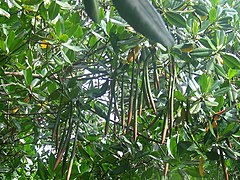 Vivipary in Rhizophora mangle seeds

.jpg)
Limiting water loss
[edit]
Because of the limited fresh water available in salty intertidal soils, mangroves limit the amount of water they lose through their leaves. They can restrict the opening of their stomata (pores on the leaf surfaces, which exchange carbon dioxide gas and water vapor during photosynthesis). They also vary the orientation of their leaves to avoid the harsh midday sun and so reduce evaporation from the leaves. A captive red mangrove grows only if its leaves are misted with fresh water several times a week, simulating frequent tropical rainstorms.[27]
Filtration of seawater
[edit]A 2016 study by Kim et al. investigated the biophysical characteristics of sea water filtration in the roots of the mangrove Rhizophora stylosa from a plant hydrodynamic point of view. R. stylosa can grow even in saline water and the salt level in its roots is regulated within a certain threshold value through filtration. The root possesses a hierarchical, triple layered pore structure in the epidermis and most Na+ ions are filtered at the first sublayer of the outermost layer. The high blockage of Na+ ions is attributed to the high surface zeta potential of the first layer. The second layer, which is composed of macroporous structures, also facilitates Na+ ion filtration. The study provides insights into the mechanism underlying water filtration through halophyte roots and could serve as a basis for the development of a bio-inspired method of desalination.[26]
Uptake of Na+ ions is desirable for halophytes to build up osmotic potential, absorb water and sustain turgor pressure. However, excess Na+ ions may work on toxic element. Therefore, halophytes try to adjust salinity delicately between growth and survival strategies. In this point of view, a novel sustainable desalination method can be derived from halophytes, which are in contact with saline water through their roots. Halophytes exclude salt through their roots, secrete the accumulated salt through their aerial parts and sequester salt in senescent leaves and/or the bark.[28][29][30] Mangroves are facultative halophytes and Bruguiera is known for its special ultrafiltration system that can filter approximately 90% of Na+ions from the surrounding seawater through the roots.[31][32][33] The species also exhibits a high rate of salt rejection. The water-filtering process in mangrove roots has received considerable attention for several decades.[34][35] Morphological structures of plants and their functions have been evolved through a long history to survive against harsh environmental conditions.[36][26]
Increasing survival of offspring
[edit].jpg)
 |
In this harsh environment, mangroves have evolved a special mechanism to help their offspring survive. Mangrove seeds are buoyant and are therefore suited to water dispersal. Unlike most plants, whose seeds germinate in soil, many mangroves (e.g. red mangrove) are viviparous,[37] meaning their seeds germinate while still attached to the parent tree. Once germinated, the seedling grows either within the fruit (e.g. Aegialitis, Avicennia and Aegiceras), or out through the fruit (e.g. Rhizophora, Ceriops, Bruguiera and Nypa) to form a propagule (a ready-to-go seedling) which can produce its own food via photosynthesis.
The mature propagule then drops into the water, which can transport it great distances. Propagules can survive desiccation and remain dormant for over a year before arriving in a suitable environment. Once a propagule is ready to root, its density changes so that the elongated shape now floats vertically rather than horizontally. In this position, it is more likely to lodge in the mud and root. If it does not root, it can alter its density and drift again in search of more favorable conditions.
Taxonomy and evolution
[edit]The following listings, based on Tomlinson, 2016, give the mangrove species in each listed plant genus and family.[38] Mangrove environments in the Eastern Hemisphere harbor six times as many species of trees and shrubs as do mangroves in the New World. Genetic divergence of mangrove lineages from terrestrial relatives, in combination with fossil evidence, suggests mangrove diversity is limited by evolutionary transition into the stressful marine environment, and the number of mangrove lineages has increased steadily over the Tertiary with little global extinction.[39]
True mangroves
[edit]| True mangroves (major components or strict mangroves) | ||||
|---|---|---|---|---|
| Following Tomlinson, 2016, the following 35 species are the true mangroves, contained in 5 families and 9 genera[38]: 29–30 Included on green backgrounds are annotations about the genera made by Tomlinson | ||||
| Family | Genus | Mangrove species | Common name | |
| Arecaceae | Monotypic subfamily within the family | |||
| Nypa | Nypa fruticans | Mangrove palm | 
| |
| Avicenniaceae (disputed) |
Old monogeneric family, now subsumed in Acanthaceae, but clearly isolated | |||
| Avicennia | Avicennia alba | 
| ||
| Avicennia balanophora | ||||
| Avicennia bicolor | ||||
| Avicennia integra | ||||
| Avicennia marina | grey mangrove (subspecies: australasica, eucalyptifolia, rumphiana) |
.jpg)
| ||
| Avicennia officinalis | Indian mangrove | .jpg)
| ||
| Avicennia germinans | black mangrove | 
| ||
| Avicennia schaueriana | 
| |||
| Avicennia tonduzii | ||||
| Combretaceae | Tribe Lagunculariae (including Macropteranthes = non-mangrove) | |||
| Laguncularia | Laguncularia racemosa | white mangrove | 
| |
| Lumnitzera | Lumnitzera racemosa | white-flowered black mangrove | .jpg)
| |
| Lumnitzera littorea | 
| |||
| Rhizophoraceae | Rhizophoraceae collectively form the tribe Rhizophorae, a monotypic group, within the otherwise terrestrial family | |||
| Bruguiera | Bruguiera cylindrica | 
| ||
| Bruguiera exaristata | rib-fruited mangrove | 
| ||
| Bruguiera gymnorhiza | oriental mangrove | 
| ||
| Bruguiera hainesii | ||||
| Bruguiera parviflora | 
| |||
| Bruguiera sexangula | upriver orange mangrove | 
| ||
| Ceriops | Ceriops australis | yellow mangrove | 
| |
| Ceriops tagal | spurred mangrove | 
| ||
| Kandelia | Kandelia candel | 
| ||
| Kandelia obovata | _Kandelia_obovata_-%E9%A6%99%E6%B8%AF%E5%A4%A7%E5%9F%94%E6%BB%98%E7%99%BD%E9%B7%BA%E6%B9%96_Lake_Egret_Park,_Hong_Kong-_(9240150714).jpg)
| |||
| Rhizophora | Rhizophora apiculata | |||
| Rhizophora harrisonii | ||||
| Rhizophora mangle | red mangrove | |||
| Rhizophora mucronata | Asiatic mangrove | 
| ||
| Rhizophora racemosa | ||||
| Rhizophora samoensis | Samoan mangrove | |||
| Rhizophora stylosa | spotted mangrove, | |||
| Rhizophora x lamarckii | ||||
| Lythraceae | Sonneratia | Sonneratia alba | .jpg)
| |
| Sonneratia apetala | ||||
| Sonneratia caseolaris | ||||
| Sonneratia ovata | ||||
| Sonneratia griffithii | ||||
Other mangroves
[edit]| Minor components | ||||
|---|---|---|---|---|
| Tomlinson, 2016, lists about 19 species as minor mangrove components, contained in 10 families and 11 genera[38]: 29–30 Included on green backgrounds are annotations about the genera made by Tomlinson | ||||
| Family | Genus | Species | Common name | |
| Euphorbiaceae | This genus includes about 35 non-mangrove taxa | |||
| Excoecaria | Excoecaria agallocha | milky mangrove, blind-your-eye mangrove and river poison tree | _W_IMG_6929.jpg)
| |
| Lythraceae | Genus distinct in the family | |||
| Pemphis | Pemphis acidula | bantigue or mentigi | 
| |
| Malvaceae | Formerly in Bombacaceae, now an isolated genus in subfamily Bombacoideeae | |||
| Camptostemon | Camptostemon schultzii | kapok mangrove | 
| |
| Camptostemon philippinense | 
| |||
| Meliaceae | Genus of 3 species, one non-mangrove, forms tribe Xylocarpaeae with Carapa, a non–mangrove | |||
| Xylocarpus | Xylocarpus granatum | 
| ||
| Xylocarpus moluccensis | 
| |||
| Myrtaceae | An isolated genus in the family | |||
| Osbornia | Osbornia octodonta | mangrove myrtle | 
| |
| Pellicieraceae | Monotypic genus and family of uncertain phylogenetic position | |||
| Pelliciera | Pelliciera rhizophorae | tea mangrove | 
| |
| Plumbaginaceae | Isolated genus, at times segregated as family Aegialitidaceae | |||
| Aegialitis | Aegialitis annulata | club mangrove | 
| |
| Aegialitis rotundifolia | 
| |||
| Primulaceae | Formerly an isolated genus in Myrsinaceae | |||
| Aegiceras | Aegiceras corniculatum | black mangrove, river mangrove or khalsi | 
| |
| Aegiceras floridum | ||||
| Pteridaceae | A fern somewhat isolated in its family | |||
| Acrostichum | Acrostichum aureum | golden leather fern, swamp fern or mangrove fern | 
| |
| Acrostichum speciosum | mangrove fern | 
| ||
| Rubiaceae | A genus isolated in the family | |||
| Scyphiphora | Scyphiphora hydrophylacea | nilad | 
| |
Species distribution
[edit]
Mangroves are a type of tropical vegetation with some outliers established in subtropical latitudes, notably in South Florida and southern Japan, as well as South Africa, New Zealand and Victoria (Australia). These outliers result either from unbroken coastlines and island chains or from reliable supplies of propagules floating on warm ocean currents from rich mangrove regions.[38]: 57


"At the limits of distribution, the formation is represented by scrubby, usually monotypic Avicennia-dominated vegetation, as at Westonport Bay and Corner Inlet, Victoria, Australia. The latter locality is the highest latitude (38° 45'S) at which mangroves occur naturally. The mangroves in New Zealand, which extend as far south as 37°, are of the same type; they start as low forest in the northern part of the North Island but become low scrub toward their southern limit. In both instances, the species is referred to as Avicennia marina var. australis, although genetic comparison is clearly needed. In Western Australia, A. marina extends as far south as Bunbury (33° 19'S). In the northern hemisphere, scrubby Avicennia gerrninans in Florida occurs as far north as St. Augustine on the east coast and Cedar Point on the west. There are records of A. germinans and Rhizophora mangle for Bermuda, presumably supplied by the Gulf Stream. In southern Japan, Kandelia obovata occurs to about 31 °N (Tagawa in Hosakawa et al., 1977, but initially referred to as K. candel)."[38]: 57
Mangrove forests
[edit]
Mangrove forests, also called mangrove swamps or mangals, are found in tropical and subtropical tidal areas. Areas where mangroves occur include estuaries and marine shorelines.[19]
The intertidal existence to which these trees are adapted represents the major limitation to the number of species able to thrive in their habitat. High tide brings in salt water, and when the tide recedes, solar evaporation of the seawater in the soil leads to further increases in salinity. The return of tide can flush out these soils, bringing them back to salinity levels comparable to that of seawater.[2][4]
At low tide, organisms are also exposed to increases in temperature and reduced moisture before being then cooled and flooded by the tide. Thus, for a plant to survive in this environment, it must tolerate broad ranges of salinity, temperature, and moisture, as well as several other key environmental factors—thus only a select few species make up the mangrove tree community.[2][4]
About 110 species are considered mangroves, in the sense of being trees that grow in such a saline swamp,[19] though only a few are from the mangrove plant genus, Rhizophora. However, a given mangrove swamp typically features only a small number of tree species. It is not uncommon for a mangrove forest in the Caribbean to feature only three or four tree species. For comparison, the tropical rainforest biome contains thousands of tree species, but this is not to say mangrove forests lack diversity. Though the trees themselves are few in species, the ecosystem that these trees create provides a home (habitat) for a great variety of other species, including as many as 174 species of marine megafauna.[42]

Mangrove plants require a number of physiological adaptations to overcome the problems of low environmental oxygen levels, high salinity, and frequent tidal flooding. Each species has its own solutions to these problems; this may be the primary reason why, on some shorelines, mangrove tree species show distinct zonation. Small environmental variations within a mangal may lead to greatly differing methods for coping with the environment. Therefore, the mix of species is partly determined by the tolerances of individual species to physical conditions, such as tidal flooding and salinity, but may also be influenced by other factors, such as crabs preying on plant seedlings.[43]

Once established, mangrove roots provide an oyster habitat and slow water flow, thereby enhancing sediment deposition in areas where it is already occurring. The fine, anoxic sediments under mangroves act as sinks for a variety of heavy (trace) metals which colloidal particles in the sediments have concentrated from the water. Mangrove removal disturbs these underlying sediments, often creating problems of trace metal contamination of seawater and organisms of the area.[44]
Mangrove swamps protect coastal areas from erosion, storm surge (especially during tropical cyclones), and tsunamis.[45][46][47] They limit high-energy wave erosion mainly during events such as storm surges and tsunamis.[48] The mangroves' massive root systems are efficient at dissipating wave energy.[49] Likewise, they slow down tidal water so that its sediment is deposited as the tide comes in, leaving all except fine particles when the tide ebbs.[50] In this way, mangroves build their environments.[45] Because of the uniqueness of mangrove ecosystems and the protection against erosion they provide, they are often the object of conservation programs,[4] including national biodiversity action plans.[46]
The unique ecosystem found in the intricate mesh of mangrove roots offers a quiet marine habitat for young organisms.[51] In areas where roots are permanently submerged, the organisms they host include algae, barnacles, oysters, sponges, and bryozoans, which all require a hard surface for anchoring while they filter-feed. Shrimps and mud lobsters use the muddy bottoms as their home.[52] Mangrove crabs eat the mangrove leaves, adding nutrients to the mangal mud for other bottom feeders.[53] In at least some cases, the export of carbon fixed in mangroves is important in coastal food webs.[54]
Mangrove forests contribute significantly to coastal ecosystems by fostering complex and diverse food webs. The intricate root systems of mangroves create a habitat conducive to the proliferation of microorganisms, crustaceans, and small fish, forming the foundational tiers of the food chain. This abundance of organisms serves as a critical food source for larger predators like birds, reptiles, and mammals within the ecosystem. Additionally, mangrove forests function as essential nurseries for many commercially important fish species, providing a sheltered environment rich in nutrients during their early life stages. The decomposition of leaves and organic matter in the water further enhances the nutrient content, supporting overall ecosystem productivity. In summary, mangrove forests play a crucial and unbiased role in sustaining biodiversity and ecological balance within coastal food webs.[55]
Larger marine organisms benefit from the habitat as a nursery for their offspring. Lemon sharks depend on mangrove creeks to give birth to their pups. The ecosystem provides little competition and minimizes threats of predation to juvenile lemon sharks as they use the cover of mangroves to practice hunting before entering the food web of the ocean.[56]
Mangrove plantations in Vietnam, Thailand, Philippines, and India host several commercially important species of fish and crustaceans.[57]
The mangrove food chain extends beyond the marine ecosystem. Coastal bird species inhabit the tidal ecosystems feeding off small marine organisms and wetland insects. Common bird families found in mangroves around the world are egrets, kingfishers, herons, and hornbills, among many others dependent on ecological range.[58] Bird predation plays a key role in maintaining prey species along coastlines and within mangrove ecosystems.
Mangrove forests can decay into peat deposits because of fungal and bacterial processes as well as by the action of termites. It becomes peat in good geochemical, sedimentary, and tectonic conditions.[59] The nature of these deposits depends on the environment and the types of mangroves involved. In Puerto Rico, the red, white, and black mangroves occupy different ecological niches and have slightly different chemical compositions, so the carbon content varies between the species, as well between the different tissues of the plant (e.g., leaf matter versus roots).[59]
In Puerto Rico, there is a clear succession of these three trees from the lower elevations, which are dominated by red mangroves, to farther inland with a higher concentration of white mangroves.[59] Mangrove forests are an important part of the cycling and storage of carbon in tropical coastal ecosystems.[59] Knowing this, scientists seek to reconstruct the environment and investigate changes to the coastal ecosystem over thousands of years using sediment cores.[60] However, an additional complication is the imported marine organic matter that also gets deposited in the sediment due to the tidal flushing of mangrove forests. Termites play an important role in the formation of peat from mangrove materials.[59] They process fallen leaf litter, root systems and wood from mangroves into peat to build their nests, and stabilise the chemistry of this peat that represents approximately 2% of above ground carbon storage in mangroves. As the nests are buried over time this carbon is stored in the sediment and the carbon cycle continues.[59]
Mangroves are an important source of blue carbon. Globally, mangroves stored 4.19 Gt (9.2×10¹² lb) of carbon in 2012. Two percent of global mangrove carbon was lost between 2000 and 2012, equivalent to a maximum potential of 0.316996250 Gt (6.9885710×10¹¹ lb) of emissions of carbon dioxide in Earth's atmosphere.[61]
Globally, mangroves have been shown to provide measurable economic protections to coastal communities affected by tropical storms.[62]
Mangrove microbiome
[edit]Plant microbiomes play crucial roles in the health and productivity of mangroves.[63] Many researchers have successfully applied knowledge acquired about plant microbiomes to produce specific inocula for crop protection.[64][65] Such inocula can stimulate plant growth by releasing phytohormones and enhancing uptake of some mineral nutrients (particularly phosphorus and nitrogen).[65][66][67] However, most of the plant microbiome studies have focused on the model plant Arabidopsis thaliana and economically important crop plants, such as rice, barley, wheat, maize and soybean. There is less information on the microbiomes of tree species.[63][65] Plant microbiomes are determined by plant-related factors (e.g., genotype, organ, species, and health status) and environmental factors (e.g., land use, climate, and nutrient availability).[63][67] Two of the plant-related factors, plant species, and genotypes, have been shown to play significant roles in shaping rhizosphere and plant microbiomes, as tree genotypes and species are associated with specific microbial communities.[66] Different plant organs also have specific microbial communities depending on plant-associated factors (plant genotype, available nutrients, and organ-specific physicochemical conditions) and environmental conditions (associated with aboveground and underground surfaces and disturbances).[68][69][70][71]
Root microbiome
[edit]
Mangrove roots harbour a repertoire of microbial taxa that contribute to important ecological functions in mangrove ecosystems. Like typical terrestrial plants, mangroves depend upon mutually beneficial interactions with microbial communities.[72] In particular, microbes residing in developed roots could help mangroves transform nutrients into usable forms before plant assimilation.[73][74] These microbes also provide mangroves phytohormones for suppressing phytopathogens[75] or helping mangroves withstand heat and salinity.[72] In turn, root-associated microbes receive carbon metabolites from the plant via root exudates,[76] thus close associations between the plant and microbes are established for their mutual benefits.[77][78]
The taxonomic class level shows that most Proteobacteria were reported to come from Gammaproteobacteria, followed by Deltaproteobacteria and Alphaproteobacteria. The diverse function and the phylogenic variation of Gammaproteobacteria, which consisted of orders such as Alteromonadales and Vibrionales, are found in marine and coastal regions and are high in abundance in mangrove sediments functioning as nutrient recyclers. Members of Deltaproteobacteria found in mangrove soil are mostly sulfur-related, consisting of Desulfobacterales, Desulfuromonadales, Desulfovibrionales, and Desulfarculales among others.[79] Highly diverse microbial communities (mainly bacteria and fungi) have been found to inhabit and function in mangrove roots.[80][72][81] For example, diazotrophic bacteria in the vicinity of mangrove roots could perform biological nitrogen fixation, which provides 40–60% of the total nitrogen required by mangroves;[82][83] the soil attached to mangrove roots lacks oxygen but is rich in organic matter, providing an optimal microenvironment for sulfate-reducing bacteria and methanogens,[72] ligninolytic, cellulolytic, and amylolytic fungi are prevalent in the mangrove root environment;[72] rhizosphere fungi could help mangroves survive in waterlogged and nutrient-restricted environments.[84] These studies have provided increasing evidence to support the importance of root-associated bacteria and fungi for mangrove growth and health.[72][73][78]
Recent studies have investigated the detailed structure of root-associated microbial communities at a continuous fine-scale in other plants,[85] where a microhabitat was divided into four root compartments: endosphere,[75][86][87] episphere,[75] rhizosphere,[86][88] and nonrhizosphere or bulk soil.[89][90] Moreover, the microbial communities in each compartment have been reported to have unique characteristics.[75][86] Root exudates selectively enrich adapted microbial populations; however, these exudates were found to exert only marginal impacts on microbes in the bulk soil outside the rhizosphere .[91][77] Furthermore, it was noted that the root episphere, rather than the rhizosphere, was primarily responsible for controlling the entry of specific microbial populations into the root,[75] resulting in the selective enrichment of Proteobacteria in the endosphere.[75][92] These findings provide new insights into the niche differentiation of root-associated microbial communities,[75][91][77][92] Nevertheless, amplicon-based community profiling may not provide the functional characteristics of root-associated microbial communities in plant growth and biogeochemical cycling.[93] Unraveling functional patterns across the four root compartments holds a great potential for understanding functional mechanisms responsible for mediating root–microbe interactions in support of enhancing mangrove ecosystem functioning.[78]
The diversity of bacteria in disturbed mangroves is reported to be higher than in well-preserved mangroves[79] Studies comparing mangroves in different conservation states show that bacterial composition in disturbed mangrove sediment alters its structure, leading to a functional equilibrium, where the dynamics of chemicals in mangrove soils lead to the remodeling of its microbial structure.[94]
Suggestions for future mangrove microbial diversity research
[edit]Despite many research advancements in mangrove sediment bacterial metagenomics diversity in various conditions over the past few years, bridging the research gap and expanding our knowledge towards the relationship between microbes mainly constituted of bacteria and its nutrient cycles in the mangrove sediment and direct and indirect impacts on mangrove growth and stand-structures as coastal barriers and other ecological service providers. Thus, based on studies by Lai et al.'s systematic review, here they suggest sampling improvements and a fundamental environmental index for future reference.[79]
Mangrove virome
[edit]

Mangrove forests are one of the most carbon-rich biomes, accounting for 11% of the total input of terrestrial carbon into oceans. Viruses are thought to significantly influence local and global biogeochemical cycles, though as of 2019 little information was available about the community structure, genetic diversity and ecological roles of viruses in mangrove ecosystems.[95]
Viruses are the most abundant biological entities on earth, present in virtually all ecosystems.[96][97] By lysing their hosts, that is, by rupturing their cell membranes, viruses control host abundance and affect the structure of host communities.[98] Viruses also influence their host diversity and evolution through horizontal gene transfer, selection for resistance and manipulation of bacterial metabolisms.[99][100][101] Importantly, marine viruses affect local and global biogeochemical cycles through the release of substantial amounts of organic carbon and nutrients from hosts and assist microbes in driving biogeochemical cycles with auxiliary metabolic genes (AMGs).[102][103][104][95]
It is presumed AMGs augment viral-infected host metabolism and facilitate the production of new viruses.[99][105] AMGs have been extensively explored in marine cyanophages and include genes involved in photosynthesis, carbon turnover, phosphate uptake and stress response.[106][107][108][109] Cultivation-independent metagenomic analysis of viral communities has identified additional AMGs that are involved in motility, central carbon metabolism, photosystem I, energy metabolism, iron–sulphur clusters, anti-oxidation and sulphur and nitrogen cycling.[103][110][111][112] Interestingly, a recent analysis of Pacific Ocean Virome data identified niche-specialised AMGs that contribute to depth-stratified host adaptations.[113] Given that microbes drive global biogeochemical cycles, and a large fraction of microbes is infected by viruses at any given time,[114] viral-encoded AMGs must play important roles in global biogeochemistry and microbial metabolic evolution.[95]
Mangrove forests are the only woody halophytes that live in salt water along the world's subtropical and tropical coastlines. Mangroves are one of the most productive and ecologically important ecosystems on earth. The rates of primary production of mangroves equal those of tropical humid evergreen forests and coral reefs.[115] As a globally relevant component of the carbon cycle, mangroves sequester approximately 24 million metric tons of carbon each year.[115][116] Most mangrove carbon is stored in soil and sizable belowground pools of dead roots, aiding in the conservation and recycling of nutrients beneath forests.[117] Although mangroves cover only 0.5% of the earth's coastal area, they account for 10–15% of the coastal sediment carbon storage and 10–11% of the total input of terrestrial carbon into oceans.[118] The disproportionate contribution of mangroves to carbon sequestration is now perceived as an important means to counterbalance greenhouse gas emissions.[95]

Despite the ecological importance of mangrove ecosystem, knowledge on mangrove biodiversity is notably limited. Previous reports mainly investigated the biodiversity of mangrove fauna, flora and bacterial communities.[120][121][122] Particularly, little information is available about viral communities and their roles in mangrove soil ecosystems.[123][124] In view of the importance of viruses in structuring and regulating host communities and mediating element biogeochemical cycles, exploring viral communities in mangrove ecosystems is essential. Additionally, the intermittent flooding of sea water and resulting sharp transition of mangrove environments may result in substantially different genetic and functional diversity of bacterial and viral communities in mangrove soils compared with those of other systems.[125][95]
Genome sequencing
[edit]- Rhizophoreae as revealed by whole-genome sequencing[126]
See also
[edit]
References
[edit]- ^ a b c Giri, C.; Ochieng, E.; Tieszen, L. L.; Zhu, Z.; Singh, A.; Loveland, T.; Masek, J.; Duke, N. (2011). "Status and distribution of mangrove forests of the world using earth observation satellite data: Status and distributions of global mangroves". Global Ecology and Biogeography. 20 (1): 154–159. doi:10.1111/j.1466-8238.2010.00584.x.
- ^ a b c d e f g h Friess, D. A.; Rogers, K.; Lovelock, C. E.; Krauss, K. W.; Hamilton, S. E.; Lee, S. Y.; Lucas, R.; Primavera, J.; Rajkaran, A.; Shi, S. (2019). "The State of the World's Mangrove Forests: Past, Present, and Future". Annual Review of Environment and Resources. 44 (1): 89–115. doi:10.1146/annurev-environ-101718-033302.
- ^ Flowers, T. J.; Colmer, T. D. (2015). "Plant salt tolerance: adaptations in halophytes". Annals of Botany. 115 (3): 327–331. doi:10.1093/aob/mcu267. PMC 4332615. PMID 25844430.
- ^ a b c d e Zimmer, Katarina (22 July 2021). "Many mangrove restorations fail. Is there a better way?". Knowable Magazine. doi:10.1146/knowable-072221-1. Retrieved 11 August 2021.
- ^ "Morphological and Physiological Adaptations: Florida mangrove website". Nhmi.org. Archived from the original on 4 February 2012. Retrieved 8 February 2012.
- ^ Primavera, J. H.; Savaris, J. P.; Bajoyo, B. E.; Coching, J. D.; Curnick, D. J.; Golbeque, R. L.; Guzman, A. T.; Henderin, J. Q.; Joven, R. V.; Loma, R. A.; Koldewey, H. J. (2012). Manual on community-based mangrove rehabilitation (PDF). Mangrove Manual. The Zoological Society of London ZSL. Archived from the original (PDF) on 1 January 2016. Retrieved 15 August 2021.
- ^ a b Bunting, P.; Rosenqvist, A.; Lucas, R.; Rebelo, L.-M.; Hilarides, L.; Thomas, N.; Hardy, A.; Itoh, T.; Shimada, M.; Finlayson, C. (2018). "The Global Mangrove Watch—A New 2010 Global Baseline of Mangrove Extent". Remote Sensing. 10 (10): 1669. Bibcode:2018RemS...10.1669B. doi:10.3390/rs10101669.
- ^ Murray, N. J.; Worthington, T. A.; Bunting, P.; Duce, S.; Hagger, V.; Lovelock, C. E.; Lucas, R.; Saunders, M. I.; Sheaves, M.; Spalding, M.; Waltham, N. J.; Lyons, M. B. (2022). "High-resolution mapping of losses and gains of Earth's tidal wetlands". Science. 376 (6594): 744–749. Bibcode:2022Sci...376..744M. doi:10.1126/science.abm9583. hdl:2160/55fdc0d4-aa3e-433f-8a88-2098b1372ac5. PMID 35549414. S2CID 248749118.
- ^ R., Carol; Carlowicz, M. (2019). "New Satellite-Based maps of Mangrove heights". Retrieved 15 May 2019.
- ^ Simard, M.; Fatoyinbo, L.; Smetanka, C.; Rivera-Monroy, V. H.; Castañeda-Moya, E.; Thomas, N.; Van der Stocken, T. (2018). "Mangrove canopy height globally related to precipitation, temperature and cyclone frequency". Nature Geoscience. 12 (1): 40–45. doi:10.1038/s41561-018-0279-1. hdl:2060/20190029179. S2CID 134827807.
- ^ "International Day for the Conservation of the Mangrove Ecosystem". UNESCO. Retrieved 9 June 2023.
- ^ a b c Saenger, P. (2013). Mangrove ecology, silviculture, and conservation (Reprint of 2002 ed.). Springer Science & Business Media. ISBN 9789401599627.
- ^ a b c d e Macnae, W. (1969). "A General Account of the Fauna and Flora of Mangrove Swamps and Forests in the Indo-West-Pacific Region". Advances in Marine Biology. 6: 73–270. doi:10.1016/S0065-2881(08)60438-1. ISBN 9780120261062. Retrieved 13 August 2021.
- ^ a b Görlach, M. (1 January 2003). English Words Abroad. John Benjamins Publishing. p. 59. ISBN 9027223319. Retrieved 13 August 2021.
- ^ Rafinesque, C. S. (1836). The American Nations. Vol. 1. C. S. Rafinesque. p. 244.
- ^ Weekley, Ernest (1967). An Etymological Dictionary of Modern English. Vol. 2 (Reprint of 1921 ed.). Dover. ISBN 9780486122861. Retrieved 13 August 2021.
- ^ a b Hogarth, Peter J. (2015). The biology of mangroves and seagrasses. Oxford: Oxford university press. ISBN 978-0-19-871654-9.
- ^ Austin, D. F. (2004). Florida Ethnobotany. CRC Press. ISBN 978-0-203-49188-1.
- ^ a b c Mathias, M. E. "Mangal (Mangrove). World Vegetation". Botanical Garden, University of California at Los Angeles. Botgard.ucla.edu. Archived from the original on 9 February 2012. Retrieved 8 February 2012.
- ^ "Distribution of coral, mangrove and seagrass diversity". Maps.grida.no. Archived from the original on 5 March 2010. Retrieved 8 February 2012.
- ^ "Red mangrove". Department of Agriculture and Fisheries, Queensland Government. January 2013. Retrieved 13 August 2021.
- ^ "Black Mangrove (Avicennia germinans)". The Department of Environment and Natural Resources, Government of Bermuda. Retrieved 13 August 2021.
- ^ "Morphological and Physiological Adaptations". Newfound Harbor Marine Institute. Retrieved 13 August 2021.
- ^ Krishnamurthy, Pannaga; Jyothi-Prakash, Pavithra A.; Qin, Lin; He, Jie; Lin, Qingsong; Loh, Chiang-Shiong; Kumar, Prakash P. (July 2014). "Role of root hydrophobic barriers in salt exclusion of a mangrove plant Avicennia officinalis". Plant, Cell & Environment. 37 (7): 1656–1671. doi:10.1111/pce.12272. PMID 24417377.
- ^ Gray, L. Joseph; et al. (2010). "Sacrificial leaf hypothesis of mangroves" (PDF). ISME/GLOMIS Electronic Journal. GLOMIS. Retrieved 21 January 2012.
- ^ a b c Kim, Kiwoong; Seo, Eunseok; Chang, Suk-Kyu; Park, Tae Jung; Lee, Sang Joon (5 February 2016). "Novel water filtration of saline water in the outermost layer of mangrove roots". Scientific Reports. 6 (1). Springer Science and Business Media LLC: 20426. Bibcode:2016NatSR...620426K. doi:10.1038/srep20426. ISSN 2045-2322. PMC 4742776. PMID 26846878.
 Material was copied from this source, which is available under a Creative Commons Attribution 4.0 International License.
- ^ Calfo, Anthony (2006). "Mangroves for the Marine Aquarium". Reefkeeping. Reef Central. Archived from the original on 1 February 2022. Retrieved 8 February 2012.
- ^ Tomlinson, P. The botany of mangroves. [116–130] (Cambridge University Press, Cambridge, 1986).
- ^ Zheng, Wen-Jiao; Wang, Wen-Qing; Lin, Peng (1999). "Dynamics of element contents during the development of hypocotyles and leaves of certain mangrove species". Journal of Experimental Marine Biology and Ecology. 233 (2): 247–257. Bibcode:1999JEMBE.233..247Z. doi:10.1016/S0022-0981(98)00131-2.
- ^ Parida, Asish Kumar; Jha, Bhavanath (2010). "Salt tolerance mechanisms in mangroves: A review". Trees. 24 (2): 199–217. Bibcode:2010Trees..24..199P. doi:10.1007/s00468-010-0417-x. S2CID 3036770.
- ^ Krishnamurthy, Pannaga; Jyothi-Prakash, Pavithra A.; Qin, LIN; He, JIE; Lin, Qingsong; Loh, Chiang-Shiong; Kumar, Prakash P. (2014). "Role of root hydrophobic barriers in salt exclusion of a mangrove plant Avicennia officinalis". Plant, Cell & Environment. 37 (7): 1656–1671. doi:10.1111/pce.12272. PMID 24417377.
- ^ Scholander, P. F. (1968). "How Mangroves Desalinate Seawater". Physiologia Plantarum. 21: 251–261. doi:10.1111/j.1399-3054.1968.tb07248.x.
- ^ Scholander, P. F.; Bradstreet, Edda D.; Hammel, H. T.; Hemmingsen, E. A. (1966). "Sap Concentrations in Halophytes and Some Other Plants". Plant Physiology. 41 (3): 529–532. doi:10.1104/pp.41.3.529. PMC 1086377. PMID 5906381.
- ^ Drennan, Philippa; Pammenter, N. W. (1982). "Physiology of Salt Excretion in the Mangrove Avicennia Marina (Forsk.) Vierh". New Phytologist. 91 (4): 597–606. doi:10.1111/j.1469-8137.1982.tb03338.x.
- ^ Sobrado, M.A. (2001). "Effect of high external Na Cl concentration on the osmolality of xylem sap, leaf tissue and leaf glands secretion of the mangrove Avicennia germinans (L.) L". Flora. 196 (1): 63–70. Bibcode:2001FMDFE.196...63S. doi:10.1016/S0367-2530(17)30013-0.
- ^ Fujita, Miki; Fujita, Yasunari; Noutoshi, Yoshiteru; Takahashi, Fuminori; Narusaka, Yoshihiro; Yamaguchi-Shinozaki, Kazuko; Shinozaki, Kazuo (2006). "Crosstalk between abiotic and biotic stress responses: A current view from the points of convergence in the stress signaling networks". Current Opinion in Plant Biology. 9 (4): 436–442. Bibcode:2006COPB....9..436F. doi:10.1016/j.pbi.2006.05.014. PMID 16759898. S2CID 31166870.
- ^ Hogarth, P. J. (1 January 2017), "Mangrove Ecosystems☆", Reference Module in Life Sciences, Elsevier, doi:10.1016/b978-0-12-809633-8.02209-3, ISBN 978-0-12-809633-8, retrieved 1 March 2024
- ^ a b c d e Tomlinson, P. B. (2016). The botany of mangroves. Cambridge, United Kingdom: Cambridge University Press. ISBN 978-1-107-08067-6. OCLC 946579968.
- ^ Ricklefs, R. E.; A. Schwarzbach; S. S. Renner (2006). "Rate of lineage origin explains the diversity anomaly in the world's mangrove vegetation" (PDF). American Naturalist. 168 (6): 805–810. doi:10.1086/508711. PMID 17109322. S2CID 1493815. Archived from the original (PDF) on 16 June 2013.
- ^ a b Polidoro, Beth A.; Carpenter, Kent E.; Collins, Lorna; Duke, Norman C.; Ellison, Aaron M.; Ellison, Joanna C.; Farnsworth, Elizabeth J.; Fernando, Edwino S.; Kathiresan, Kandasamy; Koedam, Nico E.; Livingstone, Suzanne R.; Miyagi, Toyohiko; Moore, Gregg E.; Ngoc Nam, Vien; Ong, Jin Eong; Primavera, Jurgenne H.; Salmo, Severino G.; Sanciangco, Jonnell C.; Sukardjo, Sukristijono; Wang, Yamin; Yong, Jean Wan Hong (2010). "The Loss of Species: Mangrove Extinction Risk and Geographic Areas of Global Concern". PLOS ONE. 5 (4): e10095. Bibcode:2010PLoSO...510095P. doi:10.1371/journal.pone.0010095. PMC 2851656. PMID 20386710. Material was copied from this source, which is available under a Creative Commons Attribution 4.0 International License.
- ^ "Mapping Mangroves by Satellite". earthobservatory.nasa.gov. 30 November 2010.
- ^ Sievers, M.; Brown, C. J.; Tulloch, V. J. D.; Pearson, R. M.; Haig, J. A.; Turschwell, M. P.; Connolly, R. M. (2019). "The Role of Vegetated Coastal Wetlands for Marine Megafauna Conservation". Trends in Ecology & Evolution. 34 (9): 807–817. Bibcode:2019TEcoE..34..807S. doi:10.1016/j.tree.2019.04.004. hdl:10072/391960. PMID 31126633. S2CID 164219103.
- ^ Cannicci, S.; Fusi, M.; Cimó, F.; Dahdouh-Guebas, F.; Fratini, S. (2018). "Interference competition as a key determinant for spatial distribution of mangrove crabs". BMC Ecology. 18 (1): 8. Bibcode:2018BMCE...18....8C. doi:10.1186/s12898-018-0164-1. PMC 5815208. PMID 29448932.
- ^ Saenger, P.; McConchie, D. (2004). "Heavy metals in mangroves: methodology, monitoring and management". Envis Forest Bulletin. 4: 52–62. CiteSeerX 10.1.1.961.9649.
- ^ a b Mazda, Y.; Kobashi, D.; Okada, S. (2005). "Tidal-Scale Hydrodynamics within Mangrove Swamps". Wetlands Ecology and Management. 13 (6): 647–655. Bibcode:2005WetEM..13..647M. CiteSeerX 10.1.1.522.5345. doi:10.1007/s11273-005-0613-4. S2CID 35322400.
- ^ a b Danielsen, F.; Sørensen, M. K.; Olwig, M. F.; Selvam, V.; Parish, F.; Burgess, N. D.; Hiraishi, T.; Karunagaran, V. M.; Rasmussen, M. S.; Hansen, L. B.; Quarto, A.; Suryadiputra, N. (2005). "The Asian Tsunami: A Protective Role for Coastal Vegetation". Science. 310 (5748): 643. doi:10.1126/science.1118387. PMID 16254180. S2CID 31945341.
- ^ Takagi, H.; Mikami, T.; Fujii, D.; Esteban, M.; Kurobe, S. (2016). "Mangrove forest against dyke-break-induced tsunami on rapidly subsiding coasts". Natural Hazards and Earth System Sciences. 16 (7): 1629–1638. Bibcode:2016NHESS..16.1629T. doi:10.5194/nhess-16-1629-2016.
- ^ Dahdouh-Guebas, F.; Jayatissa, L. P.; Di Nitto, D.; Bosire, J. O.; Lo Seen, D.; Koedam, N. (2005). "How effective were mangroves as a defence against the recent tsunami?". Current Biology. 15 (12): R443–447. doi:10.1016/j.cub.2005.06.008. PMID 15964259. S2CID 8772526.
- ^ Massel, S. R.; Furukawa, K.; Brinkman, R. M. (1999). "Surface wave propagation in mangrove forests". Fluid Dynamics Research. 24 (4): 219. Bibcode:1999FlDyR..24..219M. doi:10.1016/s0169-5983(98)00024-0. S2CID 122572658.
- ^ Mazda, Y.; Wolanski, E.; King, B.; Sase, A.; Ohtsuka, D.; Magi, M. (1997). "Drag force due to vegetation in mangrove swamps". Mangroves and Salt Marshes. 1 (3): 193. doi:10.1023/A:1009949411068. S2CID 126945589.
- ^ Bos, A. R.; Gumanao, G. S.; Van Katwijk, M. M.; Mueller, B.; Saceda, M. M.; Tejada, R. L. (2010). "Ontogenetic habitat shift, population growth, and burrowing behavior of the Indo-Pacific beach star, Archaster typicus (Echinodermata; Asteroidea)". Marine Biology. 158 (3): 639–648. doi:10.1007/s00227-010-1588-0. PMC 3873073. PMID 24391259.
- ^ Encarta Encyclopedia 2005. "Seashore", by Heidi Nepf.
- ^ Skov, M. W.; Hartnoll, R.G. (2002). "Paradoxical selective feeding on a low-nutrient diet: Why do mangrove crabs eat leaves?". Oecologia. 131 (1): 1–7. Bibcode:2002Oecol.131....1S. doi:10.1007/s00442-001-0847-7. PMID 28547499. S2CID 23407273.
- ^ Abrantes, K. G.; Johnston, R.; Connolly, R. M.; Sheaves, M. (2015). "Importance of Mangrove Carbon for Aquatic Food Webs in Wet–Dry Tropical Estuaries". Estuaries and Coasts. 38 (1): 383–399. Bibcode:2015EstCo..38..383A. doi:10.1007/s12237-014-9817-2. hdl:10072/141734. ISSN 1559-2731. S2CID 3957868.
- ^ Muro-Torres, Victor M.; Amezcua, Felipe; Soto-Jiménez, Martin; Balart, Eduardo F.; Serviere-Zaragoza, Elisa; Green, Lucinda; Rajnohova, Jana (5 November 2020). "Primary Sources and Food Web Structure of a Tropical Wetland with High Density of Mangrove Forest". Water. 12 (11): 3105. doi:10.3390/w12113105. hdl:1854/LU-01HV3XGJPZJE3Z72394VV0MRJB. ISSN 2073-4441.
- ^ Newman, Sp; Handy, Rd; Gruber, Sh (5 January 2010). "Diet and prey preference of juvenile lemon sharks Negaprion brevirostris". Marine Ecology Progress Series. 398: 221–234. Bibcode:2010MEPS..398..221N. doi:10.3354/meps08334. ISSN 0171-8630.
- ^ Gupta, S. K.; Goyal, M. R. (2017). Soil Salinity Management in Agriculture: Technological Advances and Applications. CRC Press. ISBN 978-1-315-34177-4.
- ^ Mohd-Taib, Farah Shafawati; Mohd-Saleh, Wardah; Asyikha, Rosha; Mansor, Mohammad Saiful; Ahmad-Mustapha, Muzzneena; Mustafa-Bakray, Nur Aqilah; Mod-Husin, Shahril; Md-Shukor, Aisah; Amat-Darbis, Nurul Darsani; Sulaiman, Norela (June 2020). "Effects of anthropogenic disturbance on the species assemblages of birds in the back mangrove forests". Wetlands Ecology and Management. 28 (3): 479–494. Bibcode:2020WetEM..28..479M. doi:10.1007/s11273-020-09726-z. ISSN 0923-4861. S2CID 218484236.
- ^ a b c d e f Vane, C. H.; Kim, A. W.; Moss-Hayes, V.; Snape, C. E.; Diaz, M. C.; Khan, N. S.; Engelhart, S. E.; Horton, B. P. (2013). "Degradation of mangrove tissues by arboreal termites (Nasutitermes acajutlae) and their role in the mangrove C cycle (Puerto Rico): Chemical characterization and organic matter provenance using bulk δ13C, C/N, alkaline CuO oxidation-GC/MS, and solid-state". Geochemistry, Geophysics, Geosystems. 14 (8): 3176. Bibcode:2013GGG....14.3176V. doi:10.1002/ggge.20194.
- ^ Versteegh, G.J.; et al. (2004). "Taraxerol and Rhizophora pollen as proxies for tracking past mangrove ecosystems". Geochimica et Cosmochimica Acta. 68 (3): 411–22. Bibcode:2004GeCoA..68..411V. doi:10.1016/S0016-7037(03)00456-3.
- ^ Hamilton, S. E.; Friess, D. A. (2018). "Global carbon stocks and potential emissions due to mangrove deforestation from 2000 to 2012". Nature Climate Change. 8 (3): 240–244. arXiv:1611.00307. Bibcode:2018NatCC...8..240H. doi:10.1038/s41558-018-0090-4. S2CID 89785740.
- ^ Hochard, J. P.; Hamilton, S.; Barbier, E. B. (2019). "Mangroves shelter coastal economic activity from cyclones". Proceedings of the National Academy of Sciences. 116 (25): 12232–12237. Bibcode:2019PNAS..11612232H. doi:10.1073/pnas.1820067116. PMC 6589649. PMID 31160457.
- ^ a b c Purahong, Witoon; Orrù, Luigi; Donati, Irene; Perpetuini, Giorgia; Cellini, Antonio; Lamontanara, Antonella; Michelotti, Vania; Tacconi, Gianni; Spinelli, Francesco (2018). "Plant Microbiome and Its Link to Plant Health: Host Species, Organs and Pseudomonas syringae pv. Actinidiae Infection Shaping Bacterial Phyllosphere Communities of Kiwifruit Plants". Frontiers in Plant Science. 9: 1563. doi:10.3389/fpls.2018.01563. PMC 6234494. PMID 30464766.
- ^ Afzal, A.; Bano, A. (2008). "Rhizobium and phosphate solubilizing bacteria improve the yield and phosphorus uptake in wheat (Triticum aestivum)". International Journal of Agriculture and Biology (Pakistan). 10 (1): 85–88. eISSN 1814-9596. ISSN 1560-8530.
- ^ a b c Busby, Posy E.; Soman, Chinmay; Wagner, Maggie R.; Friesen, Maren L.; Kremer, James; Bennett, Alison; Morsy, Mustafa; Eisen, Jonathan A.; Leach, Jan E.; Dangl, Jeffery L. (2017). "Research priorities for harnessing plant microbiomes in sustainable agriculture". PLOS Biology. 15 (3): e2001793. doi:10.1371/journal.pbio.2001793. PMC 5370116. PMID 28350798.
- ^ a b Berendsen, Roeland L.; Pieterse, Corné M.J.; Bakker, Peter A. H. M. (2012). "The rhizosphere microbiome and plant health". Trends in Plant Science. 17 (8): 478–486. Bibcode:2012TPS....17..478B. doi:10.1016/j.tplants.2012.04.001. hdl:1874/255269. PMID 22564542. S2CID 32900768.
- ^ a b Bringel, Françoise; Couée, Ivan (2015). "Pivotal roles of phyllosphere microorganisms at the interface between plant functioning and atmospheric trace gas dynamics". Frontiers in Microbiology. 06: 486. doi:10.3389/fmicb.2015.00486. PMC 4440916. PMID 26052316.
- ^ Coleman-Derr, Devin; Desgarennes, Damaris; Fonseca-Garcia, Citlali; Gross, Stephen; Clingenpeel, Scott; Woyke, Tanja; North, Gretchen; Visel, Axel; Partida-Martinez, Laila P.; Tringe, Susannah G. (2016). "Plant compartment and biogeography affect microbiome composition in cultivated and native Agave species". New Phytologist. 209 (2): 798–811. doi:10.1111/nph.13697. PMC 5057366. PMID 26467257.
- ^ Cregger, M. A.; Veach, A. M.; Yang, Z. K.; Crouch, M. J.; Vilgalys, R.; Tuskan, G. A.; Schadt, C. W. (2018). "The Populus holobiont: Dissecting the effects of plant niches and genotype on the microbiome". Microbiome. 6 (1): 31. doi:10.1186/s40168-018-0413-8. PMC 5810025. PMID 29433554.
- ^ Hacquard, Stéphane (2016). "Disentangling the factors shaping microbiota composition across the plant holobiont". New Phytologist. 209 (2): 454–457. doi:10.1111/nph.13760. hdl:11858/00-001M-0000-002B-166F-5. PMID 26763678.
- ^ a b Purahong, Witoon; Sadubsarn, Dolaya; Tanunchai, Benjawan; Wahdan, Sara Fareed Mohamed; Sansupa, Chakriya; Noll, Matthias; Wu, Yu-Ting; Buscot, François (2019). "First Insights into the Microbiome of a Mangrove Tree Reveal Significant Differences in Taxonomic and Functional Composition among Plant and Soil Compartments". Microorganisms. 7 (12): 585. doi:10.3390/microorganisms7120585. PMC 6955992. PMID 31756976. Material was copied from this source, which is available under a Creative Commons Attribution 4.0 International License.
- ^ a b c d e f Thatoi, Hrudayanath; Behera, Bikash Chandra; Mishra, Rashmi Ranjan; Dutta, Sushil Kumar (2013). "Biodiversity and biotechnological potential of microorganisms from mangrove ecosystems: A review". Annals of Microbiology. 63: 1–19. doi:10.1007/s13213-012-0442-7. S2CID 17798850.
- ^ a b Liu, Xingyu; Yang, Chao; Yu, Xiaoli; Yu, Huang; Zhuang, Wei; Gu, Hang; Xu, Kui; Zheng, Xiafei; Wang, Cheng; Xiao, Fanshu; Wu, Bo; He, Zhili; Yan, Qingyun (2020). "Revealing structure and assembly for rhizophyte-endophyte diazotrophic community in mangrove ecosystem after introduced Sonneratia apetala and Laguncularia racemosa". Science of the Total Environment. 721: 137807. Bibcode:2020ScTEn.72137807L. doi:10.1016/j.scitotenv.2020.137807. PMID 32179356. S2CID 212739128.
- ^ Xu, Jin; Zhang, Yunzeng; Zhang, Pengfan; Trivedi, Pankaj; Riera, Nadia; Wang, Yayu; Liu, Xin; Fan, Guangyi; Tang, Jiliang; Coletta-Filho, Helvécio D.; Cubero, Jaime; Deng, Xiaoling; Ancona, Veronica; Lu, Zhanjun; Zhong, Balian; Roper, M. Caroline; Capote, Nieves; Catara, Vittoria; Pietersen, Gerhard; Vernière, Christian; Al-Sadi, Abdullah M.; Li, Lei; Yang, Fan; Xu, Xun; Wang, Jian; Yang, Huanming; Jin, Tao; Wang, Nian (2018). "The structure and function of the global citrus rhizosphere microbiome". Nature Communications. 9 (1): 4894. Bibcode:2018NatCo...9.4894X. doi:10.1038/s41467-018-07343-2. PMC 6244077. PMID 30459421.
- ^ a b c d e f g Durán, Paloma; Thiergart, Thorsten; Garrido-Oter, Ruben; Agler, Matthew; Kemen, Eric; Schulze-Lefert, Paul; Hacquard, Stéphane (2018). "Microbial Interkingdom Interactions in Roots Promote Arabidopsis Survival". Cell. 175 (4): 973–983.e14. doi:10.1016/j.cell.2018.10.020. PMC 6218654. PMID 30388454.
- ^ Sasse, Joelle; Martinoia, Enrico; Northen, Trent (2018). "Feed Your Friends: Do Plant Exudates Shape the Root Microbiome?" (PDF). Trends in Plant Science. 23 (1). Elsevier BV: 25–41. Bibcode:2018TPS....23...25S. doi:10.1016/j.tplants.2017.09.003. ISSN 1360-1385. OSTI 1532289. PMID 29050989. S2CID 205455681.
- ^ a b c Bais, Harsh P.; Weir, Tiffany L.; Perry, Laura G.; Gilroy, Simon; Vivanco, Jorge M. (2006). "The Role of Root Exudates in Rhizosphere Interactions with Plants and Other Organisms". Annual Review of Plant Biology. 57: 233–266. doi:10.1146/annurev.arplant.57.032905.105159. PMID 16669762.
- ^ a b c Zhuang, Wei; Yu, Xiaoli; Hu, Ruiwen; Luo, Zhiwen; Liu, Xingyu; Zheng, Xiafei; Xiao, Fanshu; Peng, Yisheng; He, Qiang; Tian, Yun; Yang, Tony; Wang, Shanquan; Shu, Longfei; Yan, Qingyun; Wang, Cheng; He, Zhili (2020). "Diversity, function and assembly of mangrove root-associated microbial communities at a continuous fine-scale". npj Biofilms and Microbiomes. 6 (1): 52. doi:10.1038/s41522-020-00164-6. PMC 7665043. PMID 33184266. Material was copied from this source, which is available under a Creative Commons Attribution 4.0 International License.
- ^ a b c Lai, Jiayong; Cheah, Wee; Palaniveloo, Kishneth; Suwa, Rempei; Sharma, Sahadev (16 December 2022). "A Systematic Review of the Physicochemical and Microbial Diversity of Well-Preserved, Restored, and Disturbed Mangrove Forests: What Is Known and What Is the Way Forward?". Forests. 13 (12): 2160. doi:10.3390/f13122160.
- ^ Srikanth, Sandhya; Lum, Shawn Kaihekulani Yamauchi; Chen, Zhong (2016). "Mangrove root: Adaptations and ecological importance". Trees. 30 (2): 451–465. Bibcode:2016Trees..30..451S. doi:10.1007/s00468-015-1233-0. S2CID 5471541.
- ^ McKee, Karen L. (1993). "Soil Physicochemical Patterns and Mangrove Species Distribution--Reciprocal Effects?". Journal of Ecology. 81 (3): 477–487. Bibcode:1993JEcol..81..477M. doi:10.2307/2261526. JSTOR 2261526.
- ^ Holguin, Gina; Vazquez, Patricia; Bashan, Yoav (2001). "The role of sediment microorganisms in the productivity, conservation, and rehabilitation of mangrove ecosystems: An overview". Biology and Fertility of Soils. 33 (4): 265–278. Bibcode:2001BioFS..33..265H. doi:10.1007/s003740000319. S2CID 10826862.
- ^ Reef, R.; Feller, I. C.; Lovelock, C. E. (2010). "Nutrition of mangroves". Tree Physiology. 30 (9): 1148–1160. doi:10.1093/treephys/tpq048. PMID 20566581.
- ^ Xie, Xiangyu; Weng, Bosen; Cai, Bangping; Dong, Yiran; Yan, Chongling (2014). "Effects of arbuscular mycorrhizal inoculation and phosphorus supply on the growth and nutrient uptake of Kandelia obovata (Sheue, Liu & Yong) seedlings in autoclaved soil". Applied Soil Ecology. 75: 162–171. Bibcode:2014AppSE..75..162X. doi:10.1016/j.apsoil.2013.11.009.
- ^ Edwards, Joseph; Johnson, Cameron; Santos-Medellín, Christian; Lurie, Eugene; Podishetty, Natraj Kumar; Bhatnagar, Srijak; Eisen, Jonathan A.; Sundaresan, Venkatesan (20 January 2015). "Structure, variation, and assembly of the root-associated microbiomes of rice". Proceedings of the National Academy of Sciences. 112 (8): E911–E920. Bibcode:2015PNAS..112E.911E. doi:10.1073/pnas.1414592112. ISSN 0027-8424. PMC 4345613. PMID 25605935.
- ^ a b c Edwards, Joseph; Johnson, Cameron; Santos-Medellín, Christian; Lurie, Eugene; Podishetty, Natraj Kumar; Bhatnagar, Srijak; Eisen, Jonathan A.; Sundaresan, Venkatesan (2015). "Structure, variation, and assembly of the root-associated microbiomes of rice". Proceedings of the National Academy of Sciences. 112 (8): E911–E920. Bibcode:2015PNAS..112E.911E. doi:10.1073/pnas.1414592112. PMC 4345613. PMID 25605935.
- ^ Hartman, Kyle; Tringe, Susannah G. (2019). "Interactions between plants and soil shaping the root microbiome under abiotic stress". Biochemical Journal. 476 (19): 2705–2724. doi:10.1042/BCJ20180615. PMC 6792034. PMID 31654057.
- ^ Reinhold-Hurek, Barbara; Bünger, Wiebke; Burbano, Claudia Sofía; Sabale, Mugdha; Hurek, Thomas (2015). "Roots Shaping Their Microbiome: Global Hotspots for Microbial Activity". Annual Review of Phytopathology. 53: 403–424. doi:10.1146/annurev-phyto-082712-102342. PMID 26243728.
- ^ Liu, Yalong; Ge, Tida; Ye, Jun; Liu, Shoulong; Shibistova, Olga; Wang, Ping; Wang, Jingkuan; Li, Yong; Guggenberger, Georg; Kuzyakov, Yakov; Wu, Jinshui (2019). "Initial utilization of rhizodeposits with rice growth in paddy soils: Rhizosphere and N fertilization effects". Geoderma. 338: 30–39. Bibcode:2019Geode.338...30L. doi:10.1016/j.geoderma.2018.11.040. S2CID 134648694.
- ^ Johansson, Jonas F.; Paul, Leslie R.; Finlay, Roger D. (2004). "Microbial interactions in the mycorrhizosphere and their significance for sustainable agriculture". FEMS Microbiology Ecology. 48 (1): 1–13. Bibcode:2004FEMME..48....1J. doi:10.1016/j.femsec.2003.11.012. PMID 19712426. S2CID 22700384.
- ^ a b Sasse, Joelle; Martinoia, Enrico; Northen, Trent (2018). "Feed Your Friends: Do Plant Exudates Shape the Root Microbiome?" (PDF). Trends in Plant Science. 23 (1): 25–41. Bibcode:2018TPS....23...25S. doi:10.1016/j.tplants.2017.09.003. OSTI 1532289. PMID 29050989. S2CID 205455681.
- ^ a b Ofek-Lalzar, Maya; Sela, Noa; Goldman-Voronov, Milana; Green, Stefan J.; Hadar, Yitzhak; Minz, Dror (2014). "Niche and host-associated functional signatures of the root surface microbiome". Nature Communications. 5: 4950. Bibcode:2014NatCo...5.4950O. doi:10.1038/ncomms5950. PMID 25232638.
- ^ Liu, Yong-Xin; Qin, Yuan; Chen, Tong; Lu, Meiping; Qian, Xubo; Guo, Xiaoxuan; Bai, Yang (2021). "A practical guide to amplicon and metagenomic analysis of microbiome data". Protein & Cell. 12 (5): 315–330. doi:10.1007/s13238-020-00724-8. PMC 8106563. PMID 32394199.
- ^ Cotta, Simone Raposo; Cadete, Luana Lira; Van Elsas, Jan Dirk; Andreote, Fernando Dini; Dias, Armando Cavalcante Franco (2019). "Exploring bacterial functionality in mangrove sediments and its capability to overcome anthropogenic activity". Marine Pollution Bulletin. 141: 586–594. Bibcode:2019MarPB.141..586C. doi:10.1016/j.marpolbul.2019.03.001. PMID 30955771. S2CID 91872087.
- ^ a b c d e f Jin, Min; Guo, Xun; Zhang, Rui; Qu, Wu; Gao, Boliang; Zeng, Runying (2019). "Diversities and potential biogeochemical impacts of mangrove soil viruses". Microbiome. 7 (1): 58. doi:10.1186/s40168-019-0675-9. PMC 6460857. PMID 30975205. Material was copied from this source, which is available under a Creative Commons Attribution 4.0 International License.
- ^ Suttle, Curtis A. (2005). "Viruses in the sea". Nature. 437 (7057): 356–361. Bibcode:2005Natur.437..356S. doi:10.1038/nature04160. PMID 16163346. S2CID 4370363.
- ^ Holmfeldt, K.; Solonenko, N.; Shah, M.; Corrier, K.; Riemann, L.; Verberkmoes, N. C.; Sullivan, M. B. (2013). "Twelve previously unknown phage genera are ubiquitous in global oceans". Proceedings of the National Academy of Sciences. 110 (31): 12798–12803. Bibcode:2013PNAS..11012798H. doi:10.1073/pnas.1305956110. PMC 3732932. PMID 23858439.
- ^ Sime-Ngando, TéLesphore (2014). "Environmental bacteriophages: Viruses of microbes in aquatic ecosystems". Frontiers in Microbiology. 5: 355. doi:10.3389/fmicb.2014.00355. PMC 4109441. PMID 25104950.
- ^ a b Breitbart, Mya (2012). "Marine Viruses: Truth or Dare". Annual Review of Marine Science. 4: 425–448. Bibcode:2012ARMS....4..425B. doi:10.1146/annurev-marine-120709-142805. PMID 22457982.
- ^ He, Tianliang; Li, Hongyun; Zhang, Xiaobo (2017). "Deep-Sea Hydrothermal Vent Viruses Compensate for Microbial Metabolism in Virus-Host Interactions". mBio. 8 (4). doi:10.1128/mBio.00893-17. PMC 5513705. PMID 28698277.
- ^ Hurwitz, B. L.; Westveld, A. H.; Brum, J. R.; Sullivan, M. B. (2014). "Modeling ecological drivers in marine viral communities using comparative metagenomics and network analyses". Proceedings of the National Academy of Sciences. 111 (29): 10714–10719. Bibcode:2014PNAS..11110714H. doi:10.1073/pnas.1319778111. PMC 4115555. PMID 25002514.
- ^ Anantharaman, Karthik; Duhaime, Melissa B.; Breier, John A.; Wendt, Kathleen A.; Toner, Brandy M.; Dick, Gregory J. (2014). "Sulfur Oxidation Genes in Diverse Deep-Sea Viruses". Science. 344 (6185): 757–760. Bibcode:2014Sci...344..757A. doi:10.1126/science.1252229. hdl:1912/6700. PMID 24789974. S2CID 692770.
- ^ a b York, Ashley (2017). "Algal virus boosts nitrogen uptake in the ocean". Nature Reviews Microbiology. 15 (10): 573. doi:10.1038/nrmicro.2017.113. PMID 28900307. S2CID 19473466.
- ^ Roux, Simon; Brum, Jennifer R.; Dutilh, Bas E.; Sunagawa, Shinichi; Duhaime, Melissa B.; Loy, Alexander; Poulos, Bonnie T.; Solonenko, Natalie; Lara, Elena; Poulain, Julie; Pesant, Stéphane; Kandels-Lewis, Stefanie; Dimier, Céline; Picheral, Marc; Searson, Sarah; Cruaud, Corinne; Alberti, Adriana; Duarte, Carlos M.; Gasol, Josep M.; Vaqué, Dolors; Bork, Peer; Acinas, Silvia G.; Wincker, Patrick; Sullivan, Matthew B. (2016). "Ecogenomics and potential biogeochemical impacts of globally abundant ocean viruses". Nature. 537 (7622): 689–693. Bibcode:2016Natur.537..689.. doi:10.1038/nature19366. hdl:1874/341494. PMID 27654921. S2CID 54182070.
- ^ Rohwer, Forest; Thurber, Rebecca Vega (2009). "Viruses manipulate the marine environment". Nature. 459 (7244): 207–212. Bibcode:2009Natur.459..207R. doi:10.1038/nature08060. PMID 19444207. S2CID 4397295.
- ^ Sullivan, Matthew B.; Lindell, Debbie; Lee, Jessica A.; Thompson, Luke R.; Bielawski, Joseph P.; Chisholm, Sallie W. (2006). "Prevalence and Evolution of Core Photosystem II Genes in Marine Cyanobacterial Viruses and Their Hosts". PLOS Biology. 4 (8): e234. doi:10.1371/journal.pbio.0040234. PMC 1484495. PMID 16802857.
- ^ Thompson, L. R.; Zeng, Q.; Kelly, L.; Huang, K. H.; Singer, A. U.; Stubbe, J.; Chisholm, S. W. (2011). "Phage auxiliary metabolic genes and the redirection of cyanobacterial host carbon metabolism". Proceedings of the National Academy of Sciences. 108 (39): E757–E764. doi:10.1073/pnas.1102164108. PMC 3182688. PMID 21844365.
- ^ Zeng, Qinglu; Chisholm, Sallie W. (2012). "Marine Viruses Exploit Their Host's Two-Component Regulatory System in Response to Resource Limitation". Current Biology. 22 (2): 124–128. Bibcode:2012CBio...22..124Z. doi:10.1016/j.cub.2011.11.055. hdl:1721.1/69047. PMID 22244998. S2CID 7692657.
- ^ Frank, Jeremy A.; Lorimer, Don; Youle, Merry; Witte, Pam; Craig, Tim; Abendroth, Jan; Rohwer, Forest; Edwards, Robert A.; Segall, Anca M.; Burgin, Alex B. (2013). "Structure and function of a cyanophage-encoded peptide deformylase". The ISME Journal. 7 (6): 1150–1160. Bibcode:2013ISMEJ...7.1150F. doi:10.1038/ismej.2013.4. PMC 3660681. PMID 23407310.
- ^ Yooseph, Shibu; et al. (2007). "The Sorcerer II Global Ocean Sampling Expedition: Expanding the Universe of Protein Families". PLOS Biology. 5 (3): e16. doi:10.1371/journal.pbio.0050016. PMC 1821046. PMID 17355171.
- ^ Dinsdale, Elizabeth A.; Edwards, Robert A.; Hall, Dana; Angly, Florent; Breitbart, Mya; Brulc, Jennifer M.; Furlan, Mike; Desnues, Christelle; Haynes, Matthew; Li, Linlin; McDaniel, Lauren; Moran, Mary Ann; Nelson, Karen E.; Nilsson, Christina; Olson, Robert; Paul, John; Brito, Beltran Rodriguez; Ruan, Yijun; Swan, Brandon K.; Stevens, Rick; Valentine, David L.; Thurber, Rebecca Vega; Wegley, Linda; White, Bryan A.; Rohwer, Forest (2008). "Functional metagenomic profiling of nine biomes". Nature. 452 (7187): 629–632. Bibcode:2008Natur.452..629D. doi:10.1038/nature06810. PMID 18337718. S2CID 4421951.
- ^ Rosenwasser, Shilo; Ziv, Carmit; Creveld, Shiri Graff van; Vardi, Assaf (2016). "Virocell Metabolism: Metabolic Innovations During Host–Virus Interactions in the Ocean". Trends in Microbiology. 24 (10): 821–832. doi:10.1016/j.tim.2016.06.006. PMID 27395772.
- ^ Hurwitz, Bonnie L.; Brum, Jennifer R.; Sullivan, Matthew B. (2015). "Depth-stratified functional and taxonomic niche specialization in the 'core' and 'flexible' Pacific Ocean Virome". The ISME Journal. 9 (2): 472–484. Bibcode:2015ISMEJ...9..472H. doi:10.1038/ismej.2014.143. PMC 4303639. PMID 25093636.
- ^ Wommack, K. Eric; Colwell, Rita R. (2000). "Virioplankton: Viruses in Aquatic Ecosystems". Microbiology and Molecular Biology Reviews. 64 (1): 69–114. doi:10.1128/MMBR.64.1.69-114.2000. PMC 98987. PMID 10704475.
- ^ a b Alongi, Daniel M. (2012). "Carbon sequestration in mangrove forests". Carbon Management. 3 (3): 313–322. Bibcode:2012CarM....3..313A. doi:10.4155/cmt.12.20. S2CID 153827173.
- ^ Jennerjahn, Tim C.; Ittekkot, Venugopalan (2002). "Relevance of mangroves for the production and deposition of organic matter along tropical continental margins". Naturwissenschaften. 89 (1): 23–30. Bibcode:2002NW.....89...23J. doi:10.1007/s00114-001-0283-x. PMID 12008969. S2CID 33556308.
- ^ Alongi, Daniel M.; Clough, Barry F.; Dixon, Paul; Tirendi, Frank (2003). "Nutrient partitioning and storage in arid-zone forests of the mangroves Rhizophora stylosa and Avicennia marina". Trees. 17 (1): 51–60. Bibcode:2003Trees..17...51A. doi:10.1007/s00468-002-0206-2. S2CID 23613917.
- ^ Alongi, Daniel M. (2014). "Carbon Cycling and Storage in Mangrove Forests". Annual Review of Marine Science. 6: 195–219. Bibcode:2014ARMS....6..195A. doi:10.1146/annurev-marine-010213-135020. PMID 24405426.
- ^ Natarajan, Purushothaman; Murugesan, Ashok Kumar; Govindan, Ganesan; Gopalakrishnan, Ayyaru; Kumar, Ravichandiran; Duraisamy, Purushothaman; Balaji, Raju; Shyamli, Puhan Sushree; Parida, Ajay K.; Parani, Madasamy (8 July 2021). "A reference-grade genome identifies salt-tolerance genes from the salt-secreting mangrove species Avicennia marina". Communications Biology. 4 (1). Springer Science and Business Media LLC: 851. doi:10.1038/s42003-021-02384-8. ISSN 2399-3642. PMC 8266904. PMID 34239036. Material was copied from this source, which is available under a Creative Commons Attribution 4.0 International License.
- ^ Marcial Gomes, Newton C.; Borges, Ludmila R.; Paranhos, Rodolfo; Pinto, Fernando N.; Mendonã§a-Hagler, Leda C. S.; Smalla, Kornelia (2008). "Exploring the diversity of bacterial communities in sediments of urban mangrove forests". FEMS Microbiology Ecology. 66 (1): 96–109. Bibcode:2008FEMME..66...96M. doi:10.1111/j.1574-6941.2008.00519.x. PMID 18537833. S2CID 40733636.
- ^ Andreote, Fernando Dini; Jiménez, Diego Javier; Chaves, Diego; Dias, Armando Cavalcante Franco; Luvizotto, Danice Mazzer; Dini-Andreote, Francisco; Fasanella, Cristiane Cipola; Lopez, Maryeimy Varon; Baena, Sandra; Taketani, Rodrigo Gouvêa; De Melo, Itamar Soares (2012). "The Microbiome of Brazilian Mangrove Sediments as Revealed by Metagenomics". PLOS ONE. 7 (6): e38600. Bibcode:2012PLoSO...738600A. doi:10.1371/journal.pone.0038600. PMC 3380894. PMID 22737213.
- ^ Ricklefs, Robert E.; Schluter, Dolph (1993). Species Diversity in Ecological Communities: Historical and Geographical Perspectives. University of Chicago Press. ISBN 9780226718231.
- ^ Pratama, Akbar Adjie; Van Elsas, Jan Dirk (2018). "The 'Neglected' Soil Virome – Potential Role and Impact". Trends in Microbiology. 26 (8): 649–662. doi:10.1016/j.tim.2017.12.004. PMID 29306554. S2CID 25057850.
- ^ Williamson, Kurt E.; Fuhrmann, Jeffry J.; Wommack, K. Eric; Radosevich, Mark (2017). "Viruses in Soil Ecosystems: An Unknown Quantity within an Unexplored Territory". Annual Review of Virology. 4 (1): 201–219. doi:10.1146/annurev-virology-101416-041639. PMID 28961409.
- ^ Liang, Jun-Bin; Chen, Yue-Qin; Lan, Chong-Yu; Tam, Nora F. Y.; Zan, Qi-Jie; Huang, Li-Nan (2007). "Recovery of novel bacterial diversity from mangrove sediment". Marine Biology. 150 (5): 739–747. Bibcode:2007MarBi.150..739L. doi:10.1007/s00227-006-0377-2. S2CID 85384181.
- ^ Xu, Shaohua; He, Ziwen; Zhang, Zhang; Guo, Zixiao; Guo, Wuxia; Lyu, Haomin; Li, Jianfang; Yang, Ming; Du, Zhenglin; Huang, Yelin; Zhou, Renchao; Zhong, Cairong; Boufford, David E; Lerdau, Manuel; Wu, Chung-I; Duke, Norman C.; Shi, Suhua (5 June 2017). "The origin, diversification and adaptation of a major mangrove clade (Rhizophoreae) revealed by whole-genome sequencing". National Science Review. 4 (5). Oxford University Press (OUP): 721–734. doi:10.1093/nsr/nwx065. ISSN 2095-5138. PMC 6599620. PMID 31258950.

Further reading
[edit]- Saenger, Peter (2002). Mangrove Ecology, Silviculture, and Conservation. Kluwer Academic Publishers, Dordrecht. ISBN 1-4020-0686-1.
- Thanikaimoni, Ganapathi (1986). Mangrove Palynology UNDP/UNESCO and the French Institute of Pondicherry, ISSN 0073-8336 (E).
- Tomlinson, Philip B. (1986). The Botany of Mangroves. Cambridge University Press, Cambridge, ISBN 0-521-25567-8.
- Teas, H. J. (1983). Biology and Ecology of Mangroves. W. Junk Publishers, The Hague. ISBN 90-6193-948-8.
- Plaziat, Jean-Claude; Cavagnetto, Carla; Koeniguer, Jean-Claude; Baltzer, Frédéric (2001). "History and biogeography of the mangrove ecosystem, based on a critical reassessment of the paleontological record". Wetlands Ecology and Management. 9 (3): 161–180. doi:10.1023/A:1011118204434. S2CID 24980831.
- Jayatissa, L. P.; Dahdouh-Guebas, F.; Koedam, N. (2002). "A review of the floral composition and distribution of mangroves in Sri Lanka" (PDF). Botanical Journal of the Linnean Society. 138: 29–43. doi:10.1046/j.1095-8339.2002.00002.x.
- Ellison, Aaron M. (2000). "Mangrove Restoration: Do We Know Enough?". Restoration Ecology. 8 (3): 219–229. Bibcode:2000ResEc...8..219E. doi:10.1046/j.1526-100x.2000.80033.x. S2CID 86352384.
- Agrawala, Shardul; Hagestad; Marca; Koshy, Kayathu; Ota, Tomoko; Prasad, Biman; Risbey, James; Smith, Joel; Van Aalst, Maarten. 2003. Development and Climate Change in Fiji: Focus on Coastal Mangroves. Organisation of Economic Co-operation and Development, Paris, Cedex 16, France.
- Barbier, E. B.; Sathirathai, S. (2001). "Valuing Mangrove Conservation in Southern Thailand". Contemporary Economic Policy. 19 (2): 109–122. doi:10.1111/j.1465-7287.2001.tb00054.x.
- Bosire, J. O.; Dahdouh-Guebas, F.; Jayatissa, L. P.; Koedam, N.; Lo Seen, D.; Nitto, Di D. (2005). "How Effective were Mangroves as a Defense Against the Recent Tsunami?". Current Biology. 15 (12): R443–R447. doi:10.1016/j.cub.2005.06.008. PMID 15964259. S2CID 8772526.
- Bowen, Jennifer L.; Valiela, Ivan; York, Joanna K. (2001). "Mangrove Forests: One of the World's Threatened Major Tropical Environments". BioScience. 51 (10): 807–815. doi:10.1641/0006-3568(2001)051[0807:mfootw]2.0.co;2.
- Jin-Eong, Ong (2004). "The Ecology of Mangrove Conservation and Management". Hydrobiologia. 295 (1–3): 343–351. doi:10.1007/BF00029141. S2CID 26686381.
- Glenn, C. R. 2006. "Earth's Endangered Creatures"
- Lewis, Roy R. III (2004). "Ecological Engineering for Successful Management and Restoration of Mangrove Forest". Ecological Engineering. 24 (4): 403–418. doi:10.1016/j.ecoleng.2004.10.003.
- Kuenzer, C.; Bluemel, A.; Gebhardt, S.; Vo Quoc, T. & Dech, S. (2011). "Remote Sensing of Mangrove Ecosystems: A Review". Remote Sensing. 3 (5): 878–928. Bibcode:2011RemS....3..878K. doi:10.3390/rs3050878.
- Lucien-Brun, H (1997). "Evolution of world shrimp production: Fisheries and aquaculture". World Aquaculture. 28: 21–33.
- Twilley, R. R., V. H. Rivera-Monroy, E. Medina, A. Nyman, J. Foret, T. Mallach, and L. Botero. 2000. Patterns of forest development in mangroves along the San Juan River estuary, Venezuela. Forest Ecology and Management
- Murray, M. R.; Zisman, S. A.; Furley, P. A.; Munro, D. M.; Gibson, J.; Ratter, J.; Bridgewater, S.; Mity, C. D.; Place, C. J. (2003). "The Mangroves of Belize: Part 1. Distribution, Composition and Classification". Forest Ecology and Management. 174 (1–3): 265–279. Bibcode:2003ForEM.174..265M. doi:10.1016/s0378-1127(02)00036-1.
- Vo Quoc, T.; Kuenzer, C.; Vo Quang, M.; Moder, F. & Oppelt, N. (December 2012). "Review of Valuation Methods for Mangrove Ecosystem Services". Ecological Indicators. 23: 431–446. Bibcode:2012EcInd..23..431V. doi:10.1016/j.ecolind.2012.04.022.
- Spalding, Mark; Kainuma, Mami and Collins, Lorna (2010) World Atlas of Mangroves Earthscan, London, ISBN 978-1-84407-657-4; 60 maps showing worldwide mangrove distribution
- Warne, Kennedy (2013) Let them eat shrimp: the tragic disappearance of the rainforests of the sea. Island Press, 2012, ISBN 978-1597263344
- Massó; Alemán, S.; Bourgeois, C.; Appeltans, W.; Vanhoorne, B.; De Hauwere, N.; Stoffelen, P.; Heaghebaert, A.; Dahdouh-Guebas, F. (2010). "The 'Mangrove Reference Database and Herbarium'" (PDF). Plant Ecology and Evolution. 143 (2): 225–232. doi:10.5091/plecevo.2010.439.
- Vo Quoc, T.; Oppelt, N.; Leinenkugel, P. & Kuenzer, C. (2013). "Remote Sensing in Mapping Mangrove Ecosystems – An Object-Based Approach". Remote Sensing. 5 (1): 183–201. Bibcode:2013RemS....5..183V. doi:10.3390/rs5010183.
External links
[edit] Definitions from Wiktionary
 Media from Commons


- "Mangrove Factsheet". Waitt Institute. Archived from the original on 4 September 2015. Retrieved 8 June 2015.
- "Mangroves". Smithsonian Ocean Portal. 30 April 2018.
- Top 10 Mangrove Forest In The World – Travel Mate
- "Mangroves Fact Sheet" (PDF). Fisheries Western Australia. 2013. Archived from the original (PDF) on 23 April 2013.* In May 2011, the VOA Special English service of the Voice of America broadcast a 15-minute program on mangrove forests. A transcript and MP3 of the program, intended for English learners, can be found at Mangrove Forests Could Be a Big Player in Carbon Trading
- "Water Center for the Humid Tropics of Latin America and the Caribbean". Archived from the original on 5 February 2012. Retrieved 25 January 2014.
- "Ocean Data Viewer – UNEP-WCMC". UNEP-WCMC's official website – Ocean Data Viewer. Retrieved 27 November 2020.
- Queensland's coastal kidneys: mangroves. Stacey Larner, John Oxley Library Blog. State Library of Queensland.
- "Take Shelter - Mangroves work together to protect the Earth and its waters. What can they teach us about community and sacrifice?". Atmos. 16 February 2024.
| Taxa | .jpg) | ||||||||
|---|---|---|---|---|---|---|---|---|---|
| Ecology | |||||||||
| By region |
| ||||||||
| Conservation | |||||||||
| Related | |||||||||


| Types and landforms |
| ||||
|---|---|---|---|---|---|
| Life | |||||
| Soil mechanics | |||||
| Processes | |||||
| Classifications | |||||
| Conservation |
| ||||
| Related articles | |||||

| |||||||||||||||||||||||||||
| |||||||||||||||||||||||||||
| |||||||||||||||||||||||||||
| |||||||||||||||||||||||||||
| |||||||||||||||||||||||||||
| |||||||||||||||||||||||||||
| |||||||||||||||||||||||||||
| |||||||||||||||||||||||||||

