


Military Police (Brazil)
| Military Police Polícia Militar | |
|---|---|
![Insignia of the Military Police used since 1957.[1]](/wiki/File:Bras%C3%A3o_Nacional_PPMMsvg.svg) Insignia of the Military Police used since 1957.[1] | |
| Abbreviation | PM |
| Agency overview | |
| Formed | 1809 |
| Employees | 385,883 active personnel (2020)[2] |
| Jurisdictional structure | |
| Operations jurisdiction | Brazil |
| General nature | |
| Operational structure | |
| Agency executive |
|
| Parent agency | Military Reserve Force of Brazilian Army |
| Notables | |
| Person |
|
| Significant operation |
|
| Anniversary |
|
Military Police[a] are the uniformed preventive state police of the states and of the Federal District of Brazil. The Military Police units are the main ostensive police force at the state level and are responsible for policing and maintaining the public order. Their formations, rules and uniforms vary depending on the state. Investigative work and forensics are undertaken by the Civil Police of each state.
All state Military Police and Military Firefighters Corps are classed as reserve troops and ancillary forces of the Brazilian Army.[3] In time of war (or other emergencies) the military police forces can be pressed into federal service. But they remain distinct from the provosts belonging to the other services within the Brazilian Military: the corps Army Police (Portuguese: Polícia do Exército, PE) for the Army, Police Company of the Naval Battalion (Companhia de Polícia do Batalhão Naval) for the Navy, and Air Force Police (Portuguese: Polícia da Aeronáutica, PA) for the Air Force.
In 2004 the National Public Security Force (Portuguese: Força Nacional de Segurança Pública) was created to handle major security crisis. The unit, which is composed of the most qualified Military Police personnel from all federal states, can only be deployed through the express command of a state governor.
History[edit]
The first militarized police in Portugal (when Brazil was still a colony) was the Royal Police Guard of Lisbon (Portuguese: Guarda Real de Polícia de Lisboa), established in 1801;[4] which was followed by the model of the National Gendarmerie (French: Gendarmerie Nationale) of France, created in 1791.
When the Portuguese Royal Family was transferred to Brazil, the Royal Police Guard of Lisbon remained in Portugal, and another equivalent was created in Rio de Janeiro, under the name of Military Division of the Royal Guard Police of Rio de Janeiro, in 1809.[5]
With the abdication of Emperor Pedro I in 1831, the Regency held reformulations on the Brazilian Armed Forces. The Royal Guard Police of Rio de Janeiro was abolished,[6] and replaced by the Municipal Guard Corps of Volunteers;[7] a type of security force similar to the French National Guard. The same law allowed each province to establish its own Guard of Volunteers.
In 1834 Pedro I died in Portugal and this reduced the fear in Brazil of a reunification of the kingdoms. The Guard of Volunteers were then transformed into Province Police Corps, with professional troops.[8] The Police Corps were created with the same structure as the Army, and to serve as reserve troops when necessary.
With the fall of the Empire, the First Brazilian Republic adopted a constitution based on the United States' one, where the federal states have a large degree of autonomy. The Police Corps began to be administered by the states and became small state armies, with infantry, cavalry, artillery, and later, even air forces. This danger to national security remained until the end of World War II, with the deposition of the dictatorial government of Getúlio Vargas.
After World War II, the Military Police became a more "traditional" police force, similar to a gendarmerie, subject to the states.[9]
Structure[edit]

Organization[edit]
The Secretariat for Public Security (Secretaria de Segurança Pública—SSP) supervises all state police activities.[10] The SSPs are subordinate to the National Council of Public Security (Conselho Nacional de Segurança Pública - CONASP).[10]
According to Article 144 of the federal constitution, the function of the Military Police "is to serve as a conspicuous police force and to preserve public order."[10] The Military Police of any state are organized as a military force and have a military-based rank structure.[10] Training is weighted more heavily toward police matters, but counterinsurgency training is also included.[10] Arms and equipment of state forces include machine guns and armored cars, in addition to other items generally associated with police.[10]
Article 144 of the constitution stipulates that: "The Military Police forces and the Military Firefighters Corps, ancillary forces and army reserve, are subordinate, along with the Civil Police forces, to the governors of the states, Federal District, and territories."[10] Between 1969 and 1985, the Ministry of Army has controlled the Military Police during periods of declared national emergency.[10] Before 1930 these forces were under individual state control, and known as "the governors' armies." They sometimes outnumbered regular troops in many states.[10] In 1932, after Constitutionalist Revolution in São Paulo, the Federal Army took steps to reverse this situation. In 1964 most Military Police members were on the side of the successful conspirators.[10]

During military dictatorship, Military Police units were often commanded by active-duty army officers, but that has occurred less frequently as professional police officers have achieved higher ranks and positions.[10] The commandant of a state's Military Police is usually a Colonel.[10] The command is divided into police regions, which deploy police battalions and companies.[10] Firefighting is also a Military Police function[10] in some states, but they are organized in separate units called Corpo de Bombeiros Militar.[10] State traffic police are either the State Highway Police (Polícia Rodoviária Estadual), or the Traffic Police (Polícia de Trânsito) in the larger cities.[10] Both are part of the state Military Police.[10]
Field organization[edit]
Military police are operationally structured into intermediate commands (area or specialized policing), battalions (Portuguese: Batalhão de Polícia Militar), companies (Portuguese: Companhia de Polícia Militar), platoons (Portuguese: Pelotão de Polícia Militar), and subdivided into detachments (Portuguese: Destacamento de Polícia Militar). The battalions are based in major urban centers, and their companies and platoons are distributed according to population density in cities.
There are also other intermediate denominations, such as: special groups, garrisons and also independent military police companies (CIPM or Cia PM Ind) which are at the same level of administrative autonomy as the battalions; having, however, smaller personnel and policing areas.
The mounted police is organized into regiments (Portuguese: Regimento de Polícia Montada), subdivided into squadrons (Portuguese: Esquadrão de Polícia Montada) and platoons of mounted police (Portuguese: Pelotão de Polícia Montado).
Nomenclature[edit]
Throughout Brazil the Military Police is known by the acronym PM (for Policia Militar), followed by the abbreviation of the State, except in the State of Rio Grande do Sul, where the unit is known as BM (for Brigada Militar, "Military Brigade").[citation needed]

- 01 . PMAC - Acre
- 02 . PMAL - Alagoas
- 03 . PMAP - Amapá
- 04 . PMAM - Amazonas
- 05 . PMBA - Bahia
- 06 . PMCE - Ceará
- 07 . PMDF - Distrito Federal
- 08 . PMES - Espírito Santo
- 09 . PMGO - Goiás
- 10 . PMMA - Maranhão
- 11 . PMMT - Mato Grosso
- 12 . PMMS - Mato Grosso do Sul
- 13 . PMMG - Minas Gerais
- 14 . PMPA - Pará
- 15 . PMPB - Paraíba
- 16 . PMPR - Paraná
- 17 . PMPE - Pernambuco
- 18 . PMPI - Piauí
- 19 . PMERJ -Rio de Janeiro
- 20 . PMRN - Rio Grande do Norte
- 21 . BMRS - Rio Grande do Sul
- 22 . PMRO - Rondônia
- 23 . PMRR - Roraima
- 24 . PMSC - Santa Catarina
- 25 . PMESP- São Paulo
- 26 . PMSE - Sergipe
- 27 . PMTO - Tocantins
These forces are distinct from the three provost forces that police the Brazilian armed forces:[citation needed]
- The Naval Battalion Police Company (Portuguese: Companhia de Polícia do Batalhão Naval)
- Army Police (Portuguese: Polícia do Exército)
- Aeronautical Police (Portuguese: Polícia da Aeronáutica)
Uniforms[edit]

The Brazilian Armed Forces inherited Portuguese military traditions and during the period of the Empire and part of the Republic, with few exceptions, dark blue uniforms were used. In 1903 the Brazilian Army opted for khaki colored field uniforms, later copied by the Military Police. In 1934 the Ministry of War established khaki as the color for all reserve forces.
.jpg)
After the Second World War, the Military Police had the autonomy to adopt its own uniforms, but most stayed with the khaki. During the Military Government in 1976, the Army suggested that the Military Police adopt the blue color (color of the uniform of the Military Police of the Federal District). Since then, some units have changed their uniforms while others have not.
Currently the color khaki (with variations to beige) and blue (with variations of gray to dark blue) prevail in the colors of the uniforms of the Military Police.
- ; Forces with khaki uniforms (includes green)
- ; Forces with blue uniforms (includes Blue-grey)
This applies only to service uniforms, not to the formal uniform, which has different variations.
Ranks[edit]
The Military Police of the Brazilian States have almost the same hierarchical ranking system[11] of the Brazilian Army, but with different insignias and with no rank of "general".
- Officers
| Rank group | General / flag officers | Senior officers | Junior officers | Officer cadet | ||||||||||||||||||||||||||||||||
|---|---|---|---|---|---|---|---|---|---|---|---|---|---|---|---|---|---|---|---|---|---|---|---|---|---|---|---|---|---|---|---|---|---|---|---|---|
 Brazilian Military Police[12] Brazilian Military Police[12] |
 |
 |

|

|

|

|

|

| ||||||||||||||||||||||||||||
| Comandante geral | Comandante adjunto | Coronel | Tenente-coronel | Major | Capitão | Primeiro tenente | Segundo tenente | |||||||||||||||||||||||||||||
- Student officers
| Rank group | Student officer | |||||||||||
|---|---|---|---|---|---|---|---|---|---|---|---|---|
| Brazilian Military Police
|
.svg)
|

|

|

|

| |||||||
| Aspirante a oficial | Aluno 3° ano | Aluno 2° ano | Aluno 1° ano | Aluno CSTAPM | ||||||||
- Enlisted
| Rank group | Senior NCOs | Junior NCOs | Enlisted | |||||||||||||||||||||||||||||||||
|---|---|---|---|---|---|---|---|---|---|---|---|---|---|---|---|---|---|---|---|---|---|---|---|---|---|---|---|---|---|---|---|---|---|---|---|---|
| Brazilian Military Police[12] |

|

|

|

|

|

|

|

| ||||||||||||||||||||||||||||
| Subtenente | Primeiro-sargento | Segundo-sargento | Terceiro-sargento | Aluno sargento | Cabo | Soldado primeira classe | Soldado segunda classe | |||||||||||||||||||||||||||||
Main types of policing[edit]


- Aerial patrol
- Environmental police
- K-9
- Riot control police
- Prison security
- Urban traffic police
- School patrol
- Police bicycle
- Police motorcycle
- Mounted police
- Highway patrol
- Railroad police
- Special operations
- D.A.R.E.
- Tourist police
Ratio of Military Police to Population[edit]
Analysis by the Federal Government of the ratio of resident population to the number of official Military Police in 2003 shows that the proportion is quite varied among the states. The states of Roraima, Amapá, Acre, Rondônia, Rio Grande do Norte and Rio de Janeiro, plus the Federal District have a higher proportion of Military Police. In the Federal District, for example, for each military police there are one hundred and thirty-seven inhabitants.
At the opposite extreme, the states with the lowest ratio of military police are Pará, Maranhão, Piauí, Ceará, Mato Grosso do Sul, Paraná and Rio Grande do Sul. Maranhão has the lowest, with 822 residents per officer.
Note that in the case of São Paulo and Paraná the numbers of the Military Firefighters Corps are included in the figures for Military Police.[13]
National Public Security Force[edit]


In situations of serious disturbance of public order that exceeds the capacity of the States, their Governors can request assistance from the Federal Government.
To work in such situations, the Ministry of Justice has the National Public Security Force (Portuguese: Força Nacional de Segurança Pública; FNSP), a national gendarmeire composed of selected MP personnel and constables from state military police commands.
The FNSP is composed of specially trained officers and other ranks of the Military Police of different States, in coordination between the Secretary of Public Safety of each State and the Ministry of Justice.
Inspectorate General of Military Police[edit]

The Inspectorate General of Military Police (Portuguese: Inspetoria Geral das Polícias Militares) - IGPM is a command element of the Brazilian Army, responsible for coordinating and conducting activities of control over the Military Police and Military Firefighters Corps of States.[14]
It is part of the Land Operations Command (Portuguese: Comando de Operações Terrestres) - COTER and its mission is:
- The establishment of principles, guidelines and standards for the effective implementation of control and coordination of the Military Police under Command of the Army, through its Military Area Commands, Regions and other Major Military Command;
- The control of the organization and legislation, personnel and equipment of military police, such as:
- Weapons, ammunition, communications equipment, chemical agents, military equipment, vehicles, aircraft and boats.
- Collaboration in studies aiming to rights, justice and guarantees of the Military Police, and the establishment of conditions for convening and mobilization;
- Coordinating and monitoring compliance with the provisions of relevant State and Federal Legislation;
- Conduct regular inspections.
Equipment[edit]
Photo gallery current Brazilian Military Police cars[edit]
-
 Response car Ford Ranger PMGO.
 -
 Response car Chevrolet TrailBlazer PMESP.
 -

-
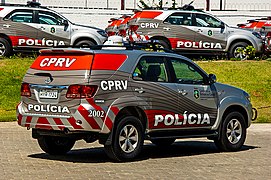 Response car Toyota Hilux SW4 PMCE.
 -
 Patrol car Fiat Linea PMDF.
 -
 Patrol car Renault Fluence PMPR.
 -
 Highway Patrol car Chevrolet Prisma MkII PMESP.
 -
 Response car Chevrolet S-10 PMERJ.
 -
 Tactical car Agrale Marruá PMDF.
 -
 Tactical car Toyota Hilux SW4 PMESP.
 -
 Patrol car Ford EcoSport and Renault Duster PMSC.
.jpg)


.jpg)


.jpg)
.jpg)

.jpg)
Armored vehicles[edit]
| Name | Origin | Type | Quantity | Used by | Note | Photo |
|---|---|---|---|---|---|---|
| Lenco BearCat |  United States United States
|
Law enforcement vehicle | 1 |  PMGO PMGO
|
Delivered to BOPE | 
|
| Paramount Group Maverick |  South Africa South Africa
|
Armored security vehicle | 6 |  PMERJ PMERJ
|
6 | 
|
| Wolf Armoured Vehicle |  Israel Israel
|
Armored security vehicle | 4 |  PMESP PMESP
|
In operation of the 4th BPChq Special Operations | 
|
| Ford Cargo 815 |  Brazil Brazil
|
Armored personnel carrier | 12 | PMERJ
|
The most armored police vehicle in use in Brazil, "caveirão" (big skull) is extensively used on anti-narcotics operations in the city of Rio de Janeiro. Armored car transport values modified for police use. | .jpg)
|
| Volkswagen Cargo 1722 | Brazil
|
Armored personnel carrier | 6 | PMERJ
|
9 vehicles were purchased, and three were designated to PCERJ. Armored car transport values modified for police use. Dubbed "caveirinha" (little skull), in a reference to "Caveirão". | .jpg)
|
| Plasan Guarder | Israel
|
Armored personnel carrier/Riot control vehicle | 6 | PMESP
|
6 | 
|
| Massari Centurion | Brazil
|
Armored personnel carrier/Riot control vehicle | 4 2 |
PMESP PMDF PMDF
|
Being disabled | .jpg)
|
| Centigon Centurion | Brazil
|
Armored personnel carrier/Riot control vehicle | 2 | PMDF
|
In operation | .jpg)
|
| Hatehof MAN TGM 18.34 Folder | Israel
|
Riot control vehicle | 4 | PMESP
|
Ordered | 
|
| Beit Alfa technologies "Model MAN RCU 6000 II" | Israel
|
Riot control vehicle/Water cannon | 1 | PMERJ
|
||
| Mercedes-Benz Autolife Troia | Brazil
|
Armored personnel carrier | 1 1 1 |
 PMPR PMPR PMSE PMSE PMBA PMBA
|
Civil police of São Paulo State also uses a vehicle of this model. Armored car transport values modified for police use. | 
|
| Amalcaburio Alcatraz | Brazil
|
Armored personnel carrier/Riot control vehicle | 2 |  PMMG PMMG
|
||
| Steel Force | Brazil
|
Armored personnel carrier/Riot control vehicle | 1 1 1 1 1 1 1 1 1 1 1 1 |
PMDF PMAM PMBA PMAM PMBA PMCE PMCE BMRS PMPR BMRS PMPR PMMT PMMG PMMT PMMG PMRN PMRN PMPE PMERJ PMPE PMERJ
|
Vehicles donated by the federal government | .jpg)
|
Helicopters[edit]
| Name | Origin | Type | Quantity/Used by | Note | Photo |
|---|---|---|---|---|---|
| Helibras Esquilo | Brazil
|
Light utility helicopter | 21 - PMESP 2 - PMGO6 - PMERJ4 -  PMES PMES5 - PMBA? -  PMSC PMSC1 -  PMMS PMMS ? - PMMG? - BMRS2 - PMDF5 -  PMMA PMMA? - PMPE
|

| |
| AgustaWestland AW119 Koala |  Italy Italy
|
Light utility helicopter | 1 - PMSC 1 - BMRS
|
.jpg)
| |
| Eurocopter EC130 | Brazil/ France France
|
Light utility helicopter | 2 - PMPR
|

| |
| Bell 206 | United States
|
Light utility helicopter | 2 - PMPR
|

| |
| Sikorsky S-300 | United States
|
trainer helicopter | 2 - PMESP 1 - PMERJ1 - BMRS
|

| |
| Bell Huey II | United States
|
Armored helicopter/Multipurpose utility helicopter | 1 - PMERJ
|

| |
| Eurocopter EC145 |  Germany Germany
|
Medium utility helicopter | 1 - PMMA 3 - PMBA? - PMCE2 - PMERJ
|

| |
| AgustaWestland AW109 | Italy
|
SAR/utility helicopter | 1 - PMESP
|

|
Gallery[edit]
|
.JPG)


.jpg)
.jpg)

See also[edit]
- Brazilian Armed Forces
- Military Police (Provost)
- Military Firefighters Corps
- Gendarmerie
- United States National Guard
- State defense forces
References[edit]
- Notes
- ^ Portuguese: Polícia Militar, IPA: [puˈlisjɐ miliˈtaʁ], also known as PM, [peˈẽmi]
- Citations
- ^ Emblem adopted at the First National Convention of the Military Police in 1957.
- ^ Rodrigues, Alex (July 2022). "Brasil tinha 544 mil policiais militares, civis e bombeiros em 2020". Agência Brasil. Retrieved 13 August 2022.
- ^ Article 144 of Constitution of Brazil.
- ^ Decree of December 10, 1801.
- ^ Decree of May 13, 1809.
- ^ Law of July 17, 1831.
- ^ Law of October 10, 1931.
- ^ Constitutional Reform of 1834, Article 15, § 11.
- ^ Decree Law 8.660, January 14, 1946.
- ^ a b c d e f g h i j k l m n o p q Hudson, Rex A., ed. (1998). Brazil: a country study (5th ed.). Washington, D.C.: Federal Research Division, Library of Congress. pp. 401–403. ISBN 0-8444-0854-9. OCLC 37588455.
 This article incorporates text from this source, which is in the public domain.
{{cite encyclopedia}}: CS1 maint: postscript (link) - ^ Ordinance of the Ministry of the Army 340, October 4, 1971.
- ^ a b "Insígnias". Polícia Militar do Estado de São Paulo (in Portuguese). Retrieved 6 February 2021.
- ^ National Secretariat of Public Safety. (in Portuguese)[dead link]
- ^ Article 22 of Constitution of Brazil.

Sources[edit]

- Em Nome da Ordem: a constituição de aparatos policiais no universo luso-brasileiro (séculos XVIII e XIX) ; Regina Helena Martins de Faria; Universidade Federal de Pernambuco (UFPE) - Recife; 2007. (texto em pdf.)
- A Polícia Militar de Mato Grosso - História e Evolução, 1835 a 1985; Ubaldo Monteiro.
- Crônica da Brigada Militar Gaúcha; Hélio Moro Mariante; edição da Imprensa Official; 1972.
- História da Polícia Militar de Pernambuco; Major Roberto Monteiro.
- História do Batalhão de Segurança - A Polícia Militar do Rio Grande do Norte, de 1834 a 1968; Romulo C. Wanderley; edição Walter Pereira S.A. / A Livraria e Papelaria; 1969.
- Episódios da História da PMPR - Volume I ao VII; Capitão João Alves da Rosa Filho; edição da Associação da Vila Militar; 2000.
- Origens Históricas da Polícia Militar de Minas Gerais - volumes 1 e 2; Coronel Paulo René de Andrade; edição da Imprensa Official de Minas Gerais; 1985.
- Raízes do Militarismo Paulista; Coronel Edilberto de Oliveira Melo; edição da Imprensa Official; 1982.
- Soldados da Pátria, História do Exército Brasileiro 1889 - 1937; Frank D. McCann; Edição da Companhia de Letras; 2007.
- Tropas Paulistas de Outrora; J. Wasth Rodrigues; edição do Governo do Estado de São Paulo; 1978.
| Federal |  | ||||
|---|---|---|---|---|---|
| State |
| ||||
| Local Municipal Guards (list by state) | |||||
| See also | |||||
| Leadership | |
|---|---|
| History and traditions | |
| General staff | |
| Commands | |
| Military regions | |


