


Talk:Romance languages
| This is the talk page for discussing improvements to the Romance languages article. This is not a forum for general discussion of the article's subject. |
Article policies
|
| Find sources: Google (books · news · scholar · free images · WP refs) · FENS · JSTOR · TWL |
Archives: Index, 1, 2, 3, 4Auto-archiving period: 30 days  |

 | This  level-4 vital article is rated C-class on Wikipedia's content assessment scale. level-4 vital article is rated C-class on Wikipedia's content assessment scale.It is of interest to the following WikiProjects: | |||||||||||||||||||||||||||||||||||||||||||||||||||||||||||||||||||||||||||||||||||||||||||||||||||||||||||||||||||||||||||||||||||||||||||||||||||||||||||||||||||||||||||||||||||
| ||||||||||||||||||||||||||||||||||||||||||||||||||||||||||||||||||||||||||||||||||||||||||||||||||||||||||||||||||||||||||||||||||||||||||||||||||||||||||||||||||||||||||||||||||||


.svg)


.svg)


 | Text and/or other creative content from this version of Romance languages was copied or moved into Gallo-Romance languages with this edit on 2015-11-08. The former page's history now serves to provide attribution for that content in the latter page, and it must not be deleted as long as the latter page exists. |
| Text and/or other creative content from this version of Romance languages was copied or moved into Romance languages linguistics with this edit. The former page's history now serves to provide attribution for that content in the latter page, and it must not be deleted as long as the latter page exists. |
Index
|
||||
|
This page has archives. Sections older than 365 days may be automatically archived by Lowercase sigmabot III when more than 10 sections are present. |

 |
This article links to one or more target anchors that no longer exist.
Please help fix the broken anchors. You can remove this template after fixing the problems. | Reporting errors |
Portuguese: first, or second language for Africans?[edit]
The article says Portuguese "is spoken as a first language by perhaps 30 million residents of that continent, most of them second-language speakers." It looks like a contradiction to me. Kotabatubara (talk) 22:58, 12 August 2022 (UTC)
- My bad. I replaced first language with primary language, which doesn't imply native. A quick search on the internet makes me think that the figures for Portuguese speakers in Africa are not reliable, and in any case they're growing with every year. --Jotamar (talk) 06:17, 13 August 2022 (UTC)
- Hi,
- Is appears now that they are native speakers now.
- Native Dark Blue Circle in Luanda, Angola per sources:
- Angola in particular - Portuguese is the native language of almost half the country.
- Link 1:
- https://www.worldatlas.com/articles/what-languages-are-spoken-in-angola.html#:~:text=The%20official%20language%20of%20Angola,most%20spoken%20language%20of%20Angola.
- " According to a 2014 study, nearly 71% of the population of Angola speak Portuguese. The language is the mother tongue of 39% of the population of the country while many more speak it as a second language. Portuguese is also the most spoken and sometimes the only language that is spoken by younger Angolans. Portuguese speakers are more common in the urban areas of Angola where 85% of the population converse in Portuguese. "
- Link 2:
- Other sources put the number much higher:
- " The 2016 CIA World Fact Book reports that 12.3 million, or 47% of the population, speaks Portuguese as their first language. However, many parents raise their children to speak only Portuguese"
- Angolan Portuguese
- https://www.britannica.com/place/Angola
- "Portuguese is often the only language spoken in Luanda and in much of the interior extending beyond the city and in other parts of the country"
- Basically the whole coast only uses Portuguese, with native languages being used in land. IntelloFR (talk) 01:06, 14 August 2023 (UTC)[reply]
- 2. Native dark blue circles in Libreville Gabon and Younde, Cameroon, and Lafayette LA.
- Libreville, Gabon:
- "It has been noted that French is increasingly be-coming the mother tongue and the initial language of the younger generations in urban Gabon (Pambou, 1998:147; Ndinga-Koumba-Binza, 2005a:72 & 2005b:141; Idiata, 2008:85; cf. Blanchon, 1994). In fact, studies by Ntong Amvame (1984), Bouché (1998), Mbondzi (1998), Ompoussa (1998), Itembo (1999) and Mouloungui Nguimbyt (2002) have shown that pupils of various ages and grades at schools learn French more efficiently than any other Gabonese language. Idiata (2008:200 & 2009:126) has also noted that some pupils do not speak any of the Gabonese native languages at all. One of the reasons for this phenomenon (i.e. French being the mother tongue of younger generations) is cross-ethnic marriages.
- In fact, many couples of mixed ethnicity prefer French rather than Gabonese native languages as the code for better communication within the family. Children from a family of this kind have no choice but to acquire French as their first language. The children learn the language at home from the parents before they even get to school, therefore lessening the chances of learning any of the Gabonese native languages.
- This urbanisation is also to be considered as a cause for French being the initial language of Gabonese younger generations. In fact, “in certain urban contexts there is a large degree of learning by contact at an early age” (Lafage, 1993:216)."
- While this does not give a specific number, it states clearly that language transmission in the urban areas is French to French - making French natively spoken per evidence in Gabon.
- 2. Younde, Cameroon:
- In Cameroon, per research: "French usage twenty years ago and in 2004 show a loss of the LWDs, which goes along with a loss of Cameroonian languages in urban areas. Bitjaa Kody has further found that the national languages are disappearing even in endogamic households where family members speak the same national language. Francophone adults used French in 42 percent of the domestic communications which were studied, whereas the young (10–17 years old) used French in 70 percent of the communication. In addition 32 percent of the young between ten and seventeen years old interviewed in Yaounde did not know any national language and had French as their L1 (Bitjaa Kody 2001a). There is a clear change in language use from the parent generation to the generation of their children (Bitjaa Kody 2005:95). As a result, there will be even less national language speakers in future, since the future parent generation will not be able to transmit a Cameroonian language to their children."
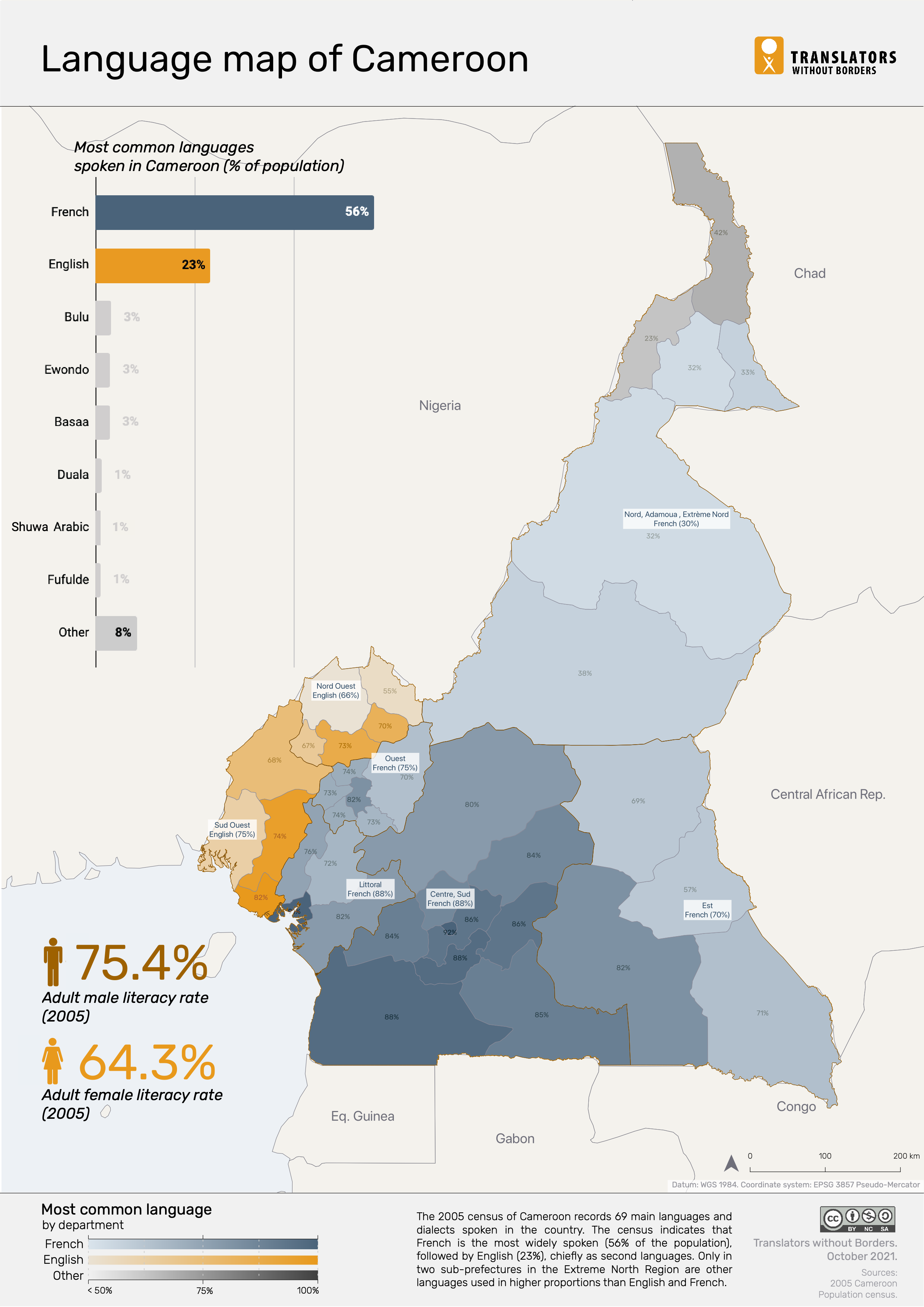
- Additionally here, this map shows Douala at 91% Francophone: https://translatorswithoutborders.org/wp-content/uploads/2021/11/Cameroon-Language-Map-option-2.png
- This again does not give a specific number, but points to the fact that in urban Cameroon, language transmission is French to French - showing French is spoken natively.
- 3. Lafayette, Louisiana :
- The history of French in Louisiana has not allowed the vast majority of francophones the opportunity to learn to read and write French. CODOFIL states, In the 1990 census, approximately 250,000 Louisianians responded that French was the language they spoke at home. The 2000 census showed 198,784 Louisiana francophones over the age of 5, including 4,470 who speak Creole French. Programs such as the Centre de la francophonie des Amériques and CODOFIL continue to identify future avenues of research and encourage francophone to produce knowledge that will lay the foundations for the future.
- "This generation of new speakers, often younger than 40, represents a generational shift that developed after home transmission of French faded in the mid to late 20th century. Their grandparents likely spoke French as a first language, "
- https://www.theadvertiser.com/story/news/local/louisiana/2023/05/30/sustainability-and-economic-developments-of-the-french-language-in-louisiana/70244915007/
- https://www.theadvocate.com/curious_louisiana/curious-louisiana-how-many-people-speak-cajun-french-in-our-state/article_947551b6-a982-11ed-b305-d7c4959e9102.html
- https://www.krvs.org/2023-05-30/new-speakers-of-french-in-louisiana-continuing-a-legacy
- @Kwamikagami IntelloFR (talk) 03:29, 15 August 2023 (UTC)
- @Kotabatubara @Jotamar IntelloFR (talk) 03:30, 15 August 2023 (UTC)
Counting and listing Romance languages in the lead[edit]
This archived discussion is still relevant Erinius (talk) 23:00, 13 January 2023 (UTC)
- Thought I'd revisit this now that the Dalby URL no longer works (at least it's available on the Internet Archive).
- Something I think worth mentioning is that several reliable sources (The Cambridge History of the Romance Languages and The Oxford Guide to the Romance Languages) I've found just don't even attempt a comprehensive listing or counting of Romance languages. The Encyclopedia Britannica's article on the Romance languages doesn't attempt a comprehensive list either, although it does offer a rather unsatisfactory map of the Romance languages in Europe.
- Points made by @Barefoot through the chollas: and @Austronesier: are still relevant - the current "list" and paragraph above still have their problems. They can still mislead readers into thinking they're a complete listing of all Romance languages, they don't go far enough in explaining the Romance dialect continuum for the unaware reader, and they can give the impression that mutual intelligibility is an unproblematic criterion for establishing different languages. Also, they can give the impression that the largely "geohistoric" language groups used (ie Ibero-Romance) are valid, well-established and uncontroversial clades with no overlap between them.
- Also, the current list in the article's lead isn't even the same as Dalby's list.
- A whole "Languages" section may be too ambitious for now, but it might be possible to fix up this vague list of Romance language areas in the lead and its associated paragraph and avoid misleading any uninformed readers. Erinius (talk) 23:40, 10 April 2023 (UTC)
- Erinius, bullseye. The editors of the CUP and OUP works you mention are serious Romance linguists who know their stuff, and (thus) are not going to engage in the fool's errand of attempting to count Romance languages. Illustrated explanation of why not could fill a thick tome, but just clicking on Occitan in Dalby's typological list eventually leads to the crux of the impasse:
- "...there is no single written standard language called "Occitan" [...] "Occitan is fundamentally defined by its dialects, rather than being a unitary language. That point is very conflictual in Southern France, as many people do not recognize Occitan as a real language and think that the next defined "dialects" are languages." [...] every settlement technically has its own dialect, with the whole of Occitania forming a classic dialect continuum that changes gradually along any path from one side to the other."
- The same can be said of the subtypes listed that haven't been subjected to what someone once called "the dead hand of standardization" -- and note even with that, the odd classification French/Oïl languages, i.e. highly engineered national standard along with autochthonous local "dialects" (in the terminology adopted for Occitan).
- As you say, the list is very misleading as it is, in more than one way. But it could be salvaged as layered typologies with some judicious editing and the appropriately informative text, making it clear that the list is not of "languages" but of types, all of which exist in varieties, such as Gallo-Romance > Oïl languages > Picard (> Rouchi, etc.). Oh, and drop, explaining why, the notion that Romance languages can be counted. Barefoot through the chollas (talk) 19:15, 11 April 2023 (UTC)
- A "Languages" section is not that hard to create. As a first emergency step, just move the final paragraph of the lede down to a section of its own. The section "Samples" also needs to be moved down.
- But: I've just intended to do that and scrolled down to find a proper place, down and down and down...the page is endlessly long! The section "Classification" has 40k of code (the corresponding "main article" only 30k!), "Sound changes" has 60k! The first is a classic case of content forking, and the second one is a highly notable topic of its own ("Phonological history of the Romance languages"). Let's put this into a more readable shape. –Austronesier (talk) 20:37, 11 April 2023 (UTC)
- There are some big swaths of content that are just unsourced (including in the "Classification" section), possibly misleading and/or largely irrelevant - I'm hoping none of you would object to them being deleted. Likewise the "samples" section seems to be just a vague listing of as many Romance languages as possible, alongside translations of an example sentence. It's possible that one or two of the translations for a language with relatively few speakers is totally inaccurate, but since none of them are sourced, who would know?
- I agree with you that a simple "Languages" section would be a good idea, and I think it would make the most sense to put it right above "Classification". Erinius (talk) 21:25, 11 April 2023 (UTC)
- Oh and of course I agree that much of "Classification" should be transferred to the subject's main article. As for "Sound changes", there is already a main article "... to Proto-Romance" and the related article on Vulgar Latin, although I think a lot of these sound changes would take place a little after "proto-Romance". Erinius (talk) 21:30, 11 April 2023 (UTC)
- I just did a preliminary rewrite of the paragraph in question - I'd appreciate further changes to phrasing, since I really wasn't sure how to explain things best. Also, IIRC, the Encyclopedia Britannica article, and the "Classifications" chapter of The Oxford Guide to the Romance Languages, explain why counting the Romance languages is impossible, a bit about how the whole language vs dialect thing is based on social factors as well as purely linguistic ones, and how a lot of somewhat medium-level classifications (ie Ibero-Romance) are largely geographical. Erinius (talk) 23:58, 25 April 2023 (UTC)
- Erinius, pressed for time just now, but I've made one little tweak, from various languages to numerous languages, to open the way for what's to come. I think you've done an excellent job of editing. Barefoot through the chollas (talk) 01:01, 26 April 2023 (UTC)
- Erinius, bullseye. The editors of the CUP and OUP works you mention are serious Romance linguists who know their stuff, and (thus) are not going to engage in the fool's errand of attempting to count Romance languages. Illustrated explanation of why not could fill a thick tome, but just clicking on Occitan in Dalby's typological list eventually leads to the crux of the impasse:
- "One, two, three, many". @Kwamikagami, Austronesier, Piotrus, and Elinruby: might be interested in this. 04:28, 12 April 2023 (UTC)
Content to remove[edit]
While a lot of the "Classification" section should be transferred to the corresponding main article, and most of "Sound Changes" should also go in a separate article, there's a lot of content on this page that I think should be removed entirely because it's either totally unsourced (and possibly misleading) or totally irrelevant to this article's scope. I don't want to start deleting things en masse, and I can see reasonable arguments being made in favor of keeping some of these things, so I'll just make a list here of everything I think should be purged from the article:
- the "Samples" section - Totally unsourced, might not be entirely relevant for this article, possible that one or two of the smaller languages have really unnatural or inaccurate translations (who would know since it isn't sourced), and the "Vulgar Latin" example seems really reconstructed-y
- Within "Classification":
- Within "Proposed Divisions"
- The giant table showing verb conjugations in different languages, supposedly ordered from conservative to innovative - unsourced which leaves the door open to possible errors, not very relevant for a classification of the Romance langs, selection of languages may be questionable, the relative ordering of languages in relation to each other as more/less innovatory may also be questionable and seems OR-y. Selection of verb conjugations is arbitrary, and the table falsely presents each language's verb forms as largely mapping onto the others' one-to-one
- The "conservative" vs "innovatory" bullet point - neither of its sources actually establish conservative vs innovatory as a widely-used way of classifying different Romance languages (sorry, Dante!)
- Three consecutive paragraphs beginning with "The usual solution to these issues...", "Probably a more accurate description..." and "This would explain why some of the "northwest" features..." - unreferenced and misleading
- " Outcome of stressed Classical Latin vowels in dialects of southern Italy, Sardinia and Corsica" - It's likely that all the info in that table is accurate and that it's compiled from one or more good sources - but the question marks on the reflexes for Latin /au/ and the parentheses and the lack of citations make me inclined to delete it
- Gallo-Romance languages - not particularly relevant for a very high-level classification of Romance dialects, and uncited
- Conlangs - Not sure how they're relevant to this page
- Within "Proposed Divisions"
- "Writing systems" - "Romance orthographies" actually is a coherent topic (which surprised me - Encyclopedia Britannica article does include a section on orthographies, and the Oxford Guide to the Romance Languages has a chapter on writing systems as well) - but this section doesn't need to be as long as it currently is - it certainly doesn't need to include every consonant digraph and trigraph
- Vocabulary comparison - the big table feels OR-y, while the lexical similarity table could be moved to the "classification" page
My current mood is that we should delete first and, if citations show that certain content actually should be included, restore later. I'd appreciate any feedback. Erinius (talk) 23:42, 17 April 2023 (UTC)
- This seems reasonable; I've a few questions, as I feel the Latin pages are suffering from similar problems of focus / bloat.
- does WP have a guide or a good model by example of how a language topic should be constructed?
- or are there other examples; for instance, what topics does Britannica cover in its Romance languages article?
- is it possible to spin sub-pages off for any of this where the content is decent, eg "writing systems"?
- does WP have a guide or a good model by example of how a language topic should be constructed?
- In general, these pages seem to fill with changes to linguistic patterns, and other quite technical information, which may interest someone with a deeper interest in linguistics, while the page contents tend to lack thematic discussions or other information which would engage someone whose interest was more general, I would say. Jim Killock (talk) 06:47, 18 April 2023 (UTC)
- Super pressed for time just now, but I'm chiming in -- I hope it's clear in a collegial spirit -- to urge restraint in executing bold deletions and other sweeping changes. Issues in no specific order...
- Samples. Such a list seems very useful in that most readers probably have no idea of the variegated richness of Romance, find themselves stuck at national languages with maybe Catalan and a couple of others tossed in. The sample list also makes it clear that the little list under Languages is the iceberg's tip only, not exhaustive and not intended to be (notwithstanding the unfortunate Dalby input). Agreed that the list is bloated in terms of variants in subgroups. Emilian, Ladin, Lombard, for example; one will do, readers can turn to specific articles for detail. The main issue in Samples is attribution. That does need resolution, which a concerted effort should be able to reach. ("Vulgar Latin" is pretty much by definition a reconstruction; there's no real need to have it in the list, though.)
- Writing systems. This is pretty well done, though running text can be made a good bit more concise. Seems to me the question is whether to edit carefully or just present a summary paragraph of high points in this article, and move the detail to an article "Romance language writing systems".
- Vocabulary comparison. Not just sound shifts, but also lexical selection, and, like Samples, surely informative for the neophyte. A bit of a mess as it is, though. Especially for that readership who can't correct as they read (no, Italian 'man' is not phonetically [ˈwɔmo], but [ˈwɔːmo]), it needs a lot of cleaning up for inconsistencies and inaccuracies in IPA -- though presented as phonetic, many entries look phonemic, or partially one, partially the other. And then there's French, all phonemic, yet said to represent pronunciation. OR doesn't seem to me an issue, as they're all basic dictionary entries easily available to one and all. Definitely check suspect entries for accuracy, though: e.g. is Sicilian 'water' really [ˈakːua], with [u]?
- Classification. If the main article were a good bit fleshed out, I'd say sure, just a paragraph or two here, with a see... the main article. But the main article is still far from containing even the (à mon avis, useful) Extent of variation table and much else that's informative that is present in this Romance article.
- Basta. Must run. Once again, I'm just urging let's take it easy. Babies and bathwater sort of thing. Barefoot through the chollas (talk) 17:34, 18 April 2023 (UTC)
- Maybe the first issue is actually the content order. The sections run in an odd order. The most helpful parts are probably "modern status" and "history" which are in the second half of the running order; "name" and "Languages" are also introductory, while "samples" is to my mind background information. I would also give these sections more helpful titles, eg:
- The Romance Language family [combine 'name' and 'languages']
- Romance languages today
- History
- On 'classification of Romance languages', move this to a separate article and add a simmar to part 1 above
- Then look at the rest of the page and work out if it needs slimming down / separating out Jim Killock (talk) 18:51, 18 April 2023 (UTC)
- Thanks for the replies! I won't go ahead with any big deletions. Erinius (talk) 22:54, 19 April 2023 (UTC)
- I completely agree. It is very odd to find the History chapter for example mid-way trough the article. Aristeus01 (talk) 12:39, 19 July 2023 (UTC)
- Maybe the first issue is actually the content order. The sections run in an odd order. The most helpful parts are probably "modern status" and "history" which are in the second half of the running order; "name" and "Languages" are also introductory, while "samples" is to my mind background information. I would also give these sections more helpful titles, eg:
- The majority of the content in Classification section has now been moved to the main article. There are still a lot of improvements needed but all the content that should be kept in Romance languages was saved/moved to the appropriate section and the further remaining changes to be made (such as citing the elements of the big table) can be done on the respective page. This page's history has suffered enough for it. Aristeus01 (talk) 16:32, 31 March 2024 (UTC)
Sound changes[edit]
Looking at the article flow a big chunk in the middle is taken by the "Sound changes" part. The topic is too complex to be compressed in a satisfactory manner. I suggest moving most of its content to "Phonological changes from Classical Latin to Proto-Romance". It would add to the main article's depth, and, at the same time, improve readability of the Romance languages article. Aristeus01 (talk) 13:07, 19 July 2023 (UTC)
- Agree, and I'm not sure anyone would disagree. Most of that content should be in a separate article. A word of caution though, not all the changes in the "sound changes" part affected all of Romance, so they wouldn't strictly be sound changes to Proto-Romance. I'm not totally sure what should be done about those. Palatalization which affected all of Romance to some degree, but some varieties more extensively, is already briefly mentioned in Phonological changes... so I think transferring most of this article's Palatalization section there would be fine. I guess we should also see what some of the main contributors to the Proto-Romance articles (namely @Nicodene:) have to say and I'm also curious if other language families have their own sound changes articles. Erinius (talk) 16:15, 19 July 2023 (UTC)
- You could certainly add a section labelled 'subsequent regional sound changes', or similar, to the article about Classical Latin > Proto-Romance changes. Nicodene (talk) 16:59, 19 July 2023 (UTC)
- I ask only that whatever content transferred there be cited to the same standard as the rest of the existing article. Nicodene (talk) 17:00, 19 July 2023 (UTC)
- A fair request. We should start by adding refences to our current text in question and when we are happy with the result we can look again at all the suggestions and decide on the best way to move forward. Aristeus01 (talk) 18:27, 19 July 2023 (UTC)
- I ask only that whatever content transferred there be cited to the same standard as the rest of the existing article. Nicodene (talk) 17:00, 19 July 2023 (UTC)
- You could certainly add a section labelled 'subsequent regional sound changes', or similar, to the article about Classical Latin > Proto-Romance changes. Nicodene (talk) 16:59, 19 July 2023 (UTC)
Agreed that the historical phonology in the Romance languages article is in some ways too detailed -- though in an article of its own, one could argue not nearly detailed enough, starting with too many languages not even mentioned. Before venturing into that quagmire, though, Phonological changes from Classical Latin to Proto-Romance as basis for a revised more complete version would have to be re-named ("moved"), but the present title (reduced to Latin to Romance) and content could provide an excellent first portion if the new article were to be articulated in two phases, either Latin to Romance, then local developments as two large sections, or each feature or set of features in two phases. The present text would need some massaging (e.g. glosses supplied, sources updated, statements such as this cleaned up: In cases where a long vowel precedes a geminate consonant, one of the elements often shortens unpredictably). The other task, deciding on how much historical phonology remains in Romance languages, is a bit thorny, but it can be done. Barefoot through the chollas (talk) 18:21, 19 July 2023 (UTC)
Length of the Roman rule and the Romance Languages Map[edit]
Proposing to remove the map due to not meeting quality standards of an academic material.

General issues:
- it arbitrarily and subjectively sets the time frames based on the length of rule of Dacia and Britannia, then on a 100 years basis, then on a generic "over 500" with no clear explanation of the relevance of such categorisation.
- it sets the end of Roman rule on the end date for the Western Roman Empire, misrepresenting the rule in Moesia that lasted until the 6th century under Eastern Roman Empire ( so "over 500 years")
- it ignores the difference between rule in most of Italian peninsula and the other areas presented as "over 500".
- it misrepresents the gradual conquest of Iberian peninsula that took over 200 years, possibly misleading the reader to think it happened in two waves.
- as above it makes no distinction between southern France and the territories added by Julius Caesar.
- it completely misrepresents North African provinces and timeline, including the geographical extent of Roman border along Libyan coast, and the length of rule in Mauretania Caesariensis ( should be "over 500")
Language specific issues:
- it mixes representation of national languages with regionally recognised languages, oddly showing only some of the latter.
- it draws the Jireček Line in an amateurish manner, following neither Jireček's indications nor one of the latter academic proposals.
- controversially assigns "Romanian" speaking label to Aromanian language (which is very poorly illustrated, by the way).
- confusingly shows a single clade of languages ("Galloitalic") touching on the subject of clades then refuses to elaborate.
Overall, the map adds little to no value to Romance languages' history and grouping, and poorly illustrates the chronology of the Roman Empire and its limits. Aristeus01 (talk) 10:00, 27 August 2023 (UTC)
- 1. It is a well known fact that most Romance languages are spoken in lands that were under Roman rule for more than 500 years, so the time frames are not arbitrary in the article's context. (Izzo, Herbert J. (1986). "On the history of Romanian". In Marino, Mary C.; Pérez, Luis A. (eds.). The Twelfth LACUS Forum, 1985. Linguistic Association of Canada and the United States. pp. 139–146.; Schramm, Gottfried (1997). Ein Damm bricht. Die römische Donaugrenze und die Invasionen des 5-7. Jahrhunderts in Lichte der Namen und Wörter [=A Dam Breaks: The Roman Danube frontier and the Invasions of the 5th-7th Centuries in the Light of Names and Words] (in German). R. Oldenbourg Verlag. ISBN 978-3-486-56262-0.)
- 2. Roman rule came to an abrupt end along the Lower Danube with the arrival of the Huns in the first half of the 5th century, and the Romans reclaimed the territory only decades after the fall of the Hunnic Empire.
- 3. And why is it important?
- 4. According to the map, the conquest of the Iberian lasted for about two centuries.
- 5. Why should if both territories were ruled by the Romans over 500 years?
- 6. We should not ignore that Mauretania Caesarensis was lost to the Vandals in the early 5th century and reconquered by Justinian in the 530s.
- 7. I think you refer to Gallego and Gallo-Italic when speaking of "regional languages". Actually, the list of Romance languages is still uncertain.
- 8. New archeological finds continuously move the Jireček Line since it is a theoretical line based on inscriptions.
- 9. In scholarly literature it is not unusual that Aromanian (or Macedo-Romanian) is presented together with Daco-Romanian, Megleno-Romanian, and Istro-Romanian (see, for instance Mallinson, Graham (1988). "Rumanian". In Harris, Martin; Vincent, Nigel (eds.). The Romance Languages. Oxford University Press. pp. 391–419. ISBN 978-0-19-520829-0.) Borsoka (talk) 11:13, 27 August 2023 (UTC)
- @Aristeus01: I understand your concerns; however, I feel that the map should be improved, rather than deleted. The original author in Commons is Andras Bereznay (probably no longer active), and it's been modified by commons:User:Liviojavi. Why don't you try to contact them? --Jotamar (talk) 11:18, 27 August 2023 (UTC)
- A re-do is definitely in order if the map is to be kept. In addition to sorting out the time questions, there's this concern: "It mixes representation of national languages with regionally recognised languages, oddly showing only some of the latter.", troublesome in multiple ways. If regionally recognised means the usual here, the designation is far more political than linguistic, thus misleading at best, and guaranteed to be less informative than might be helpful to non-expert readers. This is then compounded by the labeling of e.g. French through almost all of France and Italian for most of Italy, with nods to very few local languages or typologies (Galloitalic), not just misleading, but misinforming the non-expert. None of this is easy to deal with in a small map, but attempts at coherent language labeling can be made. Barefoot through the chollas (talk) 14:28, 27 August 2023 (UTC)
- I've contacted both editors a few days ago bit so far no reply. It's possible that the map, with improvements, could be useful for the topic but I do not have high hopes the authors will make any changes. Aristeus01 (talk) 09:17, 3 September 2023 (UTC)
- A re-do is definitely in order if the map is to be kept. In addition to sorting out the time questions, there's this concern: "It mixes representation of national languages with regionally recognised languages, oddly showing only some of the latter.", troublesome in multiple ways. If regionally recognised means the usual here, the designation is far more political than linguistic, thus misleading at best, and guaranteed to be less informative than might be helpful to non-expert readers. This is then compounded by the labeling of e.g. French through almost all of France and Italian for most of Italy, with nods to very few local languages or typologies (Galloitalic), not just misleading, but misinforming the non-expert. None of this is easy to deal with in a small map, but attempts at coherent language labeling can be made. Barefoot through the chollas (talk) 14:28, 27 August 2023 (UTC)
- @Aristeus01: I understand your concerns; however, I feel that the map should be improved, rather than deleted. The original author in Commons is Andras Bereznay (probably no longer active), and it's been modified by commons:User:Liviojavi. Why don't you try to contact them? --Jotamar (talk) 11:18, 27 August 2023 (UTC)
Historical stages of palatalization[edit]
I've been combing through the sources available to me and none seem to mention the 5 stage model presented in the Wikitable at the Palatalization paragraph (see for example: Palatalizations in the Romance Languages by Daniel Recasens - Oxford Research Encyclopedias site). Could someone with a better knowledge of the topic confirm this is not OR? Aristeus01 (talk) 16:23, 8 September 2023 (UTC)
- It's not, or not necessarily, OR, but it could use some sourcing, even if as basic as Boyd-Bowman's From Latin to Romance in sound charts. Barefoot through the chollas (talk) 18:02, 8 September 2023 (UTC)
- Decided to scan through From Latin to Romance in sound charts and I'll note here where the changes in question are mentioned - the palatalizations in that chart are mentioned in rules 5 (CA-, GA-, pp. 28-31), 6 (k-/g- before e/i/j, pp. 32-34), 18 (yod, gj-/dj-, gi/ge, these consonants all merging as yod, p. 65), 19 (intervocalic yod/-gj-/-dj-/-gi-/-ge-, merged as yod, p. 68), 22 (-lj-, p. 77), 26 (-gn- and nj-, p. 89), 32 (p/r/s/m/b/v before j, p. 106), and 40 (tj, p. 129). Also there are sections on the development of the Spanish and French sibilants.
- I haven't read through the notes on each palatalizing environment, so I can't say for sure whether or not they support the model presented there. Erinius (talk) 22:32, 8 September 2023 (UTC)
- Guess I should add - I accessed it through HathiTrust - url here: https://babel.hathitrust.org/cgi/pt?id=uiug.30112058502060&seq=7 The scan is NOT perfect, the left edges of some pages have been cut off Erinius (talk) 10:26, 9 September 2023 (UTC)
- @Barefoot through the chollas and @Erinius, thank you for the source and indications! I added a few refs from it, will add more as time permits. I'm still of the opinion the 5 stage model might need to be part of a larger conversation on timeline and phases of palatalization, but that would probably be better to do after moving the paragraph. Aristeus01 (talk) 11:35, 9 September 2023 (UTC)
- I also have been reading about the outcomes of palatalizations. I just corrected a blatant error (this article formerly indicated that Sardinian did not palatalize kj and gj, which is false) but the overall topic seems to have many complex details ("The Early History of Romance Palatalizations", Marcello Barbato 20 June 2022, is another helpful resource that can be accessed via the Wikipedia Library). I think it would be a good idea to split "Palatalization in the Romance languages" out to a separate article so it can get more room for coverage and so that this article can be shortened; does that sound like a good idea?--Urszag (talk) 17:01, 9 September 2023 (UTC)
- Sure. It sounds to me like that absolutely has enough coverage and notability to be its own article. Erinius (talk) 00:33, 10 September 2023 (UTC)
- I agree. At this stage the paragraph is perhaps too detailed for the article but in an article of its own could and should be expanded considerably. I suggest we keep the first 3 lines and the table as brief description while the body can be moved to the new article. Aristeus01 (talk) 12:18, 10 September 2023 (UTC)
- Sounds like a good idea to me. At present it suffers from lack of examples in the table; perhaps those could be included. Also, a decision should be made as to what to do with -NN- and -LL- > /ɲ/ and /ʎ/ and initial PL-, CL-, FL- in Spanish (and a few other languages), and whether to treat historical restructuring and modern allophony together or separately. Barefoot through the chollas (talk) 20:44, 10 September 2023 (UTC)
- Move completed. Please see Palatalization in the Romance languages. Aristeus01 (talk) 14:20, 11 September 2023 (UTC)
- Sounds like a good idea to me. At present it suffers from lack of examples in the table; perhaps those could be included. Also, a decision should be made as to what to do with -NN- and -LL- > /ɲ/ and /ʎ/ and initial PL-, CL-, FL- in Spanish (and a few other languages), and whether to treat historical restructuring and modern allophony together or separately. Barefoot through the chollas (talk) 20:44, 10 September 2023 (UTC)
- I agree. At this stage the paragraph is perhaps too detailed for the article but in an article of its own could and should be expanded considerably. I suggest we keep the first 3 lines and the table as brief description while the body can be moved to the new article. Aristeus01 (talk) 12:18, 10 September 2023 (UTC)
- Sure. It sounds to me like that absolutely has enough coverage and notability to be its own article. Erinius (talk) 00:33, 10 September 2023 (UTC)
- I also have been reading about the outcomes of palatalizations. I just corrected a blatant error (this article formerly indicated that Sardinian did not palatalize kj and gj, which is false) but the overall topic seems to have many complex details ("The Early History of Romance Palatalizations", Marcello Barbato 20 June 2022, is another helpful resource that can be accessed via the Wikipedia Library). I think it would be a good idea to split "Palatalization in the Romance languages" out to a separate article so it can get more room for coverage and so that this article can be shortened; does that sound like a good idea?--Urszag (talk) 17:01, 9 September 2023 (UTC)
- @Barefoot through the chollas and @Erinius, thank you for the source and indications! I added a few refs from it, will add more as time permits. I'm still of the opinion the 5 stage model might need to be part of a larger conversation on timeline and phases of palatalization, but that would probably be better to do after moving the paragraph. Aristeus01 (talk) 11:35, 9 September 2023 (UTC)
- Guess I should add - I accessed it through HathiTrust - url here: https://babel.hathitrust.org/cgi/pt?id=uiug.30112058502060&seq=7 The scan is NOT perfect, the left edges of some pages have been cut off Erinius (talk) 10:26, 9 September 2023 (UTC)
Languages Map[edit]
@Cush
I feel like we need to modernize the 'Romance Languages in the World Map'. Was there any specific reason you changed it back to the old one?
It is in need of modernization for sure, if we could get one made! IntelloFR (talk) 00:45, 21 October 2023 (UTC)
Page should be moved to "Latin Languages"[edit]
People refer to "Romance Language" as "Love Language" in modern times, it would be less confusing & more accurate if wemoved the page to "Latin Languages" & replaced all the text of "Romance Language(s)" with "Latin Language(s)". 😎😎PaulGamerBoy360😎😎 (talk) 16:32, 2 November 2023 (UTC)
- True enough that the Romance languages are all evolutions of Latin, thus all Romance languages are "Latin, only later" in the words of a well-known Romance linguist. But try googling Romance languages to see what pops up. The term in English is Romance, pretty much parallel to the term in those languages -- langues romanes, lenguas romances/románicas, lingue romanze, etc. Barefoot through the chollas (talk) 17:25, 2 November 2023 (UTC)
- A Google Books search on books with the phrase "Latin Languages" in their titles returns 59 books for me. Most of their titles refer to "the Greek and Latin Languages", rather than using "Latin Languages" to refer the likes of Italian or Romanian. Most of the rest refer to "the English and Latin Languages". There are a couple of uses of "Neo-Latin Languages", and, yes, a couple of uses of "Latin Languages" with the meaning you have mind. In contrast, a search for books with the phrase "Romance Languages" in their titles yields 128 books.
- A Google Scholar search for "Latin languages" yields 15,600 results while a search for "Romance languages" yields 251,000. Looking at the first ten results for "Latin languages", in addition, we find:
- The lexicon of emotion in the neo-Latin languages
- The Greek and Latin languages in the papyri
- A compendium of the comparative grammar of the Indo-European, Sanskrit, Greek and Latin languages
- Zipf and type-token rules for the English, Spanish, Irish and Latin languages
- The Principles of Sound and Inflexion as Illustrated in the Greek and Latin Languages
- A hybrid approach for the management of FAQ documents in latin languages
- Hebrew, Aramaic, Greek, and Latin: Languages of New Testament Judea
- A Statistical Survey of College Offerings in the Greek and Latin Languages
- On the prosodies of the Greek and Latin languages
- Dictionary of Merchandise: In the English, German, Dutch, Danish, Swedish, French, Italian, Spanish, Portuguese, Russian, Polish & Latin Languages
- A look at the next few pages shows a similar mix. So, from the 15,600 results, chop off maybe 60%-80%, where the phrase "Latin languages" isn't being used in the manner in which you're using it.
- The term "Romance language" is accurate because it is a long-time, well-established phrase with that meaning. The Oxford English Dictionary provides usage examples from as early as 1421, followed by three 18th century examples.
- I hope this clarifies the situation! Largoplazo (talk) 22:07, 2 November 2023 (UTC)
- Oppose per Largoplazo. Just not the WP:COMMONNAME at all. Johnbod (talk) 23:30, 2 November 2023 (UTC)
- Proposal Withdrawn: per @Largoplazo 😎😎PaulGamerBoy360😎😎 (talk) 14:32, 3 November 2023 (UTC)
"Latin languages" should be removed from the opening sentence of the lede. Having it there in bold font creates the misleading impression that this alternative term could be of more than just very marginal usage. This version[1] by User:Barefoot through the chollas has a much better opening sentence. –Austronesier (talk) 20:09, 3 November 2023 (UTC)
- Ok, "Latin languages" does redirect here, usefully I think, so if mentioned should be in bold. But have a go. Johnbod (talk) 20:57, 3 November 2023 (UTC)
- Yes, it seems to me that something like this below is a maximally clear opening line. It's mercifully brief; with the possible exception of vernacular (which might be made a link to hover over), easy to understand; it leaves no room for reinforcing the notion that Latin died; there's nothing likely to be misleading or confusing, yet it stretches so as to not avoid the common but unfortunate (for English, at least) Vulgar Latin label. The Romance languages are languages that evolved from vernacular spoken Latin, traditionally labeled Vulgar Latin. Barefoot through the chollas (talk) 22:35, 3 November 2023 (UTC)
- Fine with that. Johnbod (talk) 03:01, 4 November 2023 (UTC)
- I agree that the redirect (even if it is a quite unlikely search item) justifies a mention of "Latin languages" and "Neo-Latin languages" somewhere in the text. What about moving it down to the section "Name and languages" which among other things covers terminology. This is what I usually do with uncommon alternative names to avoid giving them undue prominence.
- That would be ideal IMO. Erinius (talk) 19:01, 4 November 2023 (UTC)
- Agreed. That's an excellent solution. IF (ultralarge IF) "Latin languages" belongs here at all, observing that it's an infrequent colloquial label can be mentioned very briefly in Names. Also, although is seems that Tagliavini was happy to call his magnum opus Origini delle lingue neolatine, it's not much used in English, and when it is, it bumps into a quite distinct meaning in the world of scholarship (Neo-Latin). Good opportunities here for text that reduces rather than nourishes conflation, confusion, etc. Barefoot through the chollas (talk) 19:33, 4 November 2023 (UTC)
- I agree that the redirect (even if it is a quite unlikely search item) justifies a mention of "Latin languages" and "Neo-Latin languages" somewhere in the text. What about moving it down to the section "Name and languages" which among other things covers terminology. This is what I usually do with uncommon alternative names to avoid giving them undue prominence.
- Fine with that. Johnbod (talk) 03:01, 4 November 2023 (UTC)
Huge table in "Proposed divisions"[edit]
Anyone else who is confused why "Proposed divisions" opens with a huge table illustrating the "extent of variation in development (very conservative to very innovative)"? I guess it's there because in the opening of "Classification and related languages" it says: Some other classifications can involve ranking languages according to the degree of differentiation from Latin
.
Ok, some may classify Romance languages according to this criterion, but obivously, this is not the standard way to do it; in general and also in the special case of the Romance languages, languages (or varieties in a dialect continuum) can be classified based on shared synchronic features, shared diachonic paths of development, and speaker perception. So this table is a big distraction from the following parts that present the kind of classification schemes that most readers will expect to find here. Also, measuring the degree of conservativeness/innovativeness produces a ranking, not a classification (unless you cluster the ranking data).
The third bullet point following the table also mentions the conservative vs. innovatory "classification" approach. It's unsourced. At the current state of affairs, I suggest to remove the table as unsourced, undue and monstrous. Or move it down, trim it and provide a source for presenting Romance language data in this way. Austronesier (talk) 09:19, 5 November 2023 (UTC)
- I agree the table seems like it doesn't fit at the introduction to "Proposed divisions". If kept, it might be better moved to the end of the preceding section (which says "Some other classifications can involve ranking languages according to the degree of differentiation from Latin"), although it might be better at "Classification of Romance languages". In my opinion, it's a little excessive to include both Spanish and Portuguese, as despite the phonetic differences they are very similar in terms of morphological structure.
- Speaking of tables, does anyone else agree with me that the "Evolution of stressed vowels in early Romance" table under the "Stressed vowels" header would be better placed on its own line rather than inline? The text to the left of it appears on my browser as a tiny column. --Urszag (talk) 10:38, 5 November 2023 (UTC)
- It will be just as distracting in the preceding paragraph. Moving it to "Classification of Romance languages" (the lesser fork of our huge section) sounds good once it is sourced and actually presents a classification.
- As for the latter point, I am still convinced that we need to split the section "Sound changes" out to a standalone article Phonological history of the Romance languages (not sure if a fork already exists). The result of Talk:Romance_languages#Historical_stages_of_palatalization was a first step, but this article is still exeedingly long and has excessive detail about several sub-topics and sub-sub-topics, e.g. "Outcome of stressed Classical Latin vowels in dialects of southern Italy, Sardinia and Corsica" (super-interesting, but not stuff for a general overview article about the Romance languages). –Austronesier (talk) 18:04, 5 November 2023 (UTC)
- I had also been thinking about what other spits could be made and I was instead considering making something like "Vowels in Romance languages" into a separate article. Not sure what title would be best ("Vowel changes", "Vowel systems", "Vowel evolution", "Vowel development"?) I feel like a detailed history of all phonological changes in the Romance languages might be too long for one article, whereas this article seems a good place to have a summary of the major phonological changes.--Urszag (talk) 01:23, 6 November 2023 (UTC)
"Romance peoples" listed at Redirects for discussion[edit]
 The redirect Romance peoples has been listed at redirects for discussion to determine whether its use and function meets the redirect guidelines. Readers of this page are welcome to comment on this redirect at Wikipedia:Redirects for discussion/Log/2023 November 5 § Romance peoples until a consensus is reached. #prodraxis connect 16:49, 5 November 2023 (UTC)
Representation of Classical Latin–Vulgar Latin split in infobox?[edit]
I'm trying to figure out what the best way to represent the split between the Classical Latin-derived literary varieties of Latin (i.e. Late Latin, Medieval Latin, Renaissance Latin, Neo-Latin, the Hermeneutic style, etc) and the Vulgar Latin-derived Romance languages in the language family portion of the infobox. Does anyone here have any suggestions? The name used in the Glottolog database is Latinic, if that's worth anything. Arctic Circle System (talk) 09:43, 11 November 2023 (UTC)
- I'm not sure we really need to represent that split in this article's infobox in the first place - and as it is, the infobox says the Romance languages are descended from Vulgar rather than Classical Latin. Some of the "ancestor" parameters (the ones which display as "Early Forms") ought to be either removed or put into the "Family" parameters though. Erinius (talk) 00:11, 12 November 2023 (UTC)
- @Erinius Which ones do you think should be moved to families? Old and Vulgar Latin? Regardless, as it currently stands, the family sections of the infoboxes for the various Romance languages currently suggest that they split directly from proto-Latino-Faliscan or something, which isn't the case. I think maybe adding Latin itself to the language family sections would work? It'd show that the Romance languages split via a a branch of Latin well enough, I think. Arctic Circle System (talk) 01:21, 12 November 2023 (UTC)
- Linguistic classification should not be interpreted as a form of derivation or evolution, it is simply classification. The "Early forms" section demonstrates the potential path of evolution. So whilst the Romance languages are all derived from vulgar Latin, they are not classified as a type of vulgar Latin. Jameel the Saluki (talk) 03:23, 12 November 2023 (UTC)
- @Jameel the Saluki: The classification in regards to language families is based on phylogenetic relationships (generally descent from a common ancestor). Saying that Dutch is ultimately derived from proto-Germanic is not the same as saying that it's a type of proto-Germanic. Arctic Circle System (talk) 22:05, 12 November 2023 (UTC)
- Could I construe your objection being the use of the term Latino-Faliscan as a classification that includes the Romance languages? Jameel the Saluki (talk) 03:01, 13 November 2023 (UTC)
- @Jameel the Saluki: Not quite. What I'm saying is that the way the infoboxes are written currently implies that the evolution of the Romance languages into, well, the Romance languages went as follows: Indo-European → Italic → Latino-Faliscan → Romance, as if proto-Romance split directly from Latino-Faliscan. But that's not the case. It's more accurate to say something like this: Indo-European → Italic → Latino-Faliscan → Latin → Romance. Arctic Circle System (talk) 06:18, 16 November 2023 (UTC)
- Could I construe your objection being the use of the term Latino-Faliscan as a classification that includes the Romance languages? Jameel the Saluki (talk) 03:01, 13 November 2023 (UTC)
- @Jameel the Saluki: The classification in regards to language families is based on phylogenetic relationships (generally descent from a common ancestor). Saying that Dutch is ultimately derived from proto-Germanic is not the same as saying that it's a type of proto-Germanic. Arctic Circle System (talk) 22:05, 12 November 2023 (UTC)
- For this article only "Vulgar Latin" really needs to be in "Early Forms" (we certainly don't need to go all the way back to PIE), and I agree that putting "Latin" in the family section below "Latino-Faliscan" would be a good idea. The same goes for articles on individual Romance languages like Spanish language, "Latin" should go between "Latino-Faliscan" and "Romance" in the Families section. Erinius (talk) 22:35, 13 November 2023 (UTC)
- @Erinius: Perhaps you're right on that, going back to PIE in those might be a bit much. Old Latin is probably the farthest that's reasonable. But that's beside the point of this discussion. Arctic Circle System (talk) 06:21, 16 November 2023 (UTC)
- Linguistic classification should not be interpreted as a form of derivation or evolution, it is simply classification. The "Early forms" section demonstrates the potential path of evolution. So whilst the Romance languages are all derived from vulgar Latin, they are not classified as a type of vulgar Latin. Jameel the Saluki (talk) 03:23, 12 November 2023 (UTC)
- @Erinius Which ones do you think should be moved to families? Old and Vulgar Latin? Regardless, as it currently stands, the family sections of the infoboxes for the various Romance languages currently suggest that they split directly from proto-Latino-Faliscan or something, which isn't the case. I think maybe adding Latin itself to the language family sections would work? It'd show that the Romance languages split via a a branch of Latin well enough, I think. Arctic Circle System (talk) 01:21, 12 November 2023 (UTC)
Original research / non-neutral point of view[edit]
'The usual solution to these issues is to create various nested subgroups. ... Probably a more accurate description, however ...'
As soon as you have sentences like this, you are already admitting that you are violating the WP:NPOV policy and possibly also the WP:NOR policy. First, you are openly giving undue weight to a certain view which is not 'the usual one'. The usual view (among experts) is precisely the one that Wikipedia is supposed to represent first and foremost; minority opinions, if sufficiently widespread, may be included, but not presented as more accurate than the usual ones. Second, even these minority opinions must come from reliable sources; if the alternative 'more accurate description' happens to be your own and not attributed to any reliable source, you are also engaging in original research. And indeed, the only citation I see at a cursory glance is to some dialect map from a hundred years ago, implying that the text in the article is not the published position of any modern linguist, but the conclusions that a random Wikipedian has drawn from primary source data. This sort of thing has no place on Wikipedia and really ought to be eliminated on sight. 62.73.69.121 (talk) 08:09, 5 January 2024 (UTC)
- Please, do so, along with all the other problematic things you've pointed out here. God knows this bloated mass of OR could use a trim. Nicodene (talk) 17:21, 13 March 2024 (UTC)
At the time of the Vulgate or the Glosses?[edit]
"In all of the above examples, the words appearing in the fourth century Vulgate are the same words as would have been used in Classical Latin of c. 50 BC. It is likely that some of these words had already disappeared from casual speech by the time of the Glosses; but if so, they may well have been still widely understood, as there is no recorded evidence that the common people of the time had difficulty understanding the language. By the 8th century, the situation was very different."
Something seems wrong here. The passage appears to contrast the 8th century (when the text wasn't understood) with the Glosses (when it was), but the Glosses come from the 8th century. And the Glosses would have been unnecessary if the words really had been still 'widely understood' at the time when the Glosses were written. In that sense, the Glosses themselves are 'recorded evidence that the common people of the time had difficulty understanding the language'. Perhaps what the editor meant was that some of these words had already disappeared from casual speech (but were nevertheless widely understood) by the time of the Vulgate (and not the Glosses)? 62.73.69.121 (talk) 08:53, 5 January 2024 (UTC)
'Vulgar Latin already had...'[edit]
'Vulgar Latin is believed to already have had most of the shared features that distinguish all Romance languages from Classical Latin. These include the almost complete loss of the Latin grammatical case system and its replacement by prepositions, the loss of the comparative inflections, replacement of some verb paradigms by innovations (e.g. the synthetic future gave way to an originally analytic strategy now typically formed by infinitive + evolved present indicative forms of 'have'), the use of articles, and the initial stages of the palatalization of the plosives /k/, /ɡ/, and /t/.'
This may have been true of (very) late 'Vulgar Latin', but the way it is formulated, it sounds as if it had been true already of lower class speech of classical times (the late Republican and the early Imperial periods), which is decidedly not what 'is believed'. 62.73.69.121 (talk) 09:06, 5 January 2024 (UTC)
Charlemagne's role[edit]
'During the late 8th century, Charlemagne, holding that "Latin of his age was by classical standards intolerably corrupt", successfully imposed Classical Latin as an artificial written vernacular for Western Europe. Unfortunately, this meant that parishioners could no longer understand the sermons of their priests, forcing the Council of Tours in 813 to issue an edict that priests needed to translate their speeches into the rustica romana lingua, an explicit acknowledgement of the reality of the Romance languages as separate languages from Latin.'
I can't check the source, but this seems wrong - someone should check it. The passage implies that until Charlemagne's unfortunate intervention, comprehensibility had been fine and the 'written vernacular' had been the natural, updated, 'corrupt' Vulgar Latin. This is definitely false; there are many preserved texts in Latin from the two or three centuries preceding Charlemagne's reforms (Bede, Jordanes, Isidore of Seville, Gregory of Tours) and while their language isn't exactly Classical Latin, it does not differ from it so significantly as to change whether they are intelligible or not. If you don't understand Classical Latin, you won't understand them either. They are most certainly not in some kind of Early Romance and a sermon written in their so-called 'Late Latin' would be about as unintelligible to a Romance speaker as one in Classical Latin. Written and official Latin had stopped being 'updated' long before Charlemagne; that was the reason why the 813 edict and the translation of sermons was necessary, not the Carolingian promotion of Classical Latin. Also, Charlemagne couldn't even read, so I suspect the pickiness with respect to varieties of Latin didn't emanate from him personally. 62.73.69.121 (talk) 09:53, 5 January 2024 (UTC)
No Latin from the 5th–8th centuries[edit]
'The critical period between the 5th–10th centuries AD is poorly documented because little or no writing from the chaotic "Dark Ages" of the 5th–8th centuries has survived, and writing after that time was in consciously classicized Medieval Latin.'
Again, this isn't true. We have a lot of 'Late Latin' texts from that time - Jordanes, Gregory of Tours, Isidore of Seville, Gildas, Bede, to take but a few known authors, and there are many anonymous texts as well. And they are all still basically in normal Latin, with only minuscule details distinguishing them from the classical variety - they don't display anything like a natural and gradual transition into Romance. The problem here isn't that there is no surviving writing, the problem is that the written language just didn't reflect the changes taking place in the vernacular. 62.73.69.121 (talk) 10:11, 5 January 2024 (UTC)
Vocabulary Comparison: Catalan-French Lexical Similarity.[edit]
Contrary to what is claimed in the article, Ethnologue publishes no data on Catalan-French similarity. You can go to both of their Ethnologue pages if you don't believe me, but I have gone back through the last 15 editions and found no evidence of the 85% figure ever being published. I believe that it is a mistake originating from someone misreading the identical 85% similarities of Catalan-Spanish and Catalan-Portuguese.
I have just edited the article for Lexical similarity to reflect this fact, but I am hesitant to make any changes here due to the (much neater) distance-matrix layout of the table. However, I strongly recommend that you either update the table with the correct information (and thus restructure appropriately), or remove the Catalan row entirely.
Multiple websites now tout the 85% figure as being published in Ethnologue, but it is not, so I think it's highly likely that their source is this page. Please update the data appropriately. 131.111.185.176 (talk) 19:38, 20 February 2024 (UTC)
Inconsistency[edit]
I noticed that the language trees for Portuguese and Italian, were different than French and Spanish. We list the former pair as belonging to the Latin branch of languages, but we didn't list the latter pair under that branch.
I've gone ahead and made edits to French and Spanish so that their language trees match Portuguese and Italian. There shouldn't be a difference between these languages, right?
Or was the error in the Portuguese and Italian articles, and they were the ones needing an edit?
Either way it's my understanding that the trees for these 4 languages should be identical from the Indo-European through to the Italo-Western branch Jozsefs (talk) 06:22, 11 March 2024 (UTC)
- C-Class vital articles
- Wikipedia level-4 vital articles
- Wikipedia vital articles in Society and social sciences
- C-Class level-4 vital articles
- Wikipedia level-4 vital articles in Society and social sciences
- C-Class vital articles in Society and social sciences
- C-Class language articles
- High-importance language articles
- WikiProject Languages articles
- C-Class Latin articles
- High-importance Latin articles
- C-Class Italy articles
- Low-importance Italy articles
- All WikiProject Italy pages
- C-Class Spain articles
- Low-importance Spain articles
- All WikiProject Spain pages
- C-Class France articles
- Low-importance France articles
- All WikiProject France pages
- C-Class Moldova articles
- Mid-importance Moldova articles
- Moldova articles
- C-Class Romania articles
- Low-importance Romania articles
- All WikiProject Romania pages
- C-Class Portugal articles
- Low-importance Portugal articles
- WikiProject Portugal articles
- C-Class Switzerland articles
- Low-importance Switzerland articles
- All WikiProject Switzerland pages
- C-Class Catalan-speaking countries articles
- Low-importance Catalan-speaking countries articles
- WikiProject Catalan-speaking countries articles
- C-Class Latin America articles
- Low-importance Latin America articles
- Latin America articles
- C-Class Africa articles
- Low-importance Africa articles
- WikiProject Africa articles
- C-Class European history articles
- High-importance European history articles
- All WikiProject European history pages
- C-Class Sicily articles
- Mid-importance Sicily articles
- WikiProject Sicily articles
- C-Class Ethnic groups articles
- High-importance Ethnic groups articles
- WikiProject Ethnic groups articles
- C-Class Linguistics articles
- High-importance Linguistics articles
- WikiProject Linguistics articles