


Trdelník
 |
 | This article needs additional citations for verification. (October 2015) |
 | |
| Type | Spit cake |
|---|---|
| Place of origin | Kingdom of Hungary |
| Region or state | Hungary, Székely Land (Romania), Skalica (Slovakia), Czech Republic |
| Main ingredients | Dough, sugar, walnuts |

Trdelník (Czech pronunciation: [ˈtr̩dɛlɲiːk]; or rarely trdlo or trozkol) is a kind of spit cake and variant of Kürtőskalács. It is made from dough that is wrapped around a stick, then baked and topped with sugar and walnut mix.
Origin[edit]
Trdelník has its origins in the northern part of the historical Kingdom of Hungary. In the mid-19th century, it was known as a Slovak dish,[1] and in the 20th century as a Moravian dish.[2][3] A similar pastry was also popular in the Hungarian-speaking part of Transylvania (in today's Romania), where it is called kürtőskalács. The word trdelník is of Czech-Slovak origin. The root of this word, trdlo, is the name of the wooden tool the cake ingredients are wrapped around during baking (which gives it its traditional hollow shape), and it can also mean "simpleton" in English (see trdlo).
In the 21st century, the confection became popular among tourists in the Czech Republic, Hungary, and Slovakia. A variation of trdelník, with an ice-cream filling, has been popularized by Prague cafés.[4]
The version from the Slovak town of Skalica (Skalický trdelník) was registered in December 2007 as a protected geographical indication in the European Union.[5][6]
Tourism in Prague[edit]
Although trdelník is usually presented as a "traditional Czech cake" or "old Bohemian pastry", and mentions of český trdelník ("Czech trdelník") can be found in 20th-century literature,[7] the cake is mostly mentioned in literature as a Slovak or Moravian, not Bohemian dish, and the spread of this dessert in Prague is recognized to have started more recently.[citation needed]
Skalický trdelník[edit]
The production of trdelník has a long tradition in the Slovak town of Skalica, near the border with the Moravian town Hodonín. The original recipe was owned at the end of the 18th century by the Transylvanian cook of poet József Gvadányi, a retired Hungarian general and resident of Skalica.[8]
Gallery[edit]
-
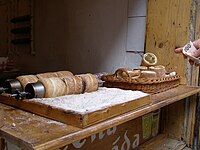 Trdelník on the metal pin upon which they are baked
 -
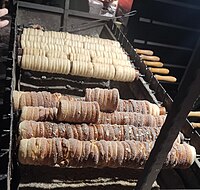 Trdelník being baked in a stall in Wenceslas Square, Prague
 -
Baking of trdelník


See also[edit]
References[edit]
- ^ Časopis Českého Musea. XXII/2. České Museum Prague. 1848. p. 331.
- ^ Menšik, J. S. (1983). Moravské národní pohádky a pověsti. p. 334.
- ^ Vlastimil Vondruška, František Skála (jr.) (1991). Církevní rok a lidové obyčeje. Nakladatelství DONA. p. 88. ISBN 9788085463033.
- ^ Tennent, James (1 March 2016). "Chimney cake: The doughnut ice cream foodporn oozing over your Instagram". Ibtimes.co.uk. Retrieved 15 December 2017.
- ^ "EUR-Lex – 32007R1485". EUR-Lex. Retrieved 15 December 2017.
- ^ "EUR-Lex – 52007XC0421(02)". EUR-Lex. Retrieved 15 December 2017.
- ^ Zvon: týdenník beletristický a literární. 1930. p. 153.
- ^ "Town Skalica: "Trdelník", a traditional cake from Skalica". Archived from the original on 3 March 2016.
External links[edit]
- History of trdelník
- Jůn, Dominik (23 August 2014). "The 'Old Bohemian' Trdelník". Czech Radio 7, Radio Prague.


| Regional varieties |  | |
|---|---|---|
