


Villers-Cotterêts
 | You can help expand this article with text translated from the corresponding article in French. (December 2008) Click [show] for important translation instructions.
|
Villers-Cotterêts | |
|---|---|
 Main square with a statue of Alexandre Dumas père and church | |
.svg) Coat of arms | |
Location of Villers-Cotterêts  | |
  Villers-Cotterêts  Villers-Cotterêts | |
| Coordinates: 49°15′36″N 3°05′26″E / 49.26°N 3.0906°E | |
| Country | France |
| Region | Hauts-de-France |
| Department | Aisne |
| Arrondissement | Soissons |
| Canton | Villers-Cotterêts |
| Government | |
| • Mayor (2020–2026) | Franck Briffaut[1] (RN) |
| Area 1 | 41.71 km2 (16.10 sq mi) |
| Population (2021)[2] | 10,454 |
| • Density | 250/km2 (650/sq mi) |
| Time zone | UTC+01:00 (CET) |
| • Summer (DST) | UTC+02:00 (CEST) |
| INSEE/Postal code | 02810 /02600 |
| Elevation | 65–226 m (213–741 ft) (avg. 120 m or 390 ft) |
| 1 French Land Register data, which excludes lakes, ponds, glaciers > 1 km2 (0.386 sq mi or 247 acres) and river estuaries. | |
Villers-Cotterêts (pronounced [vilɛʁ kɔt(ə)ʁɛ]) is a commune in the Aisne department in Hauts-de-France, France. It is notable as the signing-place in 1539 of the Ordinance of Villers-Cotterêts discontinuing the use of Latin in official French documents, and as the birthplace in 1802 of French novelist Alexandre Dumas père.
Geography[edit]
It is located 80 km (50 mi) NE of Paris via the RN2 facing Laon. Its nickname Petite villa sur la côte de Retz means Little villa by the coast of Retz, as the town is situated next to the Forest of Retz, which covers 130 km2 (50 sq mi) of land.
History[edit]
Villers-Cotterêts is famous in French law because of the Ordinance of Villers-Cotterêts of 1539 signed by king Francis I of France ('François Ier'), which made French the official language in the kingdom instead of regional languages like Occitan or the elite European lingua franca of the time, Latin.
In 1914, the British Expeditionary Force fought a rearguard action here during the Retreat from Mons. On 1 September, the British 4th (Guards) Brigade who were covering the withdrawal of 2nd Division, came into contact with the leading units of the German III Corps on the edge of woodland near Villers-Cotterêts. The brigade lost more than 300 men in the encounter, but were able to break away and continue the withdrawal.[3] Many are buried at Guards' Grave, a military cemetery maintained by the Commonwealth War Graves Commission.[4] An ancillary hospital to that of Royaumont was set up in the town and a silent documentary about it was made.[5][6]
La Plaine Saint-Rémy, Pisseleux, was an ancient commune that was merged with Villers-Cotterêts in 1971.
Population[edit]
The inhabitants are called Cottevreziens in French.
|
| ||||||||||||||||||||||||||||||||||||||||||||||||||||||||||||||||||||||||||||||||||||||||||||||||||||||||||||||||||
| |||||||||||||||||||||||||||||||||||||||||||||||||||||||||||||||||||||||||||||||||||||||||||||||||||||||||||||||||||
| Source: EHESS[7] and INSEE (1968-2017)[8] | |||||||||||||||||||||||||||||||||||||||||||||||||||||||||||||||||||||||||||||||||||||||||||||||||||||||||||||||||||

Notable residents[edit]
- Charles Baur (1929–2015), Mayor of Villers-Cotterêts (1953–1989), President of the Regional Council of Picardy (1976–1978, 1985–2004)[9]
Sports[edit]
The town was the start of Stage 4 in the 2007 Tour de France.
Sights[edit]
The original château was built around 950 AD and was burnt to the ground twice before being rebuilt out of stone in the early 12th century. The front entrance is the only original remaining structure, which is listed with the Historic Monument Registry at the École des Beaux Arts. Francis I purchased the château from the de Noüe family to house his mistress Anne de Pisseleu d'Heilly. The Château de Noüe was updated with 18th-century régence decoration by Gilles-Marie Oppenordt. The current owner is the Pépinières du Valois, an agricultural venture.
In 1902 the city opened a Museum Alexandre Dumas to gather souvenirs about the family. In 1952 the museum moved to a local 19th century mansion that served as General Maunoury's headquarters during the First World War. It has three rooms, each of them dedicated to one of the family members,[10] being the general Thomas-Alexandre Dumas, his son novelist Alexandre Dumas père and grandson novelist/playwright Alexandre Dumas fils.
See also[edit]

Gallery[edit]
-
![The 16th century Château de Noüe [fr]](//upload.wikimedia.org/wikipedia/commons/thumb/6/61/Villers-Cotter%C3%AAts_-_Ch%C3%A2teau_de_No%C3%BCe_-_2.jpg/120px-Villers-Cotter%C3%AAts_-_Ch%C3%A2teau_de_No%C3%BCe_-_2.jpg) The 16th century Château de Noüe
The 16th century Château de Noüe -
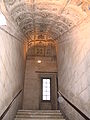 One of the very decorated staircases of the castle where King Francis I signed the Ordinance of Villers-Cotterêts.
 -
 Villers-Cotterêts town hall
![The 16th century Château de Noüe [fr]](/wiki/File:Villers-Cotter%C3%AAts_-_Ch%C3%A2teau_de_No%C3%BCe_-_2.jpg)


References[edit]
- ^ "Répertoire national des élus: les maires" (in French). data.gouv.fr, Plateforme ouverte des données publiques françaises. 6 June 2023.
- ^ "Populations légales 2021". The National Institute of Statistics and Economic Studies. 28 December 2023.
- ^ Mons 1914: the BEF's Tactical Triumph by David Lomas and Ed Dovey, Osprey Publishing, 1997 p.85
- ^ "CWGC - Cemetery Details". Commonwealth War Graves Commission. Retrieved 16 June 2012.
- ^ "Scottish Women's Hospitals: A field hospital on the front line during the First World War". Scotland on Screen. Retrieved 7 January 2022.
- ^ Cornelis, Marlene (2020). "The Scottish Women's Hospitals: the first World War and the careers of early medical women". Medicine, Conflict and Survival. 36 (2): 174–194. doi:10.1080/13623699.2020.1748320. PMID 32249598. S2CID 214811345.
- ^ Des villages de Cassini aux communes d'aujourd'hui: Commune data sheet Villers-Cotterêts, EHESS (in French).
- ^ Population en historique depuis 1968, INSEE
- ^ Alberts, Jennifer (5 January 2015). "Charles Baur, emblématique président du Conseil Régional de Picardie, est décédé". France 3. Retrieved 29 January 2015.
- ^ Page du musée sur le site internet de la mairie
External links[edit]

- Tourist office website (in French)
- Historic society of Villers-Cotterêts (in French)
- The Catholic Encyclopedia entry on Gilles-Marie Oppenordt

| International | |
|---|---|
| National | |
