


Patriarchate of Peć (monastery)
 The Church complex of the Monastery of Peć | |
| Monastery information | |
|---|---|
| Denomination | Eastern Orthodox |
| Established | 13th century |
| Diocese | Eparchy of Raška and Prizren (just territorially, since monastery is under direct patriarchal (stavropegial) jurisdiction) |
| Controlled churches |
|
| People | |
| Founder(s) | Archbishop Sava, Archbishop Arsenije I |
| Important associated figures | Archbishops Sava, Arsenije I, Nikodim I, Danilo II |
| Architecture | |
| Style | Serbo-Byzantine |
| Site | |
| Location | Near Peja (Serbian: Peć) |
| Country | Kosovo |
| Coordinates | 42°39′40″N 20°15′58″E / 42.661°N 20.266°E |
| Public access | Yes |
| Type | Cultural |
| Criteria | ii, iii, iv |
| Designated | 2004 (28th session), modified 2006 |
| Part of | Medieval Monuments in Kosovo |
| Reference no. | 724-002bis |
| Region | Europe and North America |
| Endangered | 2006–... |
| Official name | Manastir Pećka patrijaršija |
| Type | Monument of Culture of Exceptional Importance |
| Designated | 25 October 1947 |
| Reference no. | SК 1370 |
The Patriarchate of Peć Monastery (Serbian: Манастир Пећка патријаршија, romanized: Manastir Pećka patrijaršija, pronounced [pɛ̂ːt͡ɕkaː patrijǎ(ː)rʃija]; Albanian: Patrikana e Pejës) or the Patriarchal Monastery of Peć, is a medieval Serbian Orthodox monastery located near the city of Peja (Serbian: Peć), Kosovo. Built in the 13th century, it became the residence of Serbian Archbishops. It was expanded during the 14th century, and in 1346, when the Serbian Patriarchate of Peć was created, the Monastery became the seat of Serbian Patriarchs. The monastery complex consists of several churches, and during medieval and early modern times it was also used as mausoleum of Serbian archbishops and patriarchs. Since 2006, it is part of the "Medieval Monuments in Kosovo", a combined World Heritage Site along with three other monuments of the Serbian Orthodox Church.
The monastery is ecclesiastically administered by the Eparchy of Raška and Prizren, but it has special (stavropegial) status, since it is under direct jurisdiction of the Serbian Patriarch whose title includes Archbishop of Peć. The monastery church is unique in Serbian medieval architecture, with three churches connected as one whole,[1] with a total of four churches.[2]
Geography
[edit]The monastery complex is located near Peja (or Peć), in the Metohija region in Kosovo, near the border with Montenegro.[1] It is situated by the Peć Bistrica, at the entrance of the Rugova Canyon.[3] A morus nigra tree, 750 years old, is preserved in the monastery yard, called Šam-dud (sr), planted by Archbishop Sava II between 1263 and 1272.[4]
History
[edit].jpg)
The monastery is located at the edges of an old Roman and Byzantine Siperant.[1] The monastery complex, consisting of four churches,[2] of which three churches connected as one whole,[1] was built in the first third of the 13th century, 1321–24, and 1330–37.[1] It is presumed that the site became a metochion (land owned and governed by a monastery) of the Žiča monastery, the seat of the Serbian Archbishopric at that time, while Archbishop Sava (d. 1235) was still alive.[3] In the first third of the 13th century, Archbishop Arsenije I (s. 1233–63) had the Church of the Holy Apostles built on the north side.[5] That church was decorated on Arsenije's order in ca. 1250[3] or ca. 1260.[5] In 1253,[6] Arsenije I moved the Serbian Church seat from Žiča to Peć amid foreign invasion,[7][8][9] to a more secure location, closer to the centre of the country.[3] The Serbian Church seat was then shortly returned to Žiča in 1285, before being moved to Peja in 1291, again amid foreign invasion.[10][11] Archbishop Nikodim I (s. 1321–24) built the Church of St. Demetrius on the north side of the Church of the Holy Apostles, while his successor, Archbishop Danilo II (s. 1324–37) built the Church of the Holy Mother of God Hodegetria and the Church of St. Nicholas on the south side.[5] In front of the three main churches, he then raised a monumental narthex.[5] In the time of Archbishop Joanikije II, around 1345, the hitherto undecorated Church of St. Demetrius was decorated with frescoes. Serbian Emperor Stefan Dušan (r. 1331–1355) raised the Serbian Archbishopric to the patriarchal status in 1346, thus creating the Serbian Patriarchate of Peć.[12]

During the 14th century, small modifications were made to Church of the Holy Apostles, so some parts were decorated later. From the 13th to the 15th century, and in the 17th century, the Serbian Archbishops and Serbian Patriarchs were buried in the churches of the Patriarchate. In 1459–63, after the death of Arsenije II, the patriarchate became vacant upon abolishment by the Ottoman Empire but was restored in 1557 during the reign of sultan Suleiman the Magnificent.[13] The re-establishment was done under the advice of grand vizier Sokollu Mehmed Pasha, while some of Bulgarian eparchies were also placed under its jurisdiction.[14] Georgije Mitrofanović (1550–1630) painted new frescoes in the Church of St. Demetrius in 1619–20.[5] In 1673–74 painter Radul painted the Church of St. Nicholas.[5] In the early 18th century, and especially during and after the Austro-Russian–Turkish War (1735–1739), the patriarchate became the target of the Phanariotes and the Ecumenical Patriarchate of Constantinople, whose goal was to place the eparchies of the Serbian Patriarchate under its own jurisdiction. In 1737 the first Greek head of the Serbian Patriarchate was appointed after the intervention of Alexandros Mavrocordatos, who labeled the Serb leadership "untrustworthy". In the following years the Phanariotes embarked on policy initiatives that led to the exclusion of Serbs in the succession of the patriarchate, which was eventually abolished in September 1766.[15][16]
Period of Ottoman rule in the region ended in 1912.[17] At the beginning of the First Balkan War (1912–1913), army of the Kingdom of Montenegro entered Peja ((Serbian: Peć). By the Treaty of London (1913) the region of Peja was officially awarded to Montenegro and the Monastery of Peć again became an episcopal seat.[18] Bishop Gavrilo Dožić of Peć (future Serbian Patriarch) initiated works on monastery complex, but those efforts were halted due to the breakout of the First World War (1914) and subsequent Austro-Hungarian occupation of Montenegro, including Peja. War ended in 1918, and Montenegro joined Kingdom of Serbia and South Slavic provinces of former Austria-Hungary to form the Kingdom of Serbs, Croats and Slovenians. In 1920, structural unity of Serbian Orthodox Church was restored, and Serbian Patriarchate was renewed, with traditional primatial seat in the Patriarchal Monastery of Peć.[19] Since then, all Serbian Patriarchs were enthroned in the Monastery.[20] Major reconstruction works in the Monastery were undertaken during 1931 and 1932.[21]

In 1947, the Patriarchate of Peć was added to Serbia's "Monument of Culture of Exceptional Importance" list,[5] and on 13 July 2006 it was placed on UNESCO's World Heritage List as an extension of the Visoki Dečani site which was overall placed on the List of World Heritage in Danger.[22]
In March 2004, during the wave of ethnic violence in Kosovo, the Patriarchate was threatened but narrowly avoided destruction.[23] The monastery complex was placed under increased protection by international peacekeeping forces, preventing it from being attacked.
From 2004 onwards, the protection of the Patriarchate of Peć was primarily handled by NATO-led Kosovo Force (KFOR) troops. KFOR had been deployed in Kosovo since 1999 following UN Security Council Resolution 1244, tasked with maintaining a secure environment and safeguarding important sites, including Serbian Orthodox monasteries like the Patriarchate. This protection continued through the years, with KFOR troops ensuring the site remained unharmed, particularly during periods of ethnic tension. Over time, some responsibilities have been gradually transferred to the Kosovo Police, causing some concern among Serbs, who were wary of the transition.[24][25] KFOR retained its protective role during the critical years after the March 2004 violence.
Restoration of the complex began in June 2006 and was completed in November 2006. The main aim was to protect the complex from the weather, as well as to repair the inner walls and exterior appearance. Two previously unknown frescoes were uncovered on the north facade of the Church of St. Demetrios, of a Serbian queen and nobleman.[26] In 2008, the church facades were painted red, as Žiča, which led to some reactions.
Mausoleum
[edit]Serbian Orthodox archbishops and patriarchs were ktetors of the monastery, and these were buried in its churches. The monastery is the greatest mausoleum of Serbian religious dignitaries.[6] The monastery holds the relics of Serbian church leaders (most of whom are saints) Arsenije (s. 1233–63), Sava II (s. 1263–71), Jevstatije I (s. 1279–86), Nikodim I (s. 1316–24), Danilo II (s. 1324–37), Joanikije II (s. 1338–54), Jefrem (s. 1375–79; 1389–92), Spiridon (s. 1380–89) and Maksim I (s. 1655–74).
Complex
[edit]Churches
[edit]| Church | Image | Notes |
|---|---|---|
| Church of the Holy Apostles (Crkva sv. Apostola, also called Church of the Holy Saviour) |

|
Built in the first third of the 13th century. |
| Church of St. Demetrius (Crkva sv. Dimitrija) |
|
Built by 1324 |
| Church of the Holy Mother of God Hodegetria (Crkva Bogorodice Odigitrije) |

|
Built by 1337 |
| Church of St. Nicholas (Crkva sv. Nikole) |

|
Built by 1337. A small modest church built at the side of the Hodegetria Church. |
The three main churches with domes (Holy Apostles, St. Demetrius and Hodegetria) are connected with each other, linked by a joint monumental narthex. A smaller church, without a dome, is by the side of the Hodegetria Church.
Gallery
[edit]-
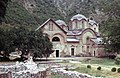 Photograph from June 1980
 -
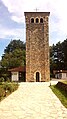 Tower in the monastery yard
 -
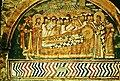 Burial of Sava II
 -
 Fresco of the Nemanjić dynasty
 -
 Šam-dud, a 750-year-old tree


See also
[edit]- Category:Burials at the Patriarchate of Peć (monastery)
- List of Serb Orthodox monasteries
- Archbishops of Peć and Serbian Patriarchs
- Serbs in Kosovo
- Tourism in Kosovo
- Kosovo: A Moment in Civilization
References
[edit]- ^ a b c d e Krstić 2003, p. 22.
- ^ a b Janićijević 1998, p. 524.
- ^ a b c d Stefanović 2001.
- ^ "Шам-дуд чува Пећку патријаршију 750 година". politika.rs.
- ^ a b c d e f g Манастир Пећка патријаршија.
- ^ a b Ерић 2006, p. 212.
- ^ Ćirković 2004, p. 50.
- ^ Vásáry 2005, p. 100.
- ^ Коматина 2016, p. 297, 407.
- ^ McAllester 2001, p. 52.
- ^ Коматина 2016, p. 368, 407.
- ^ Fotić 2008, p. 519.
- ^ Fotić 2008, p. 519-520.
- ^ Kia 2011, p. 117.
- ^ Frazee 1969, p. 6-7.
- ^ Fotić 2008, p. 520.
- ^ Ćirković 2004, p. 245-246.
- ^ Đorđević & Pejić 1999, p. 18, 21.
- ^ Petković 1982, p. 8.
- ^ Warrander & Knaus 2010, p. 161.
- ^ Petković 1982, p. 8, 16, 31.
- ^ UNESCO (2006). "List of World Heritage in Danger". Retrieved 24 February 2013.
- ^ OSCE (2016). "Building Blocks for Peace: Cultural Heritage Protection in Kosovo". Retrieved 2 October 2024.
- ^ "NATO's Role in Kosovo". Retrieved 3 October 2024.
- ^ "Srpske svetinje na KiM strahuju od čuvara". novosti.rs.
- ^ "Work on Restoration of Pec Patriarchate Draws to a Close". KIM Info Newsletter. November 14, 2006. Archived from the original on October 16, 2013. Retrieved 2014-05-18.
Sources
[edit]- Базић, Миљојко М. (2007). Идентитет и културно наслеђе Срба. Београд: Научна КМД.
- Čanak-Medić, Milka; Todić, Branislav (2017). The Monastery of the Patriarchate of Peć. Novi Sad: Platoneum, Beseda.
- Ćirković, Sima (2004). The Serbs. Malden: Blackwell Publishing. ISBN 9781405142915.
- Curta, Florin (2006). Southeastern Europe in the Middle Ages, 500–1250. Cambridge: Cambridge University Press.
- Đorđević, Života; Pejić, Svetlana, eds. (1999). Cultural Heritage of Kosovo and Metohija. Belgrade: Institute for the Protection of Cultural Monuments of the Republic of Serbia.
- Ђурић, Војислав Ј.; Ћирковић, Сима; Кораћ, Војислав (1990). Пећка патријаршија. Београд-Приштина: Југословенска ревија, Јединство.
- Ерић, Слободан (2006). Косово и Метохија: Аргументи за останак у Србији. Београд: Удружење грађана Цер.
- Ferrari, Silvio; Benzo, Andrea (2014). Between Cultural Diversity and Common Heritage: Legal and Religious Perspectives on the Sacred Places of the Mediterranean. London & New York: Routledge. ISBN 9781317175032.
- Fine, John Van Antwerp Jr. (1994) [1987]. The Late Medieval Balkans: A Critical Survey from the Late Twelfth Century to the Ottoman Conquest. Ann Arbor, Michigan: University of Michigan Press.
- Fotić, Aleksandar (2008). "Serbian Orthodox Church". Encyclopedia of the Ottoman Empire. New York: Infobase Publishing. pp. 519–520. ISBN 9781438110257.
- Frazee, Charles A. (1969). The Orthodox Church and Independent Greece 1821-1852. Cambridge: Cambridge University Press.
- Janićijević, Jovan, ed. (1998). The Cultural Treasury of Serbia. Belgrade: IDEA, Vojnoizdavački zavod, Markt system.
- Јанковић, Марија (1985). Епископије и митрополије Српске цркве у средњем веку (Bishoprics and Metropolitanates of Serbian Church in Middle Ages). Београд: Историјски институт САНУ.
- Kia, Mehrdad (2011). Daily Life in the Ottoman Empire. Santa Barbara, California: Greenwood Press.
- Коматина, Ивана (2016). Црква и држава у српским земљама од XI до XIII века. Београд: Историјски институт.
- Krstić, Branislav (2003). Saving the Cultural Heritage of Serbia and Europe in Kosovo and Metohia. Belgrade: Coordination Center of the Federal Government and the Government of the Republic of Serbia for Kosovo and Metohia.
- Ljubinković, Radivoje (1975). The Church of the Apostles in the Patriarchate of Peć. Belgrade: Jugoslavija.
- McAllester, Matthew (2001). Beyond the Mountains of the Damned: The War Inside Kosovo. New York-London: New York University Press.
- Мијовић, Павле (1960). Пећка Патријаршија. Београд: Туристичка штампа.
- Милеуснић, Слободан (2007). Водич кроз манастире у Србији. Београд: МСТ Гајић, Завод за унапређивање образовања и васпитања.
- Pavlovich, Paul (1989). The History of the Serbian Orthodox Church. Serbian Heritage Books.
- Pavlowitch, Stevan K. (2002). Serbia: The History behind the Name. London: Hurst & Company.
- Petković, Sreten (1982). The Patriarchate of Peć. Belgrade: Serbian Patriarchate.
- Popović, Svetlana (2002). "The Serbian Episcopal sees in the thirteenth century (Српска епископска седишта у XIII веку)". Старинар (51: 2001): 171–184.
- Слијепчевић, Ђоко М. (1962). Историја Српске православне цркве (History of the Serbian Orthodox Church). Vol. књ. 1. Минхен: Искра.
- Subotić, Gojko (1975). The Church of St. Demetrius in the Patriarchate of Peć. Belgrade: Jugoslavija.
- Subotić, Gojko (1998). Art of Kosovo: The Sacred Land. New York: The Monacelli Press.
- Todić, Branislav (1999). Serbian Medieval Painting: The Age of King Milutin. Belgrade: Draganić.
- Tomasevich, Jozo (2001). War and Revolution in Yugoslavia, 1941–1945: Occupation and Collaboration. Vol. 2. San Francisco: Stanford University Press.
- Vásáry, István (2005). Cumans and Tatars: Oriental Military in the Pre-Ottoman Balkans, 1185–1365. Cambridge: Cambridge University Press.
- Veremis, Thanos; Kofos, Evangelos, eds. (1998). Kosovo: Avoiding Another Balkan War. Athens: Hellenic Foundation for European and Foreign Policy.
- Vlasto, Alexis P. (1970). The entry of the Slavs into Christendom. Cambridge University Press.
- Вуковић, Сава (1996). Српски јерарси од деветог до двадесетог века (Serbian Hierarchs from the 9th to the 20th Century). Евро, Унирекс, Каленић.
- Warrander, Gail; Knaus, Verena (2010). Kosovo (2nd ed.). Bradt Travel Guides.
External links
[edit]
- САНУ. "Манастир Пећка патријаршија". Споменици културе у Србији.
- Patriarchate of Peć- virtual tours and photo collections of the Blago Fund
- Stefanović, Zoran, ed. (2001). The Patriarchate of Peć. Belgrade: Projekat Rastko.
- Official site of Serbian Orthodox Eparchy of Raška and Prizren - old
- New official site of Serbian Orthodox Eparchy of Raška and Prizren
- Official site of the Serbian Orthodox Church
- Serbian Unity Congress
- Map - Area under jurisdiction of Patriarchate of Peć in the 17th century


- Cultural Monuments of Exceptional Importance (Serbia)
- Medieval Serbian Orthodox monasteries
- Serbian Orthodox monasteries in Kosovo
- World Heritage Sites in Serbia
- Monuments and memorials in Kosovo
- Medieval Serbian sites in Kosovo
- Christian monasteries established in the 13th century
- Burial sites of Serbian Orthodox clergy
- Cultural heritage of Kosovo
- Patriarchate of Peć
- Eastern Orthodox pilgrimage sites