


Agnes of Rome
Agnes of Rome | |
|---|---|
 Saint Agnes by Domenichino (c. 1620) | |
| Virgin and martyr | |
| Born | c. 291 Rome, Italy |
| Died | c. 304 Rome, Italy |
| Venerated in | Catholic Church, Eastern Orthodox Churches, Oriental Orthodox Churches, Anglican Churches, and Lutheran Churches. |
| Canonized | Pre-congregation |
| Major shrine | Church of Sant'Agnese fuori le mura and the Church of Sant'Agnese in Agone, both in Rome |
| Feast | 21 January; before Pope John XXIII revised the calendar, there was a second feast on 28 January |
| Attributes | A lamb, martyr's palm |
| Patronage | Girls; chastity and virgins; victims of sexual abuse; betrothed couples; gardeners; Girl Guides; the Diocese of Rockville Centre, New York; Children of Mary; Collegio Capranica, Rome; the city of Fresno. |
Agnes of Rome (c. 291 – c. 304) is a virgin martyr, venerated as a saint in the Catholic Church, Oriental Orthodox Church and the Eastern Orthodox Church, as well as the Anglican Communion and Lutheran Churches.[1] She is one of several virgin martyrs commemorated by name in the Canon of the Mass, and one of many Christians martyred during the reign of the Roman emperor Diocletian.
Biography[edit]
Substantially the broader social circumstances of her martyrdom are believed to be authentic, though the legend cannot be proven true, and many details of the fifth-century Acts of Saint Agnes are open to criticism.[2] A church was built over her tomb, and her relics venerated.[3]
According to tradition, Agnes was a member of the Roman nobility, born in AD 291 and raised in an early Christian family. She suffered martyrdom at the age of 12 or 13 during the reign of the Roman emperor Diocletian, on 21 January 304.[4][5]
A beautiful young girl from a wealthy family, Agnes had many suitors of high rank, and the young men, slighted by her resolute devotion to religious purity, submitted her name to the pagan authorities as a follower of Christianity.[6][7] One suitor, Procop, brought Agnes to his father, the governor, who urged Agnes to deny God, but she refused.[8]
The Prefect Sempronius condemned Agnes to be dragged naked through the streets to a brothel. In one account, as she prayed, her hair grew and covered her body.[9] It was also said that all of the men who attempted to rape her were immediately struck blind. The son of the prefect was struck dead but revived after she prayed for him, causing her release. There commenced a trial from which Sempronius recused himself, allowing another figure to preside and sentence St. Agnes to death. She was led out and bound to a stake, but the bundle of wood would not burn, or the flames parted away from her, whereupon the officer in charge of the troops drew his sword and beheaded her, or, in some other texts, stabbed her in the throat. It is also said that her blood poured to the stadium floor where other Christians soaked it up with cloths.[10]

Agnes was buried beside the Via Nomentana in Rome.[6] A few days after her death, her foster-sister, Emerentiana, was found praying by her tomb; she claimed to be the daughter of Agnes' wet nurse, and was stoned to death after refusing to leave the place and reprimanding the people for killing her foster-sister. Emerentiana was also later canonized. The daughter of Constantine I, Constantina, was said to have been cured of leprosy after praying at Agnes' tomb. She and Emerentiana appear in the scenes from the life of Agnes on the 14th-century Royal Gold Cup in the British Museum.
An early account of Agnes' death, stressing her young age, steadfastness and virginity, but not the legendary features of the tradition, is given by Ambrose.[4]
Veneration[edit]

Agnes was venerated as a saint at least as early as the time of St Ambrose, based on an existing homily. She is commemorated in the Depositio Martyrum of Filocalus (354) and in the early Roman Sacramentaries.[7]
Saint Agnes' bones are conserved beneath the high altar in the church of Sant'Agnese fuori le mura in Rome,[11] built over the catacomb that housed her tomb. Her skull is preserved in a separate chapel in the church of Sant'Agnese in Agone in Rome's Piazza Navona.
Agnes is remembered in the Anglican Communion with a Lesser Festival on 21 January.[12][13][14]
Patronage[edit]

Because of the legend around her martyrdom, Saint Agnes is patron saint of those seeking chastity and purity.[3] She is also the patron saint of young girls and girl scouts. Folk custom called for them to practise rituals on Saint Agnes' Eve (20–21 January) with a view to discovering their future husbands. This superstition has been immortalised in John Keats's poem The Eve of Saint Agnes.[15]
Iconography[edit]
Since the Middle Ages, Saint Agnes has traditionally been depicted as a young girl with her long hair down, with a lamb, the symbol of both her virginal innocence[16] and her name, and a sword (together with the palm branch an attribute of her martyrdom). The lamb, which is agnus in the Latin language, is also the linguistic link to the traditional blessing of lambs.[17] Saint Agnes has been depicted with a lamb since the 4th century.[18][19]
Blessing of the lambs[edit]
On the feast of Saint Agnes, two lambs are traditionally brought from the Trappist abbey of Tre Fontane in Rome to be blessed by the Pope. In summer, the lambs are shorn, and the wool is used to weave the pallia, which the Pope gives on the feast of Saint Peter and Paul to the newly appointed metropolitan archbishops as a sign of his jurisdiction and their union with the pope.[6][20][21] This tradition of the blessing of the lambs has been known since the 16th century.[22]
Notable churches[edit]

- Basilica of St James and St Agnes, Nysa, Poland
- St Agnes Cathedral, Rockville Centre, New York[23]
- St Agnes Church, New York City
- Sant'Agnese in Agone, Rome
- Sant'Agnese fuori le mura, Rome
- Sainte-Agnès, Lac-Mégantic, Quebec, Canada
- St Agnes, St Agnes, Cornwall, England[24]
- St Agnes, Cologne, Germany
- St Agnes, Cawston, Norfolk, England
- St Agnes' Church, St Agnes, Isles of Scilly, England
- St Agnes Cathedral, Springfield, Missouri, US
- St Agnes Church, Saint Paul, Minnesota
- St. Agnes Roman Catholic Church, Key Biscayne, Florida[25]
Legacy[edit]
The Congregation of Sisters of St. Agnes is a Roman Catholic religious community for women based in Fond du Lac, Wisconsin, US. It was founded in 1858, by Father Caspar Rehrl, an Austrian missionary, who established the sisterhood of pioneer women under the patronage of Agnes, to whom he had a particular devotion.

The city of Santa Ynez, California is named after her.
Cultural references[edit]
Hrotsvitha, the 10th-century nun and poet, wrote a heroic poem about Agnes.[26]
In the historical novel Fabiola or, the Church of the Catacombs, written by Cardinal Nicholas Wiseman in 1854, Agnes is the soft-spoken teenage cousin and confidant of the protagonist, the beautiful noblewoman Fabiola.[27]
The Eve of St. Agnes is a Romantic narrative poem written by John Keats in 1819.
The instrumental song "Saint Agnes and the Burning Train" appears on the 1991 album The Soul Cages by Sting.
The song "Bear's Vision of St. Agnes" appears on the 2012 album Ten Stories by rock band mewithoutYou.
The St. Agnes Library is a branch of the New York Public Library located on the Upper West Side of Manhattan, on Amsterdam Avenue between West 81st and West 82nd Streets.[28]
Gallery[edit]
-
 18th-century statue of Saint Agnes and the Lamb of God by Vincenzo Felici, located in the Pantheon, Rome, Italy
 -
 9th-century mosaic in the Church of St. Praxedes, Rome
 -
 16th-century polychrome statue in Burgos Cathedral, Spain
 -
 The saint's statue is among those on the colonnade in St. Peter's Square.
 -
 1593 by Girolamo Campagna Santa Maria Gloriosa dei Frari
 -
 Statue in Gora Oljka, Slovenia
 -

-

-
 Statue of Saint Agnes, Camarin, Caloocan, Philippines
 -
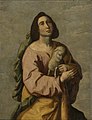 Santa Inês by Francisco de Zurbarán
 -
 17th-century painting by Cesare Dandini
 -
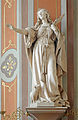 Sculpture in the Parish church of Urtijëi
 -
 A statue of Saint Agnes that survived the atomic bombing of Nagasaki, formerly of Urakami Cathedral, now on display at the United Nations Headquarters
 -
 Saint Agnes with John the Baptist by Quentin Matsys
 -
 Pencil drawing by Johann Friedrich Overbeck
 -
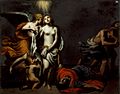 Saint Agnes Protected by an Angel, painting by Alessandro Turchi


_nave_right_-_Statue_of_Saint_Agnes_by_Girolamo_Campagna.jpg)


_-_John_the_Baptist_and_St_Agnes_-_WGA14280.jpg)


See also[edit]
References[edit]
- ^ admin (2024-01-17). "Saint Agnes of Rome". Understanding Faith. Retrieved 2024-04-14.
- ^ "Monks of Ramsgate. "Agnes". Book of Saints, 1921. CatholicSaints.Info. 12 May 2012".
- ^ a b ""St. Agnes", Faith ND, University of Notre Dame".
- ^ a b "NPNF210. Ambrose: Selected Works and Letters – Christian Classics Ethereal Library". Ccel.org. 2005-06-01. Retrieved 2009-01-21.
- ^ "Our Patroness: St. Agnes the Martyr". St. Agnes Parish. Retrieved 2024-04-12.
- ^ a b c "St. Agnes, Virgin and Martyr". St. Agnes Cathedral. Archived from the original on 2015-01-21. Retrieved 2013-04-24.
- ^ a b "Duffy, Patrick. "Jan 21 – St Agnes (d. 305) martyr", Catholic Ireland, 21 January 2012".
- ^ "Our Patroness: St. Agnes the Martyr". St. Agnes Parish. Retrieved 2024-04-12.
- ^ "St. Agnes of Rome". Antiochian Orthodox Christian Archdiocese.
- ^ "Saint Agnes of Rome, Virgin and Martyr". Learn Religions. Retrieved 31 January 2020.
- ^ ""Virginmartyr Agnes of Rome", Orthodox Church in America".
- ^ "The Calendar". The Church of England. Retrieved 2021-03-27.
- ^ "For All the Saints / For All the Saints - A Resource for the Commemorations of the Calendar / Worship Resources/ Karakia/ ANZPB-HKMOA / Resources / Home - Anglican Church in Aotearoa, New Zealand and Polynesia". www.anglican.org.nz. Retrieved 2021-03-27.
- ^ "Agnes and Cecilia of Rome". The Episcopal Church. Retrieved 2022-07-19.
- ^ One or more of the preceding sentences incorporates text from a publication now in the public domain: Chisholm, Hugh, ed. (1911). "Agnes, Saint". Encyclopædia Britannica. Vol. 1 (11th ed.). Cambridge University Press. p. 377.
- ^ "CATHOLIC ENCYCLOPEDIA: St. Agnes of Rome".
- ^ "Why is St. Agnes depicted with a lamb?". Aleteia — Catholic Spirituality, Lifestyle, World News, and Culture. 2023-01-20. Retrieved 2024-04-12.
- ^ "Why is St. Agnes depicted with a lamb?". Aleteia — Catholic Spirituality, Lifestyle, World News, and Culture. 2023-01-20. Retrieved 2024-04-12.
- ^ "St Agnes, Little Lamb of the Lord". Missionaries of Divine Revelation. 2015-08-07. Retrieved 2024-04-12.
- ^ "Pope modifies and enriches Pallium Investiture Ceremony". Vatican Radio. January 29, 2015. Retrieved January 29, 2015.
- ^ "Pope Francis celebrates Saint Agnes with blessing of lambs".
- ^ "Blessing of lambs a 500 year old tradition, priest reveals".
- ^ ""History", St. Agnes Cathedral". Archived from the original on 2018-09-13. Retrieved 2019-01-29.
- ^ "Church of St Agnes, English Heritage National Monuments".
- ^ Pacenti, John (2023-06-19). "St. Agnes pastor to critics: "We are building to leave a legacy". Key Biscayne Independent. Retrieved 2024-04-12.
- ^ "The non-dramatic works of Hrosvitha : Text, translation, and commentary". 1936.
- ^ Librivox. "LibriVox". librivox.org. Retrieved 2018-03-16.
- ^ "St. Agnes Library".

Further reading[edit]
- Of Saint Agnes in "Ælfric's Lives of Saints", by Ælfric of Eynsham London, Pub. for the Early English text society, by N. Trübner & co. (1881).
- Henry Gardiner Adams, ed. (1857). "Agnes, Saint". A Cyclopaedia of Female Biography: 14. Wikidata Q115376221.
- Kirsch, Johann Peter (1907). . In Herbermann, Charles (ed.). Catholic Encyclopedia. Vol. 1. New York: Robert Appleton Company.
External links[edit]


- "St Agnes – St Peter's Square Colonnade Saints"
- Satucket.com, St. Agnes of Rome
- "Saint Agnes" at the Christian Iconography website
- "Of Saint Agnes" from the Caxton translation of the Golden Legend
- Remarks on the feast of St. Agnes from St. Ambrose of Milan, On Virgins
- Saint Agnes – The patron saint of young girls.


- Christian child saints
- 291 births
- 304 deaths
- 4th-century Christian martyrs
- 3rd-century Roman women
- 4th-century Roman women
- 3rd-century Christian saints
- 4th-century Christian saints
- People executed by the Roman Empire
- Virgin martyrs
- Burials at Sant'Agnese fuori le mura
- Ante-Nicene Christian female saints
- Late Ancient Christian female saints
- Anglican saints
- Christians martyred during the reign of Diocletian
- Christian martyrs