


British Rail Class 27
| BRCW Type 2 British Rail Class 27 | |||||||||||||||||||||||||||||||||||||||||
|---|---|---|---|---|---|---|---|---|---|---|---|---|---|---|---|---|---|---|---|---|---|---|---|---|---|---|---|---|---|---|---|---|---|---|---|---|---|---|---|---|---|
 A Class 27 at Carlisle. | |||||||||||||||||||||||||||||||||||||||||
| |||||||||||||||||||||||||||||||||||||||||
| |||||||||||||||||||||||||||||||||||||||||
| |||||||||||||||||||||||||||||||||||||||||
| |||||||||||||||||||||||||||||||||||||||||
British Rail's Class 27 comprised 69 diesel locomotives built by the Birmingham Railway Carriage and Wagon Company (BRCW) during 1961 and 1962. They were a development of the earlier Class 26; both were originally classified as the BRCW Type 2. The Class 27s were numbered D5347-D5415.[1]
Working life[edit]
.jpg)
  ED  HA | ||
| Code | Name | Quantity |
|---|---|---|
| ED | Eastfield | 57 |
| HA | Haymarket | 11 |
| Withdrawn (1966) | 1 | |
| Total built: | 69 | |
Original allocations were D5347–D5369 to Glasgow Eastfield, D5370–D5378 to Thornaby and D5379–D5415 to London Cricklewood for Tilbury Boat trains and Cross-London freight services. In the period September to December 1963, some of the Cricklewood allocation were transferred to Leicester and in December 1965 the Thornaby allocation was also nominally transferred to Leicester to join them. Traffic changes combined with reallocation of Class 25s led to the gradual transfer of the Leicester and Cricklewood locomotives to Scotland during 1969 thus concentrating the whole class within Scotland and being part of the replacement fleet that allowed the withdrawal of the poorly performing Clayton Class 17 locomotives from traffic. For many years they were extensively used on the West Highland Line. By September 1986, the final vacuum brake only locomotives had been withdrawn, regular duties on passenger services had ceased and only twenty-one of the class remained, allocated entirely to Eastfield depot. A mass withdrawal in July 1987 due to the presence of blue asbestos left 27008 as the last in service. Its final working was on 13 August and the loco was officially withdrawn on 19 August 1987. The Class 27s were actually outlived by the older Class 26s, whose less powerful engines were more reliable.
Sub-classes[edit]
- 27/0: Locomotives as built with steam heating (excluding 27024–27031)
- 27/1: Locomotives converted in 1971–1973 for push pull operation, renumbered back to 27/0 after conversion starting in 1982.
- 27/2: Locomotives converted in 1973–1976 with Electric Train Heat, renumbered back to 27/0 after conversion starting in 1982.
Edinburgh-Glasgow push-pull operation[edit]
By the late 1960s, the Swindon-built Inter City DMUs operating the Edinburgh Waverley - Glasgow Queen Street express service were becoming unreliable. In 1970 the decision was made to replace them with locomotive-hauled carriages. So between 1971 and 1973, twenty-four Class 27s were fitted-up with dual (vacuum and air) brakes and reclassified Class 27/1, while 36 Mark 2 carriages (7 brake second opens, 22 open seconds, and 7 corridor firsts) swapped their vacuum-operated shoe brakes for air-operated disc brakes and were though-wired with "Blue Star" control cables to enable "top and tail" push-pull working. It was later decided that as the Mark 2 stock was dual (steam or electric) heated, to convert half the 27/1 fleet to electric train heat, by replacing the train heating boiler with a Deutz 8-cylinder, air-cooled diesel engine and alternator. The conversions were then classified as Class 27/2, and were used on one end of the train, with a 27/1 on the other.
The very intensive 90 mph (140 km/h) "push-pull" service was demanding on the locomotives and reliability started to suffer. The 27/2s, especially, appeared prone to fire damage, especially from their electric train heating alternators. The push-pull sets were replaced in 1980 by single Class 47/7s at one end of a rake of Mark 2 carriages and a DBSO. The Class 27/1s and 27/2s were then renumbered to 27/0 and could often be found on Edinburgh-Dundee semi-fast passenger services, until their replacement, briefly by Class 101 and subsequently by Class 150 Sprinter DMUs in 1987, whilst the remainder were largely used on freight.
Accidents and incidents[edit]
- On 30 June 1962, locomotive D5386 was in a minor collision with a diesel multiple unit at Cricklewood carriage sidings, London due to confusion over a hand signal. The engine is now preserved and stored at Barrow Hill Roundhouse.[3]
- On 25 August 1965, locomotive D5383 was heading a freight train that collided with the rear on another freight train at East Langton. It was taken to Derby Works for evaluation, but was withdrawn in January the following year.[4]
- Locomotive 27 044 was severely damaged by fire before 5 September 1980. It was consequently withdrawn and scrapped.[5]
Fleet list[edit]
| Original D-series No. |
First TOPS No. |
Second TOPS No. |
Third TOPS No. |
BRCW serial No. |
Date built | Date withdrawn | Notes |
|---|---|---|---|---|---|---|---|
| D5347 | 27001 | — | — | DEL190 | Jun 1961 | Jul 1987 | Preserved |
| D5348 | 27002 | — | — | DEL191 | Jul 1961 | Jan 1986 | |
| D5349 | 27003 | — | — | DEL192 | Jul 1961 | Jan 1987 | |
| D5350 | 27004 | — | — | DEL193 | Aug 1961 | May 1986 | |
| D5351 | 27005 | — | — | DEL194 | Aug 1961 | Jul 1987 | Preserved |
| D5352 | 27006 | — | — | DEL195 | Sep 1961 | Jan 1976 | |
| D5353 | 27007 | — | — | DEL196 | Sep 1961 | Jan 1985 | Preserved |
| D5354 | 27008 | — | — | DEL197 | Sep 1961 | Aug 1987 | |
| D5355 | 27009 | — | — | DEL198 | Sep 1961 | Jul 1980 | Withdrawn due to fire damage[7] |
| D5356 | 27010 | — | — | DEL199 | Oct 1961 | Apr 1986 | |
| D5357 | 27011 | — | — | DEL200 | Oct 1961 | Mar 1981 | |
| D5358 | 27012 | — | — | DEL201 | Oct 1961 | May 1986 | |
| D5359 | 27013 | — | — | DEL202 | Nov 1961 | Jul 1976 | |
| D5360 | 27014 | — | — | DEL203 | Nov 1961 | Sep 1986 | |
| D5361 | 27015 | — | — | DEL204 | Nov 1961 | Jan 1977 | Withdrawn due to accident damage[7] |
| D5362 | 27016 | — | — | DEL205 | Nov 1961 | Apr 1984 | |
| D5363 | 27017 | — | — | DEL206 | Dec 1961 | May 1986 | |
| D5364 | 27018 | — | — | DEL207 | Dec 1961 | May 1986 | |
| D5365 | 27019 | — | — | DEL208 | Dec 1961 | May 1984 | |
| D5366 | 27020 | — | — | DEL209 | Jan 1962 | Apr 1986 | |
| D5367 | 27021 | — | — | DEL210 | Jan 1962 | Jun 1985 | |
| D5368 | 27022 | — | — | DEL211 | Jan 1962 | Jan 1985 | |
| D5369 | 27023 | — | — | DEL212 | Jan 1962 | May 1986 | |
| D5370 | 27024 | ADB968028 | — | DEL213 | Jan 1962 | Jul 1987 | Preserved |
| D5371 | 27025 | — | — | DEL214 | Jan 1962 | Jun 1987 | |
| D5372 | 27026 | — | — | DEL215 | Jan 1962 | Jul 1987 | |
| D5373 | 27027 | — | — | DEL216 | Jan 1962 | Jun 1983 | |
| D5374 | 27101 | 27045 | — | DEL217 | Feb 1962 | May 1986 | |
| D5375 | 27028 | — | — | DEL218 | Feb 1962 | Aug 1984 | |
| D5376 | 27029 | — | — | DEL219 | Feb 1962 | Jan 1986 | |
| D5377 | 27030 | — | — | DEL220 | Feb 1962 | Apr 1986 | |
| D5378 | 27031 | — | — | DEL221 | Mar 1962 | May 1978 | Withdrawn due to fire damage[7] |
| D5379 | 27032 | — | — | DEL222 | Mar 1962 | May 1985 | |
| D5380 | 27102 | 27046 | — | DEL223 | Apr 1962 | Jul 1987 | |
| D5381 | 27033 | — | — | DEL224 | Apr 1962 | Feb 1986 | |
| D5382 | 27034 | — | — | DEL225 | Apr 1962 | Jul 1984 | |
| D5383 | — | — | — | DEL226 | Apr 1962 | Jan 1966 | Withdrawn due to accident damage[7] at East Langton, 20 August 1965 |
| D5384 | 27035 | — | — | DEL227 | May 1962 | Sep 1976 | |
| D5385 | 27036 | — | — | DEL228 | May 1962 | Apr 1986 | |
| D5386 | 27103 | 27212[i] | 27066 | DEL229 | May 1962 | Jul 1987 | Preserved |
| D5387 | 27104 | 27048 | — | DEL230 | May 1962 | May 1986 | |
| D5388 | 27105 | 27049 | — | DEL231 | May 1962 | Apr 1987 | |
| D5389 | 27037 | — | — | DEL232 | May 1962 | Mar 1986 | |
| D5390 | 27038 | — | — | DEL233 | Jun 1962 | Feb 1987 | |
| D5391 | 27119 | 27201 | — | DEL234 | Jun 1962 | Jan 1979 | |
| D5392 | 27120 | 27202 | — | DEL235 | Jun 1962 | Aug 1980 | Withdrawn due to fire damage[7] |
| D5393 | 27121 | 27203 | 27057 | DEL236 | Jun 1962 | May 1985 | |
| D5394 | 27106 | 27050 | — | DEL237 | Jun 1962 | Jul 1987 | Preserved |
| D5395 | 27107 | 27051 | — | DEL238 | Jun 1962 | Jul 1987 | |
| D5396 | 27108 | 27052 | — | DEL239 | Jun 1962 | Jul 1987 | |
| D5397 | 27109 | 27053 | — | DEL240 | Aug 1962 | May 1987 | |
| D5398 | 27039 | — | — | DEL241 | Jul 1962 | Oct 1975 | |
| D5399 | 27110 | 27054 | — | DEL242 | Jul 1962 | Jul 1987 | |
| D5400 | 27111 | 27055 | — | DEL243 | Jul 1962 | Jul 1987 | |
| D5401 | 27112 | 27056 | — | DEL244 | Jul 1962 | Feb 1987 | Preserved |
| D5402 | 27040 | — | — | DEL245 | Jul 1962 | Jan 1986 | |
| D5403 | 27122 | 27204 | 27058 | DEL246 | Jul 1962 | May 1986 | |
| D5404 | 27133 | 27207 | 27061 | DEL247 | Jul 1962 | May 1986 | |
| D5405 | 27041 | — | — | DEL248 | Jul 1962 | May 1986 | |
| D5406 | 27042 | — | — | DEL249 | Jul 1962 | May 1987 | |
| D5407 | 27114 | 27208 | 27062 | DEL250 | Aug 1962 | Feb 1986 | |
| D5408 | 27115 | 27209 | 27063 | DEL251 | Aug 1962 | Jul 1987 | |
| D5409 | 27116 | 27210 | 27064 | DEL252 | Aug 1962 | May 1986 | 27116 allocated, but never carried |
| D5410 | 27123 | 27205 | 27059 | DEL253 | Aug 1962 | Jul 1987 | Preserved |
| D5411 | 27117 | 27211 | 27065 | DEL254 | Sep 1962 | May 1986 | |
| D5412 | 27124 | 27206 | 27060 | DEL255 | Sep 1962 | Mar 1986 | |
| D5413 | 27118 | 27103[i] | 27047 | DEL256 | Sep 1962 | Apr 1986 | |
| D5414 | 27043 | — | — | DEL257 | Sep 1962 | Apr 1980 | Withdrawn due to fire damage[7] |
| D5415 | 27044 | — | — | DEL258 | Oct 1962 | Jul 1980 | Withdrawn due to fire damage[7] |
Preserved locomotives[edit]
Eight examples of the class have been preserved at various heritage railways in Great Britain.[9] Two members of this class were rescued from Vic Berry's Scrapyard in the 1980s. D5410/27059 was rescued from Vic Berry's Scrapyard in September 1987 [10] and D5401/27056 was also rescued from there in October 1987.[11]
| Numbers (current in bold) |
Livery | Location | Image | Condition | |||
|---|---|---|---|---|---|---|---|
| D5347 | 27001 | BR Blue | Bo'ness and Kinneil Railway | 
|
Fully operational | ||
| D5351 | 27005 | BR Blue | Bo'ness and Kinneil Railway | 
|
Stored, awaiting restoration | ||
| D5353 | 27007 | BR Green | Caledonian Railway (Brechin) | 
|
Stored, awaiting restoration | ||
| D5370 | 27024 | ADB968028 | BR Green (Yellow Warning Panels) | Caledonian Railway (Brechin) | .jpg)
|
Serviceable | |
| D5386 | 27103 | 27212 | 27066 | BR Blue | Barrow Hill Roundhouse | .jpg)
|
Stored, Running |
| D5394 | 27106 | 27050 | BR Green (no Yellow Warning Panels) | Strathspey Railway | 
|
Serviceable | |
| D5401 | 27112 | 27056 | BR Blue | Great Central Railway | .jpg)
|
Under Repairs | |
| D5410 | 27123 | 27205 | 27059 | BR Green | UK Rail Leasing, Leicester | 
|
Under Restoration |
-
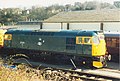 27001 at the Bo'ness and Kinneil Railway
 -
 27066 on the Dean Forest Railway
 -
 D5401 (27056) at the Great Central Railway


Notes[edit]
Footnotes[edit]
- ^ "27 Bo-Bo". BRDatabase.
- ^ British Railways Locoshed Book 1974 edition. Shepperton: Ian Allan. 1974. pp. 21–22. ISBN 0-7110-0558-3.
- ^ Earnshaw, Alan (1991). Trains in Trouble: Vol. 7. Penryn: Atlantic Books. p. 41. ISBN 0-906899-50-8.
- ^ "BRCW Type 2: 1958–1976". DerbySulzers.com. Retrieved 11 September 2016.
- ^ Butlin, Ashley (1988). Diesels and Electrics for scrap. Penryn: Atlantic Books. p. 9. ISBN 0-906899-27-3.
- ^ "BR Class 27 Fleet". BRdatabase.info. Retrieved 11 September 2016.
- ^ a b c d e f g Strickland 1983, p. 85.
- ^ Webb (1978), p. 53.
- ^ "Preserved Diesels - Class 27". Archived from the original on 30 April 2008. Retrieved 28 October 2009.
- ^ Devereux, Nigel (12 May 2017). "A FIERY END". Rail Express. Rail Express. Retrieved 12 October 2020.
- ^ "Class 27 D5401". Great Central Railway. Retrieved 10 November 2020.
References[edit]
- Harris, Roger (1985). The Allocation History of BR Diesels and Electrics (2nd ed.). Bromsgrove: Roger Harris.
- Marsden, Colin J. (1981). Motive power recognition:1 Locomotives. Shepperton: Ian Allan Ltd. ISBN 0-7110-1109-5.
- Oakley, Michael (1981). BR Class 26/27 Diesels. Truro: D Bradford Barton. ISBN 0-85153-418-X.
- Strickland, David C. (September 1983). Locomotive Directory: Every Single One There Has Ever Been. Camberley: Diesel and Electric Group. ISBN 978-0-906375-10-5. OCLC 16601890. OL 27959920M. Wikidata Q105978499.
- Tayler, A.T.H (1984). BR Locomotives:2 Sulzer Types 2 and 3. Ian Allan Ltd. ISBN 0-7110-1340-3.
- Webb, Brian (1978). Sulzer Diesel Locomotives of British Rail. David & Charles. ISBN 0715375148.
- Williams, Alan; Percival, David (1977). British Railways Locomotives and Multiple Units including Preserved Locomotives 1977. Shepperton: Ian Allan Ltd. ISBN 0-7110-0751-9.
- Ian Allan ABC of British Railways Locomotives, 1983 edition
Further reading[edit]
- Marsden, Colin J.; Fenn, Graham B. (1988). British Rail Main Line Diesel Locomotives. Sparkford: Haynes. pp. 112–117. ISBN 9780860933182. OCLC 17916362.
- Vehicle Diagram Book No. 100 for Main Line Diesel Locomotives (PDF). Derby: British Railways Board. October 1984. pp. 14–15, 35, 69–77 (per pdf) – via Barrowmore MRG.
- Warner, Alan (2012). The Deadman's Pedal. Jonathan Cape. ISBN 978-0-224-07170-3.
- Kerr, Fred (May 1984). "Short and snappy". Rail Enthusiast. EMAP National Publications. pp. 23–27. ISSN 0262-561X. OCLC 49957965.
- Clough, David (October 1986). "A Tale of Two Scotties — the BCRW Classes 26 and 27". Rail Enthusiast. No. 61. EMAP National Publications. pp. 36–39. ISSN 0262-561X. OCLC 49957965.
External links[edit]
