


Grauman's Chinese Theatre
 The forecourt entrance, Hollywood Boulevard | |
 | |
| Former names | Mann's Chinese Theatre (1973–2001) Grauman's Chinese Theatre (1927–1973; 2001–2013) |
|---|---|
| Address | 6925 Hollywood Boulevard Hollywood, California 90028 |
| Coordinates | 34°6′7″N 118°20′27.5″W / 34.10194°N 118.340972°W |
| Public transit |   Hollywood/Highland Hollywood/Highland |
| Owner | Chinese Theatres, LLC |
| Type | Indoor movie theater |
| Capacity | 932 (as of 2013)[1] |
| Construction | |
| Broke ground | January 9, 1926 |
| Built | January 16, 1926 |
| Opened | May 18, 1927 |
| Renovated | 2001–04 2013 (Digital IMAX conversion) 2014 (70mm IMAX installation for Interstellar) 2015 (IMAX with Laser installation) |
| Architect | Raymond M. Kennedy Donald Wilkinson |
| Website | |
| www | |
| Designated | June 5, 1968 |
| Reference no. | 55 |
| Designated | April 4, 1985 |
| Part of | Hollywood Boulevard Commercial and Entertainment National Historic District |
| Reference no. | 85000704 |
The TCL Chinese Theatre, commonly referred to as Grauman's Chinese Theatre (its official name for much of its history), is a movie palace on the historic Hollywood Walk of Fame in the Hollywood neighborhood of Los Angeles, California, United States.
The original Chinese Theatre was commissioned following the success of the nearby Grauman's Egyptian Theatre, which opened in 1922. Both were built as Exotic Revival style architecture.[2] Built by a partnership headed by Sid Grauman over 18 months beginning in January 1926, the theater opened May 18, 1927, with the premiere of Cecil B. DeMille's The King of Kings.[3] It has since been home to many premieres, including the 1977 debut of Star Wars,[4] as well as many private events and three Academy Awards ceremonies. Among the theater's features are the concrete blocks set in the forecourt, which bear the signatures, footprints, and handprints of popular motion picture personalities from the 1920s to the present day.
Originally named Grauman's Chinese Theatre, it was renamed Mann's Chinese Theatre in 1973, and reverted to its original name in 2001. On January 11, 2013, Chinese electronics manufacturer TCL Corporation purchased the facility's naming rights for $5 million.[5]
In 2013, the Chinese Theatre partnered with IMAX Corporation to convert the house into a custom-designed IMAX theater. The newly renovated theater seats 932 people and features one of the largest movie screens in North America.[1]
History
[edit]In March 1923, a meeting occurred at the offices of Fox West Coast Theatres where Sid Grauman, Mary Pickford, Douglas Fairbanks, and several other executives discussed plans for a new US$1 million venue that would be dedicated to "the spoken drama" with films only being screened on rare occasions. Although the project called for immediate construction, it was ultimately shelved for three years. In that time, several of its aspects were altered, including a change in scope from play house to movie theater due to the increasing profitability of motion pictures.[6]

Grauman, a theater mogul who previously founded the Million Dollar Theater and Egyptian Theatre, moved forward with the plans for a new venue in 1925. Looking to build along Hollywood Boulevard, he leased the site of actor Francis X. Bushman's mansion in a deal brokered by real estate developer Charles E. Toberman. In appreciation, a plaque was installed on the front of the theater dedicating it to Bushman.[3][7]
Los Angeles-based architecture firm Meyer & Holler, which previously partnered with Grauman on the Egyptian, designed the "palace-type" Chinese Theatre. Raymond M. Kennedy served as principal architect on the project. In October 1925, local newspapers published an artist's impression of the planned theater's facade. The accounts promised a US$5 million cost as well as a "tropical garden" in the forecourt, complete with imported flowers, trees, and fish in ponds.[8] In contrast to early reports, the theater cost $2.1 million to construct. Grauman co-owned the venue with Pickford, Fairbanks, Howard Schenck, and West Coast Theatres.[3][7]

The groundbreaking ceremony for the Chinese Theatre occurred on the evening of January 5, 1926. Newspapers advertised the public event as the founding of "the world's most unusual playhouse". Celebrities at the ceremony included Grauman, Charlie Chaplin, Conrad Nagel, Norma Talmadge, and Anna May Wong. Talmadge and Wong turned the first spadeful of earth using a gold-plated shovel.[9] Wong also put the first rivet into the structure of the theater.[10][11]
During construction, Grauman hired Jean Klossner to formulate an extremely hard concrete for the forecourt of the theater. Klossner later became known as "Mr. Footprint", performing the footprint ceremonies from 1927 through 1957.[12]
Many stories exist to explain the origins of the footprints. The theater's official account credits Norma Talmadge as having inspired the tradition when she accidentally stepped into the wet concrete.[13] However, in a short interview during the September 13, 1937, Lux Radio Theatre broadcast of a radio adaptation of A Star Is Born, Grauman related another version of how he got the idea to put hand and foot prints in the concrete. He said it was "pure accident. I walked right into it. While we were building the theatre, I accidentally happened to step in some soft concrete. And there it was. So, I went to Mary Pickford immediately. Mary put her foot into it."[14]: 194
Another account, says that the original "accidental" slabs were made and stayed, at the curb, on the sidewalk, until 1958, when they were removed for the Hollywood Walk of Fame.[15]
When they stepped up off the curb, they accidentally walked on wet cement and left a trail of footprints from the street to the front doors of the theater ... The stars, seeing what they had done, grabbed a nail on the ground and signed their names next to their footprints, Pickford even dated it." — Marc Wanamaker, Hollywood Heritage Museum.[15]
Still another account by Klossner recounts that Klossner autographed his work next to the right-hand poster kiosk and that Grauman and he developed the idea then and there.[16] His autograph and handprint, dated 1927, remain today. (Note: In 1949, Klossner's story changed to say that Grauman had accidentally stepped into the wet concrete.[17]) The theater's third founding partner, Douglas Fairbanks, was the second celebrity after Talmadge to be immortalized in the concrete.
In 1929, Grauman decided to retire and sell his share to William Fox's Fox Theatres chain. However, just a few months later, Howard Hughes convinced Grauman to return to the theater, because he wanted Grauman to produce the world premiere of his aviation epic Hell's Angels, which would also feature one of Grauman's theatrical prologs before the film. Grauman remained as the theater's managing director for the entire run of Hell's Angels, retiring once again after its run finished. Unsatisfied with retirement, though, Grauman returned to the theater as managing director on Christmas Day 1931 and kept that position until his death in 1950.[7][14]: 69
The Chinese Theatre hosted the 1944, 1945, and 1946 Academy Awards ceremonies; they are now held at the adjacent Dolby Theatre, formerly known as the Kodak Theatre.[18]
One of the highlights of the Chinese Theatre has always been its grandeur and décor. In 1952, John Tartaglia, the artist of nearby Saint Sophia Cathedral, became the head interior decorator of the Chinese Theatre, as well as the theater chain then owned by Fox West Coast Theatres. He later continued the work of Klossner, by recommendation of J. Walter Bantau, for the Hollywood footprint ceremonies.[19]
Tartaglia performed his first ceremony as what the City of Los Angeles termed "Hollywood's Master Mason"[19] for Jean Simmons in 1953, for the premiere of The Robe, the first premiere in CinemaScope. Although replacing Klossner was initially thought to be a temporary job for Tartaglia, his dedication resulted in a 35-year career in which he last performed as the master mason/concrete artist in honor of Eddie Murphy in May 1987. Tartaglia was formally recognized by the City of Los Angeles in October 2011.[19]

The Chinese Theatre was declared a historic and cultural landmark in 1968, and has undergone restoration projects in the years since then. Ted Mann, owner of the Mann Theatres chain and husband of actress Rhonda Fleming, purchased it in 1973. From then until 2001, it was known as Mann's Chinese Theatre. Mann Theatres grew to become the largest independent chain in the country before Mann sold the business, including the Chinese Theatre, to Gulf+Western in 1986.[20][21]
In 1984, the Hollywood Boulevard Commercial and Entertainment District was added to the National Register of Historic Places, with the Chinese Theater listed as a contributing property in the district.[22]
In 1988, Time Warner predecessor Warner Communications Inc. bought a 50% stake from Gulf+Western for $150 million.[23] The theater chain was eventually sold to WestStar Holdings in 1997.[24] In 2000, a partnership of Warner Bros. and Paramount Pictures acquired the theater, along with the other Mann Theatres properties.[25]
In 2000, Behr Browers Architects, a firm previously engaged by Mann Theatres, prepared a restoration and modernization program for the structure. The program included a seismic upgrade, new state-of-the-art sound and projection, new vending kiosks, and exterior signage, and the addition of a larger concession area under the balcony. The program began in 2002 and restored the original name — "Grauman's Chinese Theatre" — to the cinema palace. As part of the upgrade, Behr Browers also designed a new Chinese-themed six-plex in the attached Hollywood and Highland shopping center that continued to operate under the name Mann's Chinese 6 Theatre.[3][26]
In 2007, the CIM Group purchased the land on which the theater sits for an undisclosed price from the Damon Runyon Cancer Research Foundation of New York and Barlow Respiratory Hospital of Los Angeles. CIM Group also owns the Hollywood and Highland shopping center, as well as numerous other residential and commercial properties in Hollywood.[27] On May 27, 2011, Chinese Theatres LLC, a partnership owned by producer Elie Samaha and Donald Kushner, purchased both Grauman's Chinese Theatre and the adjacent Mann Chinese 6.[28]
Grauman's Chinese Theatre was sold for $25 million in 2013,[29] and today it continues to serve the public as a first-run movie theater.
Architecture
[edit]Exterior
[edit]Raymond M. Kennedy, a Southern California architect of the firm Meyer & Holler, designed the Chinese Theatre at the behest of owner Sid Grauman. Prior to conceiving the Exotic Revival-style plan for the Chinese Theatre, Meyer & Holler had previously designed the similarly themed West Coast Theatre in Long Beach. Plans called for an ambitious venue that would cost US$2.1 million to construct, considered a very high budget for a movie theater at the time.[30][31]
The exterior's most notable feature is the 90 foot (27 m)-tall pagoda centered in the middle of the forecourt. The pagoda's upright structure is supported by two prominent red pillars and its roof is plated in bronze. The design features numerous traditional Chinese ornamentations, including a 30 foot (9.1 m)-tall stone-carved mural of a dragon on the central wall between the columns. Two Ming dynasty-era guardian lion statues flank the venue's entrance. The U.S. government granted permission for the statues, as well as temple bells and other artifacts, to be imported from China. Moon Quon, a Chinese poet and filmmaker, traveled to the United States to oversee a team of Chinese artisans tasked with creating the theater's traditional decoration.[30][32] Xavier Cugat painted the trees and foliage between the pillars on the side walls and Keye Luke painted the Chinese murals in the lobby.[7]
Interior
[edit]The auditorium features a sixty-foot-wide ornate doily on its ceiling with various silver dragon emblems and gold medallions. A bronze chandelier fashioned to appear as a lantern hangs from the center of the doily. The theater's color scheme is primarily various shades of red – ruby, crimson, pale scarlet, and coral lacquer – with bronze, gold, stone, and silver providing accents. Author Charles Beardsley likened the auditorium to a "gigantic shrine at the time of the Five Emperors or the Dynasty of Hsia".[33]
In its original configuration, the auditorium included a 150 foot (46 m)-wide, 46 foot (14 m)-deep, 71 foot (22 m)-high stage, one of the largest in the world. The stage was divided into sections, making it possible to recess it into a 20 foot (6.1 m)-deep pit below in order to quickly change sets during live productions. The theater used "its own power plant" and an "auxiliary dynamo system" to generate its electricity independent of the city power grid.[33]
Despite the grandiose nature and high construction cost of the theater, its original capacity of 2,258 was only about half of the seats that the largest movie palaces had at the time. The lack of a proper general-admission balcony partly contributed to its smaller size; instead, the auditorium features four private box suites.[30]
The Chinese Theatre was the first commercial movie theater to have air conditioning. The vents are concealed behind the imported decorative pillars on the side walls of the auditorium.[7] The interior design also features a concealed three-manual, 17-rank Wurlitzer organ; its pipes were above the proscenium with tone chutes directing the sound through holes in the ceiling to make the sounds "feel like they were descending from the heavens." In 1957, theater ownership removed the organ and gave it to the Roman Catholic Archdiocese of Los Angeles, who in turn installed most of its parts at the St. Finbar Church in Burbank.[31]
A concession stand was not in the theater's original plans, because Grauman thought it would detract from the theatrical experience. The theater began to sell concessions in the 1930s.[7]
-
 Hall interior of the Chinese Theatre
 -
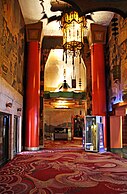 Interior corridor
 -
 The interior of the Chinese Theatre before its refurbishment
 -
 The ceiling of the Chinese Theatre
 -
 Entrance of the Chinese Theatre
 -
 Decoration of the column
 -
 A Ming dynasty Guardian Lion statue outside Grauman's Chinese Theatre
 -
 The Chinese Theatre at night
.jpg)
.jpg)


Handprints
[edit]
Nearly 200 Hollywood celebrity handprints, footprints, and autographs are in the concrete of the theater's forecourt. Fairbanks and Pickford were the first, done on April 30, 1927.[34]

Variations of this honored tradition are imprints of Harold Lloyd's eyeglasses, Groucho Marx's cigar, Whoopi Goldberg's dreadlock, the wands used by Harry Potter stars Daniel Radcliffe, Rupert Grint, and Emma Watson, John Barrymore's facial profile (reflecting his nickname "The Great Profile"), Betty Grable's leg, and Marilyn Monroe's earring.[35]
Western stars William S. Hart and Roy Rogers left imprints of their revolvers. John Wayne left his boot and fist prints, Herbie, a Volkswagen Beetle, left the imprints of his tires. The hoofprints of Tom Mix's horse, Tony, Gene Autry's horse, Champion, and Rogers' horse, Trigger, were left in the concrete beside those of their owners.[36][37]
Since 2011, a surge of concrete ceremonies has occurred, many of which have been paid for by movie studios for publicity reasons. One of the theater's current owners, Donald Kushner, acknowledged this and referred to them as mock ceremonies.[38] This influx has been a matter of concern for film buffs and historians, as well as misleading for fans. However, despite the increase of concrete blocks, the ones placed within the forecourt are still chosen by a special committee which selects celebrities based on their contributions to Hollywood cinema. Practice blocks, completed inside the theater before the ceremony, are placed on the walls of the Chinese 6 Theatre lobby, which is also used as an event space.[citation needed]
IMAX conversion
[edit]In April 2013, owners announced plans to convert the original theater for IMAX. The new 94 ft × 46 ft (29 m × 14 m) silver screen is curved and can be masked for premieres and screening events of non-IMAX films. To accommodate better sightlines and a taller screen, seating was re-arranged in stepped rows, descending from street level to the floor of the former basement.[39]
The auditorium's decorative walls and ceiling remain unaltered, the existing curtain was extended, decorative lighting effects were added and TCL added digital signage. The theater reopened on September 20, 2013, with the IMAX 3D version of The Wizard of Oz. Although it opened with only a digital projection system, a 70 mm IMAX projection system was temporarily installed for the runs of Interstellar and Oppenheimer in 2014 and 2023 respectively.[39][40] Because of the success of the Oppenheimer run, the 70 mm projection system was kept in 2024 for the re-release of Tenet and the release of Dune: Part Two.[41][42][43]
In April 2015, the IMAX system was upgraded to use the new dual-4K IMAX with Laser projector system for the premiere of Furious 7.[44]
Recreations
[edit]A full-scale recreation of the Chinese Theatre's exterior facade and lobby exists at Disney's Hollywood Studios theme park at the Walt Disney World Resort in Bay Lake, Florida. The recreation originally housed The Great Movie Ride which opened with the park on May 1, 1989, and closed on August 13, 2017. Its replacement attraction, Mickey & Minnie's Runaway Railway, opened on March 4, 2020.[45] It also has concrete handprints inside the sidewalks from the years 1988–1995.[46]
A sized-down recreation of the Chinese Theatre, both interior and exterior was built at Parque Warner Madrid theme park in San Martín de la Vega, near Madrid, Spain. The building shows films relevant to Warner Bros., previously The Lego Movie and Storks. During Halloween, horror films for guests over the age of 18 are shown such as Friday the 13th.[47]
In popular culture
[edit]Films
[edit]The Chinese Theater has appeared in multiple films set in Los Angeles, including Speed,[48] Austin Powers in Goldmember,[49] and Iron Man 3.[50]
Janet Gaynor visits the courtyard and a number of the signatures and footprints are seen in the 1937 movie A Star is Born - including Harold Lloyd's glasses, Joe E. Brown's "mouthprint", Jean Harlow's handprints, Eddie Cantor's "eyes", Shirley Temple's "Love to you all" message, and the fictitious Norman Maine's footprints.[51]
 |
Videogames
[edit]A building known as the Oriental Theater, which is based on the Chinese Theater, makes an appearance in the 2013 videogame Grand Theft Auto V.[52]
The theater also makes an appearance in the 2001 game, S.W.A.T. 3, Game Of The Year Edition.
See also
[edit]
- List of Grauman's Chinese Theatre handprint ceremonies
- List of Los Angeles Historic-Cultural Monuments in Hollywood
- List of contributing properties in the Hollywood Boulevard Commercial and Entertainment District
References
[edit]- ^ a b "IMAX at the TCL Chinese Theatre". TCL Chinese Theatres. Archived from the original on January 11, 2014. Retrieved February 4, 2014.
- ^ "Chinese Theatre". Los Angeles Conservancy. Retrieved May 2, 2023.
- ^ a b c d "Chinese Theatres – History". Mann Theatre. Archived from the original on May 31, 2011. Retrieved February 4, 2014.
- ^ "Today in History: Star Wars Premieres in 1977". Lomography. May 25, 2011. Archived from the original on March 17, 2016. Retrieved May 2, 2023.
- ^ Verrier, Richard (January 11, 2013). "China firm buys naming rights to Grauman's Chinese Theatre". Los Angeles Times. Archived from the original on January 12, 2013. Retrieved February 4, 2014.
- ^ "Grauman's Chinese Theatre, Hollywood, Los Angeles, CA". Pacific Coast Architecture Database. The University of Washington. Retrieved March 8, 2024.
- ^ a b c d e f King, Susan (May 11, 2017). "Celebrating 90 years of Hollywood history on the Chinese Theatre's anniversary". Los Angeles Times. Archived from the original on November 23, 2020. Retrieved May 18, 2017.
- ^ "Entrance to Sid Grauman's New $5,000,000 Theatre". Daily Pilot. San Pedro, Los Angeles. October 19, 1925. p. 3. Retrieved March 8, 2024 – via Newspapers.com.
- ^ Hodges, Graham Russell Gao (2004). Anna May Wong: From Laundryman's Daughter to Hollywood Legend (3rd ed.). Chicago: Chicago Review Press Incorporated. p. 58. ISBN 978-1-64160-883-1.
- ^ Sweet, Matthew (February 6, 2008). "Snakes, slaves and seduction: Anna May Wong". The Guardian. Retrieved October 14, 2023.
- ^ Hodges, Graham Russell Gao (2004). Anna May Wong: From Laundryman's Daughter to Hollywood Legend (3rd ed.). Chicago: Chicago Review Press Incorporated. p. 66. ISBN 978-1-64160-883-1.
- ^ Spicer, Chrystopher J. (October 14, 2011). Clark Gable, in Pictures: Candid Images of the Actor's Life. McFarland. p. 47. ISBN 9780786487141. Archived from the original on November 23, 2020. Retrieved April 15, 2019.
- ^ Davis, Laura E. (March 13, 2014). "Throwback Thursday: The story behind stars' handprints in Hollywood". Los Angeles Times. ISSN 0458-3035. Archived from the original on November 23, 2020. Retrieved April 15, 2019.
- ^ a b Endres, Stacey; Cushman, Robert (June 1, 2009). Hollywood at Your Feet: The Story of the World-Famous Chinese Theater. Pomegranate Press. ISBN 9780938817642. Archived from the original on November 23, 2020. Retrieved April 15, 2019.
- ^ a b Wallis-Finestone, Tara; Henry, Chuck (January 19, 2011). "Forgotten Footprints: Hollywood History Found in Airport Hangar". NBC Los Angeles. Archived from the original on November 23, 2020. Retrieved November 19, 2020.
The iconic hand-and-feet-in-cement tradition began by accident in the spring of 1927, when Sid Grauman asked silent film stars, Douglas Fairbanks, Mary Pickford and Norma Talmadge to take a short walk from the Roosevelt Hotel, to come check out his still under construction theater, located across the street on Hollywood Boulevard.
- ^ Haver, Ronald (November 1971). "Out of the Past: Mr. Grauman's Chinese Theater". First Los Angeles International Film Exposition. Archived from the original on November 23, 2020. Retrieved April 15, 2019.
- ^ Kishi, Russell (September 18, 1988). "Chinese Theater: The Tourists Still Make Tracks to Hollywood Shrine". Los Angeles Times. United Press International. ISSN 0458-3035. Archived from the original on November 23, 2020. Retrieved April 15, 2019.
- ^ "Academy Awards, USA". The Internet Movie Database. Retrieved April 17, 2007.
- ^ a b c "City of Los Angeles Resolutions, October 26, 2011" (PDF). Archived (PDF) from the original on November 23, 2020. Retrieved April 15, 2019.
- ^ "Ted Mann, 84, Who Owned Theater Where the Stars Preserve Their Prints". The New York Times. January 22, 2001. Archived from the original on November 23, 2020. Retrieved April 19, 2019.
- ^ "Company News; G.&W. Acquisition". The New York Times. October 18, 1986. Archived from the original on November 23, 2020. Retrieved April 19, 2019.
- ^ "National Register of Historic Places Inventory Nomination Form - Hollywood Boulevard Commercial and Entertainment District". United States Department of the Interior - National Park Service. Retrieved June 18, 2024.
- ^ "Company News; Warner to Buy Theater Stake". The New York Times. February 20, 1987. Archived from the original on November 23, 2020. Retrieved April 19, 2019.
- ^ "'Chinese Theatre' owner agrees to acquisition by WestStar Holdings". AP News. November 25, 1997. Archived from the original on November 23, 2020. Retrieved April 19, 2019.
- ^ "Studio Partnership Buys Mann Theatres". Los Angeles Times. January 13, 2000. Archived from the original on March 4, 2014. Retrieved February 4, 2014.
- ^ "Grauman's Chinese Theatre". Behr Browers Architects. Archived from the original on January 12, 2015. Retrieved February 4, 2014.
- ^ Vincent, Roger (September 3, 2007). "Famed Chinese Theatre is sold". Los Angeles Times. Archived from the original on March 4, 2014. Retrieved February 4, 2014.
- ^ Miller, Daniel (April 28, 2011). "Grauman's Chinese Theatre to Be Sold to Producers Elie Samaha, Don Kushner". The Hollywood Reporter. Archived from the original on December 10, 2013. Retrieved February 4, 2014.
- ^ "TCL Chinese Theatre - 6911 Hollywood Boulevard, Los Angeles, CA 90028". Property Shark. Retrieved July 16, 2024.
- ^ a b c "Grauman's Chinese Theatre, Hollywood, Los Angeles, CA". Pacific Coast Architecture Database. The University of Washington. Retrieved February 22, 2024.
- ^ a b Hume, Mike. "TCL Chinese Theatre". Historic Theatre Photography. Retrieved February 22, 2024.
- ^ "TCL Chinese Theatre: The Story of an L.A. Icon". Discover Los Angeles. May 18, 2023. Retrieved February 22, 2024.
- ^ a b Endres, Stacy; Cushman, Robert (November 1, 1992). Hollywood at Your Feet. Los Angeles: Pomegranate Press. pp. 28–30. ISBN 0938817086.
- ^ "Imprint Ceremonies Archive". TCL Chinese Theatres. Archived from the original on November 26, 2019. Retrieved April 15, 2019.
- ^ Cohen, Sandy (May 18, 2017). "Secrets about the Chinese Theatre's famous cement footprints". AP NEWS. Archived from the original on November 23, 2020. Retrieved November 19, 2020.
- ^ Conradt, Stacy (April 29, 2011). "The Quick 10: 10 Interesting Prints at Grauman's Chinese Theater". Mental Floss. Archived from the original on November 23, 2020. Retrieved April 15, 2019.
- ^ Woerner, Meredith (May 18, 2017). "All the Hollywood secrets hidden in the handprints at the Chinese Theatre's Forecourt of the Stars". Los Angeles Times. Archived from the original on January 24, 2018. Retrieved April 15, 2019.
- ^ Kaufman, Amy (December 29, 2011). "Grauman's Chinese: Movie star prints' futures not set in cement". Los Angeles Times. Archived from the original on October 14, 2012. Retrieved September 20, 2012.
- ^ a b "Top of the World Famous Chinese Theatre". Socialbilitty. February 10, 2014. Archived from the original on November 23, 2020. Retrieved August 25, 2017.
- ^ "Experience Oppenheimer in IMAX 70mm Film at Select Locations for a Limited Time". IMAX. June 1, 2023. Retrieved July 22, 2023.
- ^ "Dune 2's IMAX 70MM Release Plan Revealed After Oppenheimer's Record-Breaking Run". Screen Rant. January 26, 2024.
- ^ "Only 12 theaters in the world are showing Christopher Nolan's re-release of 'Tenet' in Imax 70mm — here they all are". Business Insider.
- ^ "Dune: Part Two IMAX 70MM Film Tickets Now on Sale". January 26, 2024.
- ^ "Imax premieres new laser system at TCL Chinese Theatre in Hollywood". Los Angeles Times. Archived from the original on November 23, 2020. Retrieved December 30, 2015.
- ^ Lambert, Marjie (July 22, 2017). "4 new rides for Disney World: Ratatouille, Tron, Mickey Mouse, Guardians of the Galaxy". Miami Herald. Archived from the original on November 23, 2020. Retrieved April 16, 2019.
- ^ "Our Hollywood Yard of Fame at Disney's Hollywood Studios". Disney Parks Blog. January 16, 2012. Archived from the original on November 23, 2020. Retrieved April 16, 2019.
- ^ "Chinese Theater 3D". Parques Reunidos. May 9, 2015. Archived from the original on October 26, 2018. Retrieved October 25, 2018.
- ^ "Speed Locations". latlong.net. Retrieved June 25, 2024.
- ^ "Austin Powers in Goldmember Filming Locations". moviemaps.org. Retrieved June 25, 2024.
- ^ Gallagher, Brian (January 22, 2013). "Iron Man 3 Blows Up a Hollywood Landmark in New Set Video". movieweb.com.
- ^ Lenker, Maureen Lee (July 10, 2022). "Everything you need to know about the 1937 version of A Star Is Born". Entertainment Weekly.
- ^ Mitra, Ritwik; Painter, Ben (May 19, 2024). "GTA 5 Locations That Are Based On Real-Life". Game Rant.
External links
[edit]
- Official website
- "Collection of photographs from Grauman's Chinese Theatre ceremonies, ca. 1937–1969". UCLA Library, Performing Arts Special Collections. Online Archive of California, California Digital Library.
- Grauman's Chinese Theater "Trader Horn" program, MSS 2383 at L. Tom Perry Special Collections, Brigham Young University
- Map and list of forecourt handprints at TCL Chinese Theatre
- Grauman's Chinese Theatre Imprints at Classic Movie Hub
- Handprint & Footprint Map
| International | |
|---|---|
| National | |
| Geographic | |

- 1927 establishments in California
- Chinese-American history
- Chinese design
- Cinemas and movie theaters in Hollywood, Los Angeles
- Event venues established in 1927
- Theatres completed in 1927
- Revival architecture in the United States
- Hollywood Boulevard
- Los Angeles Historic-Cultural Monuments
- Movie palaces
- IMAX venues in the United States
- Theatre companies in Los Angeles
- Walks of fame
- Historical footprints
- 1920s architecture in the United States
- History of Los Angeles
- Culture of Los Angeles
- Culture of Hollywood, Los Angeles
- Buildings and structures in Hollywood, Los Angeles
- Buildings and structures in Los Angeles
- Historic district contributing properties in California
- Theatres on the National Register of Historic Places in Los Angeles