


Hyde Park, Chicago
Hyde Park | |
|---|---|
| Community Area 41 – Hyde Park | |
 Hyde Park in Chicago | |
 The official Hyde Park community area (bold black) and the unofficial Hyde Park-Kenwood neighborhood extending into the official Kenwood community area (thin black). | |
 Location of Hyde Park in Chicago | |
| Coordinates: 41°48′N 87°35.4′W / 41.800°N 87.5900°W | |
| Country | United States |
| State | Illinois |
| County | Cook |
| City | Chicago |
| Neighborhoods | List
|
| Area | |
| • Total | 1.65 sq mi (4.27 km2) |
| Population (2020) | |
| • Total | 29,456 |
| • Density | 18,000/sq mi (6,900/km2) |
| Demographics (2020)[1] | |
| • White | 47.0% |
| • Black | 24.4% |
| • Asian | 14.2% |
| • Hispanic | 7.5% |
| • Other | 6.9% |
| Educational Attainment 2018[1] | |
| • High School Diploma or Higher | 96.77% |
| • Bachelor's Degree or Higher | 75.00% |
| Time zone | UTC-6 (CST) |
| • Summer (DST) | UTC-5 (CDT) |
| ZIP codes | parts of 60615 and 60637 |
| Median household income 2020 | $52,423[1] |
| Source: U.S. Census, Record Information Services | |
Hyde Park is the 41st of the 77 community areas of Chicago. It is located on the South Side, near the shore of Lake Michigan 7 miles (11 km) south of the Loop.
Hyde Park's official boundaries are 51st Street/Hyde Park Boulevard on the north, the Midway Plaisance (between 59th and 60th streets) on the south, Washington Park on the west, and Lake Michigan on the east.[2] According to another definition, a section to the north between 47th Street[3] and 51st Street/Hyde Park Boulevard is also included as part of Hyde Park, although this area is officially the southern part of the Kenwood community area. The area encompassing Hyde Park and the southern part of Kenwood is sometimes referred to as Hyde Park-Kenwood, which includes the neighborhoods of East Hyde Park and Indian Village.[4]
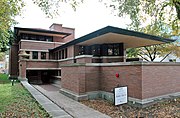
Hyde Park is home to a number of institutions of higher education; among these are the University of Chicago, Catholic Theological Union, Lutheran School of Theology at Chicago, and McCormick Theological Seminary. The community area is also home to the Museum of Science and Industry, and two of Chicago's four historic sites listed in the original 1966 National Register of Historic Places (Chicago Pile-1, the world's first artificial nuclear reactor, and Robie House).[5] In the early 21st century, Hyde Park received national attention for its association with U.S. President Barack Obama, who, before running for president, was a Senior Lecturer for twelve years at the University of Chicago Law School.[6][7] The Barack Obama Presidential Center which is currently under construction in Jackson Park is located nearby.[8]
History[edit]
Founding and early years[edit]

In 1853, Paul Cornell, a real estate speculator and cousin of Cornell University founder Ezra Cornell, purchased 300 acres (1.2 km2) of land[9] between 51st and 55th streets along the shore of Lake Michigan,[10] with the idea of attracting other Chicago businessmen and their families to the area.[9] The land was located seven miles south of Downtown Chicago in a rural area that enjoyed weather tempered by the lake – cooler in the summer and warmer in the winter. It was conveniently located near the Illinois Central Railroad, which had been constructed two years earlier. Cornell successfully negotiated land in exchange for a railroad station at 53rd Street. Hyde Park quickly became a suburban retreat for affluent Chicagoans who wanted to escape the noise and congestion of the rapidly growing city.
In 1857, the Hyde Park House, an upscale hotel, was built on the shore of Lake Michigan near the 53rd Street railroad station.[9] For two decades, the Hyde Park House served as a focal point of Hyde Park social life. During this period, it was visited or lived in by many prominent guests, including Mary Todd Lincoln, who lived there with her children for two and a half months in the summer of 1865 (shortly after her husband was assassinated).[11] The Hyde Park House burned down in an 1879 fire. The Sisson Hotel was built on the site in 1918 and was eventually converted into a condominium building (the Hampton House).
In 1861, Hyde Park was incorporated into an independent township (called Hyde Park Township). Its boundaries were Pershing Road (39th Street) on the north, 138th Street on the south, State Street on the west, and Lake Michigan and the Indiana state line on the east.[12] The territory of the township encompassed most of what is now the South Side of Chicago. Hyde Park Township remained independent of Chicago until it was annexed to the city in 1889.[13] After annexation, the definition of Hyde Park as a Chicago neighborhood was restricted to the historic core of the former township, centered on Cornell's initial development between 51st and 55th streets near the lakefront.
The Hyde Park Herald, the neighborhood's community newspaper, was established in 1882 and continues to be published weekly.
Growth and notability[edit]

In 1891, two years the city of Chicago annexed Hyde Park,[9] the University of Chicago was established in the neighborhood through the philanthropy of John D. Rockefeller and the leadership of William Rainey Harper.[10]
In 1893, Hyde Park hosted the World's Columbian Exposition (a world's fair marking the 400th anniversary of Christopher Columbus' arrival in the New World). The World's Columbian Exposition brought fame to the neighborhood, which gave rise to an inflow of new residents and spurred new development that gradually started transforming Hyde Park into a more urban area. However, since most of the structures built for the fair were temporary, it left few direct traces in the neighborhood. The only major structure from the fair that is still standing today is Charles Atwood's Palace of Fine Arts, which has since been converted into the Museum of Science and Industry.
In the early decades of the twentieth century, many upscale hotels were built in Hyde Park (mostly along the lakefront). Hyde Park became a resort area in Chicago.[10] Most of these hotels closed during the Great Depression, and were eventually converted into apartment and condominium buildings (most of which are still standing today).
Historical images of Hyde Park can be found in Explore Chicago Collections, a digital repository made available by Chicago Collections archives, libraries and other cultural institutions in the city.[14]
Racial integration, economic decline, and urban renewal[edit]
Until the middle of the twentieth century, Hyde Park remained an almost exclusively white neighborhood (despite its proximity to Chicago's Black Belt). Hyde Parkers relied on racially restrictive covenants to keep African Americans out of the neighborhood. At the time, the use of such covenants was supported by the University of Chicago.[15]
After the Supreme Court banned racially restrictive covenants in 1948, African Americans began moving into Hyde Park, and the neighborhood gradually became multiracial. In 1955, civil rights activist Leon Despres was elected alderman of Hyde Park and held the position for twenty years.[16] Despres argued passionately for racial integration and fair housing on the floor of the Chicago City Council, and became known as the "liberal conscience of Chicago" for often casting the sole dissenting vote against the policies of Chicago's then-mayor Richard J. Daley.[17]
During the 1950s, Hyde Park experienced economic decline as a result of the white flight that followed the rapid inflow of African Americans into the neighborhood.[10] In the 1950s and 1960s, the University of Chicago, in its effort to counteract these trends, sponsored one of the largest urban renewal plans in the nation.[18][19] The plan involved the demolition and redevelopment of entire blocks of supposedly decayed buildings with the goal of creating an "interracial community of high standards."[20] After the plan was carried out, Hyde Park's average income soared by seventy percent, but its African American population fell by forty percent, since the substandard housing primarily occupied by low-income African Americans had been purchased, torn down, and replaced, with the residents not being able to afford to remain in the newly rehabilitated areas.[citation needed] The ultimate result of the renewal plan was that Hyde Park did not experience the economic depression that occurred in the surrounding areas and became a racially integrated middle-class neighborhood.[citation needed]
Subdivisions[edit]

The University of Chicago[edit]
The central campus of the University of Chicago—including Pritzker School of Medicine, the University of Chicago Hospital, the historic Main Quadrangles, and the Booth School of Business—is bounded by Washington Park on the west, 55th Street on the north, University Ave. on the east, and 61st Street on the south, placing most of the University within Hyde Park's southwestern quadrant (with the remainder, south of the Midway, being in Woodlawn). The University also owns a number of additional properties throughout Hyde Park, with many concentrated along a narrow corridor along 59th Street between the central campus and the Metra tracks—including, for example, the University of Chicago Laboratory Schools and International House. Due to the University's proximity, the blocks just east of the central campus are dominated by (privately owned) student and faculty residences.
East Hyde Park[edit]

The part of Hyde Park located east of the Metra tracks is locally called East Hyde Park. This area, the part of Hyde Park nearest to Lake Michigan, has a large number of high-rise condominiums, many of them facing the lakefront. Some of these condominiums are remnants of older hotels, like The Mayfair or Regents Park. In this respect, East Hyde Park differs markedly from the rest of Hyde Park, where the vast majority of residences are either three-story apartment buildings or single-family homes (with only a small number of high-rise condominiums).
South Kenwood[edit]
Although the neighborhood bounded by 47th Street on the north, 51st Street (Hyde Park Boulevard) on the south, Cottage Grove Avenue on the west, and Lake Michigan on the east is officially the southern half of the Kenwood community area, it is often considered part of Hyde Park due to the two areas' shared culture and history; "Hyde Park-Kenwood" is thus sometimes applied to this collective area (as in, e.g., the "Hyde Park-Kenwood Historic District"). Some differences are nonetheless apparent: unlike Hyde Park, which is dominated by three- and four-story apartment buildings and modest family homes, southern Kenwood boasts a great many luxurious mansions, built mainly at the end of the nineteenth and the beginning of the twentieth centuries for wealthy Chicagoans. A number of prominent Chicagoans currently reside or own homes in this area, including former U.S. president Barack Obama and Nation of Islam leader Louis Farrakhan. Boxer Muhammad Ali and former Nation of Islam leader Elijah Muhammad also once resided in south Kenwood.
Demographics[edit]
| Census | Pop. | Note | %± |
|---|---|---|---|
| 1930 | 48,017 | — | |
| 1940 | 50,550 | 5.3% | |
| 1950 | 55,206 | 9.2% | |
| 1960 | 45,577 | −17.4% | |
| 1970 | 33,531 | −26.4% | |
| 1980 | 31,198 | −7.0% | |
| 1990 | 28,630 | −8.2% | |
| 2000 | 29,920 | 4.5% | |
| 2010 | 25,681 | −14.2% | |
| 2020 | 29,456 | 14.7% | |
| [21][1] | |||
Diversity[edit]

Hyde Park is a very racially diverse neighborhood. Its population is 47.6% White, 26.8% African American, 12.1% Asian American, 8.5% Hispanic, and 5.0% of other races or of more than one race.[1] There are some differences between the racial demographics of the part of Hyde Park south of 55th Street and the part of Hyde Park north of 55th Street. Residents south of 55th Street are predominantly White and Asian American, with a smaller percentage being African American or Hispanic. North of 55th Street, African Americans make up approximately half of the population and there's a larger percentage of Hispanics.[22] In 2000, Hyde Park was 45.8% White, 38.1% African American, 0.1% American Indian, 11.3% Asian, 0.1% Pacific Islander, 4.1% Hispanic, and 4.6% from other races or two or more races.[23]
Hyde Park's location in the center of the predominantly African American South Side as well as the neighborhood's large population of affluent and upper-middle class black residents have made it an important cultural and political hub of Chicago's black community. Many of Chicago's prominent African American politicians live or have lived in Hyde Park, including former Chicago Mayor Harold Washington;[24] former U.S. Senator Carol Moseley Braun, the first ever Black female U.S. senator;[25] and former U.S. President Barack Obama.[15]
Landmarks[edit]

The following Hyde Park community area properties have been added to the National Register of Historic Places: Chicago Beach Apartments, Arthur H. Compton House, East Park Towers, Chicago Pile-1, Flamingo-on-the-Lake Apartments, Mayfair Apartments, Isadore H. Heller House, Charles Hitchcock Hall, Hotel Del Prado, Hotel Windermere East, Frank R. Lillie House, Robert A. Millikan House, Poinsettia Apartments, Promontory Apartments, Jackson Shore Apartments, Frederick C. Robie House, George Herbert Jones Laboratory, St. Thomas Church and Convent, Shoreland Hotel, German submarine U-505, and University Apartments.
In addition, the NRHP Hyde Park-Kenwood Historic District and Jackson Park Historic Landscape District and Midway Plaisance are located, at least in part, within the Hyde Park community area.
Parks[edit]
Promontory Point[edit]

Promontory Point is an artificial peninsula that extends into Lake Michigan at 55th Street, providing views of the Downtown Chicago skyline to the north. Promontory Point is a common location for picnicking, sunbathing, and swimming. It made news as the location of the wedding reception between George Lucas and Mellody Hobson in June 2013. [26]
Jackson Park[edit]
The southeastern corner of Hyde Park contains the northern end of Jackson Park. Jackson Park consists of lagoons surrounding an island in the middle (called the Wooded Island), on which a small Japanese garden is located. It is home to a large population of beavers and over two dozen species of birds. The Midway Plaisance, a wide boulevard that runs from Stony Island Avenue to Cottage Grove Avenue between 59th and 60th streets, connects Jackson Park to Washington Park (located to the west of Hyde Park).
Jackson Park has been selected by the Obama Foundation as the site of the future Obama Presidential Center.[27]
Retail corridors[edit]

The shopping areas on 53rd, 55th, and 57th streets host most of the retail businesses in Hyde Park.
53rd Street[edit]
53rd Street is Hyde Park's oldest shopping district, lined with many small businesses and restaurants offering various dining options. Harper Court, a small-business-oriented shopping center, extends north of 53rd Street along Harper Avenue. A farmers' market is held there in the summer.
55th Street[edit]
The segment of 55th Street between the Metra line and the lake offers a series of ethnic restaurants serving Thai, Japanese, and Korean cuisine. To the west of the Metra line between 54th and 55th streets lies the Hyde Park Shopping Center.
57th Street[edit]
57th Street is noted for its independent bookstores. 57th Street also offers restaurants along with small grocery stores, hair stylists, and dry cleaners. On the first weekend in June, the venerable 57th Street Art Fair takes up 57th Street between Kimbark and Kenwood avenues.
Museums[edit]
- DuSable Museum of African American History (located just outside Hyde Park on the eastern edge of Washington Park)
- Hyde Park Art Center
- Museum of Science and Industry
- Institute for the Study of Ancient Cultures – an archaeology museum (mostly focusing on the ancient Near East) within the University of Chicago.
- Smart Museum of Art – an art museum within the University of Chicago.
Educational institutions[edit]
- Catholic Theological Union – a seminary of Roman Catholic religious orders and lay women and men.
- Chicago Theological Seminary – a seminary of the United Church of Christ.
- Lutheran School of Theology at Chicago – a seminary of the Evangelical Lutheran Church in America.
- McCormick Theological Seminary – a seminary of the Presbyterian Church.
- University of Chicago – a private research university.
- University of Chicago Laboratory Schools – a private coeducational nursery-12 school founded by educational reformer John Dewey in 1896.
Churches and houses of worship[edit]
- Congregation Rodfei Zedek
- The First Baptist Church of Chicago, the oldest Baptist church in the city
- First Unitarian Church of Chicago
- The Hyde Park Chapel of the Church of Jesus Christ of Latter-day Saints
- The Hyde Park Seventh-day Adventist Church
- Hyde Park Union Church
- KAM Isaiah Israel
- Rockefeller Chapel
- St. Paul & the Redeemer Episcopal Church
- St. Thomas Church and Convent
- 57th Street Meeting of Friends, a Quaker meeting for worship
Politics[edit]
The Hyde Park community area has supported the Democratic Party in the past two presidential elections by overwhelming margins. In the 2016 presidential election, Hyde Park cast 10,479 votes for Hillary Clinton and 442 votes for Donald Trump (91.9% to 3.9%).[28] In the 2012 presidential election, Hyde Park cast 9,991 votes for Barack Obama and cast 651 votes for Mitt Romney (91.4% to 6.0%).[29]
Transportation[edit]
Hyde Park is connected to the rest of the city by CTA buses and the Metra Electric Line. CTA buses provide express service to the downtown, and they also allow transfers to Red Line and Green Line trains to the Loop. The Metra Electric Line, which uses the tracks of the former Illinois Central Railroad, has several stops in Hyde Park and provides service to Millennium Station in the downtown.
CTA bus services:
- 2 Hyde Park Express
- 4 Cottage Grove
- 6 Jackson Park Express
- 10 Museum of Science and Industry
- 15 Jeffery Local
- 28 Stony Island
- 55 Garfield
Additional CTA bus services, paid for by the University of Chicago:
- 171 University of Chicago/Hyde Park
- 172 University of Chicago/Kenwood
- 192 University of Chicago Hospitals Express
Notable people[edit]
- Gertrude Abercrombie – painter[30]
- Muhammad Ali – boxer
- Quentin Young – physician, a founder of Physicians for National Health Care (PNHP)
- Bill Ayers[31] – educator and activist
- Saul Bellow[32] – writer, 1976 Nobel Prize laureate
- Lee Botts[33] – environmentalist
- Chesa Boudin (born 1980), 30th District Attorney of San Francisco (2020-present). He was raised in Hyde Park by his legal guardians Bill Ayers and Bernardine Dohrn.[34][35]
- Carol Moseley Braun[25] – U.S. Senator from Illinois
- Oscar Brown Jr. – singer, songwriter, playwright, poet, civil rights activist, and actor.
- Paul Butterfield[36] – blues musician
- Subrahmanyan Chandrasekhar[37] – astrophysicist, 1983 Nobel Prize laureate
- James W. Cronin[37] – physicist, 1980 Nobel Prize laureate
- Clarence Darrow[38] – lawyer
- Barbara Flynn Currie, former Illinois House of Representatives Majority Leader
- Leon Despres[16] – civil rights activist
- William Dodd[39] – U.S. Ambassador to Germany
- Bernardine Dohrn[40] – lawyer and activist
- Paul Douglas – U.S. Senator from Illinois
- Arne Duncan[41] – U.S. Secretary of Education
- Amelia Earhart[42] (day resident as student of Hyde Park High School)[43] – aviator
- Kurt Elling[44] – jazz musician
- Louis Farrakhan[45] – leader of the Nation of Islam.
- Enrico Fermi – physicist, 1938 Nobel Prize laureate
- Marshall Field – retail icon and founder of Marshall Field's
- Susan Fiske[46] – social psychologist
- Milton Friedman[15] – economist, 1976 Nobel Prize recipient, taught economics at the University of Chicago (1946-1977)
- Francis Fukuyama – political scientist
- Caroline Glick – Journalist
- Dick Gregory[47] – comedian, activist
- Austan Goolsbee – economist, writer, senior Obama administration official, former Chair of the Council of Economic Advisers
- Bonnie Harris – painter[48]
- Hugh Hefner[49] – magazine publisher, founder of Playboy
- Maria Hinojosa – journalist
- Mahalia Jackson – gospel singer
- Elena Kagan – Associate Justice of the Supreme Court
- Jim Karvellas – play-by-play sportscaster
- Echo Kellum (born 1982), actor and comedian known for his roles in Arrow and Sean Saves the World. He was a childhood resident of Hyde Park.[50]
- Sydney Kamlager-Dove (born 1972), member of the United States House of Representatives from California's 37th congressional district since 2023. She was a childhood resident of Hyde Park[51]
- Chaka Khan – singer
- R. Kelly – singer and convicted sex offender
- Karen Lewis (1953-2021) – American labor leader, former reform president of Chicago Teachers Union
- Ramsey Lewis – jazz musician
- Mary Todd Lincoln[11] – wife of 16th U.S. President Abraham Lincoln
- John A. List – Distinguished Service Professor of Economics, University of Chicago
- Leopold and Loeb – convicted murderers
- Vic Mensa – rapper
- Albert Abraham Michelson – physicist, 1907 Nobel Prize laureate
- Robert Andrews Millikan – physicist, 1923 Nobel Prize laureate, Robert A. Millikan House is National Historic Landmark
- Elijah Muhammad – former leader of the Nation of Islam
- NeonSeon – writer and illustrator Seon Ricks[52]
- Barack Obama[15] – 44th President of the United States
- Clara Peller (1902–1987), actress best known for her appearances in Where's the beef? campaign of Wendy's. She was a longtime Hyde Park resident.[53]
- Richard Posner – former federal judge and senior lecturer at the University of Chicago Law School
- Toni Preckwinkle – Cook County Board President, activist
- Kwame Raoul – Illinois Attorney General
- Janet D. Rowley – Cytogeneticist and cancer research pioneer[54]
- Antonin Scalia[15][55] – Associate Justice of the Supreme Court, residency at the University of Chicago Law School (1977-1982)
- John Paul Stevens[56] – Associate Justice of the Supreme Court
- George Stigler[37] – economist, 1982 Nobel Prize laureate
- Dana L. Suskind – professor
- James Tiptree Jr.[57] – author
- Harold Washington[24] – Mayor of Chicago
- Bernard Wasserstein[58] – professor
- Jody Watley – singer
- Henry Clay Work – composer
- Hubert Louis Will[59] – federal judge
Gallery[edit]

-
 The University of Chicago as seen from the Midway Plaisance, a wide boulevard connecting Jackson Park and Washington Park.
 -
-
 The Rockefeller Chapel, located on the University of Chicago campus and named after University of Chicago founder John D. Rockefeller.
 -
 The University of Chicago Laboratory Schools, founded by the prominent educational reformer John Dewey in 1896.
 -
 The Museum of Science and Industry, housed in the former Palace of Fine Arts from the 1893 World's Columbian Exposition, as seen from the northern edge of Jackson Park.
 -
 The Hampton House, a condominium located on the property that once housed the Hyde Park House (Hyde Park's first hotel). In the 1980s, the Hampton House was home to Chicago Mayor Harold Washington.
 -
 Shops and restaurants on 53rd Street.
 -
 A monument marking the location of the first kiss between Barack Obama and Michelle Obama, located on the corner of 53rd Street and Dorchester Avenue.
 -
 Osaka Garden, a Japanese garden in Jackson Park.
 -
 The banks of Promontory Point.
 -
 Downtown Chicago and lakefront condominiums in Hyde Park as seen from the northern side of Promontory Point.


References[edit]
- ^ a b c d e "Community Data Snapshot - Hyde Park" (PDF). MetroPulse. Retrieved July 25, 2020.
- ^ "Guides and Maps - Neighborhood Maps: Hyde Park and Bronzeville" (PDF). City of Chicago. Archived from the original (PDF) on January 26, 2012. Retrieved February 27, 2012.
- ^ "Business Directory (C): Coldwell Banker Residential Brokerage-Hyde Park". Hyde Park Chamber of Commerce. Archived from the original on February 26, 2012. Retrieved February 27, 2012.
- ^ "The Hyde Park-Kenwood Urban Renewal Story". Hyde Park-Kenwood Community Conference. Archived from the original on August 28, 2014. Retrieved February 27, 2012.
- ^ "National Register Information System". National Register of Historic Places. National Park Service. January 23, 2007.
- ^ Kantor, Jodi (July 30, 2008). "Teaching Law, Testing Ideas, Obama Stood Slightly Apart". The New York Times. Retrieved October 10, 2019.
- ^ "Statement Regarding Barack Obama". The University of Chicago Law School Media Inquiries. December 16, 2008. Retrieved October 10, 2019.
- ^ Tareen, Sophia (February 4, 2021). "Obama Presidential Center construction in Jackson Park to start in 2021". ABC7 Chicago. Archived from the original on February 9, 2021. Retrieved February 9, 2021.
- ^ a b c d "Paul Cornell - Founder of Hyde Park". Hyde Park Historical Society. Archived from the original on February 4, 2012. Retrieved February 27, 2012.
- ^ a b c d Grinnell, Max. "Hyde Park". Chicago Historical Society. Retrieved February 27, 2012.
- ^ a b Cornelius, James (April 4, 2011). "Two new stories about the Lincolns". Abraham Lincoln Presidential Library & Museum. Archived from the original on November 24, 2011. Retrieved February 27, 2012.
- ^ Keating, Ann Durkin (2005). "Annexations and Additions to the City of Chicago". The Electronic Encyclopedia of Chicago. Chicago Historical Society. Retrieved July 18, 2007.
- ^ Keating, Ann Durkin (2005). "Hyde Park Township". The Electronic Encyclopedia of Chicago. Chicago Historical Society. Retrieved July 19, 2007.
- ^ Long, Elizabeth. "A Single Portal to Chicago's History". The University of Chicago News. Retrieved September 17, 2016.
- ^ a b c d e Slevin, Peter (October 16, 2008). "Uncommon Ground". The Washington Post. Retrieved February 27, 2012.
- ^ a b Grossman, Ron (May 7, 2009). "Leon Despres, 1908-2009: Chicago alderman challenged elder Mayor Daley: Liberal voice of city, 101, also championed civil rights and political reforms". Chicago Tribune. Retrieved February 27, 2012.
- ^ Wilgoren, Jodi (May 31, 2005). "Age 97, and Still at War With the Old Daley Machine". New York Times. Retrieved February 27, 2012.
- ^ "Hyde Park Featured on TV Show". Hyde Park Herald. January 16, 1957. Retrieved July 31, 2009.
- ^ "Hyde Parkers Tell Renewal Story". Hyde Park Herald. January 30, 1957. Retrieved July 31, 2009.
- ^ "HPKCC Story and role in Urban Renewal". February 2, 2012. Archived from the original on February 2, 2012. Retrieved January 23, 2021.
- ^ Paral, Rob. "Chicago Community Areas Historical Data". Archived from the original on March 18, 2013. Retrieved August 29, 2012.
- ^ Rankin, Bill. "Chicago Boundaries - radicalcartography". Retrieved July 10, 2013.
- ^ "Hyde Park".
- ^ a b "Monk Parakeets in Hyde Park and beyond". Hyde Park-Kenwood Community Conference. Archived from the original on October 25, 2007. Retrieved February 27, 2012.
- ^ a b Rodkin, Dennis (November 24, 2010). "Carol Moseley Braun Puts Her Hyde Park Home Up for Sale". Chicago. Archived from the original on March 9, 2012. Retrieved February 27, 2012.
- ^ Geiger, Kim; Delgado, Jennifer (June 27, 2013). "Promontory Point to serve as stage for star-studded wedding reception". Chicago Tribune. Retrieved July 9, 2014.
- ^ "The Obama Presidential Center". Obama Foundation. Retrieved September 28, 2020.
- ^ Ali, Tanveer (November 9, 2016). "How Every Chicago Neighborhood Voted In The 2016 Presidential Election". DNAInfo. Archived from the original on September 24, 2019. Retrieved October 4, 2019.
- ^ Ali, Tanveer (November 9, 2012). "How Every Chicago Neighborhood Voted In The 2012 Presidential Election". DNAInfo. Archived from the original on February 3, 2019. Retrieved October 4, 2019.
- ^ "GERTRUDE ABERCROMBIE (1909 - 1977)". Corbett vs. Dempsey reproduced from Art in Chicago 1945 - 1995. Archived from the original on September 20, 2012. Retrieved February 27, 2012.
- ^ Remnick, David (November 4, 2008). "MR. AYERS'S NEIGHBORHOOD". The New Yorker. Retrieved February 27, 2012.
- ^ Yoe, Mary Ruth (June 2005). "He seized the day". University of Chicago Magazine. Retrieved February 27, 2012.
- ^ "LEE BOTTS--HON. PETER J. VISCLOSKY of indiana in the house of representatives: Wednesday, February 13, 2008". Government Printing Office. February 13, 2008. Retrieved February 27, 2012.
- ^ Fusco, Chris; Pallasch, Abdon M. (18 April 2008). "Who is Bill Ayers?". Chicago Sun-Times. p. 8. Archived from the original on 8 October 2008. Retrieved 5 October 2008.
- ^ Paul, Deanna (November 2, 2019). "After decades visiting his parents in prison, this lawyer wants to be San Francisco's next DA". Washington Post. Archived from the original on November 2, 2019. Retrieved November 4, 2019.
- ^ Spink, George. "Blues for Big John's". Jazz Institute of Chicago. Archived from the original on April 7, 2015. Retrieved February 27, 2012.
- ^ a b c Epstein, Nadine (May 29, 1985). "U. Of C. Seems To Get Nobel Supply On Demand". Chicago Tribune. Retrieved February 27, 2012.
- ^ Ciccone, F. Richard (April 22, 1999). "Impact Players: The 100 Most Significant Chicagoans Of The Twentieth Century The Great Defender: Clarence Darrow". Chicago Tribune. Retrieved February 27, 2012.
- ^ "William Dodd: The U.S. Ambassador In Hitler's Berlin". National Public Radio. May 9, 2011. Retrieved February 27, 2012.
- ^ "AN INTERVIEW WITH BILL AYERS". The Point Magazine. Spring 2012. Retrieved February 27, 2012.
- ^ Janega, James (December 16, 2008). "Duncan to join Obama Cabinet: Chicago schools chief is his pick for education secretary". Chicago Tribune. Retrieved February 27, 2012.
- ^ Long, Elgen M.; Long, Marie K. (1999). Amelia Earhart : the mystery solved. Internet Archive. New York, NY : Simon & Schuster. p. 33. ISBN 978-0-684-86005-3.
- ^ "Timeline: Amelia Earhart, 1897-1937". American Experience, Public Broadcasting Service. Retrieved February 27, 2012.
- ^ Welch, Will (November 24, 2009). "Kurt Elling: Live at 1600 Pennsylvania Avenue". GQ. Retrieved February 27, 2012.
- ^ Kleban Mills, Barbara (September 17, 1990). "Predicting Disaster for a Racist America, Louis Farrakhan Envisions An African Homeland for U.S. Blacks". People Magazine. Archived from the original on May 7, 2012. Retrieved February 27, 2012.
- ^ "Susan T. Fiske". John Simon Guggenheim Memorial Foundation. Archived from the original on January 4, 2013. Retrieved August 31, 2012.
- ^ Johnson, Steve (October 25, 2009). "Dick Gregory on Obama, longevity, comic geniuses". Chicago Tribune. Archived from the original on January 26, 2011. Retrieved February 27, 2012.
- ^ "Bonnie Harris (1870-1962)". Hyde Park Art Center. Archived from the original on December 22, 2015. Retrieved December 15, 2015.
- ^ Grinnell, Max. "Playboy". Chicago Historical Society. Retrieved February 27, 2012.
- ^ Sun Times Wire (December 19, 2013). "Comics with Chicago roots to perform here this weekend". Chicago Sun-Times. Retrieved August 12, 2020.
- ^ Kamlager, Sydney (February 20, 2023). (Interview). Interviewed by C-SPAN https://archive.org/details/CSPAN_20230221_040900_Rep._Sydney_Kamlager-Dove_Profile_Interview. Retrieved September 24, 2023.
{{cite interview}}: Missing or empty|title=(help) - ^ NeonSeon (March 2, 2011). "NeonSeon (Author of Life of Shouty)". Goodreads.com. Retrieved October 20, 2011.
- ^ Baumann, Edward (August 12, 1987). "Feisty Clara Peller, 86; 'Where's the Beef?' Lady". Chicago Tribune. Retrieved July 23, 2020.
- ^ "Janet Rowley, 1925-2013: U. Of C. Scientist made breakthrough cancer discoveries". December 18, 2013.
- ^ Shipp, E. R. (July 26, 1986), "Scalia's Midwestern colleagues cite his love of debate, poker, and piano", The New York Times, retrieved January 13, 2010
- ^ Mullen, William (April 9, 2010). "John Paul Stevens' Chicago ties: Before Supreme Court, Hyde Park native's life was centered in the city". Chicago Tribune. Retrieved February 27, 2012.
- ^ Phillips, Julie (2006). "James Tiptree, Jr.: The Double Life of Alice B. Sheldon - Alice Bradley Sheldon, 1915-1987". St. Martin's Press. Retrieved February 27, 2012.
- ^ "Bernard Wasserstein | History | The University of Chicago". history.uchicago.edu. Retrieved November 29, 2022.
- ^ www.fjc.gov https://www.fjc.gov/node/1389801. Retrieved November 29, 2022.
{{cite web}}: Missing or empty|title=(help)
External links[edit]

- Official City of Chicago Hyde Park Map
- Hyde Park Historical Society
- Hyde Park-Kenwood Community Conference
- South East Chicago Commission Archived June 29, 2007, at the Wayback Machine


Places adjacent to Hyde Park, Chicago | |
|---|---|


| International | |
|---|---|
| National | |
