


Over-the-Rhine
Over-the-Rhine Historic District | |
 From upper left: Italianate architecture, the Art Academy of Cincinnati, the OTR Gateway Quarter, Music Hall, Findlay Market, and the School for Creative and Performing Arts | |
  | |
 Interactive map showing the location of Over-the-Rhine | |
| Location | Bounded by Central Parkway to the south, Central Parkway to the west, Sycamore St. to the east, and Mulberry, W Clifton & Klotter St. to Brighton Approach to the north.Cincinnati, Ohio |
|---|---|
| Coordinates | 39°6′47″N 84°30′58″W / 39.11306°N 84.51611°W |
| Area | 319 acres (1.29 km2) |
| Architectural style | Greek Revival and Late Victorian[1] |
| NRHP reference No. | 83001985[1] |
| Added to NRHP | May 17, 1983[1] |


Over-the-Rhine, also known as "Cincinnati's Rhineland, and the "Rhineland of America", is a German cultural district of Cincinnati, Ohio.[2][3][4] Over-the-Rhine is among the largest, most intact urban historic districts in the United States.[5] Germans from Ohio are known as "Ohio Rhinelanders" (German: Ohio Rheinländer), named after the Ohio Rhineland.[6][7][8] The Cincinnati Reds baseball team was highly supported by Ohio Rhinelanders, and was commonly known as the "Cincinnati Rhinelanders", referring to Cincinnati's German heritage.[9]
Etymology[edit]
The neighborhood's name comes predominantly from Rhinelanders and other Germans who settled the area in the mid-19th century.[10] Many walked to work across bridges over the Miami and Erie Canal, which separated the area from downtown Cincinnati. The canal was nicknamed "the Rhine" in reference to the river Rhine in Germany, and the newly settled area north of the canal as "Over the Rhine".[11][12] In German, the district was called über den Rhein.[citation needed]
An early reference to the canal as "the Rhine" appears in the 1853 book White, Red, Black, in which traveler Ferenc Pulszky wrote, "The Germans live all together across the Miami Canal, which is, therefore, here jocosely called the 'Rhine.' "[13] In 1875 writer Daniel J. Kenny referred to the area exclusively as "Over the Rhine." He noted, "Germans and Americans alike love to call the district 'Over the Rhine.' "[14]
Eventually, the canal was drained and capped by Central Parkway; the resulting tunnel was to be used for the now-defunct Cincinnati Subway project.[citation needed]
History[edit]
Built in the nineteenth century during a period of extensive German immigration, first settled by Pennsylvania Dutch and bolstered by Rhinelanders and other Germans, Over-the-Rhine began to change demographically as residents moved to the suburbs following World War II.[15] The city and area had lost many of the industrial jobs that once supported its workers. By the end of the century, the area was noted for its poverty. Residents united and created many life-saving organizations.[11] Following social unrest in 2001, the neighborhood has since been the focus of millions of dollars of redevelopment.[citation needed]
Geography[edit]

Over-the-Rhine, one of the largest, most intact urban historic districts in the United States,[5] has several districts. The Northern Liberties[16] and the Brewery District[17] are north of Liberty Street. South of Liberty are the Gateway Quarter and Pendelton.[citation needed]
The Washington Park Area[edit]
In recent years, developers have renamed this portion of Over-the-Rhine as "The Gateway Quarter". This area has been the focal point of gentrification, which has displaced African Americans and low-income residents. More than 1,000 African Americans left this area between 2000 and 2010, and by 2012 it had become a predominantly white, wealthy and exclusive section of the neighborhood.[18]
The Brewery District[edit]
North of Liberty Street sat the heart of Cincinnati's beer brewing industry.[19] Christian Moerlein established his first brewing company in Over-the-Rhine in 1853. Eventually the Christian Moerlein Brewing Co. became the city's largest brewery and expanded into the national market. At its height the brewery occupied three entire city blocks. Prohibition brought an end to the company in the 1920s.[20] In 2010 the revived Christian Moerlein Brewing Co. began brewing beer in the Brewery District once again.[21]
North of Liberty Street[edit]
This area of the neighborhood has been relatively untouched by recent "gentrification efforts" and may resemble 1990s OTR better than other areas.[22]
In the late 1820s, English writer Fanny Trollope, mother of Anthony Trollope, lived in the Mohawk area, which today is considered part of Over-the-Rhine.[23] The acerbic portrayal of Americans of that period in her book Domestic Manners of the Americans is based in part on her interactions with the rough-hewn residents of the area.[citation needed]
Until 1849, today's Liberty Street, then called Northern Row, was the corporation line forming Cincinnati's northern boundary. The area north of Northern Row was not subject to municipal law and was called "The Northern Liberties". In 1955, the city decided to widen Liberty Street to connect with Reading Road as an east-west crosstown access point for the interstate highway system. Buildings on the south side of the street were demolished and the street was widened from two to five lanes. As of 2019, efforts are underway to narrow Liberty Street to bridge the gap between these halves of the neighborhood.[24]
Revitalization[edit]
Over-the-Rhine Neighborhood Revitalization[edit]
Over-the-Rhine, the site of the 2001 Cincinnati riots, became the city's most dangerous neighborhood by 2009. However, it has since seen intensive redevelopment efforts.[25] Private development corporations and city officials have begun to address the problems that come with a neighborhood with low employment and high crime rates. A neo-liberal urban renewal strategy encourages private corporations rather than the city government to take on renewing and updating this area.[26]
Cincinnati Center City Development Corporation[edit]
The Cincinnati Center City Development Corporation (3CDC) is a private, non-profit real-estate development and finance organization focused on revitalizing Cincinnati's urban core with the city government and local corporations. Its work is focused on the central business district and in the Over-the-Rhine neighborhood. The organization is widely credited with revitalizing OTR.[27] The organization began as a full-service real estate developer, but has since branched out and produces more than 1,000 events per year[28] at the four civic spaces it manages: Fountain Square, Washington Park, Ziegler Park and Memorial Hall.[citation needed]
In July 2003, 3CDC was formed by former mayor of Cincinnati Charlie Luken and other corporate community members. This was a result of a recommendation by a City of Cincinnati Economic Development Task Force. Most funds are gathered through corporate contributions. In 2004, 3CDC accepted responsibility for overseeing Cincinnati New Markets Fund and Cincinnati Equity Fund. As of May 2018, those funds total over $250 million and have resulted in over $1.3 billion[29] invested in downtown and Over-the-Rhine real estate projects.[citation needed]
Architecture[edit]
Over-the-Rhine has been praised for its collection of historic architecture. The New York Times described the neighborhood as having "a scale and grace reminiscent of Greenwich Village in New York."[30] Its architectural significance has also been compared to the French Quarter in New Orleans and the historic districts of Savannah, Georgia and Charleston, South Carolina.[30][31] When Arthur Frommer, founder of the Frommer's travel guides, visited Over-the-Rhine he described it as the most promising urban area for revitalization in the United States, and claimed that its potential for tourism "literally could rival similar prosperous and heavily visited areas."[32][33]
Most of Over-the-Rhine's ornate brick buildings were built by German immigrants from 1865 to the 1880s.[30] The architecture of Over-the-Rhine reflects the diverse styles of the late nineteenth century—simple vernacular, muted Greek Revival, Italianate and Queen Anne.[34] Most of the buildings in Over-the-Rhine are one of these styles, but other motifs include the Art Deco American Building on Central Parkway; the Germania Building at Twelfth and Walnut streets, ironically one of the few examples of German ornamentation in the neighborhood; Music Hall, a mixture of styles best described as Venetian Gothic; a handful of buildings with Gothic architecture; and the new SCPA on Central Parkway, the most notable example of Modern architecture in the neighborhood.[5]
-
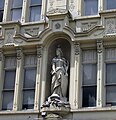 The Germania Building (Eastlake H)
 -
 Music Hall (Venetian Gothic)
 -
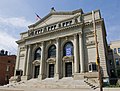 Memorial Hall (Beaux Arts)
 -
 Elaborate ornamentation of an Elm Street building
 -
 Rounded window cornices are a common feature of Italianate architecture.
 -
 Italianate greystone at Clay and 13th Streets.
 -
 Entrance to the American Building (Art Deco)
 -
 Hanke Building on Main Street detail (Renaissance Revival)
 -
 Queen Anne architecture on Main Street


New construction[edit]
Noted Indianapolis architect Evans Woollen III and his architectural firm of Woollen, Molzan and Partners helped redevelop the historic neighborhood in the 1970s and 1980s. Woollen designed the Over-the-Rhine Pilot Center (1972–84), a group of four modern, mixed-use buildings within a two-block area.[35] The Pilot Center buildings included a recreational center, a senior citizens center, a Montessori school and daycare center, and a meeting and event space. Funding for the $2.5 million project came from the U.S. Department of Housing and Urban Development.[36]
Historic restoration[edit]

In 2011 the Over-the-Rhine Foundation, which works to prevent historic building loss in OTR, won third place in the National Trust for Historic Preservation's nationwide "This Place Matters" community challenge.[37] In 2006 the National Trust for Historic Preservation listed the status of Over-the-Rhine as "Endangered."[34] Since 1930, about half of Over-the-Rhine's historic buildings have been destroyed.[32] More will follow unless deteriorating buildings are repaired.[34] Between 2001 and 2006, the city approved more than 50 "emergency demolitions," which were caused by absentee landlords' allowing their buildings to become so critically dilapidated that the city declared them a danger to the public. Reinvestment could have saved them.[32][38] Due to the situation, the National Trust for Historic Preservation declared Over-the-Rhine one of Eleven Most Endangered Historic Places in 2006.[34] Over-the-Rhine was included in the 2008 book, Frommer's 500 Places to See Before They Disappear, which noted the district's "shocking state of neglect".[39]
According to WCPO in 2001, some of the worst-kept properties at the time were owned by Over-the-Rhine's non-profits,[40] which let the buildings sit vacant and deteriorating because of lack of funds[41] or volunteers.[42] With some buildings on the verge of collapse, investors and real-estate developers are trying to restore them before deterioration to the point of requiring demolition.[30] According to the U.S. Census Bureau in 2010, part of Over-the-Rhine had one of the highest rates of abandoned and vacant homes in the country. They classified it then as the sixth hardest area in the nation to get an accurate population count.[43]
In recent years there has been a burst of restoration and development slowly moving northward year by year from Central Parkway, with a focus on attracting local small businesses rather than national chains.[44] Developers have restored and renovated the abandoned buildings, the city renovated nearby Washington Park, and businesses and residents have moved into what were abandoned spaces. Local chefs and artisan brewers in particular embraced the area, and in 2018 Food & Wine Magazine called it "one of the country's most promising food scenes."[45]
Demographics[edit]
| Year | Pop. | ±% | ||
|---|---|---|---|---|
| 1819 | 10,283[50] | — | ||
| 1850 | 13,032 | +26.7% | ||
| 1860 | 19,226 | +47.5% | ||
| 1870 | 32,726 | +70.2% | ||
| 1880 | 33,472 | +2.3% | ||
| 1890 | 31,525 | −5.8% | ||
| 1900 | 39,500 | +25.3% | ||
| 1910 | 36,350 | −8.0% | ||
| 1920 | 30,200 | −16.9% | ||
| 1930 | 25,771 | −14.7% | ||
| 1940 | 24,246 | −5.9% | ||
| 1950 | 31,586 | +30.3% | ||
| 1960 | 27,577 | −12.7% | ||
| 1970 | 15,338 | −44.4% | ||
| 1980 | 10,206 | −33.5% | ||
| 1990 | 8,303 | −18.6% | ||
| 2000 | 6,497 | −21.8% | ||
| 2010 | 6,064 | −6.7% | ||
| 2020 | 5,622 | −7.3% | ||
| ||||
| 2007 population was estimated at 4970[46]Wards were utilized from 1840-1890 which have slightly different boundaries from census tracts utilized from 1900-40.[47] [48] [49] | ||||

| Year | Pop. | ±% | ||
|---|---|---|---|---|
| 1950 | 9,933 | — | ||
| 1960 | 9,275 | −6.6% | ||
| 1970 | 7,312 | −21.2% | ||
| 1980 | 6,387 | −12.7% | ||
| 1990 | 5,212 | −18.4% | ||
| 2000 | 4,563 | −12.5% | ||
| 2010 | 4,298 | −5.8% | ||
| 2020 | 3,845 | −10.5% | ||
| ||||
In 2001 there were an estimated 500 vacant buildings in Over-the-Rhine with 2,500 residential units.[22] Of those residential units 278 were condemned as uninhabitable.[22] Also in 2001 the owner-occupancy rate was between 3 and 4 percent compared to the citywide rate of 39 percent.[22] According to the "Drilldown", a comprehensive analysis of the city's actual population and demographics conducted in 2007, OTR's current population was just 4,970.[51] At the 2000 census,[52] the racial makeup of Over-the-Rhine was 19.4% White, 76.9% African American, and less than 4% of other races. 0.6% of the population were Hispanics or Latinos of any race.[citation needed]
The neighborhood's residents comprise roughly 1.2% of the population of the City of Cincinnati.[citation needed]
Recent gentrification has changed the demographic makeup of the area as residents moving in tend to have a higher income and are more likely to be white.[53] By 2018 the website statisticalatlas.com was estimating OTR's population to be 34% white and 54% black, with 56% of those between the ages of 20 and 24 being white.[54]
In media[edit]
- In the movie Ides of March, George Clooney plays a politician who campaigns at Memorial Hall in Over-the-Rhine.[citation needed]
- In the movie Traffic (2000), the teenage daughter of the US drug czar becomes addicted to heroin and goes to Over-the-Rhine for drugs.[55]
- Harry's Law (2011), an NBC legal comedy-drama, is set in Over-the-Rhine, though only old stock photos are shown. No filming was done in Over-the-Rhine or Cincinnati.[56]
- Little Man Tate (1991) was filmed in Over-the-Rhine as well as various other Cincinnati locations.[citation needed]
- A Rage in Harlem (1991) was filmed in Over-the-Rhine because it resembled 1950s Harlem.[57]
- In Eight Men Out (1988) scenes depicting Chicago in 1919 were shot in Over-the-Rhine.
- Over-the-Rhine and other nearby neighborhoods are featured in the 3 Doors Down music video “It's Not My Time”.[citation needed]
- In music, the folk-rock group Over the Rhine took its name from the Cincinnati neighborhood, where the band first started in 1989.[58]
- The indie band Big Red Machine has a song called "The Ghost of Cincinnati" which repeatedly references Over-the-Rhine and its gentrification.[59]
- Cincinnati-born vocalist Matt Berninger references the neighborhood in the lyrics of the 2015 EL VY song "I'm the Man to Be."[citation needed]
- Electronic Music Producer "OTR" took his name from the Cincinnati neighborhood, when he saw the transformation it was undergoing mirrored his own.[60]
List of annual events[edit]
A partial list of Over-the-Rhine’s distinctive annual events includes:
- Bockfest
- Cincinnati Fringe Festival Annual - Occurs the two weeks after Memorial Day
- MidPoint Music Festival
- Cincinnati May Festival
- Cincinnati Reds Opening Day Parade from Findlay Market to Fountain Square
- Nowhere Else Music and Arts Festival[citation needed]
List of landmarks[edit]
Most of Over-the-Rhine's landmarks are related to the arts and are clustered in one area near Downtown.

- Art Academy of Cincinnati, founded in 1869, is a four-year arts college with its campus centered around 12th and Jackson streets.[61]
- Cincinnati Music Hall, built in 1878, is a concert theatre that hosts the Cincinnati Opera, the Cincinnati Symphony Orchestra, the Cincinnati Pops Orchestra, and the Cincinnati May Festival.
- Emery Theatre was built as the original home of the Cincinnati Symphony Orchestra. Famous conductor Leopold Stokowski considered its acoustics comparable to Carnegie Hall.[62][63] It is currently closed for renovations.
- Ensemble Theatre of Cincinnati In Over The Rhine since 1988, a theatre that presents new works and works that are new to the region.
- Findlay Market is the oldest continuously operated public market in Ohio.[64] It is also the site of special events and a farmers' market.[65]
- Know Theatre of Cincinnati a theatre that produces contemporary theatre with new works and regional premieres. Know Theatre produces the annual Cincinnati Fringe Festival - the largest performing arts festival in Cincinnati.
- Memorial Hall is the home of the Cincinnati Chamber Orchestra, the progressive MusicNow festival, and the American Classical Music Hall of Fame and Museum.
- School for Creative and Performing Arts is the first K-12 selective arts school in the United States.[66] In 2009 the school was the subject of the MTV reality television series Taking the Stage.
- Washington Park, the second oldest park in the city behind Piatt Park, originally established as a burial ground for several small churches.
- Cincinnati Ballet
List of historic churches[edit]
- St. Paulus Kirche, 1419 Race Street, German Evangelical Protestant (Oldest Protestant church in the city)
- German Baptist Church, Walnut and Liberty Streets[citation needed]
- Old St. Mary's Church, 123 E. Thirteenth Street
- Philippus United Church of Christ, West Mcmicken and Ohio Avenues
- St. John the Baptist Church, Green and Bremen Streets[citation needed]
- Saint Francis Seraph Church, Vine and Liberty Streets
- St. Paul Church, East 12th and Spring Streets
- Salem United Church of Christ, 1425 Sycamore Street
- Nast Trinity United Methodist Church, 1310 Race Street (Known as Over-the-Rhine Community Methodist Church since 2015)
- Wesley Chapel, 76 E. McMicken Avenue
- Prince of Peace Lutheran Church, 1528 Race Street[citation needed]
- First Lutheran Church, 1208 Race Street[citation needed]
- St. John's Unitarian Church, 1205 Elm Street[67]
Notable people[edit]
- Buddy Gray, community activist
- Anna Marie Hahn, serial killer
- Ronald Howes, American toy inventor, created the Easy-Bake Oven
- Venus Ramey, 1944 Miss America winner
References[edit]
- ^ a b c "National Register Information System". National Register of Historic Places. National Park Service. June 30, 2007.
- ^ Walter D. Kamphoefner (July 1982). Cincinnati Magazine volume 15 number 10. Emmis Communications. p. 50.
- ^ Cincinnati Magazine volume 15 number 10. Emmis Communications. July 1982. p. 50.
- ^ Richard S. Simons (1985). The Rivers of Indiana. Indiana University Press. p. 81.
- ^ a b c Over-the-Rhine Foundation. Guide to OTR Architecture. Accessed on 2009-08-13.
- ^ Richard S. Simons (1938). Princeton Alumni Weekly Volume 39. Princeton University. p. 468.
- ^ Richard Worth (2013). Baseball Team Names A Worldwide Dictionary, 1869-2011. McFarland, Incorporated, Publishers. p. 1301.
- ^ Gentlemen's Quarterly GQ. · Volume 29. Indiana University. 1959. p. 154.
- ^ Cincinnati Reds Hall of Fame Highlights Memorable Moments in Team History as Heard on the Reds Radio Network. Clerisy Press. 2013. p. 60.
- ^ Polly Campbell (2020). Cincinnati Food A History of Queen City Cuisine. American Palate, a division of the History Press. p. 31.
- ^ a b Over-the-Rhine Foundation. OTR History Archived 2009-05-28 at the Wayback Machine. Accessed on June 13, 2009
- ^ Kenny (1875), pg. 130.
- ^ Pulszky, Francis; Theresa Pulszky (1853). White, Red, Black: Sketches of American Society in the United States. New York: Redfield. pp. 297.
- ^ Kenny (1875), pg. 129.
- ^ Margrit Beran Krewson (1991). Immigrants from the German-speaking Countries of Europe A Selective Bibliography. Indiana University Press. p. 7.
- ^ Market History | Findlay Market of Cincinnati, Ohio
- ^ OTR Brewery District | Cincinnati, OH
- ^ Skirtz, Alice (2012). Econocide: Elimination of the Urban Poor. NASW Press. ISBN 978-0-87101-424-5.
- ^ OTR Brewery District | Cincinnati, OH
- ^ "Over-the-Rhine, Cincinnati, OH - iRhine.com - Brewery District". Archived from the original on July 13, 2011. Retrieved December 24, 2010.
- ^ Newberry, Jon (December 17, 2010). "Christian Moerlein brews new 'Arnold's' beer in OTR".
- ^ a b c d Federal Reserve Bank of Cleveland, Bridging the Economic Divide: Cincinnati's Crisis Presents New Opportunities Archived 2011-07-08 at the Wayback Machine. Fall 2001. Retrieved on 2009-01-11
- ^ Trollope, Fanny, Domestic Manners of the Americans, Ch. 12.
- ^ "Liberty Street Road Diet – UrbanCincy". Retrieved October 22, 2020.
- ^ "How Cincinnati Salvaged the Nation's Most Dangerous Neighborhood". POLITICO Magazine. Retrieved November 27, 2018.
- ^ Addie, Jean-Paul (September 1, 2009). "Constructing Neoliberal Urban Democracy in the American Inner-city" (PDF). Local Economy. 24 (6): 536–554. doi:10.1080/02690940903314944. ISSN 0269-0942. S2CID 144067253.
- ^ Woodard, Colin (June 16, 2016). "How Cincinnati Salvaged the Nation's Most Dangerous Neighborhood". POLITICO Magazine. Retrieved January 1, 2019.
- ^ "How 3CDC built a local events empire". Cincinnati.com. Retrieved January 1, 2019.
- ^ "3CDC shifting its mission in downtown Cincinnati (Video) - Cincinnati Business Courier". Cincinnati Business Courier. May 18, 2018. Retrieved May 4, 2020.
- ^ a b c d MAAG, CHRISTOPHER (November 25, 2006). "In Cincinnati, Life Breathes Anew in Riot-Scarred Area". New York Times.
- ^ OTR Foundation Why OTR Matters. Accessed on 2010-08-13.
- ^ a b c Over-the-Rhine Foundation. Historic Preservation Archived 2009-02-14 at the Wayback Machine. Accessed on 2009-08-13.
- ^ iRhine.com, Over-the-Rhine History, Part 2 Archived 2008-06-07 at the Wayback Machine. Accessed on 2009-08-13
- ^ a b c d "Plan your next trip with the National Trust | National Trust for Historic Preservation". savingplaces.org. Retrieved August 14, 2022.
- ^ Philip J. Trounstine (May 9, 1976). "Evans Woollen: Struggles of a 'Good Architect'". [Indianapolis] Star Magazine: 23.
- ^ "Pilot Center Filling in Over-the-Rhine". Architectural Record. 158 (5): 81. October 1975.
- ^ "2011 This Place Matters Community Challenge". National Trust for Historic Preservation. Retrieved July 20, 2011.
- ^ "Now, not soon, is the time to save OTR's historic treasures". Cincinnati Enquirer. January 14, 2010. Retrieved February 26, 2010.
- ^ Hughes, Holly; West, Larry (January 29, 2009). 500 Places to See Before They Disappear. Frommer's. pp. 346–47. ISBN 978-0-470-18986-3.
- ^ Quinlivan (2001) 27:58
- ^ Quinlivan (2001) 28:30
- ^ Quinlivan (2001) 12:10
- ^ "OTR, West End a quagmire for census". Cincinnati Enquirer. March 1, 2010. Archived from the original on March 4, 2010. Retrieved March 14, 2010.
- ^ Woodard, Colin (June 16, 2016). "How Cincinnati Salvaged the Nation's Most Dangerous Neighborhood". Politico. Retrieved June 14, 2018.
- ^ Landsel, David. "This Midwest Neighborhood Is Home to One of the Country's Most Promising Food Scenes". Food and Wine. Retrieved June 14, 2018.
- ^ "Drilldown report" (PDF).
- ^ Quinn, James; Eubank, Earle; Elliott, Lois (1947). Population changes--Cincinnati, Ohio, and adjacent areas 1900- 1940. Bureau of Business Research, the Ohio State Univ. in co-operation with the City of Cincinnati, and the Dept. of Sociology.
- ^ Enquirer, Cincinnati. "A neighborhood comparison: Population (2020)". The Enquirer. USA Today. Retrieved February 16, 2024.
- ^ Census, US. "Population Publications (1790-2020)". US Census. Retrieved February 16, 2024.
- ^ "Inner-city destruction and survival" (PDF). urbanform.org. Retrieved September 16, 2023.
- ^ "Cincinnati Neighborhood Market DrillDown" (PDF). Social Compact Inc. June 2007. Retrieved December 23, 2011.
- ^ "U.S. Census website". United States Census Bureau. Retrieved January 31, 2008.
- ^ Swartsell, Nick. "The Ollie's Trolley mural at Liberty and Race streets will come down to make way for building improvements and a new bar". City Beat. Retrieved June 14, 2018.
- ^ "The Demographic Statistical Atlas of the United States - Statistical Atlas". StatisticalAtlas.com. Retrieved June 14, 2018.
- ^ "Rebirth of Over-the-Rhine :: A Documentary Film :: A Steve Dorst - Joe Brinker Co-Production". www.over-the-rhine-movie.com. Retrieved August 14, 2022.
- ^ Kiesewetter, John (January 17, 2011). "Laying down the 'Harry's Law'" (Press release). WCPO.
- ^ William Horberg (November 7, 2008). "The Last Chester Himes Movie? pt 2". Typepad. Retrieved November 5, 2010.
- ^ "FAQ - over the Rhine".
- ^ Deletter, Emily (June 30, 2021). "Aaron Dessner's 'The Ghost of Cincinnati' lyrics full of local connections". Cincinnati Enquirer. Archived from the original on September 13, 2023. Retrieved September 13, 2023.
- ^ Bhanawat, Akshay (May 6, 2019). "From Aerospace Engineer To Music Producer, This Is The Journey of OTR [INTERVIEW]". T.H.E - Music Essentials. Retrieved November 22, 2019.
- ^ "About AAC". Art Academy of Cincinnati. February 7, 1828. Retrieved August 14, 2022.
- ^ "$3 Million Projected to Reopen the Emery Theatre" (Press release). Emery Center Corporation. October 29, 2008. Retrieved December 7, 2008.
- ^ Gelfand, Janelle (August 31, 1999). "Emery fix-up in the wings : Team works to bring 1911 gem into the 21st century". Cincinnati Enquirer. Retrieved July 10, 2008.
- ^ Findlay Market. About Findlay Market. Accessed on 2009-08-23.
- ^ Findlay Market-Historic renovated Cincinnati Public Market and Farmers Market Corporation for Findlay Market, 2007. Accessed 27 May 2007.
- ^ School for Creative and Performing Arts. The New SCPA Archived 2010-12-25 at the Wayback Machine. Accessed on 2009-08-23.
- ^ "The Transept | Event Venue| Funky's Catering Events". The Transept. Retrieved August 14, 2022.
External links[edit]


| Lists by county |
|   |
|---|---|---|
| Lists by city | ||
| Other lists | ||