


Spanish nobility

The Spanish nobility are people who possess a title of nobility confirmed by the Spanish Ministry of the Presidency, Justice and Relations with the Cortes, as well as those individuals appointed to one of Spain's three highest orders of knighthood: the Order of the Golden Fleece, the Order of Charles III and the Order of Isabella the Catholic. Some members of the Spanish nobility possess various titles that may be inherited or not, but the creation and recognition of titles is legally the prerogative of the monarchy of Spain.
Many Spanish titles and noble families still exist who have transmitted their aristocratic status since the Middle Ages. Some aristocratic families in Spain use the nobiliary particle de before their family name, although this was more prominent before the 20th century. During the rule of Francisco Franco in Spain, some new hereditary titles were conferred on individuals, and titles granted by Carlist pretenders were officially recognised.
Despite Juan Carlos I's ascension to the Spanish throne in 1975, the royal court of nobles holding positions and offices attached to the Royal Household of Spain was not restored. Noble titleholders are subjected to taxation, whereas until 1923[1] they were exempt from doing so. King Juan Carlos resumed the conferral of titles to recognize those whose public service, artistic endeavours, personal achievements, philanthropy, etc. is deemed to have benefitted the Spanish nation.
Spanish nobility today
[edit]
As of 2023, there are approximately 2,237 titled nobles in Spain, and there are 418 Grandes de España, with 2,825 total titles of Spanish nobility. Some nobles may carry more than one title of nobility. Many are active in the worlds of business, finance, and technology, with some taking on leadership roles in major IBEX 35 companies, some of Spain's largest companies. Examples include the president of FCC, Esther Alcocer Koplowitz, 9th Marchioness of Casa Peñalver, or Alfonso Martínez de Irujo Fitz-James Stuart, Duke of Híjar, president of IE Law School in Madrid.[2][3]
Legal situation
[edit]In Spain today, the possession of a title of nobility does not imply any legal or fiscal privilege; the possession of titles of nobility is subject to the payment of a normal level of taxation. It is a distinction of merely honorary and symbolic character, accompanied by the treatment of the most excellent lord for those titles that possess the dignity of grandees of Spain and of illustrious lords for others. The last privilege, suppressed in 1984, was the right to a diplomatic passport by the Grandees of Spain (Grandes de España). This privilege disappeared by Royal Decree 1023/1984. The titles without the rank of grandee of Spain never enjoyed this privilege.
With the establishment of the Second Spanish Republic in 1931, the use of noble titles was abolished by way of Decree of 1 June 1931,[4] ratified by Law of 30 December of the same year.[5] In 1948, legal recognition of the usage of noble titles was provided for by Law of 4 May 1948 restoring the rules as they were before 14 April 1931.[6]
At present, titles of nobility find their legal basis in article 62, section f, of the 1978 constitution, which grants the prerogative of the king to grant honors and distinctions in accordance with the laws.
Spanish legislation recognizes titles of nobility and protects their legal owners against third parties. The Spanish nobility titles are in no case susceptible of purchase or sale, since their succession is strictly reserved for blood relatives of better right of the first holder of the title. The successions are processed by the Ministry of Justice and their use is subject to their respective tax.
The legal status of individual titles can be checked at La Diputación de la Grandeza de España y Títulos del Reino (DGET) and using Guía de Títulos in the Navigation bar.[7]
Classification of Spanish nobles
[edit]-
 The crown of the Spanish monarch
 -
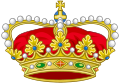 The crown of the Prince or Princess of Asturias (heir apparent)
 -
 The coronet of an infante (prince)
 -
 A coronet of a grandee
 -
 A coronet of a Spanish duke
 -
 A coronet of a Spanish marquess
 -
 A coronet of a Spanish count
 -
 A coronet of a Spanish viscount
 -
 A coronet of a Spanish baron
 -
 A coronet of a Spanish señor (lord)
 -
 A coronet of a Spanish Hidalgo
.svg)


.svg)
.svg)


Spanish nobles are classified as either grandees, as titled nobles, or as untitled nobles.
In the past, grandees were divided into first, second, and third classes, but this division has ceased to be relevant in practice while remaining a titular distinction; legally all grandees enjoy the same privileges in modern times. At one time however, each class held special privileges such as:
- those who spoke to the king and received his reply with their heads covered.
- those who addressed the king uncovered, but put on their hats to hear his answer.
- those who awaited the permission of the king before covering themselves.
Additionally, all grandees were addressed by the king as mi Primo (my Cousin), whereas ordinary nobles were only qualified as mi Pariente (my Kinsman).
An individual may hold a grandeeship, whether in possession of a title of nobility or not. Normally, however, each grandeeship is attached to a title. A grandeeship is always attached to the grant of a ducal title. The grant of a grandeeship with any other rank of nobility has always been at the will of the sovereign. Excepting dukes and some very ancient titles of marquesses and counts, most Spanish titles of nobility are not attached to grandeeships.
A grandee of any rank outranks a non-grandee, even if that non-grandee's title is of a higher degree, with the exception of official members of the Spanish royal family who may in fact hold no title at all. Thus, a baron-grandee enjoys higher precedence than a marquess who is not a grandee.
Since 1987, the children of Spanish infantes, traditionally considered part of the royal family, have been entitled to the rank and style of a grandee but do not hold the legal dignity of grandee unless a grandeza is officially conferred by the sovereign; once the dignity has been officially bestowed, it becomes hereditary.
Some notable titles, which are attached to grandeeships, are: Duke of Alba, Duke of Medinaceli, Duke of Osuna, Duke of Infantado, Duke of Albuquerque, Duke of Nájera, Duke of Frías and Duke of Medina Sidonia, Marquess of Aguilar de Campoo, Marquess of Astorga, Marquess of Santillana, Marquess of Los Vélez, Count of Benavente, Count of Guaqui, Count of Lerín, Count of Olivares, Count of Oñate, and Count of Lemos.
Form of address
[edit]Dukes, Grandees, their spouses and heirs are entitled to the honorific style of The Most Excellent Lord/Lady.
Non-Grandee titled nobles, their spouses and offspring use the style of The Most Illustrious Lord/Lady.
Ranks
[edit]The ordinary Spanish nobility is divided into six ranks. From highest to lowest, these are: duque (duke), marqués (marquess), conde (count), vizconde (viscount), barón (baron), and señor (lord) (as well as the feminine forms of these titles).
Nobility descends from the first man of a family who was raised to the nobility (or recognized as belonging to the hereditary nobility) to all his legitimate descendants, male and female, in the male line (with some very few and notable exceptions). Thus, most persons who are legally noble hold no noble title. Hereditary titles formerly descended by male-preference primogeniture, a woman being eligible to inherit only if she had no brother or if her brothers also inherited titles. However, by Spanish law, all hereditary titles descend by absolute primogeniture, gender no longer being a criterion for preference in inheritance, since 2005.
On October 21, 2022, the Spanish authorities abolished 33 aristocratic titles: In early October, the Senate (upper house of parliament) of Spain approved a bill on historical memory, declaring the dictatorship of Francisco Franco and the judicial decisions made under his regime illegal.
Princes
[edit].jpg)
The often overlooked title of 'prince' (príncipe/princesa) has historically been borne by those who have been granted or have inherited that title. It is often not included in lists of the Spanish nobility because it is rare. Prince/Princess are English translations of Infante/Infanta, referring to the son or daughter of a king; such titles are reserved for members of the royal family (the heir to the throne or the consort of the Queen regnant). Historically, infante or infanta could refer to offspring, siblings, uncles and aunts of a king. The heir's princely titles derive from the ancient kingdoms which united to form Spain.
Three titles of prince are held by the heir to the Spanish throne.
- Prince of Asturias as heir apparent to the throne of the Kingdom of Castile and León.
- Prince of Girona as heir apparent to the throne of the Kingdom of Aragon.
- Prince of Viana as heir apparent to the throne of the Kingdom of Navarre.
Other titles of 'prince' were frequently granted by the kings of Spain, but usually in their capacity as kings of Naples or of Sicily. Such nobles often sojourned at the Spanish court where their titles were acknowledged, but rarely were Spanish nobles the recipients of a title of prince in Spain. The most notable exceptions were the title Prince of the Peace conferred in 1795 on Manuel Godoy, a favourite of the Spanish king and the title Prince of Vergara conferred to Baldomero Espartero. And Joseph Bonaparte conferred the title to be hereditary on his grandchildren in both the male and female line, Although legislation of the twentieth century ended official recognition of the title of prince outside the royal bloodline family, it did allow the holder of a princedom to have the dignity converted to a ducal title of the same name. When military dictator Francisco Franco appointed Juan Carlos de Borbón as his heir apparent with the future title of king, he created the new titles of prince of Spain for him. [8]
Duke/Duchess (Duque/Duquesa)
[edit]

All dukedoms (except Fernandina) are attached to a grandeeship. A partial list includes:
- Duke of Abrantes
- Duke of Acerenza (no apparent record at La Diputación de la Grandeza de España y Títulos del Reino)
- Duke of Ahumada
- Duke of Alba
- Duke of Alburquerque
- Duke of Alcalá de los Gazules
- Duke of Alcudia
- Duke of Algeciras
- Duke of Algete
- Duke of Aliaga
- Duke of Almazán
- Duke of Almazán de Saint Priest
- Duke of Almodóvar del Río
- Duke of Amalfi
- Duke of Andría
- Duke of Arco
- Duke of Arcos
- Duke of Arión
- Duke of Arjona
- Duke of Aveiro
- Duke of Bailén
- Duke of Béjar
- Duke of Benavente
- Duke of Bivona
- Duke of Cádiz
- Duke of Camiña
- Duke of Cardona
- Duke of Ciudad Real
- Duke of Ciudad Rodrigo, bestowed on the 1st Duke of Wellington for his services to the Spanish King
- Duke of Feria
- Duke of Franco, bestowed upon the descendants of General Francisco Franco (Defunct as of October 2022)
- Duke of Gandia
- Duke of Granada de Ega
- Duke of Infantado
- Duke of Lugo
- Duke of Mandas
- Duke of Medina Sidonia
- Duke of Medinaceli
- Duke of Moctezuma de Tultengo, held by the descendants of the Aztec Emperor Moctezuma II
- Duke of Mola, held by the descendants of Emilio Mola, a leader of the 1936 military putsch (Defunct as of October 2022)
- Duke of Nájera
- Duke of Osuna
- Duke of Palma de Mallorca
- Duke of Primo de Rivera
- Duke of Seville
- Duke of Suárez
- Duke of Sueca
- Duke of Tamames
- Duke of Tetuán
- Duke of Veragua, held by the descendants of Christopher Columbus
- Duke of la Victoria
Marquess/Marchioness (Marqués/Marquesa)
[edit]_Mar%C3%ADn_asiste_al_acto_del_V_Centenario_del_nacimiento_de_Don_Francisco_de_Toledo_(16425636495)_(cropped).jpg)
- Marquess of Almenara
- Marquess of Altamira
- Marquess of Alventos
- Marquess of Ardales
- Marquess of Astorga
- Marquess of Bolarque
- Marquess of Borghetto
- Marquess of Camarasa
- Marquess of Campotéjar
- Marquess of Castel-Moncayo
- Marquess of Cañada Honda
- Marquess of Cañete
- Marquess of Casa Fuerte
- Marquess of Del Bosque
- Marquess of Fontellas
- Marquess of Fuster
- Marquess of Griñón
- Marquess of Iria Flavia
- Marquess de los Jardines de Aranjuez
- Marquess of Leganés
- Marquess of Maratea
- Marquess of Moratalla
- Marquess of Navamorcuende
- Marquess of Novaliches
- Marquess of Larios
- Marquess of Laserna
- Marquess of Laula
- Marquess of Merry del Val
- Marquess of O'Shea
- Marquess of Oquendo
- Marquess of Portago
- Marquess of Samaranch
- Marquess of San Damián
- Marquess of San Felices de Aragón
- Marquess of Santa Cruz
- Marquess of San Saturnino
- Marquess of Silvela
- Marquess of Tabuérniga
- Marquess of Terranova
- Marquess of Torre Soto de Briviesca
- Marquess of Urquijo
- Marquess of Valdecarzana
- Marquess of Valdueza
- Marquess of Vallado
- Marquess of Vargas Llosa
- Marquess of Vessolla
- Marquess of Villabrágima
- Marquess of Villaviciosa de Asturias
- Marquess of Villena
Count/Countess (Conde/Condesa)
[edit]- Count of Altamira
- Count of Barcelona held by Don Juan, heir of Alfonso XIII, father of Juan Carlos I
- Count of Baños
- Count of Batanes
- Count of Bornos
- Count of Cervera
- Count of Covadonga
- Count of Elda: belonged to the House of Coloma.
- Count of Empúries
- Count of Fontanar
- Count of Fontao
- Count of Lemos
- Count of Lerín
- Count of Lucena
- Count of Maceda
- Count of Manila
- Count of Mansilla
- Count of la Maza
- Count of la Mejorada
- Count of Montijo
- Count of Olocau
- Count of Roussillon
- Count of Salvatierra
- Count of San Esteban de Cañongo
- Count of Teba
- Count of Torrubia
- Count of Toreno
- Count of Torre Arias
- Count of Urgell
- Count of Velayos
- Count of Villacieros
- Count of Villada
- Count of Yebes
- Count of Osorno
Viscount/Viscountess (Vizconde/Vizcondesa)
[edit]- Viscount of la Alborada
- Viscount of Altamira
- Viscount of Banderas
- Viscount of Cabrera
- Viscount of la Calzada
- Viscount of Castillo de Almansa
- Viscount of Jala-Jala
- Viscount of Mindanao
- Viscount of Quintanilla de Florez
- Viscount of Rocabertí
Baron/Baroness (Barón/Baronesa)
[edit]Baronies did not exist in the Kingdom of Castile nor the Kingdom of Navarre, and the subsequent kings of Spain did not confer any baronies attached to Castilian or Navarrese estates. However, they did exist in the Kingdom of Aragon, such as:
Lord/Lady (Señor/Señora) (Don/Doña)
[edit]The title of Señor is, together with that of Conde, the oldest in seniority of the Spanish realms. Many of these lordships are among the oldest titles of nobility in Spain, and the señor usually exercised military and administrative powers over the lordship. Although some lordships were created by the kings of Spain, others existed before them and have not been created by any known king. For example, the lord of Biscay held a great degree of independence from the king of Castile, to whom he could pledge or not pledge feudal allegiance, but of whom he was not automatically a vassal: each new lord of Biscay had to renew his oath to the king. Ultimately, however, the kings of Castile inherited the lordship.
Besides those held by the King, in Spain remain seven lordships that maintain the official consideration of Titles of the Kingdom according to the Official Guide of the Titles and Grandees of the Kingdom published by the Ministry of Justice: the Lordship of Solar de Tejada, the Lordship of Solar de Mandayona y Villaseca, the Lordship of Alconchel, the Lordship of Lazcano (with Grandee of Spain), the Lordship of Rubianes (with Grandee of Spain), the Lordship of Higuera de Vargas (with Grandee of Spain), the Lordship of Meirás (with Grandee of Spain) and the Lordship of Sonseca. Other lordships that were considered as Titles of the Kingdom in the past, have not been rehabilitated.
- Lord of Alconchel
- Lord of Balaguer, held by the King of Spain
- Lord of Biscay, held by the Spanish monarchy since 1378, when merged with the previously semi-independent lordship of Biscay
- Lord of Higuera de Vargas
- Lord of Casa Lazcano
- Lady of Meirás, señora de Meiras, created for Carmen Polo, wife of Francisco Franco and abolished in 2022.[9]
- Lord of Casa Rubianes
- Lord of Solar de Tejada
- Lord of Sonseca
Other titles
[edit]
- Infante: currently borne by royal princes, other than the heir apparent to the throne, who are sons of a Spanish king.
- Knight of the Order of Charles III caballero de la Orden de Carlos III: the bestowal of the highest order of knighthood on an individual grants personal nobility and certain heraldic privileges such as a heraldic mantle. The King of Spain continues to bestow this honor.
- Knight of the Royal Order of Isabella the Catholic caballero de la Orden de Isabel la Catolica: the bestowal of the second highest order of knighthood on an individual grants personal nobility and certain heraldic privileges such as a golden heraldic mantle. The King of Spain continues to bestow this honor.
- ricohombre (fem. Ricahembra): used during the Reconquista. The transition from ricohombres to grandes occurred between 1390 and 1530 as the new "noble oligarchy" replaced the old one due to the change of power base caused by the conflict between infantes of Aragon and the supporters of John II of Castile with his favorite Álvaro de Luna.[10] Alfonso de Cartagena in his Doctrinal de los caballeros (c. 1441-1444), while discussing the grandes, states that the previous term ricohombres is "old-fashioned".[11] By the 17th century the term was used to describe any nobleman.[citation needed]
- Condestable: cognate with "constable", it was a hereditary title used in the kingdoms of Castile and León for the official second in authority to the king. It became hereditary in the Velasco family which, however, gradually lost the powers once attributed to the Condestable of Castile.
- Caballero: equivalent to knight, it was very rare in the kingdom of Castile, but common in the kingdom of Aragon, where there were four types of caballeros:
- Golden-spur caballero: borne by those infanzones (descendants of one of the cadet branches of the kings of Aragon which did not inherit the throne) who had been knighted. They were the highest ranking knights.
- Royal-privilege caballero: a personal, non-hereditary title granted by the king to doctors of the law. It was rarely used by its holders, since the doctoral status enjoyed more privileges.
- Caballero Mesnadero: borne by the cadet sons of a ricohombre. It fell into desuetude during the 18th century, when the Bourbon kings purged the ranks of the nobility.
- Caballero franco: borne by those of hijosdalgo or infanzone status, but who were commoner-born.
- Potestad: borne only in the kingdom of Aragon, the equivalent of the Italian podestà, an administrative title. It disappeared with the Nueva Planta decrees in 1713.
Lower nobility
[edit]Lower nobility held ranks, without individual titles, such as infanzón (in Aragon, e.g. Latas Family), hidalgo or escudero. These did not, however, correspond to the status of a barón, a title unknown to Spanish nobility except in Catalonia.
Hidalgo was the most common of these: Originally all the nobles in the Western Peninsular Christian Realms were hidalgos and, as cristianos viejos ("old Christians"), held nearly exclusive right to privileged status (although there were some Jews and Muslims recognized as hidalgos, who shared their privilege to bear arms as knights in the mesnada real). The first of the kings of Pamplona and Asturias were originally elected and lifted up on a shield to assume Princeps inter Pares status, by these otherwise untitled nobles. For approximately three hundred years the hidalgos retained this privilege, only a few of them eventually being granted the non-heritable title of comes. Unlike Spain's later titled nobles, the early hidalgo did not necessarily possess or receive any fief or land grant. Many were as poor as commoners, although they were tax-exempt and could join the civil service or the army.
During the Middle Ages hidalgo became a title granted by the kings of Castile as a reward for service done to the crown (or, as in Biscay, as a way of recognizing prior rights). In the same way escudero was granted for military achievement when the Reconquista ended. Being the most obvious proof of noble descent, hidalgo came to be the only lesser title to remain among the modern ranks of Spanish nobility. From this ancient estate of the realm emerged Spain's nobility. All titled and untitled nobles are considered hidalgos, but many of the modern titled nobility do not descend from the original hidalguía.
The term Hidalgo de Sangre indicated membership in a family whose noble status was recognized in the earliest records of its existence; thus its immemorial nobility was acknowledged but not created by any monarch.
Succession
[edit]
The evidence supporting one's claim to a title may be reviewed by the Council of Grandees and Titled Nobles of the Kingdom (Diputación de Grandes y Títulos del Reino). The body includes eight grandees, eight nobles who are not grandees, and a president who must hold both a grandeeship and a hereditary title unattached to a grandeeship.
Succession to Spanish noble titles is hereditary, but not automatic. The original letters patent which created the title determine the order of succession. Payment of substantial fees is required whenever a title is inherited.
While noble titles historically have followed the rule of male-preference primogeniture, a Spanish law came into effect on 30 October 2006, after approval by both houses of the Cortes, establishing the inheritance of hereditary noble titles by the firstborn regardless of gender. The law is retroactive to 27 July 2005.[13]
Following the death of a noble, the senior heir may petition the sovereign through the Spanish Ministry of Justice for permission to use the title. If the senior heir does not make a petition within two years, then other potential heirs may do so on their own behalf. There is a limit of forty years from the vacancy by death or relinquishment of a title within which that title may be claimed and revived by an heir.
The petitioner must demonstrate that he or she is a child, grandchild or direct male line descendant of a noble (whether a grandee or not), or that he or she belongs to certain bodies or orders of chivalry deemed noble, or that the father's family is recognized as noble. The amount of fees due depend on whether the title is attached to a grandeeship or not, and on whether the heir is a direct descendant or a collateral kinsman of the previous holder. The petition is normally granted, except if the petitioner is a criminal.
Titles may also be ceded to heirs other than the senior heir, during the lifetime of the main titleholder. Normally, this process is used to allow younger children to succeed to lesser titles, while the highest or principal title goes to the senior heir. Only subsidiary titles may be ceded; the principal title must be reserved for the senior heir. The cession of titles may only be done with the approval of the monarch.
The late Cayetana Fitz-James Stuart, 18th Duchess of Alba (1926–2014) holds the Guinness World Record for number of titles with over 50 titles. Before her death, she ceded some of her titles to each of her six children; otherwise, all of them would have be inherited by the oldest.
Alternative nobility
[edit]The pretender Carlist branch of the Bourbons created its own titles for its supporters, unrecognized by the ruling Christinos branch. When General Francisco Franco became head of state with the support of, among others, Carlist troops, Carlist titles became officially recognized.
Titles created during the reign of King Juan Carlos
[edit]
From the beginning of his reign in November 1975, King Juan Carlos created new titles for about 51 people (as of April 2011),[14] among others recognizing the merits of politicians and artists. Some of these dignities have been hereditary. Examples include:
- Carmen Franco y Polo, daughter of dictator Francisco Franco, created 1st Duchess of Franco and Grandee of Spain in 1975
- Carlos Arias Navarro, Prime Minister, created 1st Marquess of Arias Navarro and Grandee of Spain in 1976
- Torcuato Fernández-Miranda, Prime Minister, created 1st Duke of Fernandez-Miranda and Grandee of Spain in 1977
- Adolfo Suárez, Prime Minister, created 1st Duke of Suárez and Grandee of Spain in 1981
- Andrés Segovia, classical guitarist, created 1st Marquess of Salobreña in 1981
- Salvador Dalí, surrealist painter, created 1st Marquess de Dalí de Púbol in 1982
- Joaquín Rodrigo, composer and pianist, created 1st Marquess de los Jardines de Aranjuez in 1991
- Juan Antonio Samaranch, President of the International Olympic Committee, created 1st Marquess of Samaranch and Grandee of Spain in 1991
- Manuel Gutiérrez Mellado, officer and politician, created 1st Marquess of Gutiérrez-Mellado in 1994
- Camilo José Cela, author and Nobel laureate, created 1st Marquess of Iria Flavia in 1996
- Leopoldo Calvo-Sotelo, Prime Minister, created 1st Marquess de la Ría of Ribadeo and Grandee of Spain in 2002
- Margarita Salas, scientist, created 1st Marchioness of Canero in 2008
- Paloma O'Shea Artiñano, pianist, created 1st Marchioness of O'Shea in 2008
- José Ángel Sánchez Asiaín, an international banker, created 1st Marquess of Asiaín in 2010
- Antoni Tàpies, painter, created 1st Marquess of Tàpies in 2010
- Vicente del Bosque, football manager, created 1st Marquess of Del Bosque in 2011
- Mario Vargas Llosa, author and Nobel laureate, created 1st Marquess of Vargas Llosa in 2011.
King Juan Carlos also exceptionally confirmed the title of Count of Barcelona, a title historically attached to the Crown, but used as a title of pretence by his father, Infante Juan, during the dynasty's 20th century exile and the subsequent reign of his son.
Titles created during the reign of King Felipe VI
[edit]King Felipe VI has not yet created any new titles of nobility. He has, however, revived the dukedom of Fernandina,[15] the marquisate of Murillo[citation needed], and the county of Torre Alegre[citation needed]; and has reverted the dukedom of Palma Mallorca to the crown, formerly belonging to his elder sister, Infanta Cristina of Spain, over a corruption enquiry.[16]
Gallery
[edit]-
 Álvaro de Luna, Duke of Trujillo (1390–1453)
 -

-
 Gonzalo Fernández de Córdoba, Duke of Terranova and Santangelo, Andria, Montalto and Sessa (1453–1515)
 -
 Pedro de Toledo y Zúñiga, 2nd Marquis of Villafranca del Bierzo (1484–1553)
 -
 Fernando Álvarez de Toledo, 3rd Duke of Alba (1507–1582)
 -
 Gabriel de la Cueva, 5th Duke of Alburquerque (1515–1571)
 -
 Álvaro de Bazán, 1st Marquess of Santa Cruz (1526–1588)
 -
 Luis de Velasco, Marquess of Salinas (1534–1617)
 -
 García Hurtado de Mendoza, 5h Marquess of Cañete (1535–1609)
 -

-
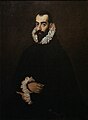 Juan Alonso Pimentel de Herrera, 5th Duke of Benavente (c. 1550–1621)
 -
 Francisco Gómez de Sandoval, 1st Duke of Lerma (1552–1625)
 -
 Ambrogio Spínola, 1st Marquess of Balbases (1569–1630)
 -
 Álvaro de Bazán, 2nd Marquess of Santa Cruz (1571–1646)
 -
 Pedro Téllez-Girón, 3rd Duke of Osuna (1574–1624)
 -
 Gaspar de Guzmán, Count-Duke of Olivares (1587–1645)
 -
 Diego López Pacheco, 7th Duke of Escalona (1599–1653)
 -
 Luis de Benavides Carrillo, Marquess of Caracena (1608–1668)
 -

-
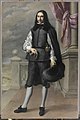 Íñigo Melchor de Velasco, 7th Duke of Frías (1635–1696)
 -
 Cardinal Luis Manuel Fernández de Portocarrero (1635–1709)
 -

-

-
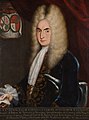 Baltasar de Zúñiga, 1st Duke of Arión (1658–1727)
 -
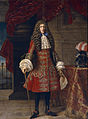 Luis Francisco de la Cerda, 9th Duke of Medinaceli (1660–1711)
 -

-
 Pedro Cebrián, 5th Count of Fuenclara (1687–1752)
 -
-
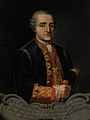
 José Moñino, 1st Count of Floridablanca (1728–1808)
 -
 María Josefa Pimentel, Duchess of Osuna (1752–1834)
 -
 Pedro Téllez-Girón, 9th Duke of Osuna (1755–1807)
 -
 María Cayetana de Silva, 13th Duchess of Alba (1762–1802)
 -

-
 José Álvarez de Toledo, Duke of Alba (1756–1796)
 -

-
 Don Pedro de Alcántara Álvarez de Toledo, 13th Duke of the Infantado (1768–1841)
 -

-

-
 José Rafael de Silva Fernández de Híjar, 12th Duke of Híjar (1776–1863)
 -
 José María Queipo de Llano, 7th Count of Toreno (1786–1843)
 -
 Francisco Serrano, 1st Duke of la Torre (1810–1885)
 -
 Ángel de Saavedra, 3rd Duke of Rivas (1815–1854)
 -

-
 Infante Juan, Count of Barcelona (1941–1977)


.jpg)
_-_Bildnis_eines_Edelmanns_-_WAF_1085_-_Bavarian_State_Painting_Collections.jpg)


.jpg)
.jpg)
_%C3%81lvaro_de_Baz%C3%A1n_y_Benavides,_retrato.png)


.jpg)


.jpg)

.jpg)
.jpg)
.jpg)

.JPG)


See also
[edit]Notes
[edit]- ^ The Agony of Spanish Liberalism: From Revolution to Dictatorship 1913–23. Francisco J. Romero Romero Salvadó, A. Smith. 26 May 2010. ISBN 9780230274648. Retrieved 24 November 2016. ISBN 978-1-349-36383-4.
- ^ Carrizosa, Susana (21 September 2019). "La aristocracia se sienta junto a su despacho aunque quizá no lo sepa". El País – via elpais.com.
- ^ "Los títulos nobiliarios en España: ¿qué tipos hay y cómo se conceden?". www.20minutos.es – Últimas Noticias. 23 November 2014.
- ^ "Ministerio de Estado" (PDF). www.boe.es. Retrieved 5 June 2021.
- ^ "Administración Central" (PDF). www.boe.es. Retrieved 5 June 2021.
- ^ "BOE.es – BOE-A-1948-3512 Ley de 4 de mayo de 1948 por la que se restablece la legalidad vigente con anterioridad al 14 de abril de 1931 en las Grandezas y Títulos del Reino". www.boe.es.
- ^ La Diputación de la Grandeza de España y Títulos del Reino (DGET)
- ^ Franco, Francisco (23 July 1969). "Ley 62/1969, de 22 de julio, por la que se provee lo concerniente a la sucesión en la Jefatura del Estado" (in European Spanish): 11607–11608. Retrieved 19 April 2022.
Artículo tercero. Prestado el juramento, el Príncipe Don Juan Corlas [sic!] de Borbón y Borbón ostentará el título de Príncipe de España, con tratamiento de Alteza Real, y asumirá los derechos y deberes inherentes a su alta condición.
{{cite journal}}: Cite journal requires|journal=(help) - ^ Jefatura del Estado: "Ley 20/2022, de 19 de octubre, de Memoria Democrática" (PDF). Boletín Oficial del Estado. Madrid: Agencia Estatal Boletín Oficial del Estado: 33–34. 20 October 2022. ISSN 0212-033X.
- ^ Iafolla 2021, p. 129.
- ^ Iafolla 2021, p. 201.
- ^ Peinado, Mari Luz (20 November 2014). "Did the Queen of England really have to bow before the Duchess of Alba?". El País.
- ^ "Ley 33/2006, de 30 de octubre, sobre igualdad del hombre y la mujer en el orden de sucesión de los títulos nobiliarios" (in Spanish). Boletin Oficial del Estado. pp. 37742–37743. Retrieved 10 January 2016.
- ^ "Nobiliario Español" : Titles and Grandeeships conferred by Juan Carlos I, with actual holders.
- ^ "Real Decreto 683/2020, de 27 de julio, por el que se rehabilita, sin perjuicio de tercero de mejor derecho el título de Duque de Fernandina, a favor de don Alonso-Enrique González de Gregorio Viñamata". www.boe.es. Retrieved 28 July 2020.
- ^ (in Spanish) "The King revokes the title of Duchess of Palma used by his sister doña Cristina". Europapress (15-06-11). (Accessed on 12 June 2015).
References
[edit]- Nobility & Grandee Titles in Spain (Ministry of Justice)
- Atienza, Julio de. Nobiliario Español: Diccionario Heráldico de Apellidos Españoles y de Títulos Nobiliarios. Madrid: Aguilar, 1948.
- Figueroa y Melgar, Alfonso de. Estudio Histórico Sobre Algunas Familias Españolas. 6v. in 12 parts. Madrid: Editions Dawson & Fry, 1965.
Bibliography
[edit]- Iafolla, Robert John (2021). Conceptions of Power in Late Medieval Castile: From Possession to Exercise (PhD in History thesis). University of California, Los Angeles.
Nobility by nation | |||||||||
|---|---|---|---|---|---|---|---|---|---|
(*) : state where monarchy still exists | |||||||||
| Africa |  | ||||||||
| Americas |
| ||||||||
| Asia |
| ||||||||
| Europe |
| ||||||||
| Oceania |
| ||||||||
