


Al Ain
Al Ain
Al-ʿAyn (ٱلْعَيْن) | |
|---|---|
Clockwise, from top: Green Mubazzarah, Sheikha Salama Mosque, the neighbouring desert, the campus of Abu Dhabi University, and Qasr Al Muwaiji | |
| Nickname(s): | |
  Al Ain Location of Al Ain in the UAE  Al Ain Al Ain (Persian Gulf)  Al Ain Al Ain (Middle East)  Al Ain Al Ain (West and Central Asia) | |
| Coordinates: 24°12′27″N 55°44′41″E / 24.20750°N 55.74472°E | |
| Country |  United Arab Emirates United Arab Emirates |
| Emirate |  Abu Dhabi Abu Dhabi |
| Municipal region | Al-Ain |
| Subdivisions |
|
| Government | |
| • Type | Absolute monarchy |
| • Body | Al Ain City Municipality |
| • Ruler | Mohamed bin Zayed Al Nahyan |
| • Ruler's Representative of the Eastern Region of the Emirate of Abu Dhabi | Tahnoun bin Mohammed Al Nahyan |
| Area | |
| • Total | 15,123 km2 (5,839 sq mi) |
| Elevation | 292 m (958 ft) |
| Population (2021) | |
| • Total | 846,747 |
| • Density | 56/km2 (150/sq mi) |
| GDP | |
| • Total | US$ 38.0 billion (2023) |
| • Per capita | US$ 58,900 (2023) |
| Time zone | UTC+4 (UAE Standard Time) |
| Official name | Cultural Sites of Al Ain (Hafit, Hili, Bidaa Bint Saud and Oases Areas) |
| Criteria | Cultural: iii, iv, v |
| Reference | 1343 |
| Inscription | 2011 (35th Session) |


Al Ain (Arabic: ٱلْعَيْن, al-ʿayn, literally, the spring of water)[4] is a border city on the eastern side of Tawam oasis and the seat of the administrative division, the Al Ain Region, in the Emirate of Abu Dhabi, United Arab Emirates. The city is bordered to the east by the Omani town of Al-Buraimi in the Al Buraimi Governorate. It is the largest inland city in the Emirates, the fourth-largest city (after Dubai, Abu Dhabi, and Sharjah), and the second-largest[2] in the Emirate of Abu Dhabi. The freeways connecting Al-Ain, Abu Dhabi, and Dubai form a geographic triangle in the country, each city being roughly 130 kilometres (81 mi) from the other two.
Climate and geography[edit]
Al Ain is known as the "Garden City" (Arabic: مَدِيْنَة ٱلْحَدِيْقَة, romanized: Madīnat Al-Ḥadīqah, lit. 'City of The Garden')[1] of Abu Dhabi,[3] the UAE[4] or the Gulf,[5][6] due to its greenery, particularly with regard to the city's oases,[2] parks, tree-lined avenues and decorative roundabouts, with there being strict height controls on new buildings, to no more than seven floors,[9] and according to one author, an oasis around Al-Ain and Al-Hasa in Saudi Arabia are the most important in the region of the Gulf.[10]
The city is located approximately 160 kilometres (99 mi) east of the capital Abu Dhabi, and about 120 kilometres (75 mi) south of Dubai.[11] The eastern region covers an area of approximately 13,100 km2 (5,100 sq mi). Oman lies to the east, Dubai and Sharjah to the north, Abu Dhabi to the west and the Empty Quarter desert and Saudi Arabia to the south. The topography of Al-Ain is unique and varies as one travels to the east. The ecologically important Jebel Hafeet ("Mount Hafeet"),[12] an outlier of the main Hajar range, is considered one of the monuments of Al-Ain, lying just to the south of the city. Rising to 1,100–1,400 metres (3,600–4,600 feet) in elevation,[2][13][14] Jabal Hafeet is one of the highest mountains in the country,[3] and has a number of ridges which stretch to the inner part of the city, two of which are Jabal An-Naqfah[15][16][17] (which touches Al-Ain Oasis),[18][19] and the Western ridge.[20][21] Sand dunes of varying texture that are tinged red with iron oxide lie to the north and east of Al-Ain.[citation needed]
The city has a hot desert climate (Köppen climate classification BWh), featuring long, extremely hot summers and warm winters. In Al-Ain, the mean annual rainfall is 96 mm (3.8 in) and the average relative humidity is 60% (United Arab Emirates University, 1993). Low humidity in Al-Ain, particularly during the summers, makes it a popular destination for many people at that time of year. Boer (1997) classified the UAE climate as hyper-arid and divided it into four climatic regions: the coastal zone along the Persian Gulf, the mountain areas northeast of UAE, the gravel plains around Al Ain, and the central and southern sand desert. More rainfall and lower temperatures occur in the northeast than in the southern and western regions. The monthly average rainfall around Al-Ain was 100–120 mm (3.9–4.7 in) from the period 1970 to 1992.[citation needed]
To the south of the city, near Oman, there is the man-made Lake Zakher, which resulted from the release of waste water from desalination plants.[22] Also in this region, to the east of Jebel Hafeet, lies the area of Mezyad, which has a border crossing with Oman, and is where the historic Mezyad Fort is located.[18][23]
| Climate data for Al Ain International Airport (1991–2020) | |||||||||||||
|---|---|---|---|---|---|---|---|---|---|---|---|---|---|
| Month | Jan | Feb | Mar | Apr | May | Jun | Jul | Aug | Sep | Oct | Nov | Dec | Year |
| Record high °C (°F) | 31.8 (89.2) |
36.6 (97.9) |
42.9 (109.2) |
44.4 (111.9) |
49.3 (120.7) |
49.0 (120.2) |
49.2 (120.6) |
48.8 (119.8) |
47.8 (118.0) |
43.1 (109.6) |
37.5 (99.5) |
35.0 (95.0) |
49.3 (120.7) |
| Mean daily maximum °C (°F) | 24.7 (76.5) |
27.5 (81.5) |
31.3 (88.3) |
36.9 (98.4) |
42.1 (107.8) |
44.6 (112.3) |
44.9 (112.8) |
44.6 (112.3) |
42.0 (107.6) |
37.7 (99.9) |
31.4 (88.5) |
26.9 (80.4) |
36.2 (97.2) |
| Daily mean °C (°F) | 18.5 (65.3) |
20.7 (69.3) |
24.0 (75.2) |
29.1 (84.4) |
33.7 (92.7) |
36.0 (96.8) |
37.2 (99.0) |
37.1 (98.8) |
34.4 (93.9) |
30.3 (86.5) |
24.8 (76.6) |
20.4 (68.7) |
28.9 (84.0) |
| Mean daily minimum °C (°F) | 12.8 (55.0) |
14.5 (58.1) |
17.3 (63.1) |
21.7 (71.1) |
25.7 (78.3) |
28.1 (82.6) |
30.2 (86.4) |
30.6 (87.1) |
27.6 (81.7) |
23.7 (74.7) |
19.0 (66.2) |
14.8 (58.6) |
22.2 (72.0) |
| Record low °C (°F) | 5.6 (42.1) |
5.9 (42.6) |
9.9 (49.8) |
13.2 (55.8) |
18.0 (64.4) |
19.9 (67.8) |
22.8 (73.0) |
21.9 (71.4) |
21.8 (71.2) |
16.2 (61.2) |
13.0 (55.4) |
7.4 (45.3) |
5.6 (42.1) |
| Average precipitation mm (inches) | 14.7 (0.58) |
4.6 (0.18) |
17.9 (0.70) |
6.1 (0.24) |
0.7 (0.03) |
0.6 (0.02) |
4.9 (0.19) |
1.5 (0.06) |
0.8 (0.03) |
0.5 (0.02) |
2.2 (0.09) |
7.3 (0.29) |
62.0 (2.44) |
| Average precipitation days (≥ 1 mm) | 3.2 | 2.0 | 2.6 | 1.7 | 1.0 | 1.5 | 1.4 | 1.2 | 1.2 | 1.0 | 1.3 | 1.8 | 20.0 |
| Average relative humidity (%) | 63 | 55 | 48 | 36 | 30 | 33 | 37 | 35 | 39 | 43 | 53 | 61 | 44 |
| Average dew point °C (°F) | 10 (50) |
10 (50) |
10 (50) |
10 (50) |
12 (54) |
16 (61) |
18 (64) |
18 (64) |
16 (61) |
15 (59) |
14 (57) |
11 (52) |
13 (56) |
| Source 1: NOAA[24] | |||||||||||||
| Source 2: Time and Date (dewpoints, between 2005 and 2015)[25] | |||||||||||||
Demographics[edit]
With a population of 766,936 (as of 2017),[27] it has the highest proportion of Emirati nationals (30.8%) in the country, though the majority of its residents are expatriates, particularly from the Indian subcontinent. Many people are from Bangladesh and Pakistan, and a few Afghans which is in total 23,000 Afghan approximately in whole U.A.E and majority are from province of Khost.[28]
Economy[edit]

Al Ain is an important services centre for a wide area extending into Oman. There are three major shopping centres,[29] Al Ain Mall, Al Jimi Mall, Al Hili Mall and Al Bawadi Mall (opened in 2009 in Al Khrair area) as well as traditional souqs for fruit and vegetables and livestock. One such souq exists for camels near an IKEA store and Bawadi Mall on Zayed Bin Sultan Street,[2] the road which leads to Mezyad.[6] Industry is growing, but is still on a small scale, and includes the Coca-Cola bottling plant and the Al Ain Portland Cement Works. The water in Al-Ain is of good quality. Service industries such as car sales, mechanics and other artisans are located in the area known as Sanaiya and Pattan Market. Social and governmental infrastructure include the Higher Colleges of Technology, well-equipped medical facilities including the teaching hospital at Tawam, Al Ain International Airport,[30] and military training areas.[citation needed] Al Ain also has world's largest dates processing and marketing company, Al Foah Company LLC. The place is also famous for Al Ain Dairy Farm located just outside Al Ain.
History and prehistory[edit]
Hafit {Tuwwam} abounds in palm trees; it lies in the direction of Hajar {Al-Hasa}, and the mosque is in the markets ... Dibba and Julfar, both in the direction of the Hajar, are close to the sea ... Tuwwam has been dominated by a branch of the Quraysh ...
—Al-Muqaddasi, 985 CE.[31]
The region of Al-Ain and Al-Buraimi, altogether Tawam[32] or Al-Buraimi Oasis,[7] is of cultural and historical importance.[33] For example, the area witnessed events relevant to the history of Islam during the Rashidun, Umayyad and Abbasid eras, similar to Dibba and Ras Al-Khaimah.[34] It was where Sheikh Zayed bin Sultan Al Nahyan, the founder of the United Arab Emirates, spent much of his life (at least since 1927, before becoming the Ruler of the Emirate of Abu Dhabi in 1966). Though it is often held that he was born in Abu Dhabi,[32][35][36] some hold the view that he was born in Al-Ain.[5][37] Al-Ain may also be the site of the oldest mosque in the country, in the premises of the Sheikh Khalifa Mosque.[38][39]
Part of the historically important Western Hajar region,[40][41] the area of Al-Ain or Tawam has been inhabited for nearly 8,000 years, with archaeological sites showing human settlement at places like Al-Rumailah, Hili and Jabel Ḥafeet. These early cultures built "beehive" tombs for their dead and engaged in hunting and gathering in the area. The oases provided water for early farms until the modern age.[18][42] In the 1950s, Sheikh Zayed discovered the tombs, and brought this to the attention of a Danish team, leading to an excavation at the tombs in 1959. In 1971, Al Ain Museum was built to house items from this area. In the 2000s, the Abu Dhabi Authority for Culture & Heritage lobbied for its recognition as a World Heritage Site by UNESCO, and in 2011, Al-Ain became the first World Heritage Site in the UAE to be recognized by UNESCO.[43]
Bronze Age burial sites often re-used materials from earlier burials. For instance, the Wadi Suq communal tomb at Qattara Oasis is thought to have been constructed from stones recovered from previous Umm Al Nar burials.[44]

Finds at Qattara include Wadi Suq era chlorite jugs and bowls and late Bronze Age short swords and daggers. Artefacts recovered also include carnelian jewellery, often associated by UAE historians with trading links to the Indus Valley. A find of particular interest from Qattara is a Bronze Age pendant discovered in the 1970s depicting a double-bodied or entwined pair of horned animals.[45] Made from electrum, an alloy of silver and gold, the motif is found repeated in a number of Bronze Age sites in the UAE. Iron Age finds in and around Al Ain include aflāj (underground water channels) in Bidaa bint Saud, Al-Ain and Al-Buraimi which have been placed several centuries prior to the qanats of the Achaemenid Empire, which had previously been credited with the innovation.[46]
Al Ain was originally within the area of influence of the Dhawahir, a Bedouin tribe who settled Dhahirah before Buraimi. A later wave of settlers, the Na'im, have long had an uneasy relationship with the Dhawahir and the two tribes were frequently in dispute.[47] Numbering 4,500, the Dhawahir consists of three subsections: the Daramikah, who populated Hili, Mutared and Qattara; the Jawabir in Al Ain and the Bani Saad who lived in Jimi. Staying in the villages for the summer date season, in winter the community would move throughout the Trucial States.
The area of Tawam had come under the rule of the Wajihid Dynasty in the 9th century CE.[33]
A number of interests jostled for influence over the tribes of Buraimi, including the Sultan of Muscat, the Wahhabis (who had made a number of incursions) and the Sheikhs of the Trucial States, particularly the Bani Yas of Abu Dhabi, who acquired large tracts of land, principally from the Dhawahir. This suzerainty over Al Ain was cemented by Sheikh Zayed bin Khalifa Al Nahyan, known as 'Zayed the Great', a strong and charismatic leader who took the Dhawahir's main settlement 'Ain Dhawahir (the original name of Al Ain) when the tribe rebelled against him in 1877. He built a fort, one of a number of fortifications established by the various interests vying for control over the oasis, to underline his dominion over the oasis and established a wali, appointing a member of the Dhawahir as his headman.[48]
Wilfred Thesiger visited Al-Ain in the late 1940s, during his travels across the Empty Quarter. He met Sheikh Zayed and stayed with him at Al-Muwaiji Fort. An ongoing dispute between Saudi Arabia, Abu Dhabi and Oman led to the Buraimi Dispute, a series of incidents which saw a Saudi armed force enter the oasis. Forces from the Trucial Oman Scouts, as well as the army of Muscat-Oman, arrived to recapture the oasis. With British intervention, the Saudi forces surrendered, leaving the oasis back in the hands of Abu Dhabi and Oman.[7][32]
In 1971, Queen Elizabeth II visited the Hilton Hotel in the area, during her tour of the Persian Gulf. Following independence in 1971, Al Ain experienced rapid growth and investment as part of the emirate of Abu Dhabi,[49] quickly becoming larger and more successful than Oman's Al-Buraimi. In 1972, Oman and Abu Dhabi agreed on the final borders to divide Buraimi and Al Ain. Until Sheikh Zayed's death in 2004, Al Ain's municipal code forbade construction of buildings over four stories, with the exceptions of the Hilton, Danat Al Ain Resort, and Rotana hotels. Until 2006, Buraimi and Al Ain shared an open border. This border was closed in November 2006, and passport controls were imposed.[citation needed]
-
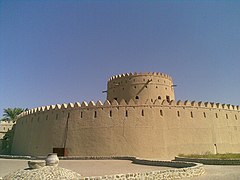 Al-Hili Tower
 -
 Al Jahili Fort, among the largest castles in the region
 -
![Jebel Hafeet, as viewed from Mezyad Fort near the southern border with Al Buraimi Governorate in Oman[18][23]](//upload.wikimedia.org/wikipedia/commons/thumb/c/c8/Mezyad_Fort.jpg/240px-Mezyad_Fort.jpg) Jebel Hafeet, as viewed from Mezyad Fort near the southern border with Al Buraimi Governorate in Oman[18][23]
Jebel Hafeet, as viewed from Mezyad Fort near the southern border with Al Buraimi Governorate in Oman[18][23] -
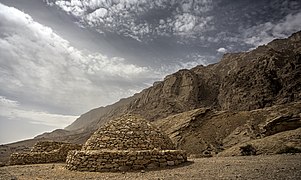 Beehive Tombs in the district of Jebel Hafeet are evidence of human habitation in the area approximately 5,000 years ago
 -
 Al-Murabba Fort in the city's central district
 -
![Qasr Al Muwaiji, the birthplace of Sheikh Khalifa bin Zayed Al Nahyan, the former Ruler of Abu Dhabi and President of the UAE, and former home of his father, Sheikh Zayed[50][51]](//upload.wikimedia.org/wikipedia/commons/thumb/1/10/Al_Muwaiji_Fort_-_01.jpg/240px-Al_Muwaiji_Fort_-_01.jpg) Qasr Al Muwaiji, the birthplace of Sheikh Khalifa bin Zayed Al Nahyan, the former Ruler of Abu Dhabi and President of the UAE, and former home of his father, Sheikh Zayed[50][51]
Qasr Al Muwaiji, the birthplace of Sheikh Khalifa bin Zayed Al Nahyan, the former Ruler of Abu Dhabi and President of the UAE, and former home of his father, Sheikh Zayed[50][51]


![Jebel Hafeet, as viewed from Mezyad Fort near the southern border with Al Buraimi Governorate in Oman[18][23]](/wiki/File:Mezyad_Fort.jpg)


![Qasr Al Muwaiji, the birthplace of Sheikh Khalifa bin Zayed Al Nahyan, the former Ruler of Abu Dhabi and President of the UAE, and former home of his father, Sheikh Zayed[50][51]](/wiki/File:Al_Muwaiji_Fort_-_01.jpg)
Oases and Aflaj[edit]

The city's wāḥāt (Arabic: وَاحَات, lit. 'oases') are known for their underground irrigation system (falaj[52] or qanāt) that brings water from boreholes to water farms and palm trees. Falaj irrigation is an ancient system dating back thousands of years, and is used widely in Oman, the UAE, China, Iran and other countries.[53][54] There are seven oases here. The largest is Al Ain Oasis,[55][56][57] near Old Sarooj, and the smallest is Al-Jahili Oasis. The rest are Al Qattara, Al-Muʿtaredh, Al-Jimi, Al-Muwaiji, and Hili.[4]
Examples of aflaj include Falaj Hazza, which is named after Sheikh Zayed's elder brother, Hazza bin Sultan Al Nahyan, and has a district named after it.[7]
Infrastructure[edit]
The city is known for its combination of modern and pre-modern buildings. The latter offer an insight into the city's and country's cultural heritage.[52] The city used to have roundabouts in every intersection but recently it has been replaced by traffic signals.
Education[edit]

Al-Ain is home to the main federal university in the UAE, the United Arab Emirates University, and to two campuses of the Higher Colleges of Technology – Al Ain Men's College and Al Ain Women's College. Al-Ain is also the home of Horizon International flight academy, Etihad Airways's cadet pilot training centre. Private higher education institutions include the Al Ain University and campus of Abu Dhabi University.[58][59] Al-Ain also houses the eastern zone headquarters of the Abu Dhabi Department of Education and Knowledge, Abu Dhabi's education authority.
Many of Al-Ain's private schools, catering mainly to the expatriate population, are located in the Al-Manaseer area. They include Al-Ain International school (British curriculum, private school, part of the Aldar group), Al Ain English Speaking School, Al Dhafra Private School, Manor Hall School, Al-Sanawbar School, Liwa International School, Al-Madar International School, Global English School, Emirates Private School, a branch of the International School of Choueifat, and an Institute of Applied Technology campus. Other private schools include the CBSE affiliated school Indian School, Al-Ain, Our Own English High School, Al Adhwa Private School, Brighton College Al Ain and Al Ain Juniors School. A new British International School, Belvedere International School is located in the Al Hili district. In 1977, the Zayed Central Library was established.[60] Al-Khwarizmi International College has started a Campus at Al-Ain and is offering BBA programme and various other licensed, accredited and approved courses.[citation needed]
Health[edit]

The first hospital in Al-Ain was Kanad Hospital (formerly known as Oasis Hospital), established in 1960 by the American missionary couple Drs. Pat and Marian Kennedy at the invitation of Sheikh Zayed. It is the oldest hospital in Al Ain and the second oldest in the United Arab Emirates.
Al-Ain is also the home of Tawam Hospital, a training and research hospital linked with the UAE University. It was officially inaugurated on 17 December 1979. In March 2006, Johns Hopkins Hospital (Johns Hopkins Medicine International) (JHMI) took over the management of Tawam hospital.[61]
Tawam Hospital is one of the largest hospitals in the UAE with 503 beds, featuring 24 VIP suites, 78 isolation rooms, 48 ER beds, 9 operating theaters and 81 specialty clinics. Its oncology centre is the main national cancer treatment centre as well as a regional referral centre.
Al Ain Hospital (abbr: AAH, also known as Al-Jimi Hospital) is the general hospital delivering health services to all Al-Ain patients regardless of their nationality. It is centrally located in the Al-Jimi district and is linked with the UAE University. Al-Ain Hospital still occupies old 1970s buildings, but a new building is planned. AAH currently has about 450 beds and provides services in all medical disciplines. In September 2007, the Medical University of Vienna International[62] (MUVI) took over the management of AAH.
Places of worship[edit]
Formerly, the city's largest mosque was that of Shaikha Salamah.[63] In 2021,[64][65] the Sheikh Khalifa Grand Mosque became the biggest in the city, as well as one of the largest mosques in the country.[52][66]
Transportation[edit]
Al-Ain is connected via the Dubai–Al-Ain Road to Al Faqa' and Dubai in the north, which also connects to Al Madam in the Emirate of Sharjah via Al-Shwaib.[67] It is also connected to Abu Dhabi in the west, Al-Qu'a in the southeast, and Mezyad in the southwest. Bus[3] and taxi[30][68] services are available between these areas.[69] The southern border area of Mezyad lies on the road to Dhank, Ibri and Nizwa in Oman.[23] The city's airport (Al Ain International Airport) has scheduled passenger flights to Egypt, Pakistan and India.[30]
Tourism and recreation[edit]
.jpg)
Al-Ain is developing as a tourist destination. The dry desert air makes it a welcome retreat from the coastal humidity of the larger cities. Many Emirati nationals in Abu Dhabi have holiday houses in the city making it a popular weekend destination for families from the capital city. Its attractions include the Al Ain National Museum,[70][71] the Al Ain Palace Museum, several restored forts and the Hili Archaeological Park site, dating back to the Bronze Age. Jebel Hafeet dominates the surrounding area. It is popular to visit to the mineral springs at Green Mubazzarah at the base of the mountain,[72] and to drive to the mountaintop at sunset. Other attractions include Al Ain Zoo, an amusement park named "Hili Fun City", many well-maintained parks popular with families in the summer evenings, and a heritage village. Opened in 2012, Wadi Adventure is located near Jebel Hafeet and provides a range of water-based activities including surfing, kayaking and rafting. On top of Jabel Hafeet is the Mercure Hotel.[citation needed] Mount Hafeet and the nearby 'beehive' tombs are part of what is known as "Jebel Hafeet Desert Park"[18][73] or "Mezyad Desert Park",[51] which is meant to preserve the nature and geology of the area, besides attracting tourists.[74]
Al-Ain has five major malls – Al Ain Mall in the town centre, Al-Jimi Mall in Al-Jimi District, Bawadi Mall in Al-Khrair District, Remal Mall located in the Sanaiya district, and Hili Mall located in the Hili District. Most commercial activity is centred in and around town centre.
Another popular pastime for Emiratis and expatriates alike is spending time in coffee shops and shisha cafes. Like the rest of the UAE, Al-Ain has strict laws governing the consumption and distribution of alcohol. Five facilities in the city currently serve alcohol, four of which are hotels. There are many café's in Al-Ain, ranging in size and quality. The city also has an International standard go-kart circuit.
The city has two English-language radio stations – 100.1 Star FM, which plays English-speaking hits alternating with Arabic-speaking hits, and 105.2 Abu Dhabi Classic FM, which plays classical music.
Sport, culture and arts[edit]

Al-Ain is a cultural retreat for residents of the cities of Dubai and Abu Dhabi. It is home to a major festival of classical music,[citation needed] and is the home of Al Ain Football Club, which is one of the most successful football clubs in the UAE and Asia.[75] It has many titles and championships to its name.[76] Al-Ain Club contains also eight other games which are: handball, volleyball, basketball, swimming, Table Tennis, Athletics, Jiu jitsu, and Taekwondo. The Al Ain Amblers are a well known rugby club with a long history fielding men's, women's and junior rugby teams in the UAE and Gulf competitions, based at the Al Ain Club.
Hili Fun City hosts two ice hockey teams, the Al Ain Vipers[77] and Ghantoot. Each team has adult and youth teams starting from age 4. The Al-Ain Vipers Men's Team won the Emirates Hockey League in the 2009–10 season.
The Palm Resort to the west of the town hosts a popular rugby club with adult and youth teams, and the Al-Ain International Soccer Club which has three youth teams, including one for 7-9-year-old's. There is a water sports centre called "Wadi Adventure", with a wave pool and surf instructors. Additionally, the park has facilities for kayaking and rafting on an artificial river.[citation needed]
Gallery[edit]
-
 A garden in Al Ain Palace Museum
 -
![Dromedaries at the city's Camel Market. The camel is important to the cultures of Arabia, the Middle East, and elsewhere.[78]](//upload.wikimedia.org/wikipedia/commons/thumb/a/a5/Camels_in_Al_Ain.jpg/270px-Camels_in_Al_Ain.jpg) Dromedaries at the city's Camel Market. The camel is important to the cultures of Arabia, the Middle East, and elsewhere.[78]
Dromedaries at the city's Camel Market. The camel is important to the cultures of Arabia, the Middle East, and elsewhere.[78] -
 Mercure Hotel, built near the top of Jebel Hafeet
.jpg)
![Dromedaries at the city's Camel Market. The camel is important to the cultures of Arabia, the Middle East, and elsewhere.[78]](/wiki/File:Camels_in_Al_Ain.jpg)

See also[edit]

- Eastern Arabia
- Archaeological Sites of Bat, Al-Khutm and Al-Ayn in Oman
- Madinat Zayed, administrative centre of the Western Region
- Swaihan
- Wadi
References[edit]
- ^ a b ʿAbd Al-Nūr, Wadīʿ (2 August 2017). "المبزّرة الخضراء واحة سياحة ... ومقصد علاج" (in Arabic). Al-Ain: Al-Hayat. Archived from the original on 16 June 2019. Retrieved 7 January 2019.
- ^ a b c d e Neild, Barry (3 October 2018). "Day trip from Abu Dhabi: The cool oasis of Al Ain". CNN. Archived from the original on 19 February 2019. Retrieved 10 March 2019.
- ^ a b c d Gillett, Katy (18 April 2019). "Visit the Garden City: New bus route launched between Dubai and Al Ain". The National. Archived from the original on 17 June 2019. Retrieved 18 April 2019.
- ^ a b c d "Al Ain". The Report Abu Dhabi 2010. Oxford Business Group. 2010. pp. 171–176. ISBN 978-1-9070-6521-7. Archived from the original on 19 February 2023. Retrieved 31 October 2018.
- ^ a b c "Al Ain". The Rough Guide to Dubai. Rough Guides UK. 1 November 2016. pp. 227–232. ISBN 978-0-2412-9864-0. Archived from the original on 20 February 2023. Retrieved 29 October 2018.
- ^ a b c The Rough Guide to Dubai. Penguin. 15 November 2016. ISBN 978-0-2412-9865-7. Archived from the original on 20 February 2023. Retrieved 10 March 2019.
- ^ a b c d El Reyes, Dr. Abdulla, ed. (December 2014). Liwa Journal of the National Archives (PDF). United Arab Emirates: Emirati National Archives. pp. 35–37. Archived from the original (PDF) on 6 February 2017. Retrieved 5 February 2017.
- ^ "TelluBase—UAE Fact Sheet (Tellusant Public Service Series)" (PDF). Tellusant. Retrieved 11 January 2024.
- ^ "Al Ain Oasis and City". Abu Dhabi Digital Government. 27 June 2018. Archived from the original on 20 February 2023. Retrieved 31 October 2018.
- ^ Cavendish, Marshall (2007). "Geography and climate". World and Its Peoples. Vol. 1. Cavendish Square Publishing. pp. 8–19. ISBN 978-0-7614-7571-2. Archived from the original on 20 February 2023. Retrieved 15 October 2020.
- ^ [1][dead link]
- ^ "Rare caracal sighting: how the fate of the country's most threatened species can be changed". The National. 26 February 2019. Archived from the original on 26 February 2019. Retrieved 27 February 2019.
- ^ Lieth, Helmut; Al Masoom, A. A., eds. (6 December 2012). "Reclamation potentials of saline degraded lands in Abu Dhabi eastern region using high salinity-tolerant woody plants and some salt marsh species". Towards the rational use of high salinity tolerant plants: Vol 2: Agriculture and forestry under marginal soil water conditions. Vol. 2: Agriculture and forestry under marginal soil water conditions. Springer Science+Business Media. pp. 271–274. ISBN 978-9-4011-1860-6. Archived from the original on 19 February 2023. Retrieved 14 January 2019.
- ^ Gardner, Andrew Somerville (January 2004). "The reptiles of Jebel Hafeet". ADCO and Emirates Natural History Group. pp. 149–168. Archived from the original on 14 January 2019. Retrieved 14 January 2019.
- ^ Az-Zahiri, Harib (7 March 2008). "العين مدينة القلب" (in Arabic). Al-Ittihad. Archived from the original on 6 December 2021. Retrieved 15 August 2019.
- ^ "الواحة المصغرة" (in Arabic). Visit Abu Dhabi. Archived from the original on 15 August 2019. Retrieved 15 August 2019.
- ^ "ركض" (in Arabic). Al-Bayan. 24 October 2016. Archived from the original on 15 August 2019. Retrieved 15 August 2019.
- ^ a b c d e Salama, Samir (30 December 2011). "Al Ain bears evidence of a culture's ability to adapt". Gulf News. Archived from the original on 16 July 2018. Retrieved 7 August 2018.
- ^ Yildirim, Ege; El-Masri, Sami (2010), Master Planning for Heritage Conservation in Al Ain Oasis, UAE (PDF), UAE: ADACH and ISOCARP, pp. 1–11, archived (PDF) from the original on 20 October 2019, retrieved 15 August 2019
- ^ The Cultural Sites of Al Ain (Hafit, Hili, Bidaa Bint Saud and Oases Areas), UNESCO, archived from the original on 15 August 2019, retrieved 15 August 2019
- ^ "The Cultural Sites of Al Ain (Hafit, Hili, Bidaa Bint Saud and Oases Areas) – Serial Property – Executive Summary", UAE Government, UNESCO, March 2010, archived from the original on 15 August 2019, retrieved 15 August 2019
- ^ "The accidental lake: Birdwatcher's oasis or ecological disaster?". CNN. 14 March 2013. Archived from the original on 18 May 2013. Retrieved 6 August 2013.
- ^ a b c Kazmi, Aftab (23 May 2013). "Mezyad Fort stands tall in the foothills of Jebel Hafeet". Gulf News. Archived from the original on 1 April 2019. Retrieved 4 March 2019.
- ^ "Climate Normals for Sharjah". National Oceanic and Atmospheric Administration. Retrieved 10 February 2013.
- ^ "Climate & Weather Averages at Al Ain International Airport weather station (41218)". Time and Date. Archived from the original on 6 February 2022. Retrieved 6 February 2022.
- ^ "Climate Normals for Al Ain I.A for the period from 1995 to 2017". The National Center of Meteorology. Archived from the original on 20 February 2018. Retrieved 20 February 2018.
- ^ "Abu Dhabi population hits 3 million, fertility rate up to 3.7 per citizen-female – Inter Press Service". www.ipsnews.net. 30 October 2017. Archived from the original on 18 February 2018. Retrieved 17 February 2018.
- ^ "Afghan city reflects expats' trust in young democracy, says envoy". Archived from the original on 8 September 2017. Retrieved 8 September 2017.
- ^ Vijayan, Ranjit. "Shopping". Explore Al Ain. Archived from the original on 23 April 2019. Retrieved 23 April 2019.
- ^ a b c Vijayan, Ranjit. "Transportation". Explore Al Ain. Archived from the original on 23 April 2019. Retrieved 23 April 2019.
- ^ Morton, Michael Quentin (15 April 2016). Keepers of the Golden Shore: A History of the United Arab Emirates (1st ed.). London: Reaktion Books. ISBN 978-1-7802-3580-6. Archived from the original on 19 February 2023. Retrieved 8 November 2016.
- ^ a b c Al-Hosani, Hamad Ali (2012). The Political Thought of Zayed bin Sultan Al Nahyan (PhD Thesis) (Thesis). Durham University. pp. 43–44. Archived (PDF) from the original on 5 February 2017. Retrieved 15 April 2016.
- ^ a b Leech, Nick (22 October 2015). "The long read: has a lost Arab capital been found on the Oman-UAE border?". The National. Archived from the original on 31 May 2017. Retrieved 20 January 2019.
- ^ Abed, Ibrahim; Hellyer, Peter (2001). The United Arab Emirates, A New Perspective. London: Trident Press Ltd. pp. 60–86. ISBN 978-1-900724-47-0. Archived from the original on 20 February 2023. Retrieved 30 January 2019.
- ^ Martin, Douglas (3 November 2004). "Zayed bin Sultan, Gulf Leader and Statesman, Dies". The New York Times. Archived from the original on 30 July 2013. Retrieved 25 January 2014.
- ^ "The legacy of Sheikh Zayed bin Sultan Al Nahyan, Father of the UAE". AMEinfo.com. 2 November 2004. Archived from the original on 29 April 2013. Retrieved 18 April 2013.
- ^ "ALAIN". The Report: Abu Dhabi 2014. Oxford Business Group. 25 March 2014. p. 228. ISBN 9781907065972. Archived from the original on 20 February 2023. Retrieved 18 April 2013.
- ^ "Remains of 1,000-year-old mosque reveal a rich past". The National. Emirates 24/7. 10 September 2018. Archived from the original on 29 March 2019. Retrieved 10 October 2018.
- ^ Power, Timothy (13 September 2018). "How a 1,000-year-old mosque in Al Ain anchors the UAE in human history". The National. Archived from the original on 28 May 2019. Retrieved 10 October 2018.
- ^ Abu-Lughod, Janet L. (2007). "Buraimi and Al-Ain". In Dumper, Michael R. T.; Stanley, Bruce E. (eds.). Cities of the Middle East and North Africa: A Historical Encyclopedia. ABC-CLIO. pp. 99–100. ISBN 978-1-5760-7919-5. Archived from the original on 19 February 2023. Retrieved 17 January 2019.
- ^ Allen, Calvin H. Jr. (5 February 2016). "1: Land and People". Oman: the Modernization of the Sultanate. Abingdon, New York: Routledge. pp. 1–8. ISBN 978-1-3172-9164-0. Archived from the original on 19 February 2023. Retrieved 17 January 2019.
- ^ Potts, Daniel T.; Nābūdah, Ḥasan Muḥammad; Hellyer, Peter (2003). Archaeology of the United Arab Emirates. London: Trident Press. pp. 174–177. ISBN 1-9007-2488-X. OCLC 54405078.
- ^ Ghazal, Rym (3 July 2011). "Al Ain's World Heritage tombs can now rest in peace". The National. Archived from the original on 6 May 2019. Retrieved 6 May 2019.
- ^ Rice, Michael (1994). The archaeology of the Arabian Gulf, c. 5000–323 BC. London: Routledge. p. 247. ISBN 0-2030-3726-X. OCLC 252810506.
- ^ "Al Ain National Museum launches Archaeology Workshops for Children". wam. Archived from the original on 7 August 2018. Retrieved 7 August 2018.
- ^ Angelakis, Andreas Nikolaos; Chiotis, Eustathios; Eslamian, Saeid; Weingartner, Herbert. Underground aqueducts handbook. Boca Raton. ISBN 978-1-3153-6856-6. OCLC 966358839.
- ^ Heard-Bey, Frauke (2005). From Trucial States to United Arab Emirates : a society in transition (1941–). London: Motivate. p. 48. ISBN 1860631673. OCLC 64689681.
- ^ Heard-Bey, Frauke (2005). From Trucial States to United Arab Emirates : a society in transition (1941–). London: Motivate. p. 109. ISBN 1860631673. OCLC 64689681.
- ^ Agyeman, K.; Feerick, C.; Jha, P.; Stosky, M.; Teran, W.; Zhong, C. (2008), Comprehensive Plan Central District, Al Ain (PDF), Ohio State University, archived from the original (PDF) on 24 April 2019, retrieved 24 April 2019
- ^ "Building History". Qasralmuwaiji.ae. Archived from the original on 19 March 2019. Retrieved 9 March 2019.
- ^ a b "Annual Report 2017" (PDF), Department of Culture and Tourism – Abu Dhabi, vol. 1: Culture, pp. 8–211, 2017, archived (PDF) from the original on 7 August 2019, retrieved 9 March 2019
- ^ a b c Leech, N. (6 March 2017). "Magical history tour of Al Ain". The National. Archived from the original on 2 April 2018. Retrieved 2 April 2018.
- ^ Wilson, A. (2008). "Hydraulic Engineering and Water Supply" (PDF). In John Peter Oleson (ed.). Handbook of Engineering and Technology in the Classical World. New York: Oxford University Press. pp. 290–293. ISBN 978-0-19-973485-6. Archived from the original (PDF) on 7 November 2017. Retrieved 1 November 2017.
- ^ Goldsmith, Edward (1968). "The qanats of Iran". Scientific American. 218 (4): 94–105. Bibcode:1968SciAm.218d..94W. doi:10.1038/scientificamerican0468-94. Archived from the original on 14 January 2012.
- ^ واحة العين, VisitAbuDhabi.ae (in Arabic), archived from the original on 16 August 2019, retrieved 28 March 2018
- ^ واحة العين مجمع التاريخ وملتقى الجمال. Al-Khaleej (in Arabic). 4 September 2014. Archived from the original on 24 May 2019. Retrieved 12 October 2016.
- ^ An oasis in the heart of Al Ain, UAE Interact, 10 October 2005, archived from the original on 23 February 2017, retrieved 23 February 2017
- ^ Khan, Sarmad (6 March 2018). "Amanat snaps up Dh320m stake in Abu Dhabi-based education operator". The National. Retrieved 24 February 2023.
- ^ Release, Press. "Abu Dhabi University leads the way in training GPT-3 on its data and services". Zawya. Retrieved 24 February 2023.
- ^ Hirsch, David (1995). "United Arab Emirates University Libraries Al-Ain, United Arab Emirates: SEPTEMBER-DECEMBER, 1993 and FEBRUARY-MAY 1994". MELA Notes (62): 5–14. ISSN 0364-2410. JSTOR 29785613. Archived from the original on 7 December 2022. Retrieved 7 December 2022.
- ^ "Tawam Hospital". Johns Hopkins Medicine International. Archived from the original on 21 January 2019. Retrieved 20 January 2019.
- ^ Medical University of Vienna Archived 12 August 2008 at the Wayback Machine.
- ^ "Sheikha Salama Mosque", APG, archived from the original on 2 April 2018, retrieved 1 April 2018
- ^ "Eid Al Fitr prayer times and venues announced by Sheikh Zayed Grand Mosque Centre". WAM. The National. 12 May 2021. Archived from the original on 13 May 2021. Retrieved 13 May 2021.
- ^ Al-Faham, Tariq (13 May 2021). "Tahnoun bin Mohammed performs Eid al-Fitr prayers". Al Ain, U.A.E.: WAM. Archived from the original on 13 May 2021. Retrieved 13 May 2021.
- ^ Abdul Kader, B. (31 October 2014). "Al Ain to have one of the largest mosques in UAE the number of mosques is 1200 mosques". Gulf News. Archived from the original on 2 April 2018. Retrieved 2 April 2018.
- ^ "Dubai-Al Ain Road renamed". WAM. Al Ain: Gulf News. 2 November 2018. Archived from the original on 4 November 2018. Retrieved 4 November 2018.
- ^ Vijayan, Ranjit. "General information". Explore Al Ain. Archived from the original on 23 April 2019. Retrieved 23 April 2019.
- ^ "Eastern Region Bus Services", Department of Transport, Government of Abu Dhabi, archived from the original on 24 May 2018, retrieved 4 November 2018
- ^ "Al Ain National Museum". VisitAbuDhabi.ae. Archived from the original on 3 September 2018. Retrieved 6 August 2017.
- ^ "Museum and archaeological park for Abu Dhabi". Past Horizons. Archived from the original on 6 March 2012. Retrieved 21 December 2013.
- ^ Al Ghalib, Essam (17 March 2011). "Park is a welcome haven of green". The National. Al-Ain. Archived from the original on 19 November 2018. Retrieved 19 November 2018.
- ^ "Annual Report 2018 – Culture" (PDF), Department of Culture and Tourism – Abu Dhabi, vol. 1, p. 117, 2018, archived (PDF) from the original on 6 May 2019, retrieved 6 May 2019
- ^ "Mezyad Desert Park". Gustafson Porter + Bowman. 2007–2012. Archived from the original on 6 May 2019. Retrieved 6 May 2019.
- ^ "AFC Champions League 2002/2003 Results – Asia Soccer". www.soccer24.com. Archived from the original on 8 September 2017. Retrieved 21 April 2016.
- ^ الأهلي يستعيد أمجاد العـــقد الأول.. والعين "زعيم" بـ 58 لقباً. الإمارات اليوم (in Arabic). 9 April 2014. Archived from the original on 27 January 2016. Retrieved 21 April 2016.
- ^ "Al Ain Vipers", alainvipers.com, archived from the original on 17 October 2015
- ^ Mukasa-Mugerwa, E. (1981). The Camel (Camelus dromedarius): A Bibliographical Review (PDF). Addis Ababa, Ethiopia: International Livestock Centre for Africa. pp. 1–147. Archived (PDF) from the original on 2 February 2016. Retrieved 27 January 2016.


External links[edit]


- Article in Arabic
- Al Ain City Municipality. Archived 13 August 2014 at the Wayback Machine.
- Al Ain Wildlife Park and Resort
- Al Ain Wildlife Park and Resort. Preserving desert wildlife & habitats
- Al Ain Wildlife Park and Resort. Expansion project
- Al Ain: Oasis in the Desert (Photographic essay from Al Ain Women's College)
- Al Ain University of Science and Technology
| Cities and areas |
|
|---|---|
| Municipal regions | |
| Government | |
| Culture | |
| Transport | |
| Infrastructure | |
| History | |
| Sister Cities | |
 Major cities of the United Arab Emirates Major cities of the United Arab Emirates | |
|---|---|
| Abu Dhabi | |
| Dubai | |
| Sharjah | |
| Ajman | |
| Umm Al Quwain | |
| Ras Al Khaimah | |
| Fujairah | |
| International | |
|---|---|
| National | |
